Match Ten – Sheffield Wednesday 1 – Ipswich 1
Hillsborough, is still a stadium living on its past.
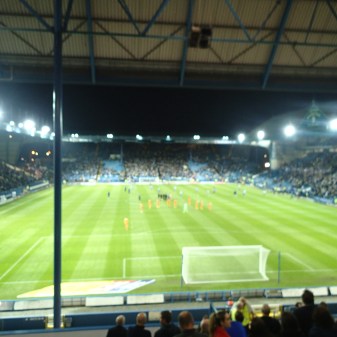
The Tired Hillsborough
Most stadia these days don’t have pillars that obstruct your view. But Hillsborough does! And it also has the worst information display in the Championship.
The only good thing about the place, is that the Leppings Lane tram stop is near to the visitors stand.
But at least Ipswich got a point in a hard fought draw.
Welcome back Jonny Williams!
A Well-Designed City Centre Hotel
On my trip to Sheffield to see Ipswich at Hillsborough, I had to stay overnight, as there is no return train after the match.
So I booked into the Leopold Hotel, mainly because it was in the city centre and by a tram stop. I booked the room without breakfast for just £85.50 on Late Rooms.



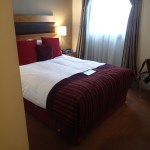
It is one of the best designed hotels, I’ve stayed in ever.
The bath and shower didn’t need a Master’s Degree in plumbing and your glasses to understand, the tea and coffee making in the room was one of the best and the bed was comfortable.
My only niggles, were that the TV wasn’t a Freeview one giving radio as well and they could do better and remove some of the clutter, like magazines and the radio/alarm, from the room.
Wi-fi was free, as it should be.
I would certainly stay in the hotel again, but I doubt I’ll get it at £85.50 again.
On Trip Advisor, people are complaining that it is a ten minute walk to get your car.
They are missing the point.
This hotel is one of those city centre hotels, where you come by train and use public ytransport for your stay. If you want car parking, stay on the M1 in a Premier Inn.
At the present time, that will be more expensive!
Every city needs at least one hotel like the Leopold or the Hope Street in Liverpool.
Before Overground – Cafe Issues
The stations to be incorporated into the Overground from the Lea Valley Lines have a sprinkling of cafes, like this one at Hackney Downs.
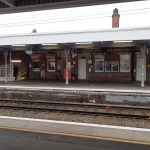


I got a nice cup of tea there, but on chatting with the owner, there are issues that London Overground need to sort out with these little cafes and other shops in the stations.
I also feel that in some of the smaller stations, the only decent small premises are the booking office, which was often closed. As it is Transport for London’s policy to do away with booking offices, perhaps some could be revamped as retail premises.
At Rectory Road, there was only one lonely guy sitting in the booking office. He should be on or watching the platforms, not hidden away!
Before Overground – A Lack Of Colour
To say some of the stations on the Lea Valley Lines are drab and colourless is an understatement.
Colourless it may be, but a station like Stoke Newington has some very interesting brick arches. Instead of just being filled with litter, perhaps some innovative ideas to brighten them up could be applied.
There are gardens in some stations, but they are generally drab and only enlivened by the odd patch of Japanese knotweed.
Perhaps a Highams Park solution can be applied, where local volunteers have created the gardens.
Before Overground – Integration Into Transport for London
One thing that Transport for London (TfL) manages better than any other transport authority I’ve used anywhere in the world, is the interface between the various modes of transport.
Turn up at most Underground or Overground stations or any bus stop and you’ll generally find two things; a bus spider map, showing where the buses in the area go and a good easy-to-read walking map for those who need, have or want to walk.
Today, I arrived at Rectory Road station for the first time and I couldn’t find the information I needed to get a bus to Hackney. Not really a problem, as I got back on the next train to Hackney Downs.
At present some of the stations have information levels more appropriate to a rural halt in the wilds of Norfolk.
So will we see better information on the Lea Valley Lines, when TfL is responsible for the stations?
Before Overground – Long Platforms And Eight-Coach Trains
When the London Overground was created in 2007, the Class 378 trains were delivered as just three car trains. Partly this was because, a lot of the platforms couldn’t handle longer trains. These trains and platforms have grown to accommodate the increase in traffic. The Class 378 trains are now going to five cars and in some documents Transport for London is talking about six cars in the future.
The Lea Valley Lines are generally worked by a mixture of four and eight car Class 315 and Class 317 trains and unlike the original Overground, the platforms are long.
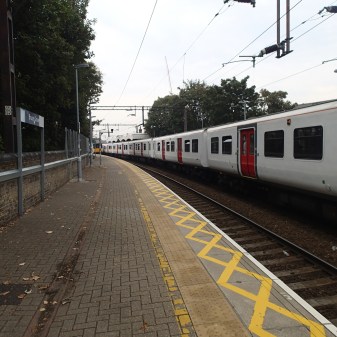
An 8-Car Class 315 At Bruce Grove
Wikipedia states this on the Overground’s future fleet.
TfL announced its Invitation To Tender for a total of 39 four-car EMUs in April 2014, with 30 required for the Cheshunt and Chingford routes, 8 for the Gospel Oak to Barking, and 1 for the Romford to Upminster.
So it looks like trains on the Lea Valley Lines will be 4-car, that at times will work in pairs as 8-car units, as they do now!
I don’t think London Overground will mind the two different lengths of trains, as on the Lea Valley Lines, there is no platform length issues and eight-car trains are easily created.
I suppose the only speculation left, is to see who wins the order for the new trains. I gave my fourpennyworth in this post. I still think that it would be better for London Overground to have a one class fleet. But who knows? I certainly don’t!
Before Overground – Stairs Not Fit For Purpose
I’ve now visited a good proportion of the stations on the Lea Valley Lines, that will be handed over to London Overground in May next year.
One factor that is constant across many of the stations is the atrocious stairs. Look at this staircase at Bethnal Green.

Stairs At Bethnal Green
It is truly dreadful. Sadly it is not a lone example, but one of many I’ve seen.
- The stairs are steep and rather long.
- There is no second rail.
- There is no middle rail making it a double and much-safer staircase.
- The surface is probably slippery when wet.
As it costs upwards of a million to put in a pair of lifts, many stations that need improving will not get much work done.
The best that can be hoped for, is an innovative and systematic approach that reduces the cost of step-free access.
Before Overground – White Hart Lane
A Station Totally Inadequate For The Area’s Need – Rating 2/10
It’s debatable whether White Hart Lane station is worse than its neighbour Bruce Grove.
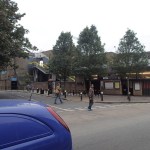
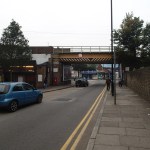
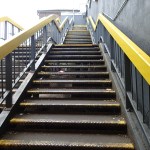
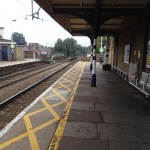

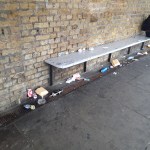
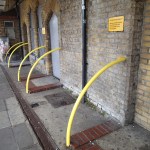

Those stairs are a disaster waiting to happen on a match day, especially, when Spurs have built their new stadium.
But if you look at the Tottenham High Road West development plans, all options envisage the station being moved towards the south and connecting it to the new stadium with a wide pedestrian route. Arsenal and Chelsea eat your hearts out!
So I suspect that improvements to the station are on hold, until the stadium is built and all the other plans are sorted.
Incidentally, if the station was to be moved south by a couple of hundred metres, it would appear that the new station might be able to use the same platforms, but accessing them at the other end. So it wouldn’t have the added problem of demolishing houses and businesses to create the station.
One subsidiary advantage of a station here, that can serve Spurs new stadium, is that it would probably be built with full step-free access. So will this take the pressure off the need to make Bruce Grove and Silver Street stations step free, if the bus routes on Tottenham High Road were improved.
I’ve always believed that the poor quality of public transport in this area of Tottenham is a factor in the crime, vandalism and general unrest. Long term residents of Hackney, including a Police Inspector, have told me they believe that the coming of the Overground and the improved buses has quietened things down in that borough and enabled more young people to get to jobs elsewhere.
Before Overground – Rectory Road
Not As Bad As Some! – Rating 3/10
Rectory Road station is a quite modern station having been built as recently as 1980.


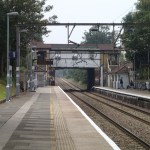
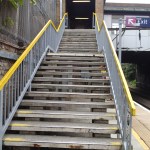

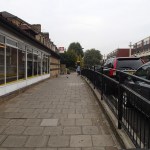
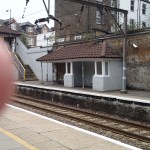
It’s later date probably accounts for the less formidable steps, which may by the reason, why this station has a quite high usage figure of 800,000 passengers a year, which is only a bit less than Stoke Newington.
So perhaps improving access does increase a station’s footfall!
Before Overground – Bruce Grove
The Area Deserves Something A Lot Better! – Rating 1/10
Bruce Grove station is very much a minimalist station.
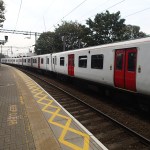
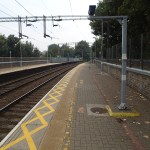


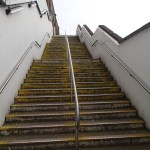
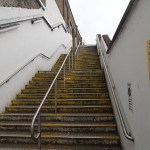
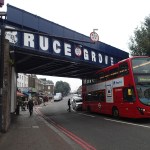
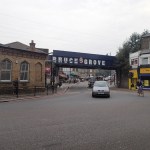
It’s debatable if it is as bad as Bethnal Green, as it does have the advantages it’s on a busy High Road opposite a large McDonalds and not too far from the Grade 1-Listed Bruce Castle.
But it is very lacking in facilities and has the obligatory access up and down steep stairs, with no alternative. The stairs are also open to the elements, so must be very safe in high winds and heavy rain.
 The Anonymous Widower