Rumours Of Battery Powered Trains
In the September edition of Modern Railways, there is an article entitled Class 387s Could Be Battery Powered.
The Class 387 train is an electric train, where the first twenty-nine members of the class are running on Thameslink between Bedford and Brighton. Built in Derby by Bombardier, they are possibly the last variant of the numerous Electrostar family. When the new Thameslink Class 700 trains are delivered, these units will be transferred to First Great Western to run services out of Paddington on the electrified Great Western Main Line.
At present Bombardier are building twenty-seven new Class 387 trains to run the Gatwick Express out of Victoria.
When this order is complete, they will build another eight units for services out of Paddington, for delivery in late 2016.
It is these eight trains that are rumoured to be capable of battery running, using technology I saw demonstrated and talked about in Is The Battery Electric Multiple Unit (BEMU) A Big Innovation In Train Design?
If you still think these trains aren’t practical, there is a BBC video on YouTube of the Class 379 IPEMU during its tests at Manningtree.
In their article, Modern Railways says the following.
Delivery as IPEMUs would allow EMUs to make use of as much wiring as is available (and batteries beyond) while electrification pushes ahead under the delayed scheme, and in the longer term would allow units to run on sections not yet authorised for electrification, such as Newbury to Bedwyn. The use of IPEMUs might also hasten the cascade of Class 16x units to the west of the franchise.
Note that these trains are now called IPEMUs or independently powered electric multiple units.
It looks to me, like the rolling stock engineers at Bombardier in Derby are getting their fellow engineers in electrification out of trouble.
Having a small number of IPEMUs could be very useful to train companies, as they could be used tactically to perhaps extend electric services, when the wires are being installed or onto a scenic branch line, where putting up overhead wires would be strongly opposed. They could also be used for blockade busting, say when a tunnel or bridge is being rebuilt.
It would be interesting to see the cost difference between a standard Class 387 and one with batteries, as this would determine, whether to electrify say a branch or use IPEMUs.
Other Places For An IPEMU
Also in Modern Railways are three articles, where an IPEMU could be the solution.
- Hull Trains are reported looking for a bi-mode fleet to run their Hull services, as they would bridge the unelectrified seventy miles of line between Selby and Hull. A Class 387 IPEMU probably doesn’t have enough performance, but it might be capable of running the route.
- Services to Blackpool have also been approved, which if the electrification is not ready in time, is a route that could be handled by a Class 387 IPEMU.
- Roger Ford is also talking about Open Access Hotting Up. Some of the routes would be ideal for a Class 387 IPEMU, as lots of places without a decent service to London, Birmingham, Manchester, Glasgow or other large cities, are thirty or so miles off a main electrified line. Places like Yarmouth, Lowestoft, Sudbury, Cromer, Lincoln, Skrgness, Wisbech, Windermere, Chester and Burnley come to mind.
I also think, that as the years pass, IPEMU technology will get better and much more efficient with a longer range when running on the batteries. Drivers will also learn how to coax the maximum range out of the trains.
This could enable services like.
- London to Norwich via Cambridge
- London to Salisbury
- Ipswich to Cambridge and Peterborough
- Manchester to Sheffield
- Newcastle to Carlisle
In my list, there would seem to be a large number of routes in East Anglia. But then Anglia Greater Anglia were part of the trials of the test train.
Visual Intrusion Of Electrification
I think too, we shouldn’t underestimate the lack of visual intrusion if say a picturesque branch line was to be served by an IPEMU rather than by a traditional electric train. The Windermere branch and some lines in South Wales may well be better served by a more visually acceptable IPEMU.
Affordable Electrification
I have listed that these IPEMU trains would be able to run between Carlisle to Newcastle.
I don’t know the Tyne Valley Line well, but it is about sixty miles long and has electrified lines at both ends. Traditional electrification may require a lot of bridge and station reconstruction to accommodate the overhead wires, whereas a Class 379 IPEMU could use the line without any modifications to infrastructure, as it can use any line that the current Class 156 trains on the line can. There would of course be a need to make sure that at both ends of the line, there was sufficient electrification to fully charge the train for its return journey.
So the cost of replacing diesel trains on this line with modern electric ones, would be solely the cost of the new trains, and perhaps the cost of a small amount of electrification in the stations and the stabling sidings at each end of the line.
In this case, I suspect Network Rail would breathe a big sigh of relief, if they didn’t have to electrify this line, with all its logistical and possibly environmental problems.
How many lines in the UK, could be electrified this way?
Route Proving For Electrification
The lines in East Anglia from Felixstowe and Ipswich to Cambridge and Peterborough are not electrified.
They carry a large amount of freight to and from the Port of Felixstowe, so if they were to be electrified the benefits of replacing Noisy and polluting diesel locomotives with environmentally-friendly electric ones is probably easily calculated.
But how do you calculate what will happen when two and three car diesel multiple units, albeit modern Class 170 trains, with new four-car electric ones?
In the case of these East Anglian lines, you could run a Class 379 IPEMU on the line.
The only problem after the test was completed, would the passengers allow their brand-new ekectric train to be moved elsewhere.
But you would get an accurate figure to put in your costings for electrification.
Electro-Diesel Freight Locomotives
Nobody except possibly the operators, love the Class 66 locomotive, which is extensively used for freight in the UK. It doesn’t meet the latest EU regulations and it’s noisy and unloved by the drivers to whom I’ve spoken.
Electrifying freight routes like Felixstowe to Nuneaton, would allow operators to send freight trains between Felixstowe and the Midlands, North and Scotland, using electric haulage all the way.
Next year, we’ll see the first of the new electro-diesel locomotives; the Class 88, which is an electric locomotive, that can use an on-board diesel engine, where there are no overhead wires.
How will these and other locomotives using similar technology affect the costs and need for electrification?
In the case of any electrified route to a port like Felixstowe or London Gateway, overhead wires in the port can present a problem, which an electro-diesel locomotive solves, as it uses the on-board diesel, anywhere near the sidings in the port.
Class 800 Trains
The Class 800 train being introduced in a few years is an electro-diesel train, which has been designed to run at 200 kph to the farthest corners or the UK, as a replacement for the diesel InterCity 125.
The specification of the train and what they’ve seen so far of the prototype must have impressed First Great Western as they’ve ordered extra trains as Wikipedia reports.
In March 2015 First Great Western agreed to acquire 29 bi-mode Hitachi AT300 (Class 800 variant) trains as HST replacements on services in and to the southwest of England. The order consisted of 22 five-car and 7 nine-car trainsets, with an option for 30 more sets. Differences with the original design included more powerful diesel engines more suited to steeper graded line in Devon and Cornwall, as well as larger fuel tanks. A £361 million contract between FGW and rolling stock leasing company Eversholt Rail was signed in July 2015. The expected introduction date of the new trains was summer 2018.
So where else could these trains appear to provide high speed services on routes with no or only partial electrification?
The Class 800 is closely related to the Class 395 train used on High Speed and third-rail routes South of the Thames. So could we see a third-rail version of the Class 800, or an electro-diesel Class 395 variant, which could run from St. Pancras to Hastings and Eastbourne and from Waterloo to Salisbury and Exeter? This would kill any thoughts of adding more third-rail electrification.
The Class 387 IPEMU and the Class 800 are a Little and Large combination to provide a cost-effective alternative to full electrification of some routes across the UK.
Conclusions
The Class 387 IPEMU, could be a component of a series of solutions, that bring high-quality new electric or electro-diesel trains to a large portion of the UK.
My only worry about them is the battery technology of the IPEMU, which has reportedly been troublesome in some applications on buses and aircraft.
A Perfect Storm In Ilford
This article from the Ilford Recorder is entitled Redbridge Council leader says Ilford town centre has ‘the perfect storm’ for regeneration.
It talks about a billion pound of investment in the next six years.
So it does look like one of the more dreary parts of East London is going to be improved.
In my view, it shows how Crossrail is going to regenerate large swathes of London.
Although, in the article, I do think that that the design for homes on the Sainsburys site on Roden Street, is very much out of the design manual of Soviet Russia, that I saw in Nova Huta.
Ilkeston Railway Station
Ilkeston wears the badge of the largest town in England without a railway station. This section in Wikipedia, details the history of railways in the town. This is an extract.
Following a long-running local campaign, in March 2013 Transport Secretary Patrick McLoughlin announced that Ilkeston was one of three sites ‘most likely’ to get a new station as part of the ‘New Stations Fund’, costing £5 million and sited close to the old Ilkeston Junction station. On the 15 May 2013 it was announced this new station would be built. It will have two platforms, which can take six trains per hour with up to six passenger cars and will include waiting shelters. A 150 space car park, cycle storage, bus stop, drop off point and taxi rank will also be on the site. The station will be unmanned with automated ticket machines and was originally scheduled to open by the end of 2014. Due to the discovery of great crested newts and flood prevention work means the opening has been delayed by four months, and will not open until 2015.
So why is there so little apparent progress? Search Google News for the station and it’s all about flooding, newts and lack of progress.
I have found an unofficial web site for Ilkeston Railway station, where there are some interesting posts.
The biggest progress seems to be that you can find the station on Google Maps.
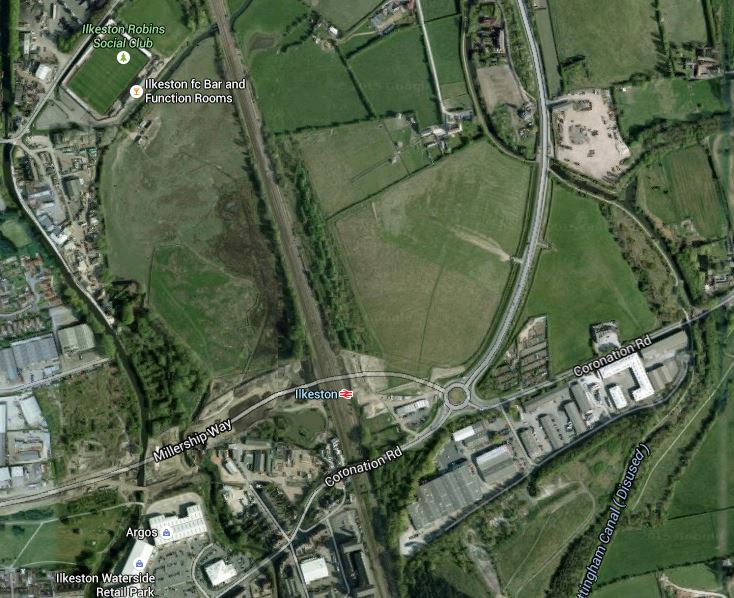
Ilkeston Station
This is a picture that I found on this page of the Derbyshire County Council web site.
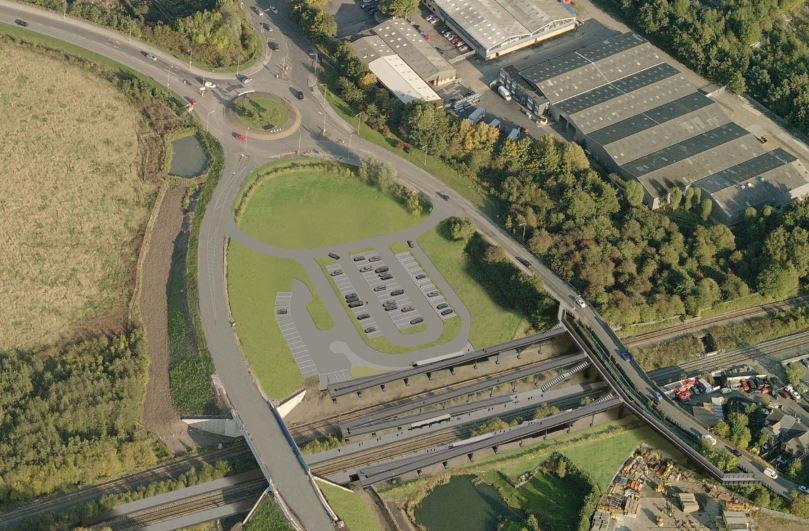
Ilkeston Station Visualisation
I feel that I should take another trip to Nottingham and make a detour to Ilkeston.
 The Anonymous Widower