Defining The GOBlin Extension To Barking Riverside
Transport for London have published the results of their consultation on proposals to extend the for Gospel Oak to Barking Line (GOBlin) from Barking station to Barking Riverside.
To see the full report visit tfl.gov.uk/barking-riverside.
The main points are summarised in the next few sections.
Class 710 Trains
After the electrification of the GOBlin, services will be run using Class 710 trains, which although the line will be fully-electrified using overhead 25kVAC, will be the dual-voltage variant able to run on 750 VDC.
I would assume that this is so that the trains can go past Gospel Oak station to access parts of the North London Line and West London Line that have third-rail electrification and are shared with both London Underground and Southern Electric trains.
Bombardier have also told me, that all Aventra trains are wired so that an on-board energy storage capability can be installed.
When I rode the prototype for this IPEMU technology in public service between Manningtree and Harwich, it felt exactly like a standard Class 379 train and one of Bombardier’s engineers told me the battery range was upwards of fifty miles with a similar performance to the standard train.
In the remainder of this post, I will use Aventra IPEMU (Independently Powered Electric Multiple Unit) to indicate an Aventra Class 710 train with an on-board energy storage capability.
Because prospective routes for Aventra like the East London Line and Merseyrail run in longish tunnels, I would think it very likely that Aventras will be certified for tunnels like the Thames Tunnel or those under Liverpool.
Transport for London have certainly ordered a train, that doesn’t limit development of new routes linked to the GOBlin.
Lines At Barking Station
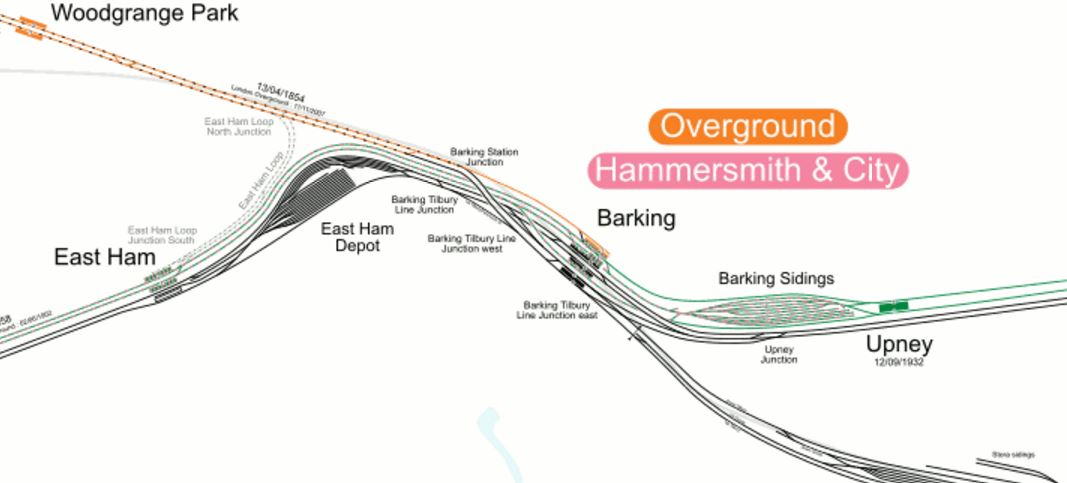
This map from carto.metro.free.fr shows the rail lines around Barking station.
Lines At Barking
The lines radiating from the station are as follows, taking them in a clockwise direction from the South West.
- District and Metropolitan Line services of the London Underground and c2c services to Fenchurch Street pass through East Ham station.
- GOBlin services to the West, freight trains crossing London and the occasional c2c service to Liverpool Street pass through Woodgrange Park station.
- District Line services to Upminster and the East and c2c services via Basildon take the lines through Upney station.
- c2c services via Rainham, freight trains crossing London and the proposed Barking Riverside service take the lines going vaguely to the South East.
Three platforms will be used at Barking station for GOBlin services, which come into the station from Woodgrange Park in the West and from Barking Riverside in the South East.
- Platform 1 which is the current terminus of the GOBlin will be retained and would remain available to Overground trains at Barking Station to aid service recovery during periods of disruption.
- Platform 7 which is currently used by eastbound c2c trains via Rainham, will also be used by GOBlin trains going to Barking Riverside.
- Platform 8 which is currently used by c2c trains from Rainham to Fenchurch Street, will also be used by GOBlin trains coming from Barking Riverside.
As can be seen on the map, there is a double-track flyover to connect Platforms 7 and 8, which are the two southernmost platforms to the GOBlin to the west.
The only platform and its associated connecting lines that doesn’t have any electrification is platform 1.
Changing Trains At Barking Station
The GOBlin services and c2c services via Rainham will share the island platform 7 and 8 at Barking, which could mean some easier step-free journeys for some passengers.
Plans exist for redevelopment at Barking station and I wonder if architects and planners can come up with a better layout for the station, that will become increasingly important as an interchange. Especially as the station is shared by three ambitious operators; London Overground, London Underground and c2c. All these operators have expansion and/or improvement plans for services through Barking.
Electrification of Platform 1 At Barking Station
No electrification work has happened on this platform until now and the platform could be electrified in the normal manner.
However, it may be more affordable to fit all the Class 710 trains with an IPEMU capability and run them in and out of the platform using the on-board energy storage.
The platform could also be electrified using London Underground’s system to create another bay platform for the District and Metropolitan Lines, if that was to be needed. This would not stop the platform being used by the dual-voltage Class 710 trains,
Obviously, the route planners and the accountants will decide.
Renwick Road Station
This map shows the layout of the extension.

Barking Riverside Extension
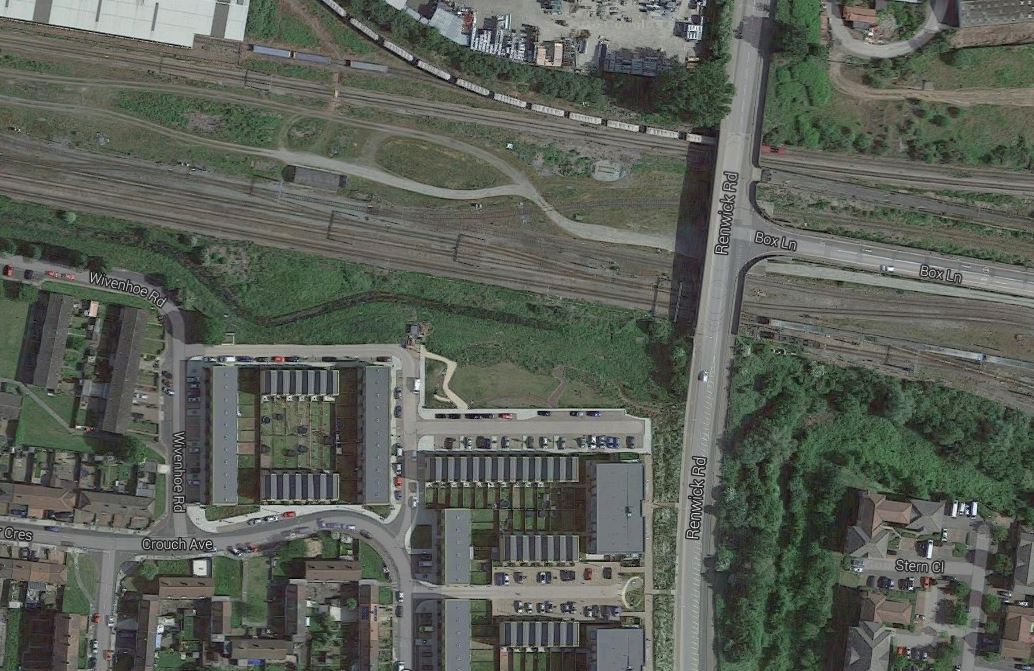
Note now the new line curves away south after passing under Renwick Road. This Google Map shows the area.
Renwick Road Area
One recommendation of the consultation is to install passive provision for a new station at Renwick Road, which eventually would make the extension a two-station branch.
The station is proposed to be a simple island platform design and TfL’s maps show it on the Western side of Renwick Road. There would appear to be plenty of space.
Barking To Renwick Road
On creating the required two lines between Barking and Renwick Road, the report doesn’t indicate, it’s anything other than a simple construction project.
Renwick Road to Barking Riverside
The line is proposed to curve off and over the rail lines and roads on a double-track viaduct, which is shown in blue on TfL’s map. The TfL report says this.
After passing under Renwick Road, the alignment would climb on a viaduct curving south towards Barking Riverside, crossing the Freight Terminal, westbound Tilbury lines and Choats Road. The viaduct would then descend to pass under the existing high voltage power line south of Choats Road, before again rising and continuing towards a station at Barking Riverside.
So it looks that the viaduct goes all the way to Barking Riverside station.
Barking Riverside Station
The proposed layout of the station is described in the TfL report.
The station would be designed to fit the look and feel expected of stations on the London Overground network, and would include the provision of step free access from street to platform and platform to train. Other features of the station would include: a ground floor ticket hall, CCTV, help points, customer information systems and secure cycle parking.
The platform level would be on the upper floor as an extension of the viaduct structure. The station ticket hall would provide direct access to Renwick Road and the separation between the railway infrastructure and ground floor ticket hall would allow additional uses to be made of the space, such as: cash machines, cafe and retail opportunities. The station design would include cladding for weather protection, including a canopy to part of the platform to allow sheltered access to trains.
So it would appear the trains are on the upper floor above the station facilities, shops and cafes.
I think this is to ensure that once the trains have passed over the Tilbury Line to Rainham and the freight tunnel, they run fairly level into Barking Riverside station. It could also mean that if the line is extended to Abbey Wood station under the Thames, the track layout to achieve this is not too complicated.
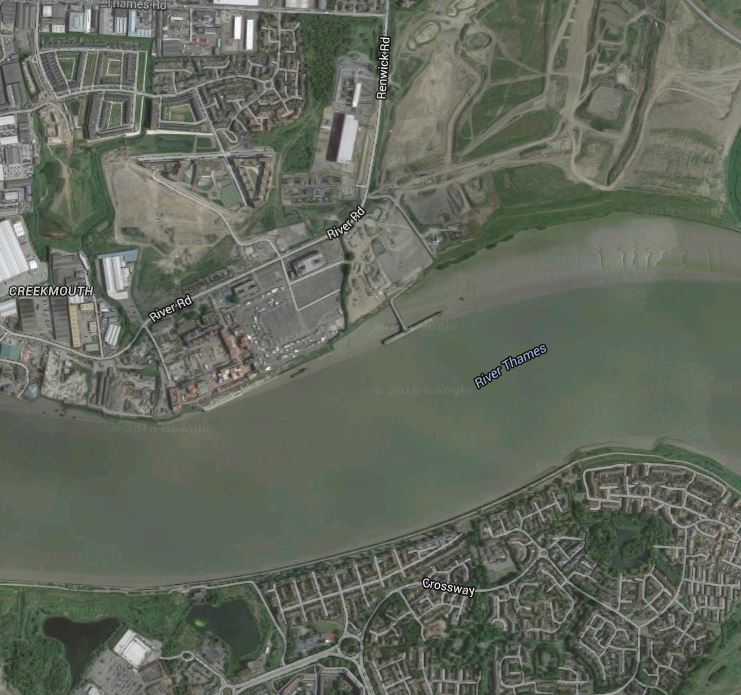
This Google Map shows the location of the station in Barking Riverside.
Barking Riverside Station And The Thames
Note.
- TfL’s map shows the station is alongside Renwick Road, where it joins River Road.
- It is perhaps a couple of hundred metres from the river.
- The housing area of Thamesmead is opposite.
- Trains could take a straight route to a possible Thames tunnel.
I think it all shows that the design of the station has been thought over long and hard.
Electrification Of The Barking Riverside Extension
The total length of the extension from Barking to Barking Riverside is 4 km., with just 1.5 km. of new line.
As with Platform 1 at Barking station, the Class 710 trains give the option of not-electrifying all or part of the extension.
Consider.
- The performance of an Aventra IPEMU running on on-board energy storage, that had been charged before Renwick Road is such, that I believe it could easily handle the extension with a full train of passengers.
- The viaduct can be built with provision for future electrification.
- As mentioned in the TfL report, the line has to be carefully profiled to avoid existing power lines. An extension without electrification, would give extra clearance.
- The Barking Riverside station design is simplified, if it is not electrified.
- The area has overhead wires everywhere and a stylish viaduct without overhead wiring could have a less negative visual impact.
- Are IPEMU trains running using on-board energy storage quieter than those using overhead wires?
But not electrifying the line from Renwick Road to Barking Riverside would reduce the complication and cost of the extension.
Intriguingly, the full TfL report only mentions overhead wires once, talking consistently about four car electric trains and a fully-electrified line.
Nothing in the TfL report precludes the use of Aventra IPEMUs to Barking Riverside and whether this route is chosen will depend on design and environmental issues, and the accountants.
Under The Thames To Thamesmead And Abbey Wood
It is planned to incorporate passive provision, so that the line can be continued in a tunnel under the River Thames.
Barking Riverside station appears to have been designed with several features to aid this continuation.
- Trains could pass through the station on their way to or from the tunnel.
- The route from the station to the tunnel would probably not need any sharp curves.
- Barking, Barking Riverside and Renwick Road stations would probably be sufficient to handle passengers on the north side of the river.
- There appears to be nothing of any importance between the Barking Riverside station site and the Thames, so it should be easy to safeguard a route.
- Barking Riverside station is elevated, so this potential energy could help to propel a train under the river.
- A crude estimate says that from Barking Riverside station to the other side of the river is about two kilometres.
The engineers involved in the Barking Riverside extension have certainly made provision to extend the railway under the Thames.
This Google Map shows Thamesmead and the Thames.

Under The River
Note River Road and Barking Riverside on the north bank of the river, Abbey Wood station with Crossrail and the North Kent Line in the South and Crossness to the East.
I don’t know the Thamesmead area well at all, and from these maps, I can’t work out whether a surface railway could be run to Abbey Wood station from the southern tunnel entrance.
However, a tunnel all the way with intermediate stops would surely be possible.
- As London Underground have thought about extending the Jubilee Line to Thamesmead, I suspect that the area would be amenable to the right type of tunnel boring machine.
- The tunnel could be bored under the A2041 if a direct route were to be chosen.
- A trip from Barking to Abbey Wood and back is probably about twenty kilometres.
- Aventra IPEMUs could handle the route with ease.
- If Aventra IPEMUs used on-board energy storage in the tunnels, the tunnels could be built without electrification.
I believe that there is an affordable innovative solution to extending the Barking Riverside extension under the Thames.
I do question if an extension to Abbey Wood will be needed, as when Crossrail opens, it will be possible to travel from Barking to Abbey Wood with a single change at Whitechapel from the District/Metropolitan Lines to Crossrail.
Conclusion
As it should be, I think it is a well-thought plan.
As to whether the Class 710 trains will use a possible IPEMU capability, nothing is stated, but I believe the proposed design could be very IPEMU-friendly and using IPEMUs would be advantageous on cost, noise and visual grounds.
Their only downside is that they could get derided as battery trains.
I also have the feeling that if the extension does use the IPEMU capability of the trains, the extension will become a model for other extensions and branch lines all over the UK.
Does London Need To Get A Grip On Rail Connectivity?
This article in the Standard has a title of Old Oak Common regeneration scheme ‘risks being London’s worst cock-up in 50 years’. This is the first three paragraphs.
Boris Johnson’s flagship regeneration scheme at Old Oak Common is in danger of turning into London’s “worst cock-up in 50 years”, a leading government adviser warned today.
Urban planner Sir Terry Farrell said the £10 billion development, the biggest in Britain, is heading for disaster because of the rush to finish Crossrail.
He blamed politicians for ducking key decisions and said the Mayor was partly responsible for a shortsighted “pass the parcel” approach. Sir Terry said: “If a tenth of the energy he put into the Boris island airport idea had gone into Old Oak Common I feel sure it would have happened without a problem.”
Old Oak Common is going to be a major development of 25,000 homes and 55,000 jobs created over the next fifteen years. A major transport hub will be created at Old Oak Common station will be created, linking some or all of the following lines together.
- Bakerloo Line
- Central Line
- Crossrail
- Dudding Hill Line
- Great Western Main Line
- HS2
- North London Line
- Watford DC Line
- West Coast Main Line
- West London Line
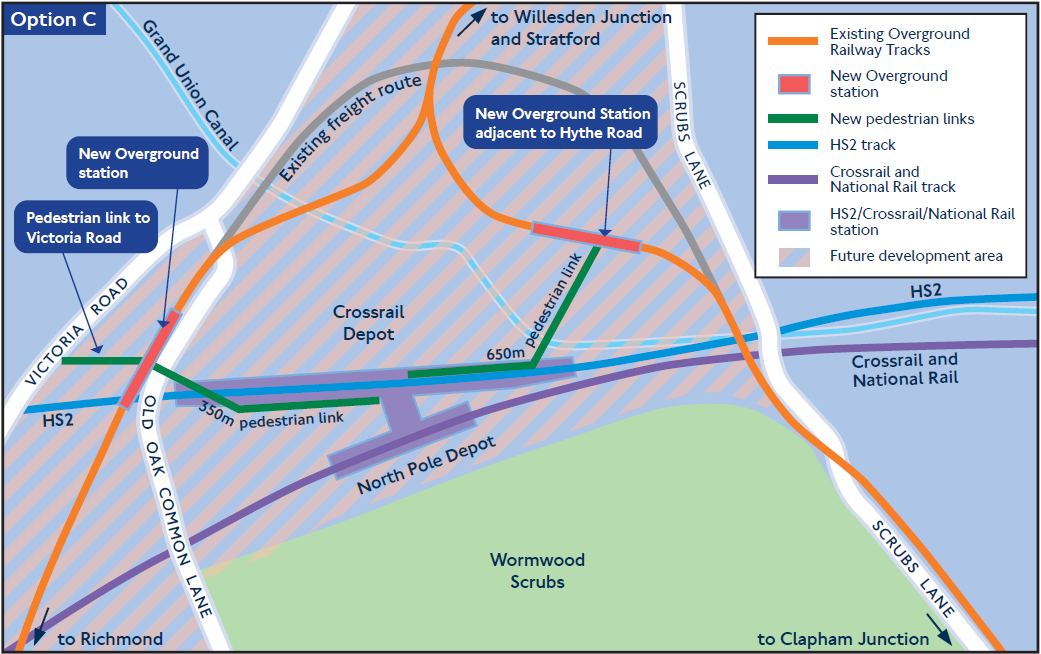
This map shows the plans for Option C of TRfL’s Old Oak Common proposals.
Option C Proposal At Old Oak Common
I wrote about this option in Should An Overground Station Be Built At Hythe Road?
Terry Farrell has said that there is no space between the rail lines to put the piling to support the homes, offices and other developments that will built over the top.
I also believe that the walking routes between the various stations will be far to long and tortuous.
The developers, Transport for London and the rail companies involved all seem to be planning their own parts in isolation.
It seems to echo what I documented in Searching For What Is Going To Happen On The East London Line After The Thameslink Programme Opens, where I was trying to find out how Thameslink will improve my journeys from Dalston Junction using the East London Line.
My correspondence on that issue, would seem to indicate that Thameslink and Transport for London don’t talk to each other and calmly go their own ways.
Someone needs to get a grip on all these big projects at a high level.
Heathrow Expansion Under Legal Threat
Heathrow Airport will look back on March 2016, as very much a mense horribilis.
After the cracks in the Class 332 trains, which led to to all sorts of problems with Heathrow Express, the airport can’t be pleased with this story on the BBC web site, entitled Heathrow third runway: Councils in legal threat over plan. This is said.
Four Tory councils have threatened to sue the government if plans for a third runway at Heathrow Airport go ahead.
Solicitors acting for Wandsworth, Hillingdon, Richmond and Windsor and Maidenhead councils have written to the prime minister saying expansion would be “irrational or otherwise unlawful”.
What is surprising about this story, is that only four councils are mentioned.
But the Councils involved, are the closest ones to the Airport and the ones likely to get the most complaints from residents. The Airport is actually in Hillingdon.
Given that the current Mayor of London and nearly all candidates for the Mayoral Election in May, are against the third runway, I would have thought a few other councils could jump on the bandwagon. And not just Tory ones!
Is there a Council in London and the South East that actually wants Heathrow to have a third runway?
According to Wikipedia, Slough is in favour.
In The Rise Of Gatwick Airport, I said this.
I am coming more to the conclusion, that despite the report of the Airports Commission, Heathrow Airport will never have a third runway, but Gatwick may get a second one, as they can start to plan, for when the deal to not build a second runway with Sussex County Council, runs out in 2019.
I think as time goes on, it will be even more unlikely that Heathrow will get another runway.
Heathrow’s only hope is that after this year’s elections and the Brexit vote, David Cameron decides to allow the runway, as it won’t affect him in 2020.
Is Trump Fit To Run A Whelk Stall?
This article on the BBC web site is entitled US election 2016: Mitt Romney warns Trump not fit to run country.
It is one of the most amazing political attacks, I’ve ever heard by someone on a member of their own party.
Even Margaret Thatcher and Tony Blair, never had an attack like Mitt Romney’s on Donald Trump, from someone who is supposedly of the same political persuasion.
Look at the Wikipedia entry for Trump University or Trump Entrepreneur Initiative as it is now called.
And what about Trump Shuttle, Trump Mortgage, Trump Ice etc.?
 The Anonymous Widower