DOO – Analysed & Explained
This article in Rail Staff is a must-read about the dispute.
It is a detailed article and if you are short of time, just read the last paragraph entitled Looking Forward.
Could Platform 13 And 14 At Manchester Piccadilly Station Be Improved?
I took this picture on the island platform 13 /14, at Manchester Piccadilly station on my trip to the North last week.
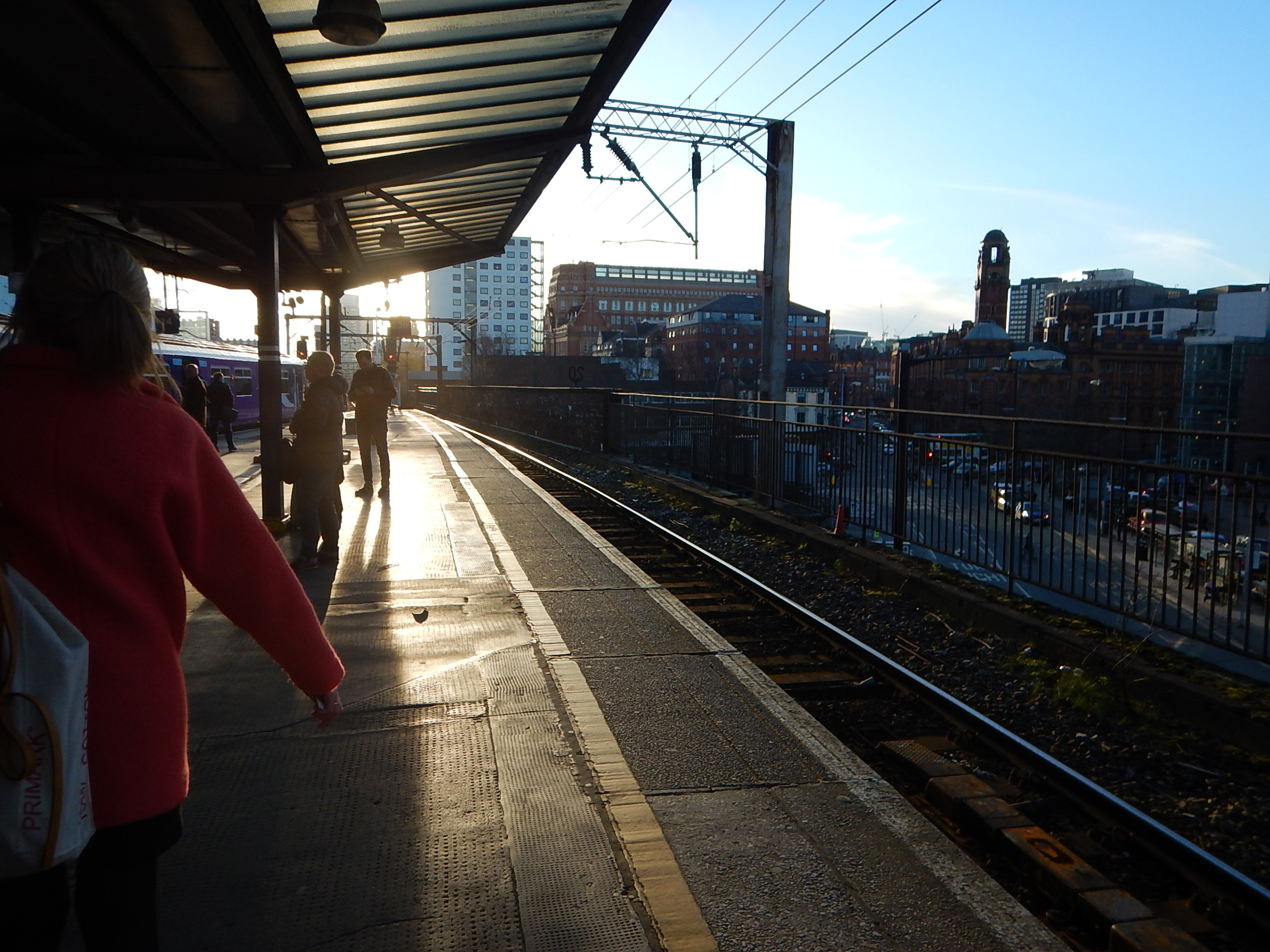
I actually took the picture, as I wanted to check if the lines were electrified, which can be seen.
Services Through Manchester Victoria, Manchester Piccadilly and Salford Crescent Stations
After the current works on the Ordsall Chord has been completed, Manchester Victoria, Manchester Piccadilly and Salford Crescent stations will form a triangle of lines and stations, through which services passing through Manchester will travel. This map from Wikipedia shows the lines in a simplified form.
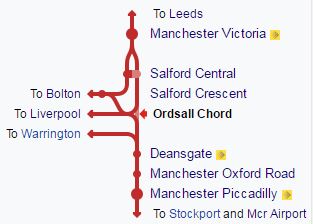
Note the lines to Leeds, Bolton, Liverpool, Warrington, Stockport. It is a real Crossrails of the North.
The only similar intensive set of railway junctions in a city with multiple terminal stations is be the tangle of lines across the South Bank of the Thames in London encompassing London Bridge, Cannon Street, Blackfriars, Waterloo East and Charing Cross stations. This map from Wikipedia shows the lines in a simplified form.
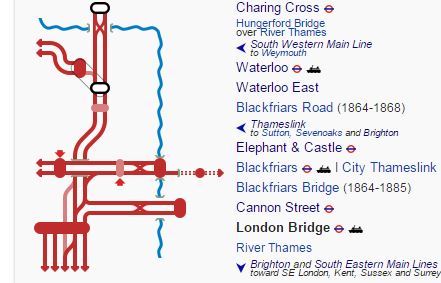
Simple it is not!
As an aside it should be noted that Thameslink is planned to run twenty-four trains per hour (tph), through the central core tunnel, of which sixteen tph stop at both Blackfriars and London Bridge stations. Add in the 14 tph terminating at Charing Cross and the 16 tph terminating at Cannon Street, all of which stop at London Bridge and you get a measure of the capability of modern signalling.
Northern Electric Services To Manchester Airport
As I write this, Northern Electrics trains from Liverpool Lime Street, Edinburgh via Wigan North Western and Blackpool North via Bolton are all scheduled to call in Platforms 13 at Manchester Piccadilly station within the next hour on their way to Manchester Airport. Only the Liverpool service is run by an electric train, which is one of the 100 mph Class 319 trains.
But after the Manchester to Preston Line via Bolton and the Blackpool Branch Lines are electrified and the Ordsall Chord is opened, which will hopefully happen late in 2017, there could be more Northern |Electrics services through these platforms going to Manchester Airport from these and other stations.
- Barrow-in-Furness – Flex
- Blackpool North
- Bolton
- Blackburn – Flex
- Huddersfield – Flex
- Liverpool Lime Street
- Manchester Victoria
- Preston
- Stalybridge – Flex
- Warrington Central – Flex
- Windermere – Flex
Stations marked with Flex will be run by Class 319 Flex trains, but as they will be running on the overhead wires through these platforms to and from the Airport, they can be considered to be the same as the electric Class 319 trains.
If you look at the current service between Manchester Oxford Road and Manchester Airport stations, the frequency is something like eight trains per hour.
So there will be a large number of electric trains going through Platforms 13/14 at Piccadilly! And the trains will be getting longer, with the minimum train size being four-cars and surely eight-cars are possible on some routes.
All of these services will bring passengers to and from Platforms 13 /14 at Piccadilly.
Manchester’s New Urban Link
Across the South Bank of London most people take the Jubilee Line!
But I don’t!
Between say London Bridge and Charing Cross, I will use Southeastern’s 14 tph service between the two stations, as it’s quicker, the views are better and there’s less walking in tunnels underground.
And according to some of their Customer Service people, I’m not the only one.
Manchester will also be getting a new similar high capacity urban link from Manchester Piccadilly station across the city, that will serve.
- Manchester Oxford Road
- Deansgate
Before splitting into two branches.
- Salford Crescent via the Windsor Link
- Salford Central and Manchester Victoria via the new Ordsall Chord
As there is also a line that joins Salford Crescent to Manchester Victoria via Salford Crescent, train planners will have a lot of scope for improving services.
- Liverpool and Manchester services have a choice of Manchester terminals and a variety of routes.
- A service linking Edinburgh, Newcastle, York, Leeds, Huddersfield, Manchester Victoria, Manchester Piccadilly and Manchester Airport would be possible. Current services go via the West Coast Main Line.
- Inwards to Manchester, an improved Salford Crescent station could be a cross-platform interchange with Salford Central/Victoria services on one platform face and Deansgate/Oxford Road/Piccadilly/Airport services on the other.
- Similarly, outwards from Manchester, Salford Crescent station could be a cross platform interchange between services.
I think that this could lead to the Metrolink being connected to one or both of the two Salford stations.
To sum everything up, there will be lots of trains going through the three stations of Manchester Victoria, Manchester Piccadilly and Salford Crescent.
And all those trains using the Windsor Link and the Ordsall Chord will be coming through Platform 13 or Platform 14 at Manchester Piccadlly station.
Overcrowding At Platform 13 and 14 At Manchester Piccadilly Station
Overcrowding at these two platforms is bad enough already and it’s going to get worse if more and longer trains are running through the platforms.
Looking at the picture, the platforms are not overly-wide either.
But at least there are solutions, as I’ll discuss now.
The Alternative Route
Londoners are world-champions at ducking-and diving and will find the route that is quickest after a few weeks of a new rail line or bus route opening. It’s probably one of the reasons that Transport for London, placed the forecast for the passenger usage on the London Overground on the low side.
I don’t know how Mancunians will react to the Ordsall Chord and the new Northern Electrics services, but if they quickly suss-out the best route for their personal journey, this may mean that passengers avoid using Platforms 13/14 at Piccadilly.
There are a quite a few interchange stations on the Piccadilly-Salford Crescent and Piccadilly-Victoria routes through the City.
Better Access To The Island Platform 13/14
Access to the island platform is not good and perhaps more escalators and lifts will help.
Whatever is done to improve the through route, improvement of the access will be on the list of projects to perform.
A Bigger Island Platform 13/14
Looking at the picture in this post, I wonder if the island platform could be made bigger.
If it was wider, this would need the tracks to be moved apart and if this is possible another metre on the platform width would help.
I was on Platform A at St. Pancras Thameslink station this morning and it is very long platform, with the trains stopping vaguely in the middle, thus leaving spare platform space at each end.
So if the platform could be lengthened would this help with the overcrowding?
This Google Map shows the Western end of Platform 13/14.
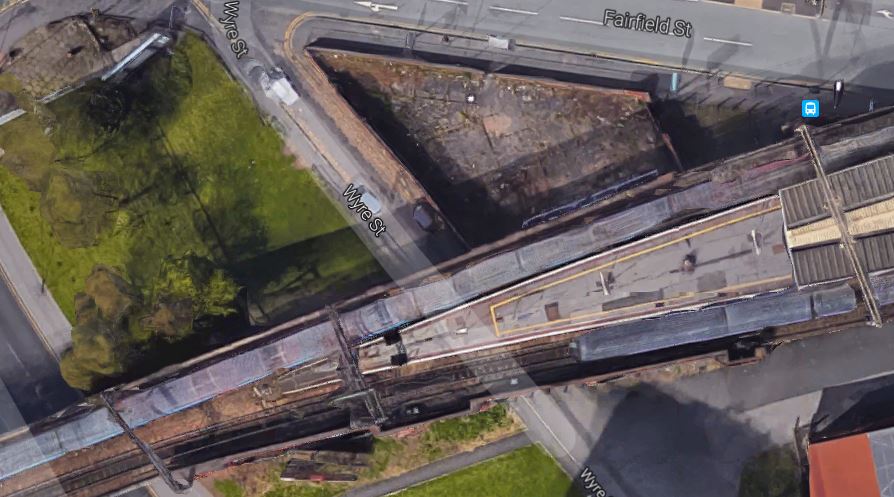
Platform 13/14 is the pointy one in the middle.
And this one the Eastern end.
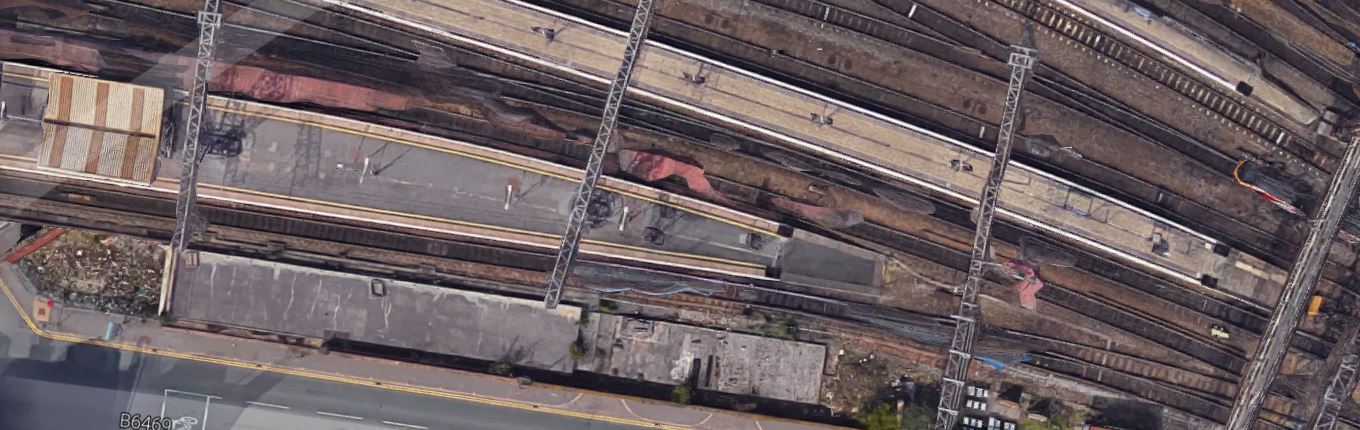
Again Platform 13/14 is the one in the middle.
It’s all very tight and I estimate Platform 13/14 isn’t much more then ten metres wide at any point.
Access to Platforms 13/14 From Below
I don’t know whether this is possible, but the platforms sit on a large viaduct and in many stations like this escalators and lifts are used to access the platforms from below.
This picture shows the Platforms on the viaduct.
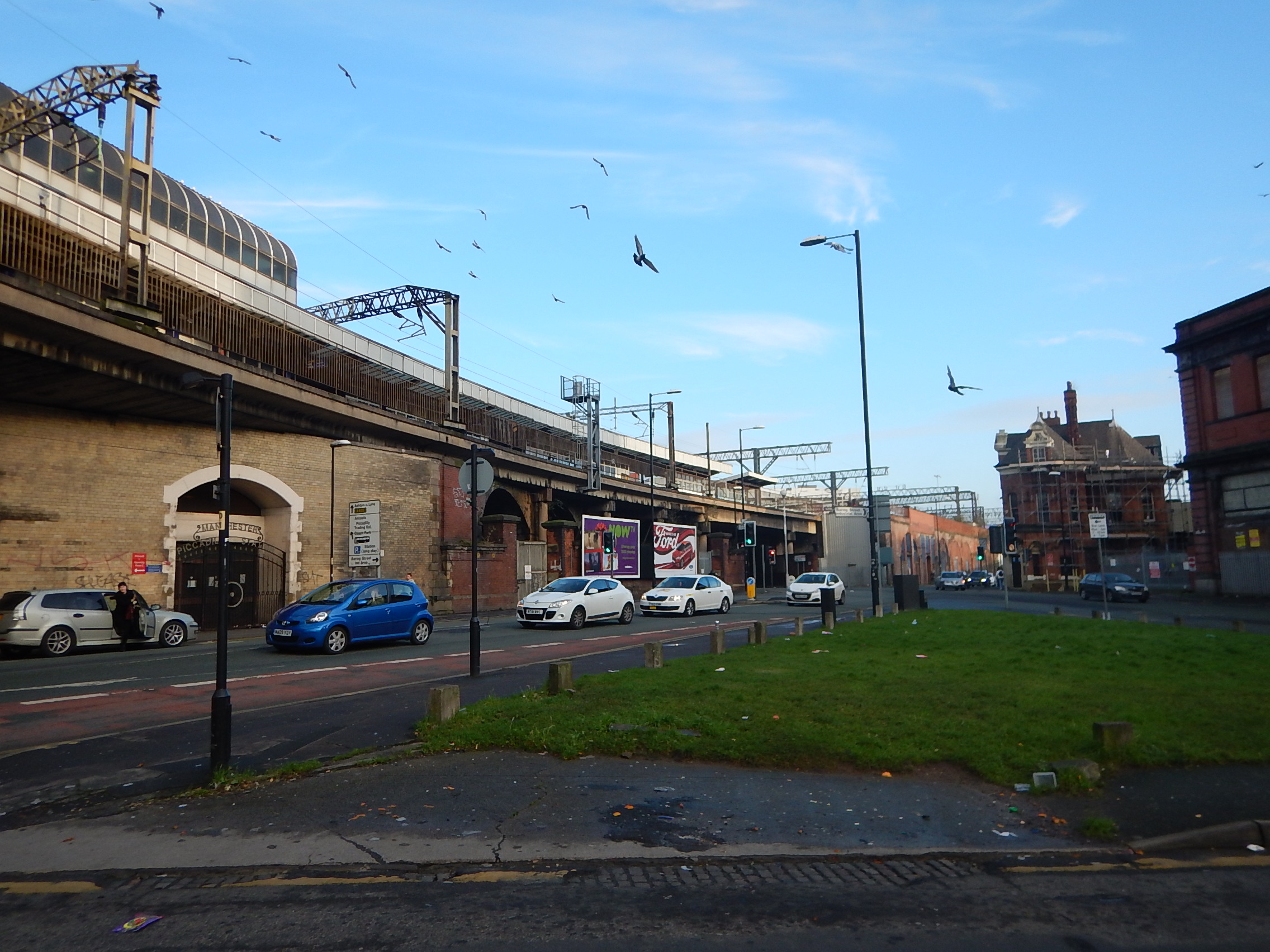
Platform 14 is closest to the camera.
I think that with imagination, access might be possible from this side.
A New Bridge To Platforms 13/14
This Google Map shows the London end of the platforms at Piccadilly.
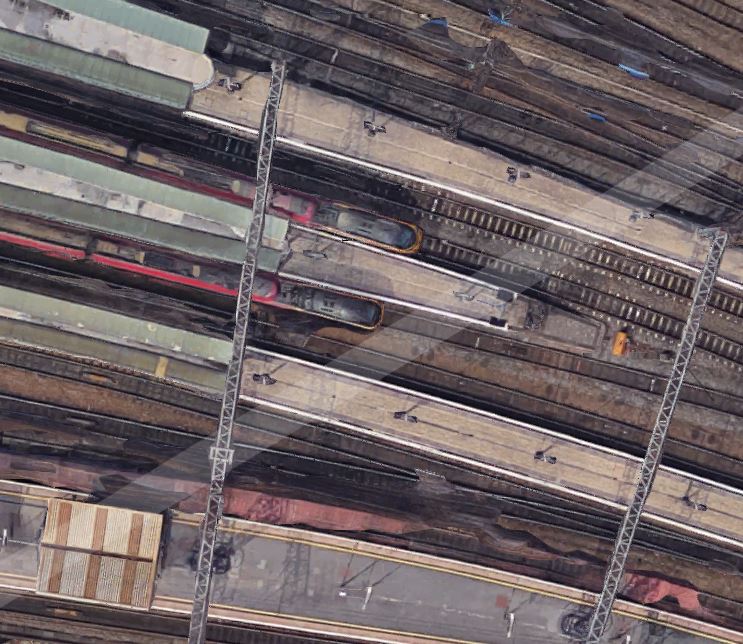
Platform 13/14 is at the bottom of the picture.
I think there is space to put a second bridge over the platforms here and it could reach all the way to the new HS2 platforms on the other side of the station.
Platforms 15 And 16 At Manchester Piccadilly Station
Building two new platforms 15 and 16 has been touted as a solution.
I think that the key to whether four through platforms is needed, is how many trains will be going through.
In a few years time the two track cross-London lines; Crossrail aqnd Thameslink will be handling 24 tph, with a third; the East London Line handling 20 tph.
Also at London Bridge, 54 tph in both directions are handled by nine platforms, which means that an average of 12 tph go through each platform.
If you look at the Y-shaped line through Manchester, Thameslink could be overlaid on the top.
- Blackfriars would be Platforms 13/14 at Piccadilly.
- St. Pancras Thameslink would be Deansgate.
- West Hampstead Thameslink would be Salford Crescent.
- Finsbury Park would be Victoria.
Other conditions would be needed for a throughput approaching that of Thameslink.
- All trains must be modern electric trains, capable of making quick stops.
- All trains must be fitted with modern signalling.
- No trains terminating at Manchester Oxford Road
- Some services from the North linked back-to-back with services to the South to free up platform space at Victoria and Piccadilly.
Thameslink is aiming for 24 tph and currently runs 14 tph.
I can’t see, if everything is done correctly, that Platform 13/14 at Piccadilly can’t handle somewhere between 14-24 tph.
And as Thameslink manages 14 tph with a proportion of Class 319 trains, I would be very surprised if this figure is not attainable.
Under Proposal in the Wikipedia entry for the Ordsall Chord, this is said.
The Ordsall Chord will provide a direct link between Piccadilly and Victoria stations, allowing trains from Manchester Victoria and the east to continue to Piccadilly. On completion the chord will allow four trains per hour to travel between Manchester Airport/Manchester Piccadilly and Manchester Victoria in each direction, eight trains per hour from Manchester Victoria towards the west via Chat Moss, and six trains per hour from Manchester Piccadilly towards either Chat Moss or Bolton and Preston. Other trains will travel from Manchester Piccadilly via Warrington.
This appears to say that only the following trains would use Platform 13/14 at Piccadilly.
- 4 tph Manchester Airport/Piccadilly to Victoria
- 6 tph Piccadilly to Chat Moss or Bolton/Preston
So that is just 10 tph.
Currently, in the Peak, it appears that the frequency of trains between Oxford Road and Piccadilly is 10 tph.
I have a feeling that with a bit of reorganisation of services, the rather difficut problem of building Platforms 15/16 can be delayed for ten years or more, if not for ever.
Manchester Airport From The South
How would people from Birmingham, London and the South get to Manchester Airport?
There are two routes.
- Change at Manchester Picaadilly to any of the several tph to Manchester Airport
- Change at Crewe to the Crewe-Manchester Line.
I would use the second option as it’s fifteen minutes quicker and avoids Platform 13/14 at Piccadilly.
I suspect that the train companies will reorganise their services from Crewe to Manchester via the Airport to take advantage of the Ordsall curve and the new electrification North of Manchester.
HS2 Arrives At Crewe
HS2 will have various effects, when it arrives at Crewe in 2027!
One interesting idea, borrowed from the French, would be to split and join, shorter HS2 trains at Crewe. So perhaps two or even three shorter units would work as a larger unit between London and Crewe.
The advantage of this is that anywhere that is electrified and has a platform long enough could get a high-speed service to London and the South, if the market was there.
According to this page in the Guardian, Crewe will be just 58 minutes from London, instead of the fastest time of 97 minutes today.
Currently Crewe to Manchester Airport takes thirty minutes in a Class 323 train. If as I suspect HS2 trains can run efficiently on classic lines, the following times might be possible using the 110 mph Crewe-Manchester Line to complete the journey.
- Manchester Piccadilly – 88 minutes instead of the current 127 minutes.
- Manchester Airport – possibly 78 minutes instead of 144 minutes.
- Stockport – 76 minutes instead of 115 minutes
No services would need any changes.
But a train might leave London, do a quick stop at Crewe, where it divided with one portion going to Manchester Airport and the other to Stockport and Manchester Piccadilly.
The operator would be able to run short HS2 trains on the classic lines to the North and East of Manchester using the lines now being electrified.
Currently, Huddersfield to Manchester Piccadilly takes 33 minutes, so a modern electric train must be able to do the journey in 20 minutes.
On my estimate of 88 minutes to Piccadilly using HS2, on the electrified existing tracks Huddersfield could be reached without a change in 108 minutes.
The current fastest time is 175 minutes with a change at York.
Running HS2 trains through platforms 13/14 at Piccadilly would have no effect on the design of the platforms, as the HS2 trains will be designed to run to any electrified platform, that is long enough.
The interesting destination of a portion of a train would be Blackburn, if the electrification was extended to the town.
I estimate it could be done in 133 minutes without a change as opposed to 162 minutes today with a change at Preston.
Until 1964, the Ribble Valley Line used to host a Manchester-Glasgow express and now I believe it could have a HS2 service to and from London.
Conclusion
Manchester and its environs will get a much better rail system.
But I suspect it will be some years before Piccadilly gets Platforms 15/16
Thoughts On The Buxton Line
In these four posts.
I describe an enjoyable trip up from Manchester Piccadilly station up and down the Buxton Line to Buxton station.
These are some thoughts.
Rolling Stock
The Buxton Line is very stiff for a railway in England. Wikipedia says this about the rolling stock.
Due to steep gradients on this line, Class 142 and Class 153 DMUs are banned from the section of line between Hazel Grove and Buxton. Therefore, services to Buxton are worked by Class 150 and Class 156 DMUs. Also Class 158 DMUs were once blocked from operating on the line to Buxton due to the possibility of the large roof-mounted air vents striking low bridges on the route.Piccadilly to Hazel Grove services used Class 323 electric multiple units up until 2008.
I went up in a Class 150 train and came down in a Class 156 train.
The Class 150 train definitely found the climb a struggle and it wasn’t even that full.
I dread to think how even two Class 156 trains working together would have coped after a City-United Derby in Manchester.
The trains up and down this line need to have the following characteristics.
- Four-cars or more.
- Lots of power.
- Step-free access from the platform for wheel-chair users and buggy pushers.
- Big windows.
- Lots of space for luggage and bicycles.
As it is a unique tourist line, what about a commentary available through the train’s wi-fi?
The Class 319 Flex train for which this Manchester to Buxton is going to be a test route, should be a lot better, but as tourism by train grows in importance for the rail companies, a need for a specialist tourism-friendly interior will need to be developed.
These are some pictures I took of a Thameslink Cllass 319/4 train, that will be the starting point for the Class 319 Flex train.

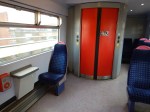
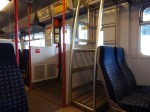
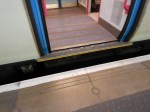
The Class 319 Flex trains could be an improvement. They’ve even got a First Class section.
Stations
When the line is run consistently by one type of rolling stock, I would hope that the platform-train step will be minimised, which I think is one of the biggest drawbacks to train travel for perhaps wheel-chair users and buggy pushers in the UK.
Not on this line, but in my recent trip to the North, on one occasion, I nearly saw a child tipped out of a buggy under a Pacer at Wigan Wallgate station. Luckily the child and the buggy was caught by two quick elderly and obviously savvy passengers.
A straight push-across gets rid of this problem. It can surely be pretty much achieved on the Buxton Line, if one one type of train works the regular services on the line.
I didn’t look in detail, but I suspect that only Stockport, Hazel Grove and Buxton are true step-free stations, although I suspect is not difficult at some stations, especially on the line going to Buxton.
The line going to Buxton is probably the most important side and it would be interesting to see how many passengers get out at intermediate stations coming down from Buxton compared to the number going to Buxton.
Some of the stations were very basic and others less so and I suspect that some improvements would be welcome, especially if on a wet day, you had to wait an hour for a train.
I would think too, that some stations have good views from the Buxton-bound platform, so is there scope to create a proper viewing place for the less-mobile.
There is certainly scope to improve the facilities at stations along the line.
Buxton Station
Buxton station has scope to be made into a proper terminus with perhaps a cafe and a comfortable waiting room.
After my experience recently, that I wrote about in A Good Day Out In A Wheelchair, some form of wheelchair or mobility scooter hire at the station might be in order.
I’ve seen mobility scooter hire at one coastal station before, but I can’t remember where. It might not even have been in the UK!
Train Frequency
This line has an hourly service, with extra trains in the Peak.
But as it is at least a double-track all the way from Manchester Piccadilly to Buxton, I’m sure that the line could be run at a frequency of two trains per hour all day. Especially, if the trains were like the Class 319 Flex trains and had enough power to maintain a faster timetable, even when fully-loaded.
Perhaps, with two trains per hour and decent kiosks at some of the intermediate stations, it would even attract more casual walkers to explore the line.
Ticketing
The Buxton Line could be one, where the normal ticketing model will be fine for the locals, but may not be the best for tourists and casual users.
Disability Issues
I haven’t had a proper look and I’m no expert, but I do wonder if selected improvements could be made, the line could be a way for those in wheelchairs or with limited mobility to explore the area.
Conclusions
The Buxton Line is a valuable railway for the residents and visitors to the area.
I do wonder though with a small amount of selective and sympathetic development, that it could be made even more valuable.
In some ways, designing the Class 319 Flex train, so that it can work the line, can only encourage more passengers to use the route.
A Good Day Out In A Wheelchair
I have a friend, who is not the best on her feet. As she was in London on business and wanted to see Hockney exhibition at Tate Britain and I have a Membership at the Tate, which allows me to take a guest into any of the exhibitions at any time, I took her to see the pictures.
We arrived at Tate Britain in a taxi at the side entrance and in the entrance one of the staff indicated we could use the wheelchair in the entrance hall.
Judging by the number of similar chairs, I saw, it wasn’t the only one, but possibly the last one yesterday at that time.
So I pushed my friend around the exhibition, which because it was timed entry, although not for Members, wasn’t that busy.
I’d never pushed a good wheelchair before and it was surprisingly easy.
But what surprised me, was the helpfulness of Tate staff, who a couple of times cleared a way through the crowds, so I could push my friend through.
We were even able to use the Members Room, where I got another surprise. They now do gluten-free sandwiches and egg was on the menu! So I indulged!
At the end of the visit, we walked to the front of the Tate, where there were at least four waiting taxis, one of which took us to my friend’s hotel.
By the end of the day, the designer in me, was saying that had all been well thought out.
I wonder if other museums and galleries are so disabled-friendly.
 The Anonymous Widower