Work Begins On New Substation For World’s Longest Electricity Cable Between Denmark and Lincolnshire
The title of this post, is the same as that, of this article on Lincolnshire Live.
This is the sub-title.
Britain and Denmark will be able to share enough clean energy to power 1.5 million homes.
The Viking Link is a 1400 MW at 525 KV electricity interconnector between Bicker Fen in Lincolnshire and Revsing in Jutland, Denmark.
This Google Map, shows the location of Bicker Fen, about halfway between Boston and Sleaford.

This second map shows an enlarged view of the Bicker Fen area.
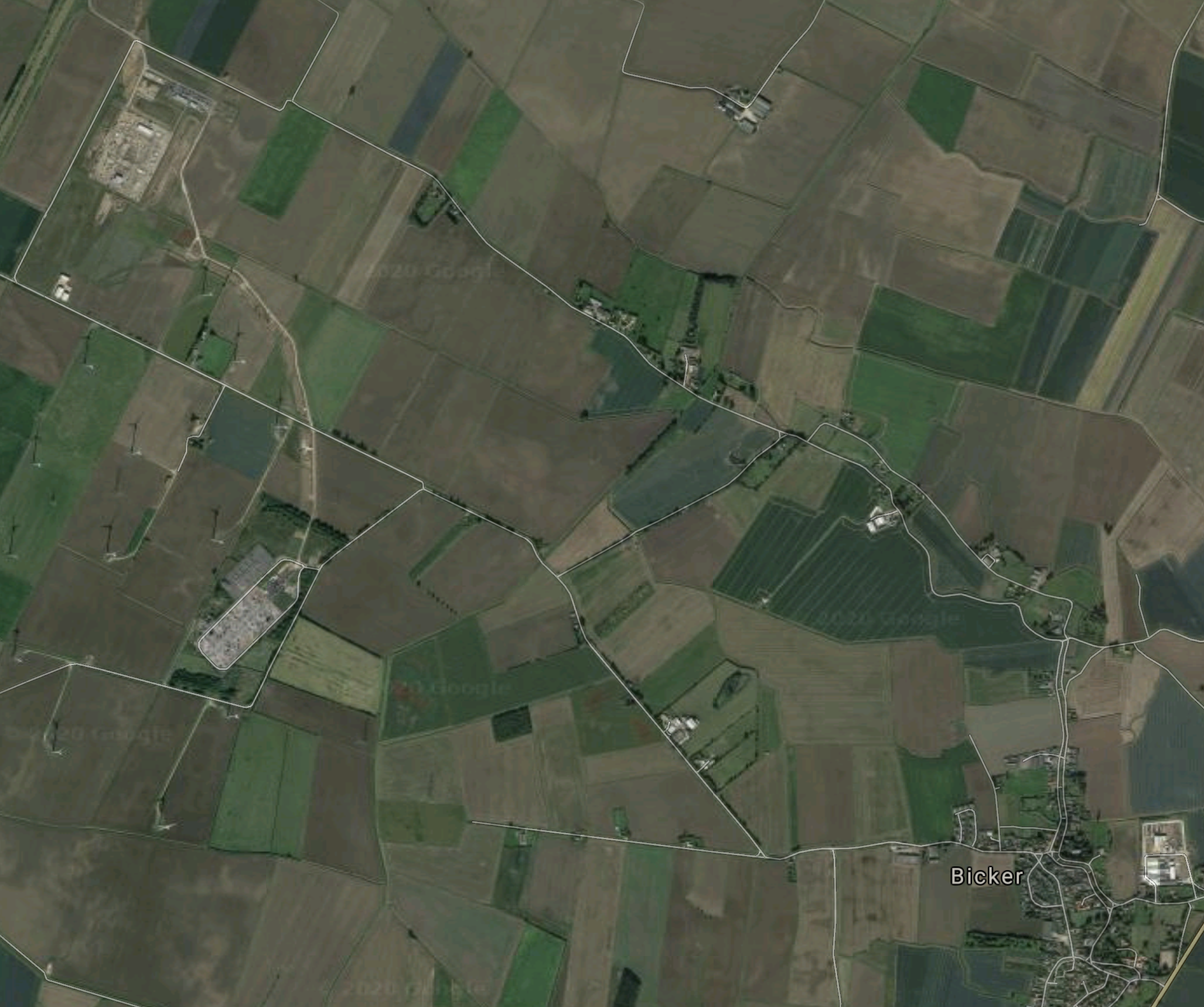
Note.
- The village of Bicker in the South-East corner of the map.
- In the North-West corner of the map is Bicker Fen Wind Farm.
This third map shows the wind farm.
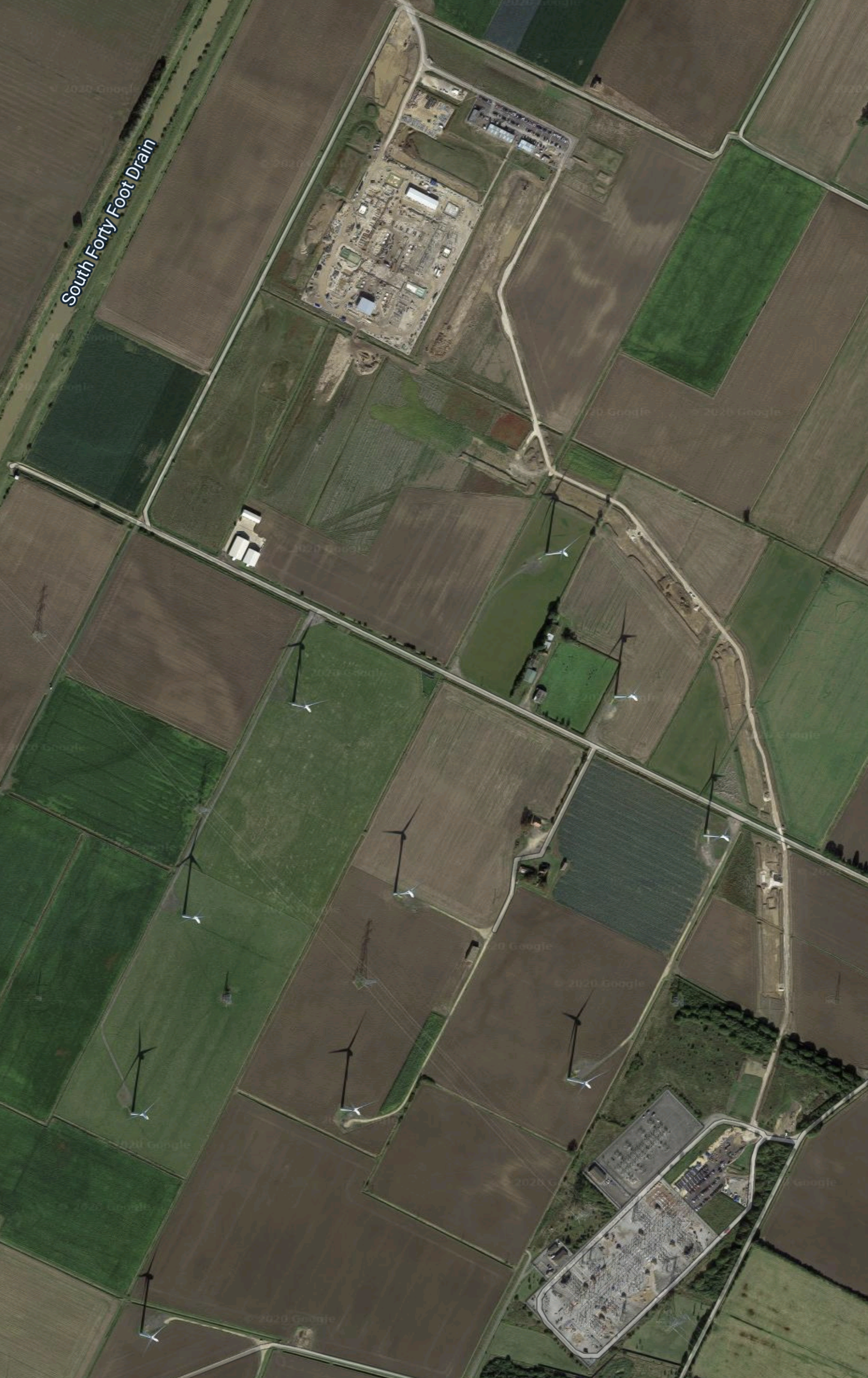
Note the thirteen wind turbines between the two sub-stations full of wo electrical gubbins.
This sentence from the Wikipedia entry for Bicker, gives more details of the wind farm and the future plans for the area.
North of the main line of 400 kV pylons is the Bicker Fen windfarm consisting of 13 turbines producing 26 MW (2 MW each), enough for 14,000 homes. The construction of the windfarm met some local objection. The windmills sit north from Poplartree Farm and were built in June 2008 by Wind Prospect for EdF. They are of the type REpower MM82, made in Hamburg. Bicker Fen substation is also the proposed landing site for a 1,400 MW power cable from Denmark called Viking Link, as well as the proposed offshore wind farm Triton Knoll.
Triton Knoll is a big wind farm, with a planned capacity of 857 MW and should start producing electricity in the next couple of years.
Conclusion
The Viking Link and Triton Knoll are obviously a good fit, as the UK will be able to exchange energy as required.
But it would appear that there’s one thing missing from this setup – energy storage.
I wouldn’t be surprised to see a large battery built at Bicker Fen. Something, like one of Highview Power‘s CRYOBatteries might be ideal.
 The Anonymous Widower
Last night IFA1 (original French I/C) was off line resulting in 2GW deficit. As this is usual in max import mode result 2.9GW of Coal was bought on line for the evening peak.
This is the problem with these interconnectors is that NG need to have enough back up capacity just in case. On this occasion it looks like it was planned downtime or forecasted but a sudden loss of this level of power needs very rapid response as there is limited inertia in the systems now when wind and solar are dominant generation to support frequency. Batteries and the Gravitycity solution would be ideal for this situation.
Comment by Nicholas Lewis | December 3, 2020 |
Situations as you outline, is why I would like Highview or other systems to be built at important nodes in the electricity network.
My limited knowledge of process engineering, indicates, that once Highview prove the system works, that systems up to a GWh are surely possible. They just add more insulated tanks for the liquified air. All of the gubbins, except the control computers, they use have been around for a couple of centuries.
The most environmentally-unfriendly substance, they use is probably lubricating oil.
The other big contender is Siemens Ganesa’s hot rock system, which can even reuse old steam turbines and their associated generators.
Gravitricity will help, but it is a tiddler compared to Highview and Siemens.
Comment by AnonW | December 3, 2020 |
Cable laying for the Viking Link is now complete https://renews.biz/87041/viking-link-installs-final-cable-section/ Looks like should be ready for action by the end of year.
Comment by Peter Robins | July 18, 2023 |
[…] I wrote about the Viking Link in Work Begins On New Substation For World’s Longest Electricity Cable Between Denmark and Lincolnshi…. […]
Pingback by Amprion Reveals Energy Corridor Project To Bring 8 GW of Offshore Wind To North Rhine-Westphalia « The Anonymous Widower | August 30, 2023 |
Viking Link is due to be switched on on Dec 29. However, it seems it won’t be at full capacity for several years, as the strengthening of the local grid in Denmark has barely started. This will however provide an extra 800MW for the respective grids to make use of. https://renews.biz/90146/800mw-viking-link-about-to-be-commissioned/
I was in the Revsing area a couple of months ago, though didn’t actually see the substation.
Comment by Peter Robins | December 15, 2023 |
Currently we are having to pay a premium most of the time to get i/c’s in import mode so be interesting to see whether this helps lower the cost as avoids the transit down through northern Europe. Still feel we mustn’t become over dependent on these as there is always a risk that at a flick of a switch they can be disconnected.
Comment by nickrl | December 15, 2023 |
AIUI, the flow is entirely dependent on relative prices. Last year, when France was having problems with its nuclear facilities and its prices were relatively high, the flow over the French interconnectors was largely GB->France; this year it’s back to the normal state where French prices are lower than GB and the flow’s mainly the other way. With Norway, when it’s very windy in GB, prices fall and Norway buys; normally, it’s the other way round, as Norway’s largely hydro power is cheaper than GB’s. Denmark’s power comes largely from wind (55% last year according to Statista), so I guess the main advantage is that, being further E, DK will be windy at different times from GB. The same will apply to the new German interconnector when that comes online (though Germany is still heavily dependent on coal).
Things changed in 2021 when GB left the EU’s Single Day-ahead Coupling, though there was a gov consultation earlier this year on re-coupling https://assets.publishing.service.gov.uk/media/64e5d4bfbc2b52000da004d3/recoupling-gb-auctions-for-cross-border-trade-with-eu-consultation-government-response.pdf One thing electricity markets certainly aren’t is simple 😦
Comment by Peter Robins | December 15, 2023
The respective grids have been running tests over the last few days, so the Viking Link is showing up in BMRS as bringing in the full 1.4GW to GB https://grid.iamkate.com/ Given the current windy conditions, there’s currently very little need for gas, something I would imagine will persist over the next few days, which are forecast to continue to be windy.
Comment by Peter Robins | December 20, 2023 |
Still have all other i/c’s in full import despite wind at 17GW at 1830 and 21GWh constrained off already which will climb rapidly once the evening peak drops away as the Scotland/England boundary can only shift 6GW. The i/c’s we needed were the new DC links that NG first proposed back in 2016 and have only just been given approval build them.
Comment by Nicholas Lewis | December 20, 2023 |
They’ve now turned off the Danish link – quite a long test, full power from 10.00 to 17.30.
Now that Ofgem’s come down firmly in favour of locational pricing, I would assume this will now start to be implemented – though atm it’s not clear when that might be. When that’s operational, prices at nodes fed by wind farms will be low when it’s windy, and the price at, say, the French interconnector node can be different, meaning the price should reflect local supply/demand. This should over time make balancing easier.
However, I quite agree that the internal interconnectors should have been approved long ago.
Comment by Peter Robins | December 20, 2023
Thanks, Peter and Nicholas!
Comment by AnonW | December 20, 2023 |
They ran extensive tests GB-DK yesterday, the full 1.4GW for several hours, and they’ve just started again today. I assume they’ll stop over the holiday w/e, and then we’ll see what’s happens once it goes live on the 29th.
The Grid have confirmed that wind crept up to a new record yesterday https://twitter.com/NationalGridESO/status/1737824446822453612 – 20GW was reached in Nov 2022, with 21GW soon after in Jan 2023. I was assuming that 22GW would have been reached by now, but not just yet.
Comment by Peter Robins | December 22, 2023 |
The Viking Link is now officially operational https://www.nationalgrid.com/national-grid-announces-commercial-operations-viking-link-worlds-longest-land-and-subsea Currently contributing 0.74GW to the balancing mechanism.
Comment by Peter Robins | December 29, 2023 |
Gridwatch need to catch up!! Anyhow high wind output forecast for later tonight lets see if it goes into export as ive noticed the NSL link has done that recently and the connection point at Bicker Fen is also the nodal point for a few offshore wind farms so shouldn’t have to worry too much about transmission constraints which afflict the near continent interconnectors this time of year.
Comment by nickrl | December 30, 2023 |
I haven’t used Gridwatch for a while. IMO https://grid.iamkate.com/ is far superior, and she keeps it bang up to date, even noting when wind hits a new record.
As I wrote above, I believe the interconnector flows are entirely driven by price. I’ve been monitoring the status over the last 10 days or so. It’s been very windy – for long periods over 20GW – and the Grid’s been using incoming power from the interconnectors rather than gas. It’s also been mild; add the holidays when demand is low anyway, and there have been lengthy periods overnight when the price has been negative. Which in turn means that CfD contracts don’t pay anything. I’ve noticed too that pumped storage has been quite active. They can get paid for pumping the water uphill when the price is negative, and then let it flow downhill and get paid again when it turns positive.
If it’s windy this holiday weekend, there could be something similar.
Comment by Peter Robins | December 30, 2023
The windmills with CfD contracts get the strike price plus the inflationary element so if price is negative they will be well in the money. Although as i type this UK price is nearly E20 above all our i/c partners despite us having 15GW of wind on the system. I/C’s providing just over 22% of demand possible a new record. My only concern is that we can’t afford to drive the CCGT stations off the system as there will still be occasions when wind will be insufficient across Northern Europe.
Oh and gridwatch have caught up!
Comment by Nicholas Lewis | December 30, 2023
Nicholas, the CfD mechanism is all quite complicated, and all depends on how much windfarms can sell at what price. See https://www.squeaky.energy/blog/the-unintended-consequences-of-negative-power-prices-in-the-uk for a detailed discussion. Over the Xmas break, there were some <-£50 prices, the level at which some CfD contracts start losing money. (The CfD reference price is based on day-ahead prices, which may well differ from the balancing price.)
I'd agree with the author that this will increasingly present problems. As he says, the more generation that's added, the more likely it is that there will be a large surplus on windy days and prices will plummet.
The CfD mechanism does provide a guarantee for investors, but it is all a bit bizarre. Imagine the outcry if consumers were forced to pay, say, chocolate manufacturers for all their output, regardless of whether anybody wanted to buy the stuff.
And you're right that the intermittency of wind messes up the economics of gas generators too. Dieter Helm pointed this out in his 2017 review, and he keeps hammering away at this point on his website. Atm I don't see a solution. Storage is fine for smoothing short-term peaks/troughs, but how can anyone calculate how much long-term storage is needed, or what returns to investors are likely to be?
Comment by Peter Robins | December 30, 2023
Peter thanks for that link ive read that item and the one he refers to in it as well to understand the basics . Its whole lot more complicated than i realised by a factor of 10!! and will need to reread again to see if i can properly understand it. A complicated system, especially in financial engineering, leaves it open to abuse and market manipulation if not properly designed but that seems to be a common theme of the modern world. Still feel we need to get back to CEGB MkII and just put generation on the system according to simple merit order that also takes into account minimising CO2 production.
Comment by nickrl | December 31, 2023
well, as I see it, the CfD system (and the various feed-in tariffs) was designed for a world where renewable generators were an add-on to the existing generators. The feed-in tariffs only provide a comparatively small amount of power, so are not that relevant systemically. But once you get to the current situation where on windy days wind can meet the bulk of demand (especially at times when demand is low), then the different generators end up competing to provide what is needed. I don’t think going back to some CEGB does anything to resolve that. How would the Grid decide which generators had more ‘merit’? IMO, the system needs a complete overhaul. I was impressed by the government’s original Review of Electricity Market Arrangements, which discussed various improvements. But they were supposed to be producing a follow-up in ‘autumn 2023’ – another missed deadline. I fear we may have to wait for the next gov to produce something.
Comment by Peter Robins | December 31, 2023
I suspect, that with the rise of companies like Gresham House, Gore Street and other companies in the hedge fund and better industries, that the algorithms driving storage, are much better than they were a few years ago.
This should have resulted in better returns, which should attract more investors to the industry.
Comment by AnonW | December 30, 2023 |
Nicholas! You say we can’t afford to drive the CCGT stations off the system as there will still be occasions when wind will be insufficient across Northern Europe. I agree, as I believe that so much research is being done and being successful about what to do with carbon dioxide in making or growing useful things, that we may have to build efficient CCGT stations for both electricity and carbon dioxide.
Comment by AnonW | December 30, 2023 |
Peter said “Storage is fine for smoothing short-term peaks/troughs, but how can anyone calculate how much long-term storage is needed”
In the 1970s, I worked with an engineer/mathematician, who got some success with difficult problems using the Box/Jenkins method.
https://en.wikipedia.org/wiki/Box%E2%80%93Jenkins_method
I’ve also met a guy, who has used Monte Carlo methods on these types of problems.
They could be a problem for AI!
Comment by AnonW | December 30, 2023 |
You can do an easy crude assessment on the basis that average power demand over a winter day is 30GW or 660GWh. So on a windless day which is worst case scenario we have Nuclear at best with Hinkley B and Torness still on the system can provide 90GW. So if all fossil fuels have been removed from the system and if its anything like coal destroyed before the boilers were even cold your looking for over 500GWh of storage. Pumped storage isn’t going to come anywhere near that even if all the viable schemes were forced through (and they need to be). Battery Storage is miniscule now but has an impressive pipeline but even fully built out wont give us much more than 100GWh. So storage isn’t the answer and i will stick with my stuck record the we have to keep CCGTs on the system and have sufficient gas storage to run them on demand. Oh and of course if we end up with heat pumps and EV chargers everywhere this energy requirement will be at least double. So i can’t see storage being viable at less its increased by ten fold. Reality is net zero requires us societally to accept that electricity will become intermittent with potentially a few days a year with 24hr+ blackouts. Perhaps we should have a referendum on it on the other hand perhaps not!!
Happy New Year it certainly wont be dull again im sure with plenty of opportunity for our blogmaster to keep us interested and engaged.
Comment by nickrl | December 31, 2023 |
I don’t think you should underestimate demand management. One of the Grid’s Future Energy Scenarios is Consumer Transformation: “… driven by higher levels of consumer engagement. They will have made extensive changes to improve their home’s energy efficiency and most of their electricity demand will be smartly controlled to provide flexibility to the system. … higher peak electricity demands managed with flexible technologies including energy storage, Demand Side Response (DSR) and smart energy management.” Atm there are just baby steps in this direction, but:
1. Retail prices are supposed to be changing to half-hourly settlement next year (yes, I mean 2025 – happy new year!), which should over time mean that time of use tariffs become the norm. That will provide a strong incentive to install storage which automatically charges when prices are low/negative ready for when it’s needed. EVs can also be integrated into this. I’ve participated in the Grid’s trials of paying people to not use electricity when supplies are tight. At the moment this is manual (I have to go round turning things off), but in the future can be incorporated into the software controlling the storage.
2. As mentioned above, locational pricing should also start to be implemented before too long. I expect this process will be gradual, but over time should provide a strong incentive for large consumers such as data centres to move near power production – it’s a heck of a lot easier and cheaper to transport data round the country than electricity. (Nothing new in this, of course, as industry was in the past placed near coal/water supplies.) The Grid is already running trials with local people getting free electricity when there’s excess power/curtailment at a particular place, and with locational pricing and widespread storage that should run itself.
3. Storage should become significantly cheaper as researchers work out how to reliably and efficiently store energy in common building materials such as brick or concrete. Lithium is too expensive for static storage.
4. PV is becoming more versatile, with thin-film, which can be pasted onto surfaces and can also be incorporated into glass. And I’ve just been reading about research into spray-on versions. I think a future with all buildings producing their own power is entirely plausible.
The main problem I see atm is that the average person is completely unaware of all this. People need to stop thinking of energy as something produced by somebody else, and start thinking of it as something they can produce and control themselves.
Comment by Peter Robins | January 2, 2024
In this post, I talk about National Grid’s plans.
They talk about 19 batteries, which I believe could be 500 MW/2.5 GWh, which curiously is a size mentioned on the Highview Power web site.
These batteries would be cheaper than lithium ion and as they talk about 19 batteries, that could be almost a distributed battery of 10 GW/500 GWh.
Have National Grid given access to some of their proven ESO algorithms?
Comment by AnonW | December 31, 2023 |
Btw, going back to the Vikings, as I write this, power is flowing from GB to DK. The same happened last night too.
Comment by Peter Robins | January 2, 2024 |
Viking is connected to grid at a good spot and interesting at time of min demand overnight the windmills connected around the Bicker Fen node weren’t asked to turn down. Whereas Hornsea 2, which is connected on a 400kV Tee was instructed down from nigh on max output to nearly zero. Of course that could be because they offered least cost to switch off!
Comment by nickrl | January 2, 2024 |
Yeah, it’s hard to tell what the reasons are for specific actions. I notice they used small amounts of coal last night, as they did a couple of nights last week. On the face of it, this doesn’t make much sense when wind+nuclear can meet all demand. But I don’t know the details of the contract they have with Ratcliffe; perhaps they were meeting some minimum supply agreement at a time when emissions were low?
Current forecast if for winds to drop and temperatures to fall. So demand for gas will probably increase.
Comment by Peter Robins | January 2, 2024
They have to use Ratcliffe for system inertia or potentially voltage support or reactive compensation to keep the system stable in the event of major transmission or generator tripping event. NG are adding new synchronous condensors at additional locations which at some point means they wont need Ratcliffe for those services.
Comment by Nicholas Lewis | January 2, 2024
They can surely use CCGT for inertia. In any case, Ratcliffe is closing in September, so won’t be providing inertia after that. https://www.nationalgrideso.com/news/first-phase-stability-pathfinders-delivered is the latest on replacements I can find.
Comment by Peter Robins | January 2, 2024
The grid was designed around the generation centres and there was a lot in the East Midlands network area all gone now except Ratcliffe and this area is devoid of CCGTs so until they install synchronous condensers Ratcliffe is there goto provider.
Comment by nickrl | January 2, 2024
In 2022 I wrote.
This wind farm is planned to come on stream in the 2nd quarter of 2025.
James
Comment by James | January 2, 2024
In 2022 I wrote.
This wind farm is planned to come on stream in the 2nd quarter of 2025.
Comment by James | January 2, 2024
I have a feeling that January is going to be very busy for this blog! There are a lot of overdue announcements and we have an election coming up!
Comment by AnonW | January 2, 2024 |
In 2022 I wrote.
This wind farm is planned to come on stream in the 2nd quarter of 2025.
Comment by AnonW | January 2, 2024 |
Wikipedia has a good article on synchronous condensers.
https://en.wikipedia.org/wiki/Synchronous_condenser
Comment by AnonW | January 2, 2024 |
I see the Viking Link has been providing 1.4GW or just under for much of today – I think that’s the first time other than with the tests. Perhaps the Danes have found a way round their capacity issues.
Last night was also interesting for wind power, as the winds were so strong many turbines turned off. So wind was only providing some 13GW rather than the 20+ you would expect now on windy days.
Comment by Peter Robins | January 22, 2024 |
Yes but the ESO has forced off a stack of Scottish windmills due grid constraints and leaves them short of North South transfer capacity when they are injecting both Viking and NSL at full capacity. Can’t really believe the grid is being run at least cost for consumers anymore.
Comment by Nicholas Lewis | January 22, 2024 |
Gas generation appears low and a GW is going to Ireland.
I also wouldn’t be surprised to see that ESO have a very sophisticated algorithm, that optimises on cost.
Comment by AnonW | January 22, 2024
Nicholas, the grid hasn’t changed at all. The NGESO site says “The ultimate goal of our trades is to minimise the overall cost of our balancing actions.” The markets continue to be driven by ‘marginal pricing’ at auctions, where the lowest-cost bids have priority, but the price is determined by the highest successful bid. Generally speaking, GB’s prices are higher than other countries (apart from Ireland), so interconnector power generally flows into GB. Of course that changes if there’s excess wind in GB and prices here fall. A search reveals https://commonslibrary.parliament.uk/why-is-cheap-renewable-electricity-so-expensive/ which is a good general overview of how spot prices are set.
I think you’re making too much of constraints. The balancing mechanism link on that page goes to the NGESO site, where they say “To date, these constraint payments have been the most cost-effective option to operate the electricity system securely.” In other words, building extra transmission capacity is more expensive than paying constraint costs. However, they do acknowledge that that calculation is changing, and the system needs an overhaul as volatile renewables become increasingly important. REMA summarised potential changes, but, as I said above, the government’s promised autumn 2023 consulation has still not materialised, so we’re still waiting to see what they’re now proposing.
Comment by Peter Robins | January 23, 2024
Problem is we constantly have a surplus of wind which is constrained off so are surely losing export possibilities. Balance of payments used to matter when i was younger doesn’t seem to bother anyone we dont pay our way. Oh and theres the risk of us now extending our energy dependency even further to others.
Comment by Nicholas Lewis | January 23, 2024
Maybe i need to recalibrate my thinking now ive seen that Hinkley Point C is delayed at least another 2 years and maybe upto 4 and that just for the first reactor. The i/c’s are going to become more critical and its even more imperative that no CCGTs are forced off the system.
Comment by Nicholas Lewis | January 23, 2024
Yes, HP C is looking more and more like HS2. Are the existing nuclear stations going to last that long? The plan is to keep them going a few years longer, but 2030 or even later? And the longer they go on, the more maintenance they need and the more downtime they’ll have. (Not that Flamanville is any better. Originally slated for 2012, EDF said last month they’d be starting fuel loading in March with a view to starting operation mid-year.)
I don’t think anybody’s ‘forcing’ CCGT off the system, but I think it’s changed role in the system. It was originally designed as baseload, with OCGT as peaking. But gas in general seems to be increasingly used as backup for low wind days. Effectively gas and wind in the balancing mechanism are mirror images – one’s up when the other’s down.
There’s been a lot of attention to nuclear plants reaching end of life, but many CCGT plants are also far from new. They can be upgraded, but that costs money, and why do it with such uncertain returns? Drax biomass effectively acts as baseload nowadays, and I see the gov recently gave them a DCO for their carbon capture scheme. But this is all untested, and biomass from N America or wherever is already an expensive way of generating power. CCGT too can in theory add carbon capture, but even if it works, it will add to the costs and take many years to implement.
As for interconnectors, according to Ofgem’s list, total capacity for the existing ones is 9.8GW. The 500MW Greenlink with Ireland should start operating later this year (work’s also starting on the Celtic Link Ireland-Brittany, which will improve Ireland’s situation). The only other one that’s underway is Neuconnect with Germany, scheduled for 2028. The only other approved ones are 2 connections with France; I’m not sure what the status with these is, but not likely to be available before the end of the decade. FAB Link recently got planning permission for their Devon converter station, albeit at a reduced capacity.
Comment by Peter Robins | January 24, 2024
Someone needs to develop a continuous steel-making process that turns iron-ore into molten iron, which emits no carbon and uses a lot of electricity.
There’s always the Hisarna process, which is owned by Tata.
https://en.wikipedia.org/wiki/HIsarna_ironmaking_process
Comment by AnonW | January 23, 2024 |
There’s some interesting analysis of the power flows over the Viking Link since it started operating at https://www.current-news.co.uk/viking-interconnector-analysing-power-flows-and-profits/
Comment by Peter Robins | March 28, 2024 |