GWR And Vivarail
This is an attempt to make some sense about what is happening between GWR and the assets of Vivarail.
These are some random thoughts.
Ongoing Maintenance Of Existing Trains
Currently, there are four operators in the UK, with various types of Vivarail‘s Class 230 trains.
- Great Western Railway – 1 – Infrastructure under construction for trial on the Greenford Branch.
- Island Line – 5 – In operation.
- Transport for Wales – 5 – Undergoing testing prior to entering service.
- West Midlands Trains – 3 – Withdrawn from service indefinitely in December 2022.
Note.
- West Midlands Trains withdrew the trains because of uncertainty about the servicing of the trains.
- West Midlands Trains are getting complaints about the bus replacement service.
- All operators will probably need assistance to service the trains.
- Great Western Railway and Island Line are First Group companies.
Could First Group have got in first, so they can protect their interests with a professional Vivarail train maintenance organisation?
Mark Hopwood
In Special Train Offers A Strong Case For Reopening Fawley Line, I said this.
This is another quote from the Rail Magazine article.
However, SWR’s Mark Hopwood favours a much bolder plan. “We’d have to take a decision, once we knew the line was going ahead. But my personal belief is that we should be looking for a modern environmentally-friendly train that can use third-rail electricity between Southampton and Totton and maybe operate on batteries down the branch line.”
Pressed on whether that would mean Vivarail-converted former-London Underground stock, Hopwood adds. “It could be. Or it could be a conversion of our own Class 456, which will be replaced by new rolling stock very shortly. But I don’t think this is the time to use old diesels.
Mark Hopwood is now the Managing Director of Great Western Railway and he seems to be in favour of battery-electric trains. I agree totally with his statement about old diesels.
Mark Hopwood And The Cholsey And Wallingford Branch
According to LinkedIn, Mark Hopwood is also the President at the Cholsey and Wallingford Railway
- This is a two-and-a-half mile long standard gauge heritage railway.
- It used to be a branch line, that served the town of Wallingford.
- It connects to the Great Western Main Line in a bay platform at Cholsey station.
- Wallingford station has now been demolished.
- The heritage railway uses a new site on the south side of St. Johns Road.
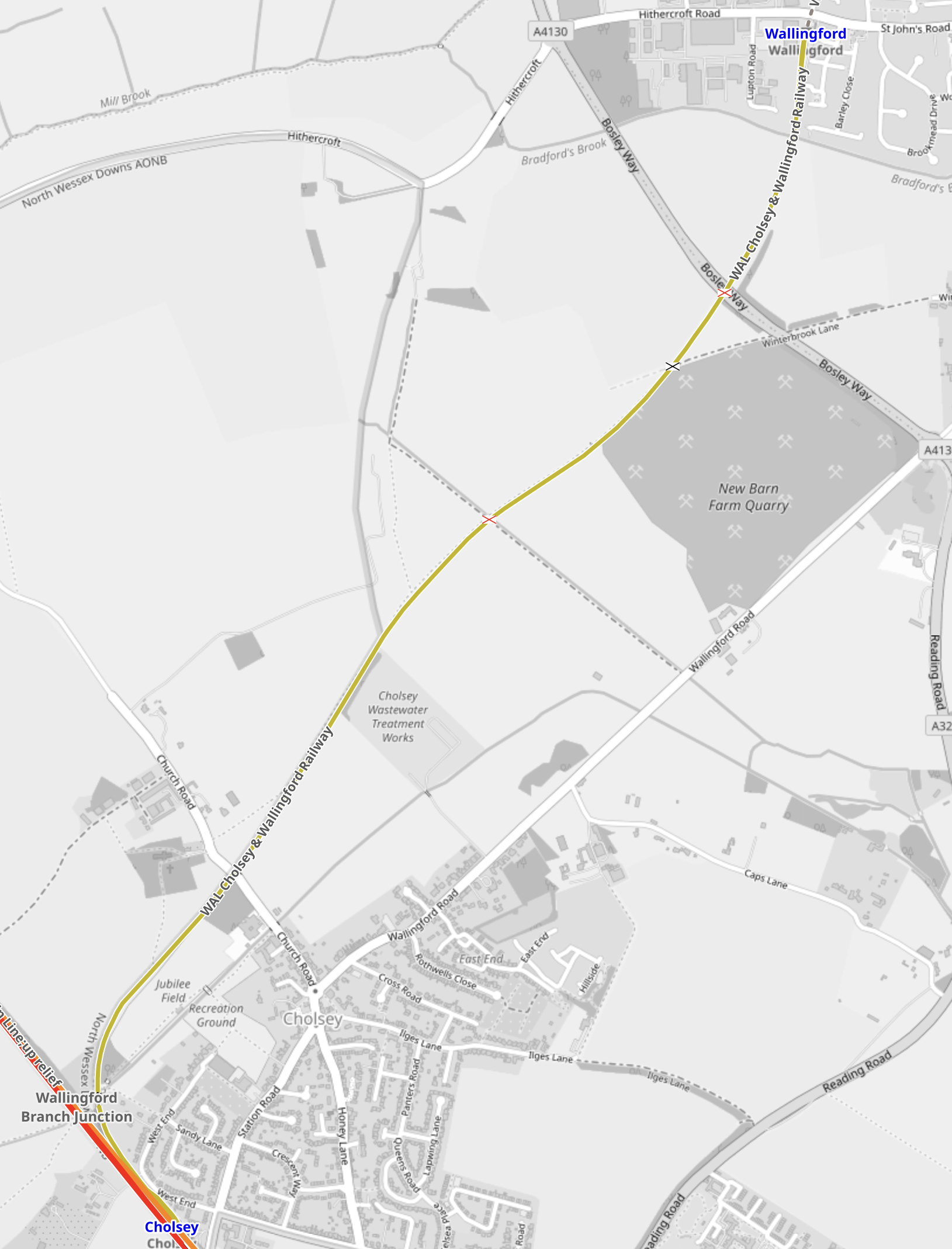
This map from OpenRailwayMap shows the branch line.
Note.
- Cholsey station and the Great Western Main Line is in the South-Western corner of the map.
- The current Wallingford station is in the North-Eastern corner.
- The Cholsey and Wallingford Railway is shown in yellow.
This Google Map shows Cholsey station.

Note.
- There are four through platforms for Great Western Railway services.
- Platforms 1 and 2 for the fast services are on the Western side.
- Platforms 3 and 4 for the slow services are on the Eastern side.
- Bay Platform 5 is tucked in the North-East corner of the station and is the terminus for services on the Cholsey and Wallingford Railway.
- There are only 55 parking spaces.
Is the number of parking spaces sufficient for the station, if a lot of passengers drive from Wallingford?
Could a commercial service run between Cholsey and Wallingford?
Consider.
- Wallingford is a town of nearly twelve thousand people.
- Cholsey station has two trains per hour (tph) between Paddington and Didcot Parkway stations, with extra services between Oxford and Reading stations in the Peaks.
- There is only limited parking at Cholsey station.
- Most GWR branch lines are run by an hourly service.
- I feel that two-car battery-electric train could provide one or two tph on the branch.
- Charging would probably be needed at only one end of the branch line.
- As all the through lines at Cholsey station are electrified with 25 KVAC overhead wires, I suspect that charging would be provided at that station.
A two-car battery-electric train could probably provide a commercial service on this branch, if the Cholsey and Wallingford Railway wanted a revenue stream.
First Group Services That Could Be Run By Battery-Electric Trains
These Great Western Railway and South Western Railway services might be suitable for battery-electric services.
- Newbury and Bedwyn – Newbury is electrified.
- West Ealing and Greenford – West Ealing is electrified.
- Slough and Windsor and Eton Central – Slough is electrified.
- Maidenhead and Marlow – Maidenhead is electrified.
- Twyford and Henley-on-Thames – Twyford is electrified.
- Reading and Gatwick Airport – Partially electrified.
- Reading and Redhill – Partially electrified.
- Reading and Basingstoke – Partially electrified.
- Didcot Parkway and Oxford – Didcot Parkway is electrified.
- Weston-super-Mare and Severn Beach – No electrification.
- Bristol Temple Meads and Avonmouth – No electrification.
- Bristol Temple Meads and Filton Abbey Wood – No electrification.
- Bristol Temple Meads and Portishead – Proposed – No electrification.
- Swindon and Westbury – Swindon is electrified.
- Exmouth and Paignton – No electrification.
- Exeter Central and Okehampton – No electrification.
- Exeter Central and Barnstaple – No electrification.
- Plymouth and Gunnislake – No electrification.
- Liskeard and Looe – No electrification.
- Par and Newquay – No electrification.
- Truro and Falmouth Docks – No electrification.
- St. Erth and St. Ives- No electrification.
- Romsey and Salisbury – Partially electrified.
- Southampton Central and Fawley – Proposed – Partially electrified.
Note.
- Most services are one or two tph or less.
- Reading and Basingstoke, Didcot Parkway and Oxford, Exmouth and Paignton, and Romsey and Salisbury are 2 tph.
- I have included the proposed Bristol Temple Meads and Portishead and Southampton Central and Fawley services.
- All electrification is 25 KVAC overhead except for the North Downs Line between Reading and Gatwick Airport via Redhill, and Romsey and Salisbury, which are 750 VDC third rail.
There are a total of 24 services. As each 2 tph service will need two trains and the North Downs services probably six, a rough calculation, indicates there would need to be a minimum of over thirty trains, to convert all these services to battery-electric operation.
This simple analysis makes Mark Hopwood’s enthusiasm, that I quoted earlier understandable.
The Requirement For First Group Battery-Electric Trains
Consider.
- Most of the services can accommodate three or four-car trains.
- A few services can only be run with two-car trains.
- Some services will need running with 25 KVAC overhead electrification for operation or deploying to and from the depot.
- Some services will need running with 750 VDC third-rail electrification for operation or deploying to and from the depot.
- A modern interior with or without a fully-accessible toilet is needed.
- Ability to recharge in a platform fitted with electrification or a charging system in under ten minutes.
- A reasonable cruising speed where electrification is needed for deployment.
This suggests to me, that two train types will be needed.
- A Vivarail-style two-car train for branches like West Ealing and Greenford and Southampton Central and Fawley.
- A three- or four-car dual-voltage electric multiple unit, based on something like an Alstom Aventra, a Bombardier Electrostar or a British Rail-era Class 321 train.
The Class 321 train could be ideal.
- It is a 100 mph train.
- It is a four-car train, that can be shortened to three-cars.
- Versions are available for both 25 KVAC overhead and 750 VDC third-rail electrification.
- Some have been converted to a modern Renatus interior, with a fully-accessible toilet.
- Greater Anglia have run Class 321 Renatus trains between London and Norwich.
- The Class 321 Renatus trains are fitted with a modern AC-based traction system.
- Eversholt Rail and Vivarail were working on a Class 321 BEMU, which I wrote about in Eversholt Rail And Vivarail To Develop Class 321 BEMU.
- Other operators like Northern, Scotrail and Transport for Wales might like a Class 321 BEMU.
Could First Group convert the Class 321 trains?
In What Train Is This?, I talk about a refurbishment of a GWR Class 150 train, that was one of the best I’ve seen.
I suspect that First Group could do the conversion, with a little help from their friends, like Wabtec and the ex-Vivarail employees, that they’ve hired.
Could The Class 387 Trains Be Converted To Battery-Electric Operation?
It was in February 2015, that I wrote Is The Battery Electric Multiple Unit (BEMU) A Big Innovation In Train Design?, after a ride in public service on Bombardier’s test battery-electric train based on a Class 379 train.

The Class 387 and Class 379 trains are very similar and with Vivarail’s battery and charging expertise, I believe that both Class 379 and Class 387 trains could be converted into modern four-car battery-electric trains.
- They would have a 100 mph or possibly a 110 mph operating speed, so could work routes like the Great Western Main Line amongst the thundering herds of Hitachis.
- The interiors would be suitable for longer routes like Cardiff Central and Exeter or Waterloo and Exeter via Salisbury.
- Great Western Railway have 33 Class 387 trains.
- Thirty Class 379 trains are wasting space in sidings.
I believe that with modern battery technology, these trains could have a battery range in excess of ninety miles.
This would enable services like Cardiff Central and Exeter St. Davids and Exeter St. Davids and Salisbury.
With judicious use of charging stations in stations like Bristol Temple Meads, Exeter St. Davids and Salisbury, all First Group main line services, that are not run by the Hitachi trains could be converted to battery-electric operation.
Conclusion
I believe a well-thought out plan is emerging.
 The Anonymous Widower