Sussex Will Be Leader In Hydrogen Energy Production
The title of this post, is the same as that of this article on The Argus.
These are the first three paragraphs.
The county is today launching its bid to become a pioneer for use and production of hydrogen energy.
Experts will unveil Brighton’s hydrogen strategy this morning showing how the city and surrounding areas are championing a clean energy infrastructure.
With plans for a Worthing crematorium to become the first in the world powered entirely by hydrogen, development of a green energy production facility in Shoreham, and a growing fleet of hydrogen-powered buses in Crawley, the region is already breaking ground in the hydrogen industry – and shows no sign of stopping.
These are my thoughts.
The Plan Is Comprehensive
This document of the Council website, is entitled the Greater Brighton Hydrogen Strategy.
It is very comprehensive and discusses hydrogen in Sussex from all angles.
Every Council in the UK needs to have their own comprehensive strategy like this.
The Report Cautions That Greater Brighton May Need More Renewable Energy
Consider.
- The Rampion wind farm, with a capacity of 400 MW is already operating in the sea South of Brighton.
- This should be joined by the 1200 GW rampion 2 wind farm in the next few years.
It is unlikely substantial onshore wind and solar farms will be built in the area.
Gatwick Airport Is Expected To Need A Hydrogen Supply
The strategy says this about Gatwick and the two Rampion wind farms.
The offshore wind farm Rampion is large enough to be considered nationally significant infrastructure. There
is a second development for this wind farm planned for 2025-6, which will connect into Bolney substation as
per the existing wind farm.The GBEB energy plan suggested that an electrolyser could be sited there, although there are no identified demand locations nearby other than potential refuelling of passing traffic on the A23.
However, considering the relative distance to Gatwick airport, which is expected to be a significant future
demand, there may be an opportunity for a direct pipeline. This would be further into the future and requires
further analysis and bilateral engagement between Rampion and Gatwick. Engagement with Rampion found
that, given the large population supplied by the Rampion wind farms, and the relative lack of other large-scale
renewables locally, these wind farms are unlikely to face significant curtailment and will fully contribute to
decarbonising the local electricity grid. Therefore, using Rampion to produce hydrogen by electrolysis is not
seen as the best use case in the near term.
It looks to me, that because of the electricity demand in the Brighton and Gatwick area, that a big decision needs to be made to create some more renewable capacity.
Could this mean a Rampion 3 or perhaps a fleet of small modular nuclear reactors at Dungeness?
An Electrolyser At Bolney Substation
This Google map shows the position of Bolney substation.
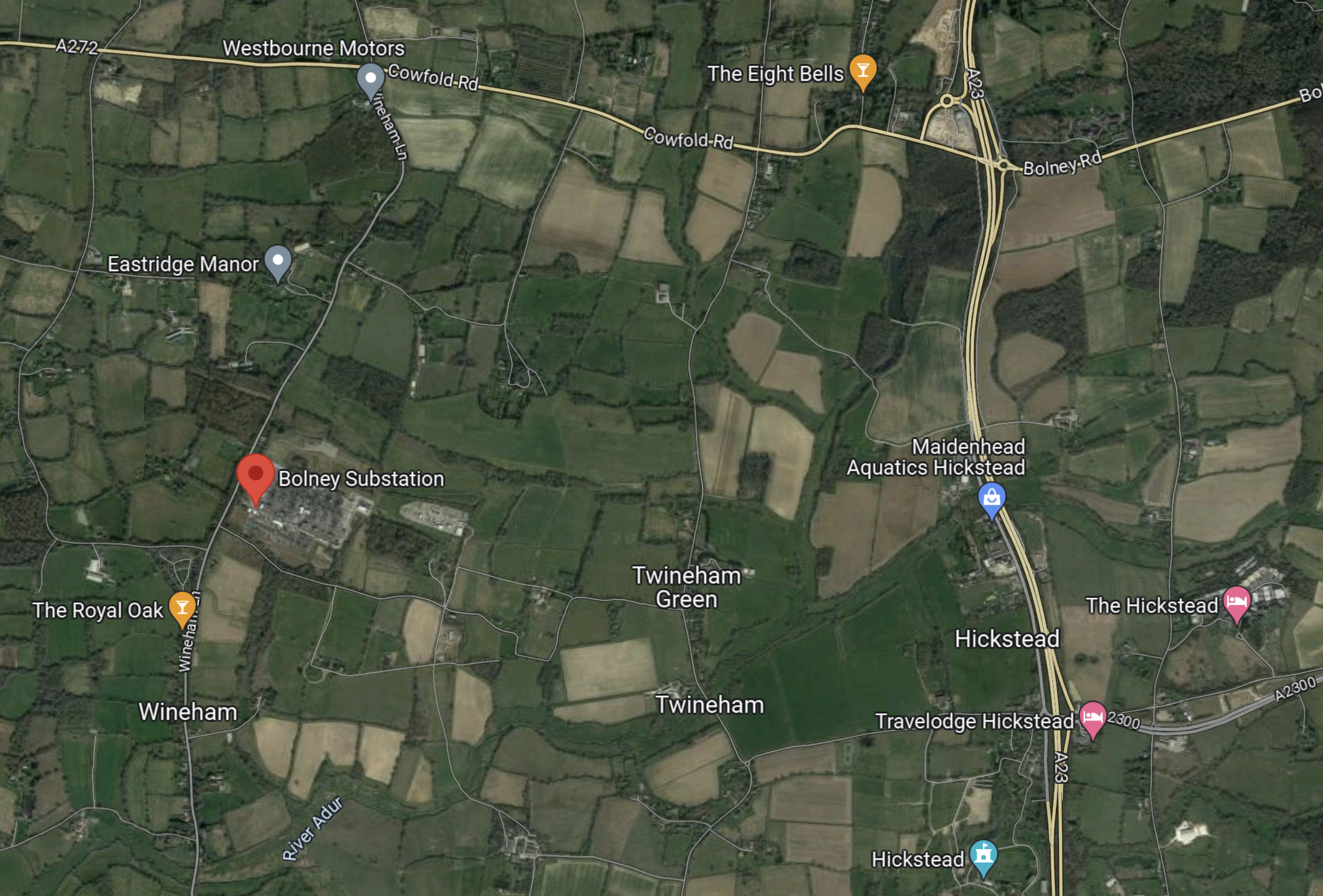
Note.
- The A23 is the main London-Brighton road.
- Bolney substation is indicated by the red arrow.
- The substation doesn’t have very good road access.
- I also suspect that the locals wouldn’t like an electrolyser in their midst.
On a brief look, I suspect that an electrolyser at Bolney substation will be a non-starter.
Shoreham Port As A Hydrogen Hub
The strategy mentions Shoreham Port several times, but gives the impression that progress is slow.
This Google Map shows Shoreham Port.
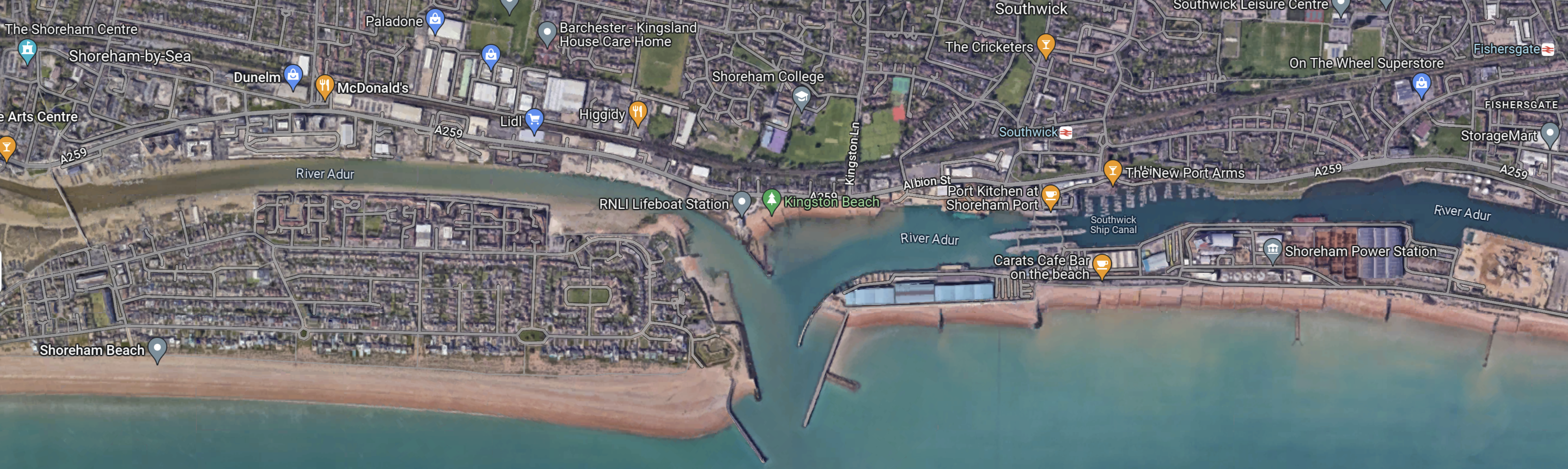
Note.
- Shoreham is in the West.
- The port reaches a long way to the East.
- The 420 MW gas-fired Shoreham Power station, is at the Eastern end of the port, close to the sea.
There appears to be spaces along the water for developing hydrogen infrastructure.
This page on the H2Green web site is entitled Agreement to Develop Clean Energy Hub for Shoreham Port, Sussex, starts with this paragraph.
Getech, the geoscience and geospatial technology provider and data-led energy asset developer, is pleased to announce that its wholly owned hydrogen subsidiary, H2 Green, has signed a Collaboration Agreement (the “Agreement”) with Shoreham Port.
It lists these three highlights.
- H2 Green granted a two-year legally binding exclusive right to develop a renewable energy hub (the “Hub”) at the Port of Shoreham, West Sussex.
- Under plans submitted by H2 Green to Shoreham Port, the Hub will initially focus on the provision of green hydrogen and renewable electricity to the Port’s fleet of 39 heavy forklift trucks and 12 heavy goods vehicles.
- Green Hydrogen will be sourced by a scalable green hydrogen production, storage and refuelling facility – the economics of which will be optimised by its integration with new solar and wind electricity generation capacity.
- The Hub will then be expanded to facilitate the decarbonisation of more than 800 heavy goods vehicles that enter Shoreham Port daily, and to provide fuel to port and coastal marine vessels.
That is all good stuff, but I do wonder, where the renewable electricity is going to come from.
In Further Thoughts On BP’s Successful INTOG Bid, I looked at BP’s plan for a 50 MW wind farm.
- It will be about twenty miles offshore from Aberdeen.
- With an appropriate electrolyser 50 MW of electricity would produce twenty tonnes of hydrogen per day.
- The electrolyser could be onshore or even offshore.
- The technology has all been developed.
Could H2Green be thinking of developing a similar hydrogen production facility?
 The Anonymous Widower
About time Brighton showed its green credentials and got the bus fleet converted to hydrogen
Comment by Nicholas Lewis | July 26, 2023 |
Brighton could be England’s flagship hydrogen project.
But then they do have Ricardo just down the road.
Comment by AnonW | July 26, 2023 |