Cloiche Onshore Wind Farm
This document from the Department of Business, Industry and Industrial Strategy lists all the Contracts for Difference Allocation Round 6 results for the supply of zero-carbon electricity.
The largest onshore wind farm in the Allocation Round, is the Cloiche wind farm, which has this web page,which is entitled Onshore Wind Projects , on the SSE Renewables web site.
It is the only project on the page and these two paragraphs describe its location and capacity.
The proposed 29 turbine Cloiche Wind Farm is located on the Glendoe and Garrogie Estates, adjacent to the operational Stronelairg Wind Farm and Glendoe Hydroelectric Scheme and approximately 11 kilometres (km) to the south-east of Fort Augustus in the Great Glen, in the Monadhliath mountain range.
It is anticipated that the wind farm will generate approximately 130.5MW.
This Google Map shows the location.
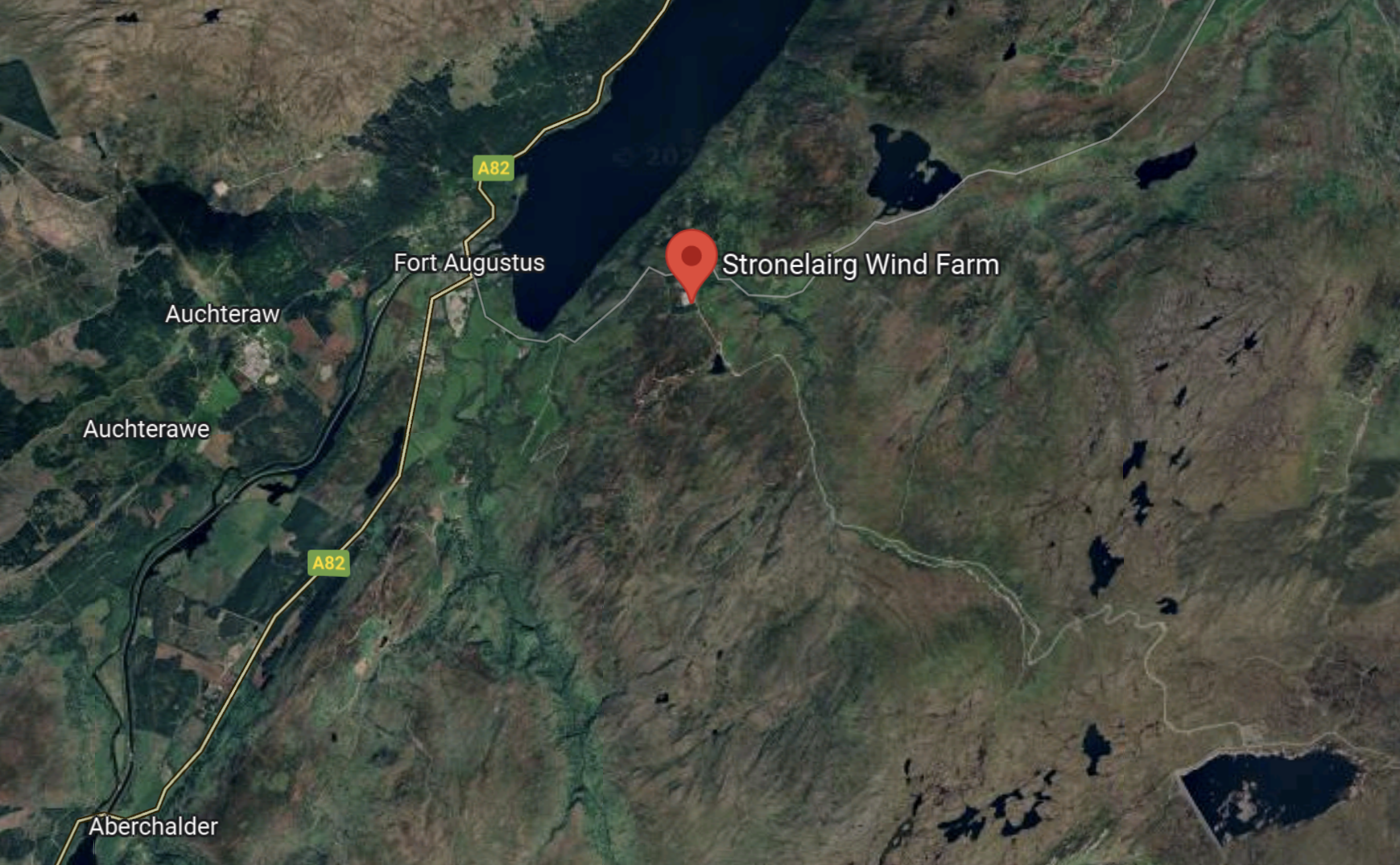
Between the village of Fort Augustus and the Stronelairg wind farm, lies the Southern end of Loch Ness.
In the South-East corner of the map, there is a large lake, which is shown in more detail in this Google Map.
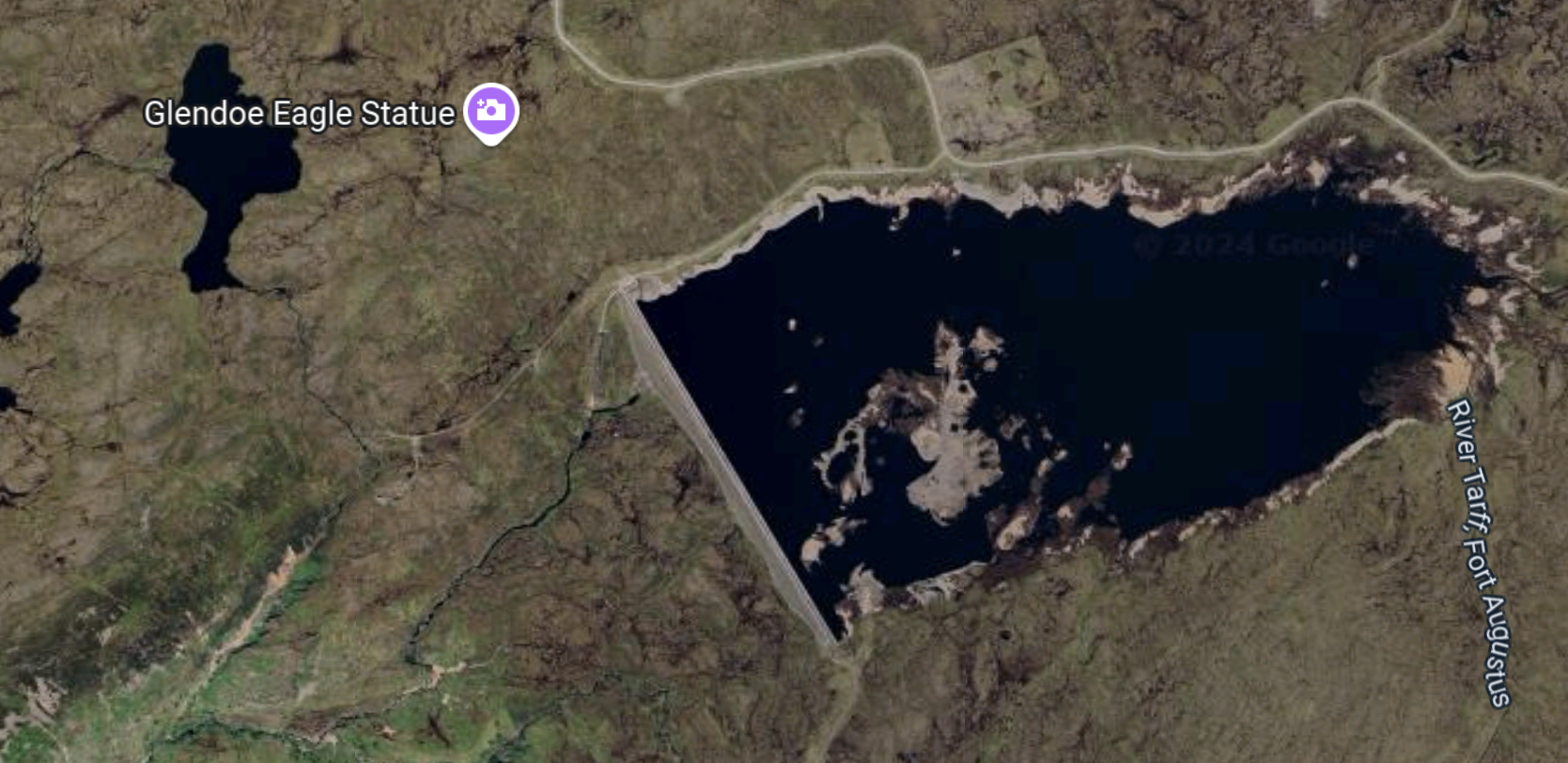
This is the Glendoe Reservoir for the Glendoe Hydro Scheme, that was built in the early years of this century, by damming the River Tarff.
The dam is clearly visible at the Western end of the Reservoir.
The Glendoe Hydro Scheme was opened in 2009 and has a generation capacity of 106.5 MW.
The planning and building of the scheme are described in this Wikipedia entry and the entry is well worth a read.
Stronelairg Wind Farm
Stronelairg wind farm, Cloiche wind farm and the Glendoe Hydro Scheme are all projects, that were or will be developed by SSE Renewables.
Stronelairg wind farm has 66 turbines and a total installed capacity of 228 MW.
It has a web page on the SSE Renewables web site.
These two paragraphs describe the location of Stronelairg wind farm.
Stronelairg sits at an elevation of around 600m above sea level in the Moadhliath Mountain range making it one of our windiest wind farms.
It sits within a natural bowl on a plateau, set well back from Loch Ness meaning that no turbines are visible from the main tourist routes in the area. Stronelairg is also located adjacent to our 100MW Glendoe hydro scheme and so the construction teams were able to use the hydro infrastructure as do our operational teams now.
Stronelairg wind farm appears tobe a powerful asset, hidden in the mountains.
Three Co-located Assets
As Cloche wind farm, will be adjacent to the operational Stronelairg Wind Farm and Glendoe Hydroelectric Scheme, these three energy producing assets, will be close together.
- Cloiche wind farm – 130.5 MW
- Stronelairg wind farm – 228 MW
- Glendoe Hydroelectric Scheme – 106.5 MW
Note.
- This is a total power of 465 MW.
- This would be equivalent to a medium-sized gas-fired power station.
- All three assets could use the same grid grid connection and other facilities.
It could be considered a 358.5 MW wind farm, backed by a 106.5 MW hydro power station.
When there is a shortage of wind, the Glendoe Hydroelectric Scheme could step in, if required.
Conclusion
Onshore wind, backed up by hydroelectric schemes would appear to be a good way to create reliable hybrid power stations.
Do any other schemes in Allocation Round 6, involve combining onshore wind with existing hydro schemes?
World’s First Semi-Submersible Floating Offshore Wind Farm Tops Production Expectations
The title of this post, is the same as that of this article on offshoreWIND.biz.
This is the sub-heading.
In its four years of operation, the world’s first semi-submersible floating offshore wind farm, WindFloat Atlantic, has surpassed anticipated production figures, achieving a total cumulative output of 320 GWh.
These first three paragraphs give more detail.
Connected to the grid by the end of 2019 and fully commissioned in 2020, the floating offshore wind farm was developed by the Windplus consortium formed by Ocean Winds, a 50:50 joint venture between EDPR and ENGIE, Repsol, and Principle Power.
The pioneer wind farm consists of three platforms, each supporting one 8.4-MW Vestas turbine, which are anchored with chains to the seabed and connected to the onshore substation in the Portuguese municipality of Viana do Castelo through a 20-kilometre cable.
It has been reported that the project’s electricity production has steadily increased each year, reaching 78 GWh in 2022 and 80 GWh in 2023.
It certainly appears that floating wind power, is living up to and above its expectations.
 The Anonymous Widower