Glen Earrach Energy (GEE) To Give £20m Per Year To Highland Communities
The title of this post, is the same as that of this article on the Inverness Courier.
These two paragraphs introduce the article.
The announcement is underpinned by the publication of a new developer-led research report, the first of its kind in the UK energy sector, which brings together national polling, public consultation, and direct input from communities.
The report marks a major step in the development of the fund, setting out emerging priorities, design principles and governance themes that reflect what GEE has heard to date and will help guide the next phase of engagement.
Other points from the article include.
Size And Delivery
This is said about the size and delivery of the project.
Subject to planning, the project will provide up to 34GWh of long-duration energy storage in 2030.
All these projects seem to be on course for delivery by 2030. Mr. Ed. Milliband will be pleased.
The Community Wealth Fund
This is said about the Community Wealth Fund.
The fund will be rooted in the communities that share the key water resource underpinning the scheme, with scope to contribute to wider regional projects, including contributions to a Strategic Fund for the Highlands as a whole.
“The GEE Community Wealth Fund is about more than sharing the benefits of clean energy, it is about creating long-term value for the communities who make this project possible.
As the grandmother of all pumped storage hydro in the UK; Electric Mountain, started storing energy and producing power in 1984, the Community Wealth Fund should last a few years.
Battery-Powered SOVs, CTVs To Soon Become Cheaper than Their MGO Alternatives, Study Says
The title of this post, is the same as that of this article on offshoreWIND.biz.
This is the sub-heading.
Studies commissioned by ScottishPower Renewables found that battery-powered vessels (re)charging offshore is feasible and could be part of the operations of future offshore wind farms. One of the reports also says electric operations and maintenance (O&M) vessels will become cheaper than their Marine Gas Oil (MGO) alternatives within the next few years.
The article is definitely a must-read, as it talks in detail about using service operation vessels (SOVs) and crew transfer vessels (CTVs), that are powered by electricity, rather than by marine gas oil (MGO).
Network Rail Objects To Wrexham To London Service
The title of this post, is the same as that of this article on the BBC.
This is the sub-heading.
Concerns have been raised about plans for a direct rail service between Wrexham and London, including fears over safety at level crossings.
These three paragraphs add details to the story.
Network Rail warned the line was already congested and there was not enough timetable capacity for extra services.
In a report, it said increased use would raise the risk of a collision at crossings along the route and that it could not support the application, put forward by a new open-access rail operator called the Wrexham, Shropshire and Midlands Railway (WSMR).
The new service would link Wrexham, Gobowen, Shrewsbury, Walsall and Coleshill up with the capital.
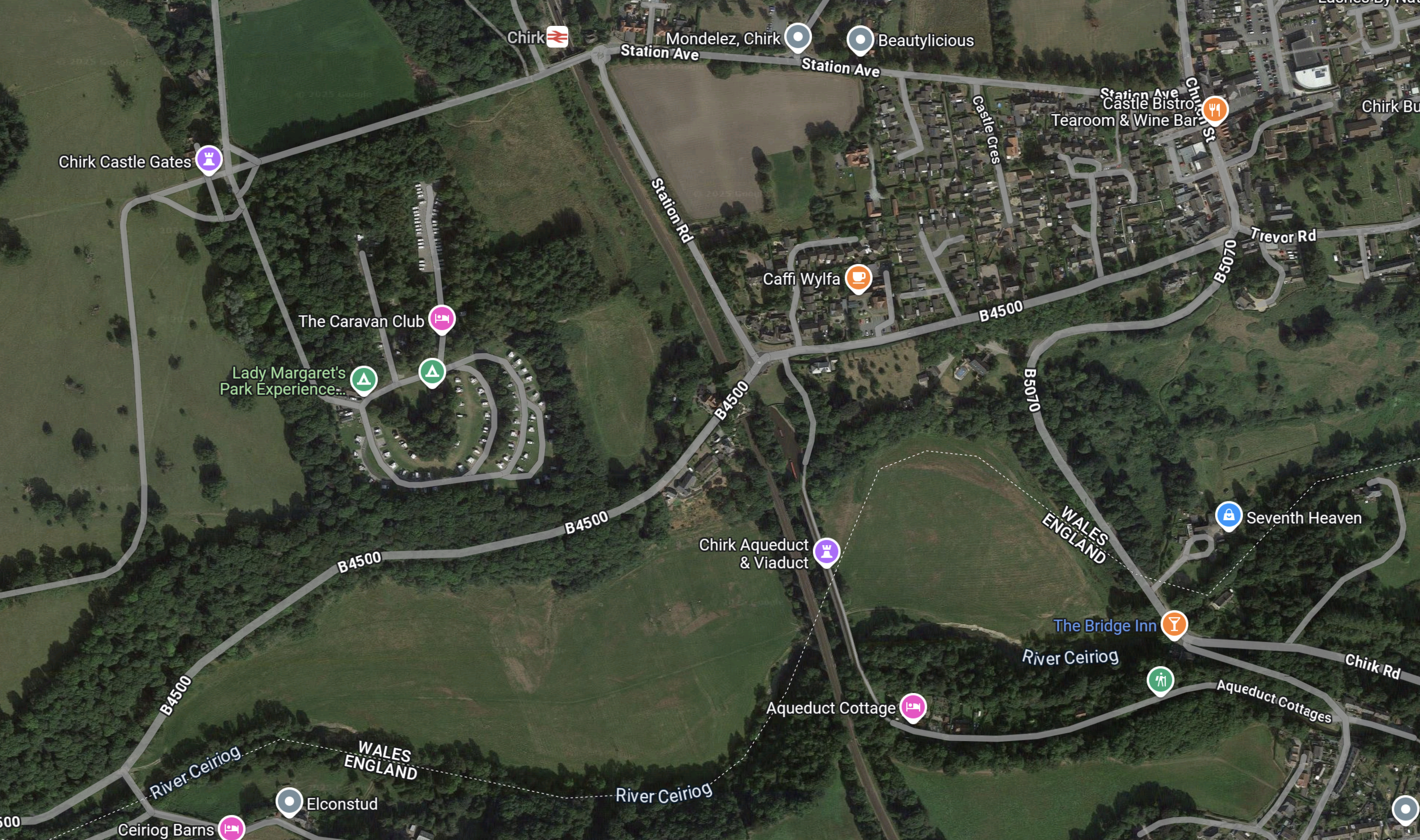
This Google Map shows the area of the crossing.
Note.
- Chirk station, which is fully-accessible via ramps, is at the top of the map.
- The railway between and running down the middle of the map.
- The railway has a maximum speed of 70 mph.
- The Aqueduct and the Viaduct crossing the valley of the River Ceirog together.
- The large caravan park.
- Chirk Castle Park.
If the Viaduct level crossing is in this area, it is a serious accident waiting to happen.
The BBC article says this about the crossing.
They include the Viaduct level crossing in Shropshire, which it said was “used by large groups and is also a hot spot for trespassing and fatalities”.
The operator said work would need to be carried out to make it safe.
North Shropshire MP Helen Morgan has previously spoken out on the safety of the crossing, which is close to the Chirk Viaduct.
She has written to Network Rail to request additional safety measures be put in place.
Network Rail said it had reviewed the safety of the crossing and brought forward plans to install crossing lights, which should be in place in December this year.
Note.
- I hope this is enough. But, I do know that the level crossing lights work well at Thurston station in Suffolk.
- It must help, that there is a bridge at the station.
The line between Wolverhampton and Wrexham, except for a short 15 mph section at Shrewsbury has at least a 70 mph maximum speed.
As electric trains, including battery-electric ones, have fast acceleration and deceleration would it not be possible for them to slow down for the level crossings?
This could even be done automatically using digital signalling.
Conclusion
I believe that this level crossing problem is solvable.
 The Anonymous Widower