E.ON Invests £4 million In Allume Energy To Boost Solar Rollout For Flats
The title of this post, is the same as that of this article on Solar Power Portal.
These three paragraphs explain the deal and say a small amount about Alume’s SolShare system.
Energy supplier E.ON UK has today (17 June) announced that it has signed a strategic investment agreement with Australian firm Allume Energy to help the firm expand into the UK.
E.ON UK has invested £4 million into Allume Energy to enable Allume to expand the reach of its SolShare technology within the UK market. SolShare allows solar energy from a single rooftop solar PV installation to be fairly shared amongst multiple homes in the same building in order to allow residents of flats to access solar PV energy.
Residents are supplied their energy when they are using by a pre-determined allocation, allowing them to lower their energy bills. Many blocks of flats that do have solar panels fitted currently only use this energy to power the common areas of the building while residents still pay their full electricity bill. According to Allume, a shared rooftop solar PV system can reduce resident energy bills by between 30% and 60%.
I must say, that when I read this article, it had something of the too-good-to-be-true about it.
But.
- My solar installation on a fair-sized roof cost me about £6,000 and I am constantly surprised at how much electricity it provides.
- If you have fifty flats, they all won’t do their weekly washing at the same time each week.
- I wouldn’t be surprised to see a big battery somewhere or a small battery in each flat.
- The batteries could soak up any excess electricity or charge on cheap-rate overnight electricity.
- Do Allume’s engineers go through every flat and make suggestions about saving energy?
- Is the pattern of electricity usage in a block of flats predictable from past usage and factors like weather, the time of the year and what’s on television?
- I wouldn’t be surprised that Allume have performed extensive mathematical modelling on blocks of flats.
I think this deal could be a winner foe E.ON, Allume and their customers.
I have some ideas about the use of the system.
Would It Work On A Small Housing Estate?
A small housing estate would be a number of solar roofs feeding a number of houses, whereas with flats it will be one roof feeding a number of dwellings.
I suspect that with a well-designed sharing and pooling system, a lot of features of the flat-powering system could be used to power houses.
How Does The System Handle Electric Vehicles?
The system could use these to store electricity, so that they are always charged at the cheapest rate.
And when there is a shortage of electricity, the electricity could be borrowed by the Allume system.
Conclusion
If you have community sharing their own source of electricity, you can probably make ideas work, that wouldn’t in a single application.
My nose says Allume’s idea has legs.
Footage Released Of East West Rail’s First Commercial Freight Train
The title of this post, is the same as that of this news item from Network Rail.
These four paragraphs give detail to the story.
The inaugural journey was part of a dual first, as it also saw the entry into service of Maritime Transport’s Northampton Gateway Terminal.
This Easter Network Rail completed its work there to join the 35-acre freight facility directly to the West Coast Main Line via the Northampton Loop.
The modern junction design allows freight trains to enter and exit the site at speeds of up to 40mph, which is eight times faster than conventional freight connections.
Clearing the railway junction much faster will significantly improve both passenger and freight journeys – as it reduces the impact on other services running on the main line.
This OpenRailwayMap shows the location of Maritime Transport’s Northampton Gateway Terminal.
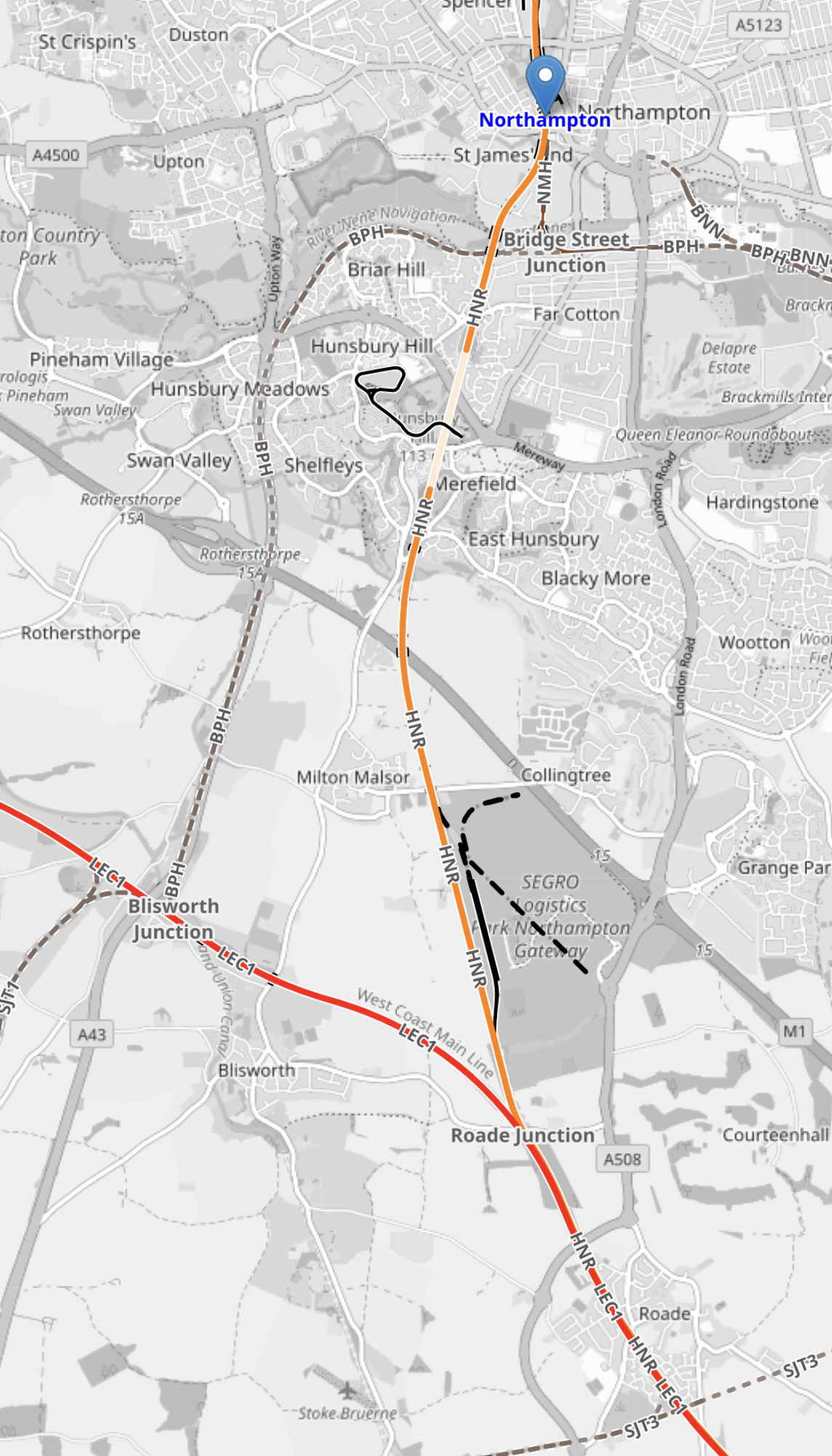
Note.
- The red track running diagonally across the bottom half of the map is the West Coast Main Line.
- The orange track running North-South is the Northampton Loop of the West Coast Main Line.
- The blue arrow indicates Northampton station.
- The grey line running diagonally across the map, vaguely parallel to the West Coast Main Line is the M1 Motorway.
- The SEGRO Logistics Park Northampton Gateway is indicated between the Northampton Loop and the M1 Motorway.
This Google Map shows the layout of the logistics park to a larger scale.
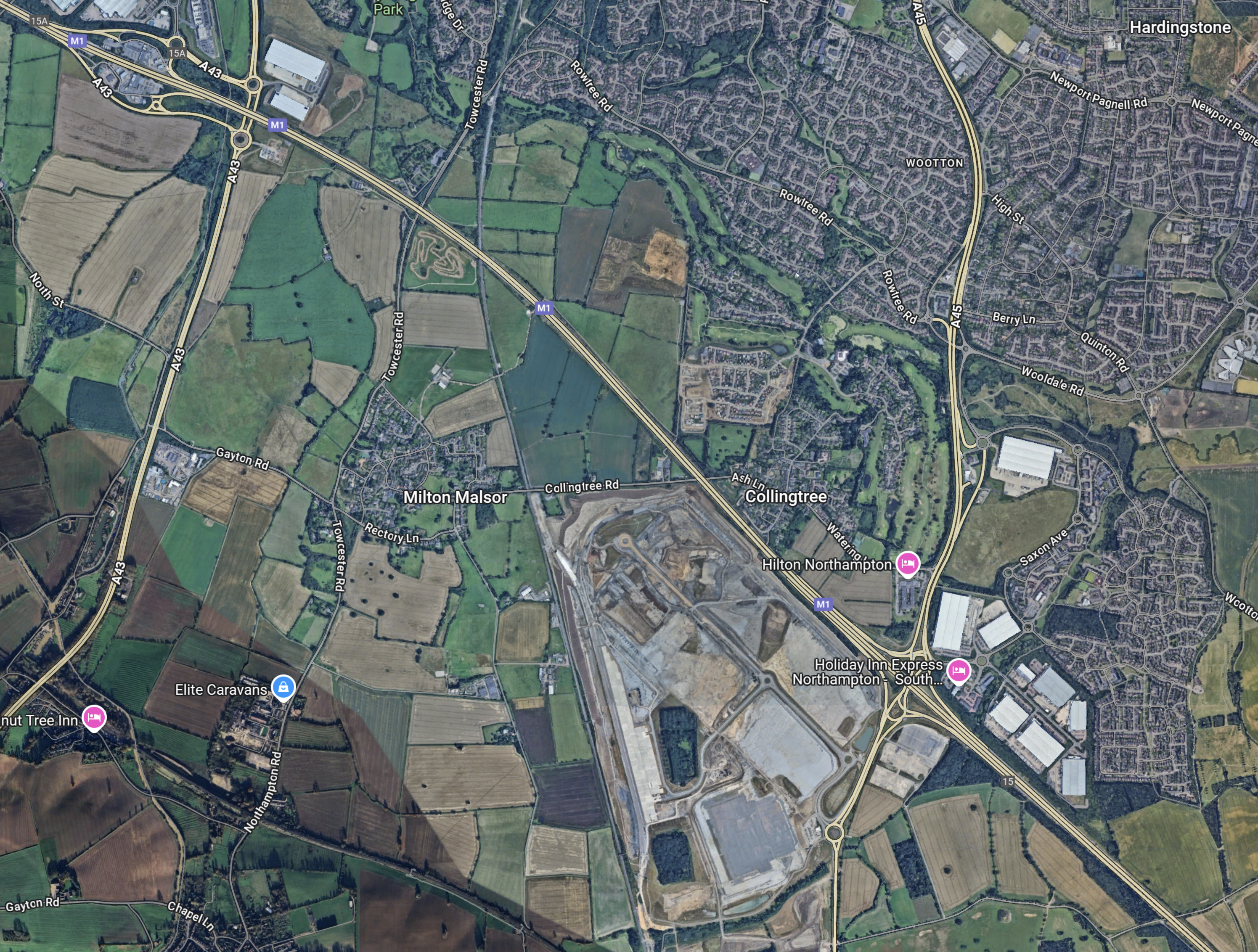
Note.
- The Northampton Loop of the West Coast Main Line running North-South across the map.
- The M1 Motorway running between the North-West and South-East corners of the map.
- Junction 15 is the M1 junction in the South-East corner of the map which connects the logistics park and the A45 to the M1.
- Junction 15A is the M1 junction in the North-West corner of the map which connects the A43 and Northampton services to the M1.
- There is probably space to add more warehouses and other facilities.
The logistics park is well connected to both rail and road.
This second Google Map shows the rail connection to the logistics park in more detail.
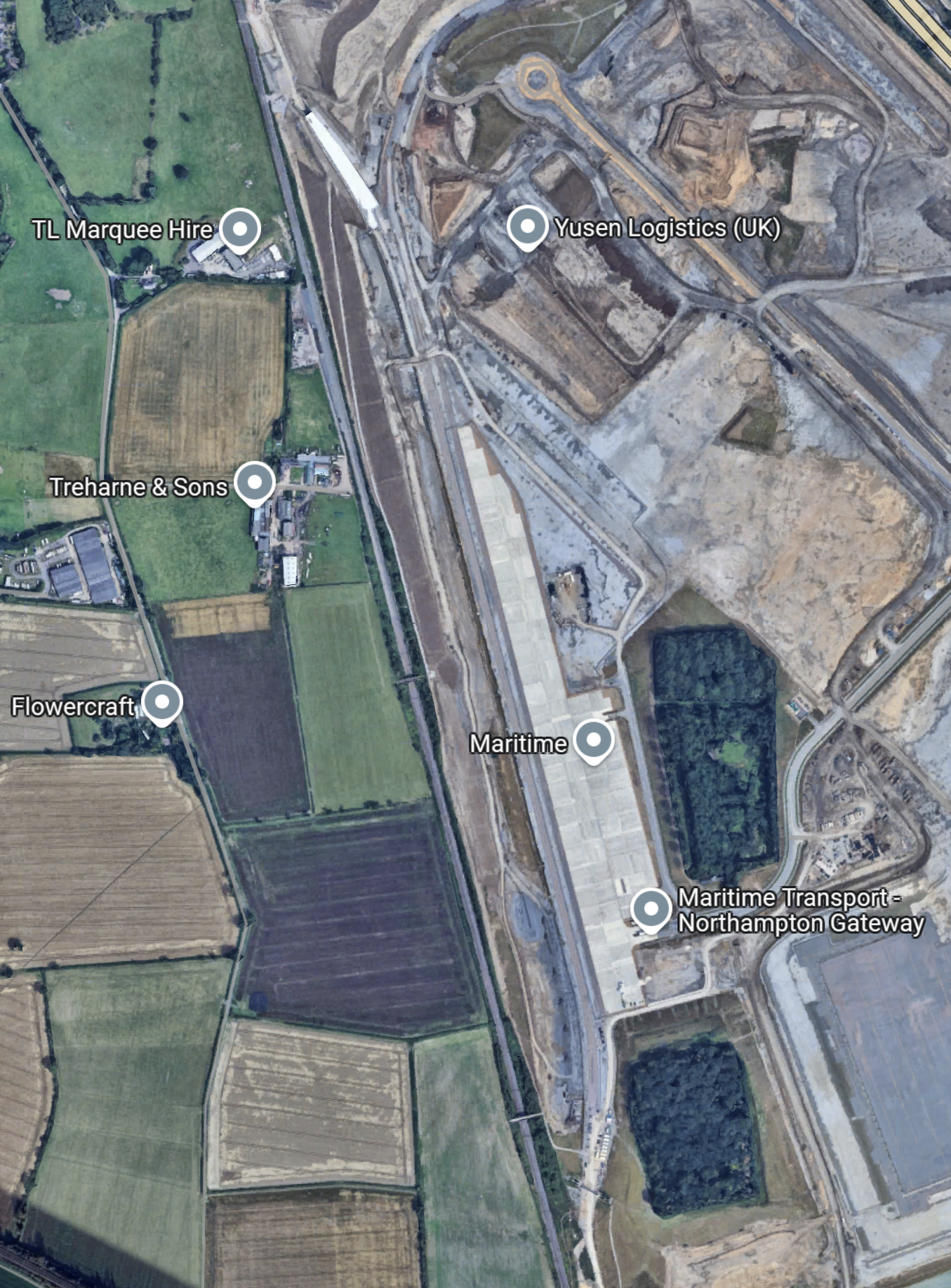
From this map, it appears that Network Rail have met their objective outlined in this paragraph of the news item.
The modern junction design allows freight trains to enter and exit the site at speeds of up to 40mph, which is eight times faster than conventional freight connections.
As only freight trains and slower passenger trains use the Northampton Loop, I would expect that freight trains should be able to enter and leave the logistics park with the minimum of disruption to traffic on the Northampton Loop.
The Route Of Yesterday’s Train
These three paragraphs from the Network Rail news item describe the route.
The first commercial freight train has travelled along the East West Rail line as part of its journey into a new strategic rail freight interchange in Northampton.
Shortly after 13:00 yesterday (Monday 16 June) the service* from Didcot came onto the new infrastructure at Oxford, travelling the 35 miles to Milton Keynes to connect with the West Coast Main Line.
It marked the first time East West Rail infrastructure has been used for commercial freight, after many months of signaller training and train driver learning since the £1.2bn railway was completed in October 2024.
This OpenRailwayMap shows the route from Didcot to Milton Keynes.
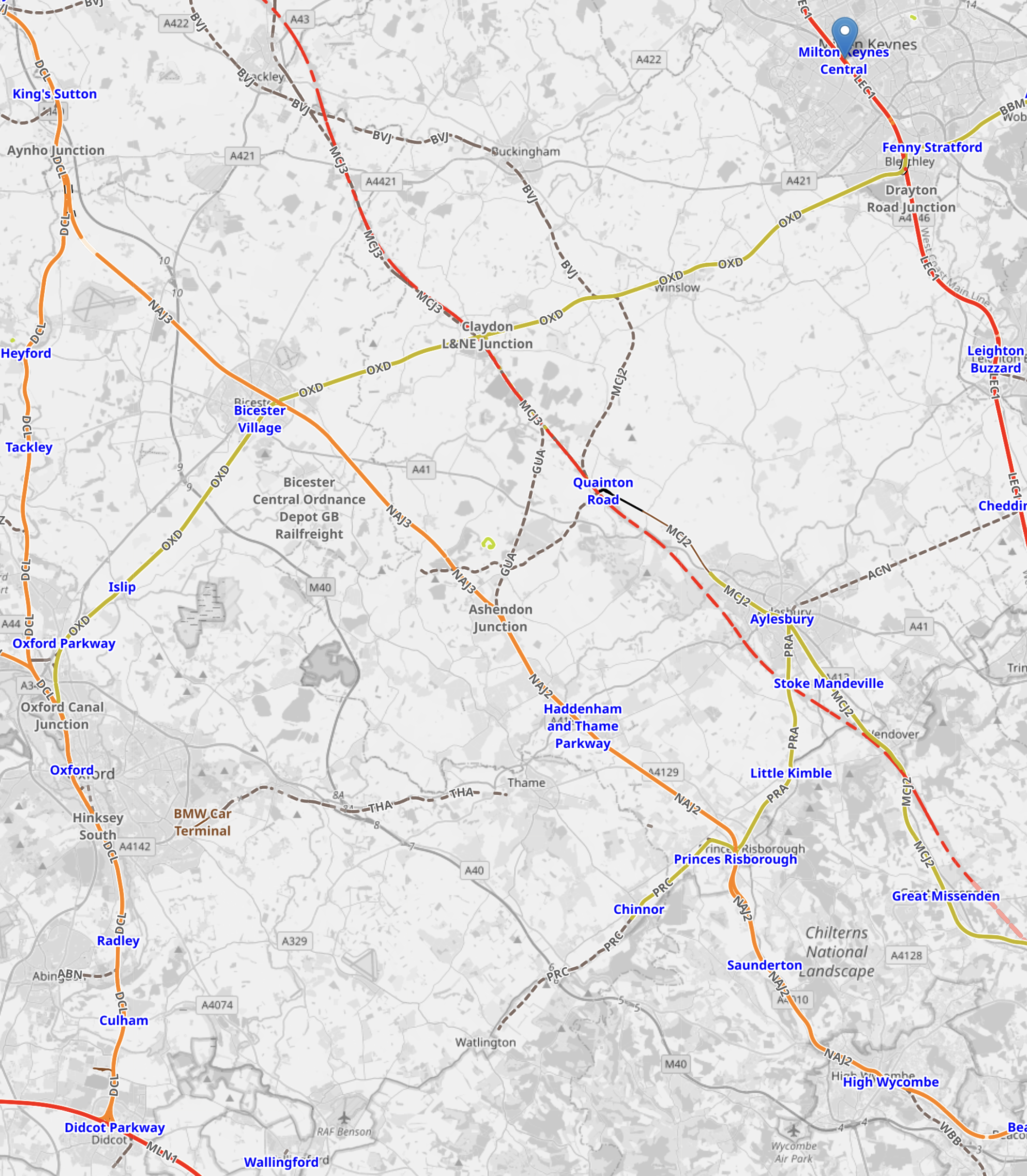
Note.
Didcot Parkway station is in the South-West corner of the map.
Milton Keynes Central is in the North-East corner of the map and marked with a blue error.
The route is via Oxford, Oxford Parkway, Bicester Village, Winslow and Bletchley.
This video shows the train passing Winslow.
 The Anonymous Widower