National Grid Pioneers UK-First Trial Of 3D Printed Technology For Low-Carbon Substations
The title of this post, is the same as that of this press release from National Grid.
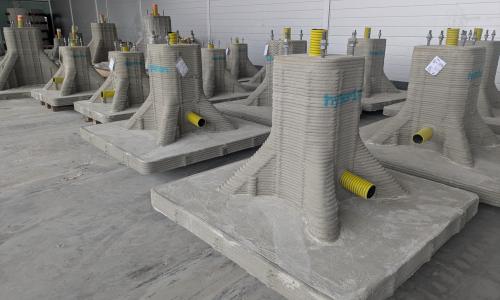
These three bullet points act as sub-headings.
- Collaboration with Hyperion Robotics and the University of Sheffield will trial low-carbon 3D-printed concrete foundations including at National Grid’s Deeside Centre for Innovation in North Wales
- Innovation could reduce waste, carbon emissions and costs to consumers of network construction
- If rolled out across National Grid substations the technology could save up to 705 tons of concrete and 323 tons of CO2 and deliver £1.7 million in consumer savings versus traditional methods over a 10-year period
These two paragraphs give more details.
National Grid is working with Hyperion Robotics and the University of Sheffield on a UK-first trial to manufacture, install and test 3D-printed substation foundations, which have the potential to reduce construction-driven carbon emissions and reduce costs to consumers of network construction. This is part of National Grid’s commitment to leverage innovation to future-proof the network.
If the project is successful and the technology is rolled out across all National Grid substations, it is estimated it could save up to 705 tons of concrete and 323 tons of CO2 over a 10-year period, and deliver £1.7 million in consumer savings versus traditional methods.
The foundation design will deliver significant savings across the entire value chain.
- 70% reduction in concrete usage
- 80% less soil displacement
- 65% decrease in embodied carbon emissions
- 70% weight reduction compared to typical foundations
- 50% reduction in site operative hours, streamlining production
The foundations will be designed and produced in Finland by Hyperion Robotics, and tested at full-scale by the University of Sheffield. Further field testing will then be carried out at National Grid’s state-of-the-art testing facility, the Deeside Centre for Innovation in North Wales, later in 2025.
Conclusion
I like this technology and I suspect there are many other applications of 3D Concrete Printing.
Project To Demonstrate 15+ MW Turbine On Ocergy’s Floating Platform Kicks Off
The title of this post, is the same as that of this article on offshoreWIND.biz.
This is the sub-heading.
The Reduced Commercial Risks with Demo of 15+ MW (RECORD15) joint industry project, which aims to install a latest generation turbine with a rated power over 15 MW on Ocergy’s floating platform in 2028, has been launched
The visualisation of the 15 MW turbine on its float in the article is impressive.
These two paragraphs add more details.
The Front-End Engineering Design (FEED) contract for this pilot project was recently signed between Ocergy and three offshore wind developers: EnBW Energie Baden-Württemberg AG, Kyuden Mirai Energy, and TEPCO Renewable Power.
Ocergy’s platform, the turbine agnostic OCG-Wind, is a modular design supporting an optimised assembly process from pre-fabricated steel sub-assemblies, allowing serial production using today’s existing supply chain and infrastructure, said the company.
Note.
- The average size of onshore wind turbine in the UK is 1.6 MW.
- Whitelee wind farm in Scotland, which is the largest onshore wind farm in the UK, uses 215 x 2.5 MW turbines.
- The Dogger Bank wind farm used 13 and 14 MW turbines on fixed foundations.
A 15+ MW turbine on a floating foundation will surely give Ocergy’s technology a very good test.
But it will be needed.
This is the overview of the Bowdun wind farm in Scotland, taken from the project’s web site.
The Bowdun Offshore Wind Farm will be located in the E3 leasing zone, which lies 44km off the coast of Aberdeenshire.
The zone, awarded to TWP under the ScotWind leasing round in January 2022, covers an area of 187km.
With water depths below 70m, it is highly suitable for fixed-foundation turbines, which will most likely sit on jacket foundations.
TWP plans to develop a 1GW offshore wind farm at the site. The base case is that the farm will number between 40-60 turbines, using ‘next-generation’ models with a capacity
between 18 MW and 25 MW. Construction is anticipated to commence in 2029 with commissioning planned for 2032-2033.This project base case will evolve as we gain knowledge from our site investigations and conduct technology research.
If turbines between 18 MW and 25 MW are to be used on fixed foundations, I can see a need to develop floats that will handle them.
London Underground’s New Piccadilly Line Trains Delayed Until 2026
The title of this post, is the same as that of this article on Railway Gazette.
These are the first two paragraphs.
The new air-conditioned trains which Siemens Mobility is supplying for London Underground’s Piccadilly Line are now expected to enter service from the second half of 2026, Transport for London has confirmed.
When the order was signed in November 2018 it was envisaged that the trains would enter service from 2024.
The article also says this about the new CAF trains for the Docklands Light Railway.
The Docklands Light Railway is to implement ‘short-term timetable changes’ on less busy routes from July 21. The reduction in services aims to ensure that reliability can be maintained pending the delayed introduction of new CAF trainsets, which was originally planned for 2023 but is now expected later this year. TfL said the age of the existing trains meant some needed to be retired this summer.
It looks like has two sets of new trains, both being delivered two years late; one being German and the other Spanish.
The only factors I can think both trains being late would be.
- Bad management of the contracts by Transport for London.
- Bad documentation of the Piccadilly Line and the Docklands Light Railway, when they were built.
- Bad project management generally throughout Europe.
- All politicians will be blaming someone else.
Take your pick!
Death Of A Dog
I vividly remember the end of the life of our first English Setter ; Charlotte.

Charlotte and Daisy
She was in a bad state and wasn’t getting up from in front of AGA.
After a phone call to our vet, who knew her well, he said he’d come round at the end of the day on his way home and assess the situation.
He turned up after midnight and after a quick assessment, he felt that she wouldn’t last the night. So he gave her an injection whilst I stroked her.
Afterwards, I had an unopened bottle of Paddy in the cupboard, so we drank well for about an hour to Charlotte.
He took Charlotte away afterwards.
I do sometimes think, that dogs get better end-of-life care than humans do!
 The Anonymous Widower