Centrica Tackles Difficult Terrain To Deliver Sustainable Solar Solution For Derbyshire Manufacturer
The title of this post is the same as that of this press release from Centrica.
This is the sub-heading.
Centrica Business Solutions has successfully completed a bespoke solar farm for Carpenter Ltd, a Glossop based manufacturer, overcoming significant terrain challenges to help the business take a major step towards a sustainable future.
These two paragraphs add some more detail.
- Built on a 14.62% sloped bank – a location once considered unsuitable for development – the project required careful planning, specialist machinery, and adaptive engineering techniques to ensure safe, efficient installation in mud-heavy winter months. Most solar farms are installed on flat ground; this project demanded a fully customised approach.
- The new solar array comprises 1,666 panels generating 1,025 MWh of renewable energy per year. This will help Carpenter Ltd cut carbon emissions by 116,150 kg CO₂ in the first year alone, reduce energy costs, and strengthen local economic resilience by supporting sustainable manufacturing jobs in the region.
This is a picture of the site from Centrica.
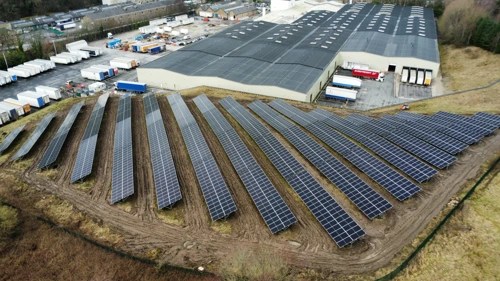
Google AI says the array is around a MW.
How many other difficult solar installations can be developed using good old-fashioned construction and engineering techniques?
How Far Will A Class 897 Train Travel Without Using The Electrification?
I have not seen this question answered, so out of curiosity, I asked Google AI and received this answer.
LNER’s upcoming Class 897 “tri-mode” trains are designed to travel approximately 120 miles (around 193 km) on battery power alone when not using 25 kV overhead electrification. These 10-car Civity UK trains, ordered from CAF, are expected to operate on electric, diesel, or battery, with the latter used for sustainable, emission-free, quiet running near stations and on non-electrified sections.
Key details regarding the Class 897, as highlighted by LNER’s announcement and related news, include:
Operational Capability: They are designated as tri-mode, capable of running on 25 kV AC overhead electric, onboard battery power, or diesel.
Intended Usage: The battery power is primarily intended for use on the approach to and departure from stations.
Range: The batteries are reported to offer a range of roughly 120 miles.
Introduction: The units are expected to be delivered from 2027 to serve the East Coast Main Line.
Branding: The trains will operate under the new Great British Railways (GBR) branding.
Most of the information used by Google AI came from an article in Railway Gazette International in early 2026.
It certainly looks like Great British Railways will have at least one 125 mph, 120 mile range express away from the wires.
I also asked Google”Do Hitachi Battery Electric InterCity Trains Have Problems?” and received this answer.
While Hitachi’s battery-powered intercity trains have shown promising results in trials, particularly regarding fuel savings and emissions reduction, there are some potential challenges and considerations. These include safety concerns related to lithium battery fires, especially in the event of a crash or derailment, as well as range limitations for longer journeys. However, the technology is continuously evolving, and Hitachi is actively working to address these issues.
That seems fairly positive.
There is also this article on the BBC, which everybody should read, which is entitled Will New Battery-Powered Trains Replace Diesel, And Are They Safe?.
In The Data Sheet For Hitachi Battery Electric Trains, I look at the data sheet, that Hitachi published in late 2023.
These were my conclusions about the data sheet.
These are my conclusions about Hitachi’s battery packs for Class 80x trains, which were written in November 2023.
- The battery pack has a capacity of 750 kWh.
- A five-car train needs three battery-packs to travel 100 miles.
- A nine-car train needs five battery-packs to travel 100 miles.
- The maximum range of a five-car train with three batteries is 117 miles.
- The maximum range of a nine-car train with five batteries is 121 miles.
As battery technology gets better, these distances will increase.
Hitachi have seen my figures.
They also told me, that they were in line with their figures, but new and better batteries would increase range.
It looks like Great British Railways will have at least two 125 mph, 120 mile range express trains away from the wires.
125 mph trains with a 120 mile range on batteries, will revolutionise UK train travel.
LNER’s Class 897 Trains
In the Wikipedia entry for LNER, this is said about LNER’s new ten CAF tri-mode trains.
In November 2023, LNER placed an order for 10 ten-car tri-mode (electric, diesel and battery power) Civity trains from CAF. In August 2024, it was announced that the units will be designated Class 897 under TOPS.
According to their Wikipedia entry, it appears the Class 897 trains will be delivered from 2027.
Can I Build A Schedule For The Introduction Of New Trains, Services and Batteries?
I think that I can from the information that is out there.
- East Coast Main Line – December 2025 – Introduction of Lumo between London King’s Cross and Glasgow
- West Coast Main Line – Spring 2026 – Introduction of Lumo between London Euston and Stirling
- Midland Main Line – 2026-2027 – Introduction of EMR Class 810 trains between London St. Pancras and Leicester, Derby, Nottingham and Sheffield.
- East Coast Main Line – From 2027 – Introduction of LNER Class 897 trains between London King’s Cross and Yorkshire.
Note.
- The two Lumo services use trains already in service.
- The Class 810 trains for EMR are being debugged and introduced at the present time.
- The only new trains are the Class 897 trains for LNER.
- The introduction of the Class 897 trains will allow LNER to withdraw some trains for refurbishment and fitting of batteries.
This would mean that before the next general election, almost the full timetable between London and the North of England and Scotland would have been implemented using diesel-electric technology.
Is it a low-risk start to the full electrification of services to the North?
The second-phase would see battery-electric trains introduced.
I believe that Grand Central’s new trains would be brought into service first.
- The new trains are scheduled to be introduced in 2028.
- Grand Central will still have the diesel trains for backup.
- Their new trains would be similar to the other Hitachi trains.
- It looks like they could be doing some splitting and joining.
After the Grand Central trains had been introduced successfully, the trains for the other Hitachi operators would have batteries fitted.
I suspect short routes like Lincoln would be electrified with battery-electric trains first.
There might also need to be short lengths of electrification erected, so that trains could be charged to send them on their way.
Other routes could also be electrified in the same way.
- Basingstoke and Exeter
- Shrewsbury and Aberystwyth – 81.5 miles
- Bristol and Penzance
- Cardiff and Swansea – 45.7 miles
- Crewe and Holyhead – 105.5 miles
- Edinburgh and Aberdeen – 130.5 miles
- Edinburgh and Inverness – 175 miles
- Reading and Bristol Temple Meads – 82.4 miles
- Reading and Cheltenham Spa – 84.5 miles
- Reading and Exeter – 137.5 miles
- Reading and Penzance – 269 miles
- Reading and Plymouth – 189.5 miles
- Reading and Taunton – 128:15 miles
- Reading and Western Super Mare – 101.4 miles
- Reading and Worcester Shrub Hill – 84.5 miles
- St. Pancras and Chesterfield – 146.1 miles
- St. Pancras and Derby – 128.3 miles
- St. Pancras and Doncaster – 157.3 miles
- St. Pancras and Leeds – 187.2 miles
- St. Pancras and Nottingham – 126.4 miles
- St. Pancras and Sheffield – 160.0 miles
If this technique could work for main lines, surely a scaled-down version with smaller trains would work for branch lines.
Conclusion
Consider.
- It looks to me, that someone has planned this thoroughly.
- There will be a lot of 125 mph trains with a 120 mile range on batteries, running before the next election.
It all fits together extremely well.
It could be the first phase of a cunning plan to use battery-electric trains to electrify the UK’s railways.
Passengers will also see benefits, from when Lumo runs its first train into Glasgow Queen Street station.
I don’t think Hitachi’s trains have any problems, but there is enough float in this plan to make sure, it can be implemented on time and on budget.

