A First Ride In A Class 700 Train
Today, I caught the 10:48 between East Croydon and London Bridge stations,. I took that train as this service was mentioned as the first one to be served by a new Class 700 train, in this article on Global Rail News.
As the pictures show it was one of the new twelve-car Siemens trains.
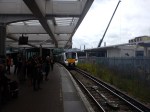

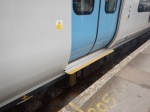
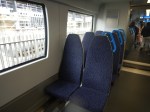


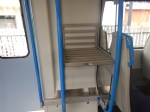





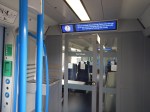



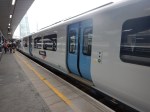
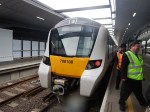
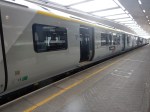
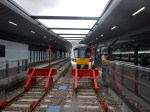
If I would give it a complement it would be competent, as most new trains seem to be these days.
The design features I like include.
- The spacious lobbies.
- The walk-through train.
- 2 x 2 seating.
- The comprehensive information system.
- The extra luggage racks, in addition to the usual racks above the seats.
- The simple colour scheme.
- The trains would work with platform-edge doors.
- Putting First Class at both ends of the train.
Passengers might complain about the following.
- The lack of audible messages. – I liked the quiet, but I’m not blind.
- The lack of tables in Standard Class compared with say the Class 387 trains, that currently work the line.
- The length of the train at 242.6m., if they get in the wrong carriage.
- The high step up into the train.
The last one is possibly to be compatible with other trains and is being addressed at East Croydon station, by raising the platforms. I didn’t go to Gatwick, but imagine large numbers of heavy cases being loaded and unloaded.
It will certainly be interesting to compare the Class 700 train, with Crossrail’s new Class 345 train, that is being built by Bombardier and could be testing later this year, with introduction in May 2017.
The length of the Class 700 and Class 345 trains at 242.6 and 200 metres respectively will certainly fuel the old chestnut about whether double-deck trains would have been better.
As I found with my short trip on a Class 700 train, walking from the back to the front could be a challenge for some. But commuters will develop strategies to make the journey easier.
So some may argue that double deck-trains might be easier on passengers.
But Thameslink and Crossrail have not been built for double-deck trains and certainly the older tunnels couldn’t accommodate them, without complete closure for a couple of years, so they could be rebored.
Both lines serve airports and stations, where passengers are likely to be bringing heavy baggage. This makes loading especially difficult on a double-deck train and delays the service.
Both trains have been designed with large lobbies and the Class 345 trains have three sets of doors on either side of each carriage. But they’ll need this space and doors as the longest trains carry upwards of 1,500 passengers.
These two fleets of massive trains will certainly change London. But I see problems in some areas, that must be addressed on Thameslink.
Stations
To realise the full potential of the Class 700 trains on Thameslink, some stations may need improvements.
Brighton could make for a lot of walking up and down the platform. Travelators?
I also think that Brighton needs a high-capacity East-West transport system to cope with the large number of passengers. Could the East Coastway and West Coastway Lines be connected together by a tunnel or a bridge over the station, which incorporated two connecting platforms?
East Croydon needs more improvements.
A dedicated island platform for Thameslink, as Crossrail has at Whitechapel, would knit all the branches together, so that journeys between any two branches were made easier and station footfall was reduced?
Gatwick is getting improvements, with a new concourse..
St. Pancras only has one big entrance in the middle. Does it need an extra Southern entrance? Or will passengers use stations like Farringdon, Finsbury Park and London Bridge to avoid the badly-designed station.
I certainly will avoid joining Thameslink at St. Pancras like the plague.
Step-Free And Disabled Access
The stations may be step-free, but the train-platform interface is not. However this is said in this document on the Thsmeslink Programme web site.
Platform humps at central London stations will provide level access for swift boarding by wheelchairs and people with buggies or heavy luggage – meaning no more ramps at the busiest central London stations.
I would assume humps would also be provided at stations like Gatwick and Brighton, if it were to be found they were needed.
I suspect, that in the end, humps will be provided at all stations served by Thameslink, as it will ease the logistics of running the system.
Platform Edge Doors
I don’t like platform edge doors as a passenger, but as an engineer, they make loading and unloading trains more efficient.
The Central Tunnel
The big problem with Thameslink, is that we are aiming to get twenty-four trains per hour under London.
Trains will have a schedule and must be driven exactly to those times. As the time between trains is just one hundred and fifty seconds.
So supposing, there was a problem with loading at say Purley and the train was delayed by five minutes, you have a serious problem, that would knock on for some time.
Every possible cause of delay should be eliminated.
- All stations must have humps for wheelchair users.
- Central stations may get platform edge doors.
- Stations must be improved so that passenger flows are not impeded.
- Train reliability must be as close to a hundred percent as possible.
As a Control Engineer, I strongly believe that all trains should be driven automatically.
An illustration of the problem was provided this morning at East Croydon, whilst I was waiting for my Class 700 train..
There were late trains all over the place, due to various problems including power supply, signalling and staff sickness.
, The Thameslink service is going to need all the help it can to get all the trains lined up and on time to go through the central tunnel.
What About Crossrail?
Crossrail has big advantages over Thameslink.
- ; All of the central stations have new platforms, which have been designed to fit the new trains.
- The branches to the four terminals, run for nearly all of their routes on dedicated tracks without other trains.
- The central stations have platform edge doors for safety, which may improve time-keeping on the service.
Overall though, Crossrail is a much simpler design than Thameslink.
Making Crossrail work will be a lot easier than making Thameslink work!
Who Will Join Corbyn’s Shadow Saddle-Bag?
The pool is getting smaller by the hour!
Tarzan Lives!
Tarzan has just been on BBC Breakfast tslking masses of sense on how to get out of the mess. Brilliant!
Now Is The Time To Change
In 1977, the climate for business wasn’t very good. So what did I do?
Together with three others, we started Metier Management Systems to create a ground breaking project management system called Artemis.
Wikipedia says this about the sale of the company several years later.
Metier was sold to Lockheed for US$130m at a time when the US$ and the £Sterling were close to parity. Since then, then company has been sold many times, each time for a considerably lesser amount, and with the company often renamed by the new owner.
The only sad part of this tale, is that the software I wrote in an attic in Suffolk, didn’t fulfil the potential, of which I believed she was possessed.
The moral of this story, is that the worse and more uncertain the times, means the better it is to change what you’re doing and perhaps start something radical.
It might even be the time to marry your long-term partner!
What Game Were Corbyn And Milne Playing?
To sabotage the Labour party’s support for Remain, as I detailed in For The Female Of The Species Is More Deadly Than The Male, seems to me a very strange thing for Seamus Milne and Jeremy Corbyn to do.
Most commentators felt that by voting Leave, it would put the country into a recession. Other commentators have stated that the EU needs the UK as a balance to Germany.
My father old me about the Molotov-Ribbentrop Pact between Hitler and Stalin , which he felt was two equally bad regimes supping together. To him, there was no difference between the extreme left and the extreme right and let’s face it Stalin’s Russia was as bad at killing people as Hitler’s Germany.
So in some ways to me, this seems like two of the hard left , have deliberately aided those to the right to remove the UK from the EU.
Perhaps, they are hoping that this will cause the EU to collapse!
And who would benefit from that?
Vladimir Putin.
I hope I’m wrong.
Certainly the pair of them have destroyed any credibility the Labour Party had left!
For The Female Of The Species Is More Deadly Than The Male
This report in the Telegraph is entitled Labour supporters boo and hiss at BBC’s Laura Kuenssberg during Jeremy Corbyn’s EU speech. This is an extract.
Labour supporters booed and hissed when the BBC’s political editor Laura Kuenssberg was called for a question during a Jeremy Corbyn’s speech on the EU.
Earlier this week it emerged Mr Corbyn had criticised the Corporation’s coverage of his leadership during a behind-the-scenes documentary by Vice News.
Perhaps because I’m sometimes a man of manners, booing somebody just because they’re reporting the news, isn’t on.
But today ths report by Laura has appeared on the BBC web site, which is entitled Corbyn office ‘sabotaged’ EU Remain campaign – sources.
This is an extract.
And documents passed to the BBC suggest Jeremy Corbyn’s office sought to delay and water down the Labour Remain campaign. Sources suggest that they are evidence of “deliberate sabotage”.
One email from the leader’s office suggests that Mr Corbyn’s director of strategy and communications, Seumas Milne, was behind Mr Corbyn’s reluctance to take a prominent role in Labour’s campaign to keep the UK in the EU. One email, discussing one of the leader’s speeches, said it was because of the “hand of Seumas. If he can’t kill it, he will water it down so much to hope nobody notices it”.
A series of messages dating back to December seen by the BBC shows correspondence between the party leader’s office, the Labour Remain campaign and Labour HQ, discussing the European campaign. It shows how a sentence talking about immigration was removed on one occasion and how Mr Milne refused to sign off a letter signed by 200 MPs after it had already been approved.
Read the whole article and see how Laura knows how to get her own back!
As if that wasn’t enough Margaret Hodge and Ann Coffey have called for a vote of confidence in the Labour Leader.
|Does Jeremy Corbyn have a problem with the female of the species?
At least we now know a couple of idiots, who were partly responsible for the Brexit vote! A bit of support for Labour Remain supporters, might just have swung the vote.
It was like fighting Muhammed Ali, with one hand tied behind your back!
Will Brexit Be A Series Of Challenges Or Opportunities?
Preamble
Before I get to the nitty-gritty of this post, I should say the following.
- I voted for Remain.
- When it was created in 1985, I felt that the UK should have been part of the Schengen Area.
- When the idea of the euro was first floated, it seemed like a good idea to me.
The last two, are because I like nice simple and efficient systems and not for any political reasons.
These days with modern technology, I believe that a Europe-wide free-movement area is possible, but it would need that everybody carried an identity card or a chip in their finger. Some individuals might have objections.
As to the euro, it would be possible to have a world currency based on contactless technology, which would go a long way to eliminating the need to carry cash, if you didn’t want to.
This would also have the ability to add your preferred currency to the card and on-line account, so when you paid a bill, a first tap gave you how much you would be charged in your preferred curency, be in pounds, euros, dollars or Ruritanian groats. It’s only software for heaven’s sake!
My random thoughts follow.
After The Vote Everything Has Changed
Prior to the vote on Thursday, both the Remain and Leave camps were speculating about what would happen should we either Remain or Leave.
We will never know how good two of the forecasts would have been.
In some ways the vote was like driving home through terrible weather and knowing that your two preferred routes home could be having trouble. So you are listening to the radio, in the hope that before you have to make the decision, you will be told that one route is so much better than the other.
But that clinching information never comes and when the routes divide, you toss a coin in your brain and let your heart or your head decide.
You never know if you’ve chosen the right route until you’re safely home.
No wonder we got such a close result, as half the country looked at the economy and the others looked at all the immigrants, who were taking their jobs, housing and schools.
The vote for Brexit has changed everything, in that it will shut up the Brexiteers for ever.
If we had voted for Remain, even by a large majority, I don’t believe they would have shut up and they would have constantly been a disruptive influence, until they got another vote. And if that one went the wrong way, another one! And another!
As it is the Remain camp is starting a petition for another referendum, as this article on the BBC, entitled EU referendum petition signed by more than 1.5m reports.
There is a time to shut-up, but I don’t believe those words are in the dictionary of the Brexiteers.
So was Brexit inevitable. Sadly, I think unless we had a complete realignment of British political patyies after the 2015 General Election, I think the answer would always be yes!
A Single Objective
The biggest change is that we now have a single objective, which we must get to work and that is for the UK to have a workable relationship with the EU, whilst remaining outside.
There will also be lots of decisions to be agreed between the UK and the EU. But many will be simple ones, where both parties will have to agree a specification for something used on both sides of the Channel.
But, if we organise this process correctly with goodwill, it is a parallel one, where large numbers of teams can look at the thousands of areas.
But, if there is no goodwill, it would take years.
A Simple Example
If the objective can’t be agreed, then an awful lot of companies with interests in both the UK and in mainland Europe will have severe problems unless they relocate all production to one side of the Channel.
A simple example is Siemen’s Class 700 trains, which are built in Germany for Thameslink and other British train companies. On this page on their web site, Siemens state that components for the trains are made in the UK.
Siemens might be able to move component production, but would Airbus want to move their multi-billion euro wing plant in Wales to France?
Transfer Pricing And Duties
I think we’ll come to a very sensible agreement on transfer pricing and import duties
As in my simple example,much of this will concern companies or commercial organisations with interests in both the UK and Europe.
- Airbus have a massive wing factory in Wales and assemble the planes in Toulouse.
- BMW produce Minis in Oxford and engines in the West Midlands.
- Deutche Bahn owns Arriva in the UK.
- Eurotunnel runs the Channel Tunnel
- Ford builds cars in Belgium and Germany and engines in Wales and England
- IAG own British Airways, Iberia and Aer Lingus.
- Tata in Scunthorpe produce a lot of rail for SNCF
We will certainly be seeing more reports like this article in the Daily Post, entitled EU Referendum: Airbus assessing impact of ‘disappointing’ Brexit vote.
But would the EU impose an import tax on the Welsh wings for the Airbuses? If they did, there would be the mother of all battles.
As to transfer pricing for smaller and hi-tech companies, the nightmare for legislators would be no easier, especially as a lot of companies use Luxembourg and Ireland to minimise tax. Many are American too, which would inject a lot of urgency and complication into the solution.
Financial Services
\Reports are starting to appear like this article on the BBC entitled City firms may lose ‘prized’ EU access, say eurozone leaders.
Negotiations on this will be tricky, especially as it is more important to the UK than the EU.
But London has the advantage of time-zone, language, expertise, experience, reputation and lifestyle.
But I don’t believe an acceptable solution can’t be found.
I also believe that IT people and others would come up with solutions that get round any restrictions.
I always remember the story of a Dane, who set up a world-wide, on-line shopping and delivery system for provisioning cargo ships as they sailed around the world. He did it in London, as everything he wanted was there.
I also believe that the herd of rhinoceres that is disruptive innovation will run riot, creating new financial businesses and destroying old ones. This is already happening and all Brexit will do is increase the pass of development, as it will throw up nice meaty billion euro/pound/dollar applications.
By choice, they will probably base themselves in London or across the Atlantic.
The only way, the EU will keep them out, will be to make use of these new systems illegal.
Never Underestimate The Power Of IT
As someone who in 1977 was part of the team setting up Metier Management Systems, whose software called Artemis, completely changed the Project Management business, I can assure you that disruptive innovation will completely change the world of financial services.
Look at how the dark web is used for nefarious purposes like pornography, drugs and guns.
Despite the best efforts of law enforcement agencies with large Government budgets, they fail to stop this illegal tide.
But use similar techniques and all sorts of methods could be used to pass information across the Internet to control manufacturing, management and financial services.
Unless a decent and fair agreement is reached between the EU, the UK and other countries, the failure to agree will cost the dissenting party dear!
This failure will just create opportunities for the disruptive innovators.
There Will Be A Lot Of Problems With Trade
With trade the devil will be in the detail and there will be challenges galore.
But in a lot of cases, everybody will just use the standard rules and we can change them if we need. and the changes will be in most cases, solely down to us.
I think too, that these days most manufactured products are now the same for most markets, with many of the differences handled by software or good engineering.
With agricultural products, it’s probably true, that many are to worldwide standards.
There will be scare stories about how some products will not be available after Brexit, but as one country’s import will be another country’s export, the differences will be solved.
The French will finally have an excuse to ban Welsh lamb for ever!
Migration
This will be the biggest challenge.
Legal EU and other migrants living and working in the UK will probably be handled by a similar system to now, but then they aren’t the difficult problem.
Their numbers will fluctuate as the work in the UK is available, so if Brexit is the disaster predicted by some forecasters, many will probably go home. It has always been thus!
There is this article on the BBC, entitled EU Brexit referendum: France’s Calais seeks border deal changes, which talks about the general unhappiness of the French. This is said.
The mayor of Calais wants changes to a deal which allows Britain to carry out immigration checks on the French side of the English Channel, after a UK vote to leave the EU.
If the French decided they were just going to put all the migrants on a ferry for Dover there would be trouble.
I think a lot depends on the French elections next year.
Ireland
Ireland is an integrated island with part in the EU and part in the UK.
But then the Irish have always helped each other out in times of troubles, like World War II and the 2007-8 Banking Crisis.
Will the whole of Ireland finally unite, as I have always believed it should?
Scotland
I actually believe that Scotland leaving the UK, could be a more difficult set of negotiations, than those for the UK leaving the EU, as there are so many state-owned assets on both sides of the Border.
The Effect On Europe
I read a piece by Katya Adler on the BBC web site last night, but can’t find it this morning. In it, she said that there will be a lot of repercussions in the EU, as Germany will become even more powerful, as the balance the UK helped provide will have gone.
Some could argue, that Merkel’s open door for migrants has caused a lot of the EU’s and especially our problems.
Conclusions
There will be opportunities and challenges.
But many of the challenges will occur in areas where big EU- or UK-based companies have substantial assets on both sides of the Channel.
The deal must satisfy the likes of Airbus, Aviva, BAe Systems, Barclays, BT, Deutsche Bank, EdF, Mercedes, Renault, Siemens and Volkswagen, and what they get will set a lot of precedents for every company or organisation in the deal.
London’s Bouncebackability
Some worry about the ability of the City of London to survive after Brexit.
I don’t and this picture gives a clue!
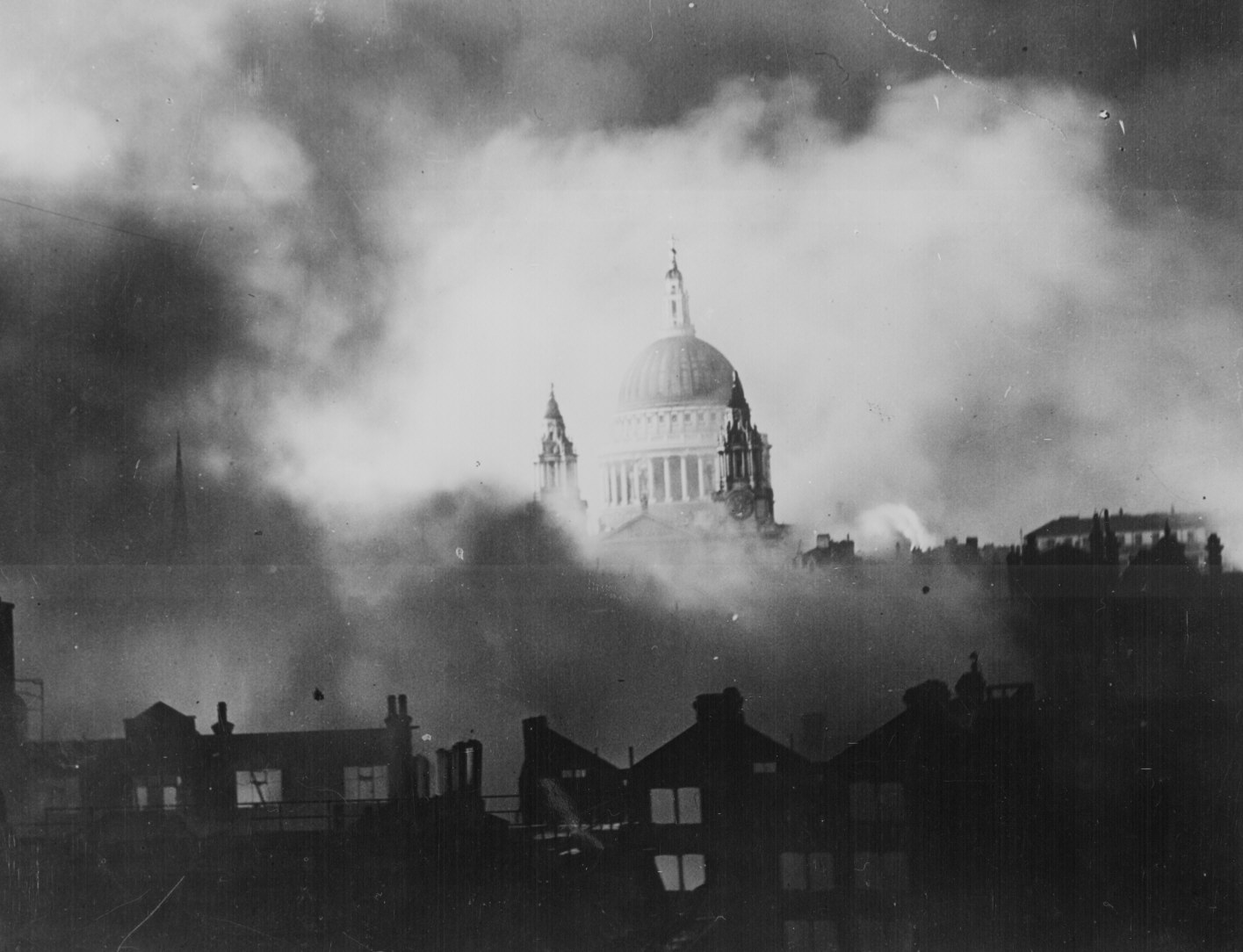
St. Pauls in the Blitz
London and the City periodically suffer disasters and annoyances.
- The Great Fire in 1666
- The Great Stink of the 1850s
- The Blitz of 1940
- The Great Smog of 1952
- The IRA Bombings in Bishopsgate and other London locations.
- The Tube Attacks of 7th July 2005
- The Financial Crisis of 2007-2008
After every one of these, London showed an impressive ability to bounce back from something that was unexpected. You coud argue that after all these events, London recovered to a higher level.
The first two, threw up two of London’s great creators; Christopher Wren and Joseph Bazalgette. Bazalgette was the grandson of a French Protestant immigrant.
Will London throw up another great creator and thinker because of Brexit?
I wouldn’t be surprised!
They might even be like Bazalgette and a descendent of a recent immigrant. London has always benefited from troubles in the rest of the world!
No-one can know what will happen to the City and its financial industry and expertise. A vindictive Europe could put in regulations to try to cut London’s market share.
But I doubt it will have much affect, as London has every expertise you could need, speaks English, is in the right time zone and quite frankly is London, where real and assimilated Londoners duck-and-dive for the best opportunity.
London will undoubtedly change, but is there any reason to suspect, that it won’t do things that make itself more successful and more powerful still?
London was the capital of the world in the Victorian Age and I can see this happening again!
I Will Just Carry On
I feel this morning, just like I did on the 2nd May 1997, which was the day Tony Blair became Prime Minister.
I was slightly apprehensive then as to what is going to happen, as after John Major’s government had fallen, I wondered what a left-wing Government would do to the economy.
But I feel that just as John Major and Kenneth Clarke left Blair an economy that worked, I believe that David Cameron and especially George Osborne have left the country in a state to live with or without the EU.
I was very much for staying in, but since the vote only one large company has expressed regrets as this article in the Daily Post, which is entitled EU Referendum: Airbus assessing impact of ‘disappointing’ Brexit vote, details.
But I am an Englishman and especially a London mongrel, with genes stolen from all the best parts of Europe.
I grew up with stories from my parents and others of the Blitz, in the midst of some of the worst air pollution, any child has ever had to endure.
Since then, I lived through the bombings of the Irish troubles and although I wasn’t in London for the bombings of the 7th July 2005, I know many who were. Perhaps the biggest terrible event, that happened near me was the Moorgate Tube Crash of 1975, which was less than 200 metres from where I lived in the Barbican.
Londoners will do what they always do in times of troubles and that is just carry on! It’s in their genes.
My genes from the Tailor of Bexley, did for a few hours about running, but my solid Devonian genes, told the others to wait and let’s see what happens first.
I said that David Cameron and George Osborne have left the country in a good state for the future.
For years, this country has been too centralised, so giving power to the regions and big cities will become Osborne’s legacy.
If Manchester wants to develop its trams or city centre, or build offices, housing and factories, that should be Manhester’s decision and should not be decided by the dead hand of London.
Scotland’s new bid for independence, is a good thing, and it is a consequence of devolved government.
I can for instance envisage a time in say a hundred years, where London becomes a powerful independent city-state. In the nineteenth century we had several of those; Birmingham, Glasgow, Liverpool, Leeds, London, Manchester and Sheffield.
That model for the UK will return.
If you look at the most powerful country in Europe; Germany already has that model with Berlin, Frankfurt, Hamburg, Munich, the Ruhr cities and Stuttgart dominating.
But look at France! What Paris and the elite want, they impose!
Perhaps the biggest consequence of Brexit, will be a desire for the people of Europe to have more independence from their own Central Government.
A Second Trip To Wemyss Bay
These pictures show my second trip to Wemyss bay station with its ferry terminal.




























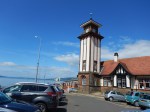

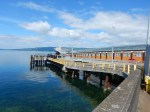














The buildings were designed by the architect; James Miller.
You might ask why this was my second visit to Wemyss Bay. In the 1960s, I caqme up to see Spurs play Glasgow Celtic at Hampden Park in what was a pre-season Glasgow Cup.
I’d arrived early in the morning, after hitching a lift from Gretna in a van that had been delivering newspapers.
So for some reason, I took the brand-new Blue Train to Wemyss Bay station and slept for an hour or so on the beach.
 The Anonymous Widower