The Cider Revolt
The BBC has just had a full hour on the tax on cider.
But perhaps the most extraordinary feature is the number of protests on Facebook in a Group called, “Leave Our Cider Alone”. It has got over 13,000 members in well under a day.
A Tax on Coeliacs
Darling has put the tax on cider up significantly.
It may be alright for those who can drink beer! But I can’t!
The Budget
Today we have the budget.
It is very much a waste of time, as the election is not even around the corner, but here in a few weeks.
But I have a more fundamental problem with budgets. If you run a business, you take financial decisions on a day-to-day basis and not at one fixed point in the year.
So is the system we have rather outdated in a modern world were a crisis can hit you overnight?
I don’t think we want to have budgets every month, but we need to have a system that on the one hand is more responsive to events and on the other takes the variations out of such things as fuel prices.
What would I do?
- I’d tax all energy heavily and use the money saved to take millions out of the tax system. It couldn’t be done overnight, but increased yearly it would have profound and positive effect on everybody’s lives.
- I’d also abolish Vehicle Excise Duty and replace it with a car transfer tax of say £30 or so to make sure all vehicles were very traceable.
- I’d also tax aircraft fuel. It is ridiculous that it is tax-free.
- I’d have a top tax rate of 50%, but anybody you employ for whatever purpose would be allowable against that tax. So if you have an idea, you could perhaps employ a student to do the leg work on it for say six months and then claim that against your tax. Childcare, gardening and all those other things would also be allowed.
- I’d abolish Inheritance Tax. I’ve had letters published in the Financial Times on that one. Two pence on Income Tax would raise the same and rich never pay Inheritance Tax anyway.
- I’d increase the tax on tobacco. Although, I doubt it would raise much money.
- I’d subsidise patents and IPR. The costs at present strangle innovation by individuals.
- But the biggest savings will come from getting rid of projects that no-one actually wants, like aircraft carriers, Joint Strike Fighter, Trident replacement, identity cards, bureacracy, extravagant pensions for civil servants etc. It is a long list!
I’ll add to this as the day goes on.
The aim though is to be tax neutral and perhaps even raise a bit more.
If you take high energy taxes, then this would raise more tax than you think, as there are large numbers of people who don’t pay tax and always seem to have large 4x4s. We’d be taxing the Black Economy which is a lot bigger than anybody thinks.
We should aim to have taxes that you can’t avoid or taxes that by avoiding them you create jobs and commercial activity.
Keep it Small on Zopa
Over the last few months, I’ve been trying to reduce the size of the individual loans I make on Zopa. I now have a limit of forty pounds and the average loan is just above that figure for the over a thousand contracts I have. When I started I had a limit of two hundred pounds and a couple of those loans went into default, which meant I had some bad debts. There was also the problem then of liquidity in that there wasn’t the same number of Zopa borrowers and it was sometimes difficult to lend the money out. Now, if I put say a thousand pounds into the market, it gets lent out within a couple of days. Note that my low limits on each individual loan, do not give Zopa any extra costs, as they only check the borrower once and the other is just data processing.
There also appears to be a big difference in how Zopa checks borrowers. They have said that their checks are more stringent, but they also appear to be much faster. Perhaps, this is because they are now bigger and have more staff, but they must have better systems too!
This leads to an interesting theory. As Zopa and others like them get bigger, then the markets will get much more fluid and responsive. Money will get lent out quickly in loans split into hundreds of small ones. This will mean that larger lenders like me, will have thousands of loans which will spread their risk and thus, they will get a good return.
Do I have any evidence to back this up?
Possibly!
My rate of return over the last year is 5.39% before tax and taking it since October 2008, it is 5.55%. These are not bad returns in these troubled times.
But if I look at my returns over the last six months, the figure is 5.85%. It would appear that my policy of restricting the amount I lend to individual borrowers is having an effect, as I started this policy in the summer of last year.
When looking at loans in arrears, I have less outstanding now than I did a year ago. Partly, this is due to the smaller amounts lend, but mainly this is due to Zopa‘s better systems.
But I am not a hundred percent optimistic. We have an election coming up and who knows what that will bring.
But I certainly feel that if you want a better return on your money, that Zopa and their ilk are a better proposition than something like an Icelandic bank.
Do I have any regrets about Zopa?
Not really! But one of my borrowers died. It just goes to show how that in this world there are much more important things than money. My heart goes out to their family and friends.
Sir Chris Newson
Whoever wrote this obviously got a Z in English language.
Dear
With Due-respect I seek your consent to have a discussion with you. Do you suggest through your email or Phone Conversation??? .
You’re Name and Contact is needed.
Thanks
Sir Chris Newson
Chief Executive Officer ( CEO)
Stanbic IBTC Bank
E-Mial:newsonchris3@naseej.com
Tel: 234-80- 7999-8449
Note the spelling of e-mail and the Nigerian phone number.
The idiot needs certifying. It would be funny, if no-one believed him. But then there is one born every minute.
Money
Everybody likes to stick it to those who get big bonuses and earn high salaries.
In 1985 I sold a company and made a lot of money. A lot of that I spent on ideas, some of which worked and some didn’t. I was also advised by my accountant to invest £9million in an office block in Basingstoke. He took the fees, I took the risk and lost the lot. But then one of the investments he thought was a waste of time, got a lot of it back!
I’ve also rebuilt a couple class houses that were good (and efficient) to live in. Jobs for builders and craftsmen.
Putting it crudely, I’ve spent some of the money much better than the government does. I’ve probably created a few jobs too! Yesterday, it was interesting to see that Victoria Beckham’s new range of clothing is made in London. Good for her!
So don’t knock all those people with big bonuses and high salaries. It would be far worse if we drove them out of the country and they spent their millions elsewhere.
But my wife died in late 2007 from cancer and that has been a lot harder. But it would have been a hell of a lot harder if I had to live on government hand-outs because the tax system meant that I hadn’t been able to save from the good times.
It may be fashionable to bash the rich, but they can afford to leave. I could buy myself a lovely beach house somewhere and fritter my money away on birds and booze. But my pain threshold is high and for me to do that would take a lot of persuasion. I’d miss live football for a start.
Remember as Isaac Newton said in a different context, “Every action has an equal and opposite reaction”. Governments never learn, believing that dogma and prejudice is more important than scientific correctness
HMRC Fraud
There has been talk on the radio this morning and in the papers about various phishing attacks purporting to be tax refunds from HRMC.
Note that HMRC do not do refunds by e-mail, so any e-mails you get from them about refunds are fake and are designed to empty your bank account, after you have given them your bank details.
Here’s one I got earlier.
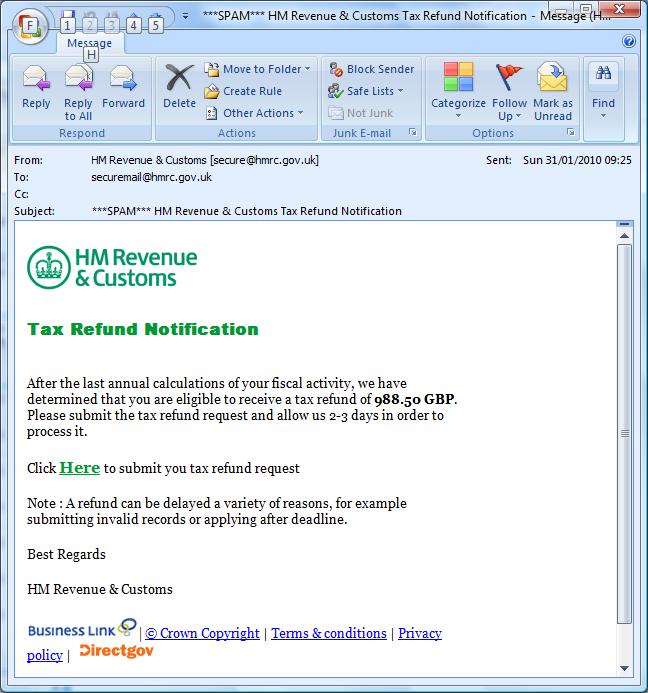
HMRC Spam E-Mail
These points should be noted.
- It is obviously spam, not least because my ISP has actually marked it as possible spam in the header.
- Bear in mind the fact too, that my accountant does my tax return and I think that HMRC don’t know my e-mail address.
- It is a good idea to learn how to read the Message Headers using your e-mail program. I use Outlook and this page in About.com tells you how to do it. In the headers for this e-mail, you can see there are lots of .br’s, which mean that at some point the e-mail has visited Brazil. Not the quickest route to Suffolk from the HMRC.
- They do show that the e-mail came to my standard e-mail address. Which means it wasn’t a genuine e-mail, as I use a special e-mail address for all financial transactions. Always use a different e-mail address for normal communications and financial transactions.
- The To: address in the e-mail is securemail@hmrc.gov.uk. Nearly all companies send important e-mails to the e-mail address you have given them.
- The value of the refund is shown as 988.50 GBP. I’m always suspicious of this, as the £ sign needed to show the value properly is not available on non-UK keyboards. About half of my genuine on line purchases use the £ sign and others use GBP. But phishing attacks nearly always use GBP.
- Click Here to submit you tax refund request. Note you instead of your. I know the HMRC can be stupid at times, but they don’t make spelling mistakes like this, as if they did, they would be a laughing stock in the tabloids.
- There are other grammatical errors and I don’t think the HMRC would use Best Regards.
You should always read these spam e-mails. That way, you will understand more and more what they look like and you won’t get caught out.
Reporting instructions for these sort of e-mails are on the HMRC web site.
Going Down?
The latest in the Portsmouth saga seems to make matters worse. According to the BBC, Peter Storrie and Avram Grant are not happy that players have been sold behind their backs.
I just think that Pompey are now at the end of the road. They face a winding up petition in the Courts on February 10th and I suspect that unless serious money turns up, they will end up in administration at best.
The point that no-one seems to say is that Pompey are favourites to go down and so the owners will lose a lot of money anyway. So would you put any more money into this type of sinking ship? Perhaps if you were a fool with money to burn. But no-one is that stupid are they? I suppose they could be if they bought a football club in the first place!
So it looks like there’ll be an extra place in Division 2 next year.
Will that be AFC Wimbledon? Now there’s a resurrection for you.
Banking Security
I don’t like internet banking. Well to be truthful, I like the concept, but some of the implementations of it are rather poor.
Take my bank. I need to enter my account reference, a password and then three numbers from a key code. I can remember these in most cases, but if I access the account from someone else’s computer, I need to have the account reference written down. But I do write it down in a way that no-one could ascertain.
Although it is a system that works, it is not the best. It is typical of many systems used to login to on-line banking.
I am a mentor on The Horse’s Mouth, which is a web site where people put ideas and others pass comments. It is an interesting concept and from what I read in the press, it is highly regarded.
In the last few days, the web site has put me in touch with a company called SafeTok.
It looks like it could be a solution to better Internet security.
But then I am not an expert in this field. But then I’m a consumer who knows what I don’t like.
Zesty Zopa
This appeared in the Daily Mail under the heading Zesty Zopa.
Who says there is no room for a new kind of banking?
The internet banking site Zopa, where lenders and borrowers decide among themselves at what rate they do business, is gathering momentum and had agreed 12,813 loans worth £63m as of January 1 this year.
It may sound like toy-town banking but it demonstrates how consumers, even bankers themselves, are determined to find ways of circumventing high street lenders.
This is typical of what newspapers, write about Zopa.
Just search Google News for Zopa and see what is written.

