Electrification Project’s Major Milestone Delivered On Time And Under Budget
The title of this post, is the same as this news item from Network Rail.
These four paragraphs give details of the electrification project.
The railway line between Kettering in Northamptonshire and Wigston near Leicester has reached a major milestone by being officially declared ready and safe for electric trains.
The certification for the 23-mile section is a massive achievement in Network Rail’s Midland Main Line Electrification Programme – the biggest programme of improvements to the line since its completion in 1870.
Electrification is a key part of the Government’s net zero carbon target by 2050, while also being quieter for passengers and residents living near the railway.
The Office of Rail and Road (ORR) issued the Authorisation to Place into Service (APiS) for the Kettering to Wigston section, which includes a new substation at Braybrooke, near Market Harborough, to provide extra power and resilience to the network.
This map from Open Railway Map shows the newly electrified section.
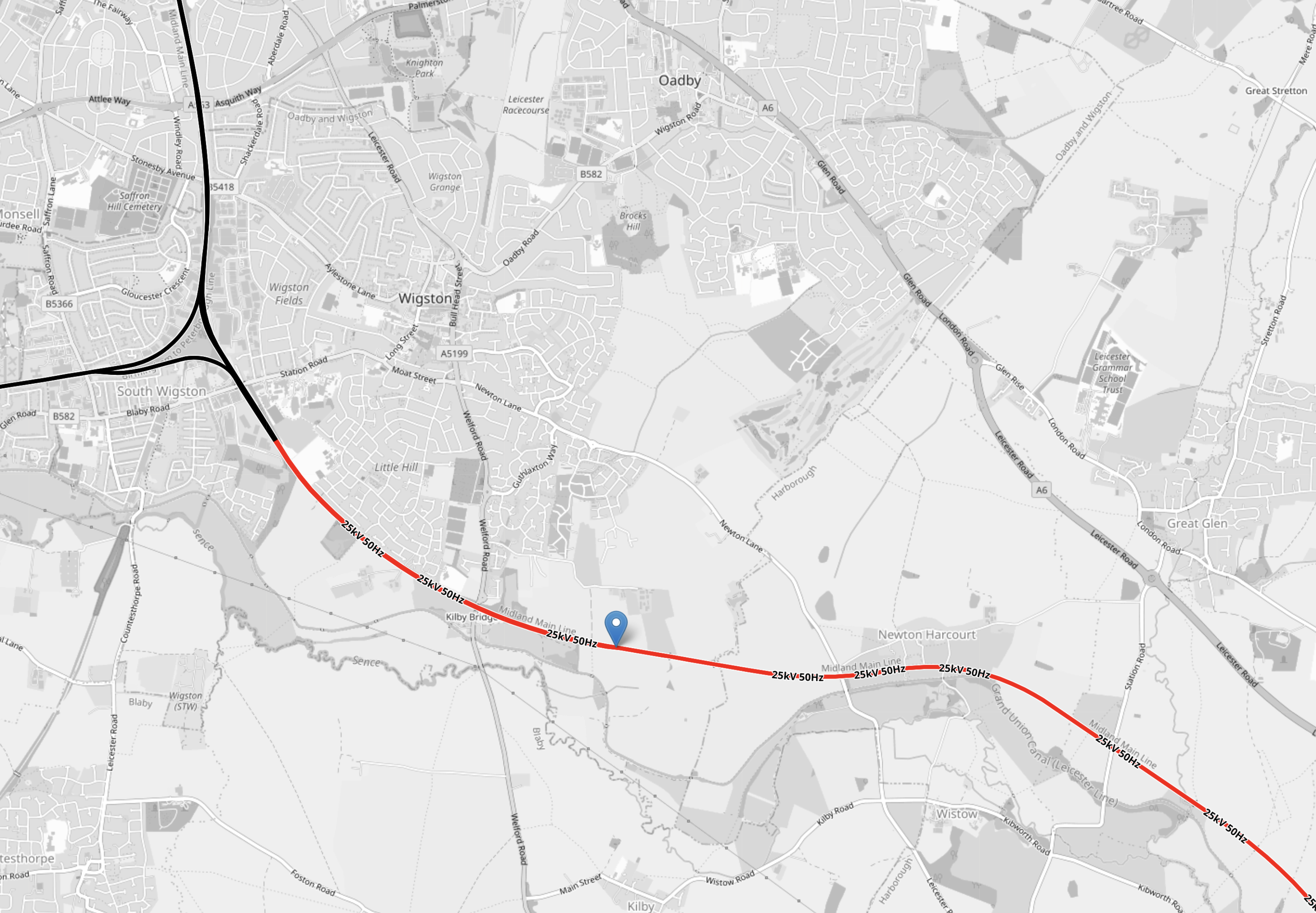
Note.
- Red tracks are electrified and black tracks are not.
- The triangular track in the North-West corner of the map is Wigston junction.
- The track going North from this junction is the Midland Main Line to Leicester, Derby, Nottingham, Sheffield and other destinations served by East Midlands Railway.
- The track going West from this junction goes to Birmingham.
- The track going South from this junction is the Midland Main Line to Kettering and ultimately to London St. Pancras.
- The blue arrow indicates Kilby Bridge junction.
The electrification goes all the way between Wigston junction and London St. Pancras station.
I believe that what electrification has now been erected on the Midland Main Line can support battery-electric trains to the East Midlands Railway’s existing destinations.
Battery-Electric Trains Between St. Pancras And Leicester Stations
Real Time Trains reveal the following about current St. Pancras and Leicester services, that are run by the new Class 810 trains.
- Trains switch between electric and diesel power at Kilby Bridge junction.
- Between Kilby Bridge junction and St. Pancras station, overhead electrication provides train power.
- Between Kilby Bridge junction and Leicester station diesel generators provide train power.
- Kilby Bridge junction and Leicester station are 5.6 miles apart.
This would mean.
- For a one-way journey a battery range of 5.6 miles would be needed.
- For a return journey a battery range of 11.2 miles would be needed.
I suspect charging could be erected if required at Nottingham station.
Battery-Electric Trains Between St. Pancras And Nottingham Stations
Real Time Trains reveal the following about current St. Pancras and Nottingham services, that are run by the new Class 810 trains.
- Trains switch between electric and diesel power at Kilby Bridge junction.
- Between Kilby Bridge junction and St. Pancras station, overhead electrication provides train power.
- Between Kilby Bridge junction and Nottingham station diesel generators provide train power.
- Kilby Bridge junction and Nottingham station are 33.1 miles apart.
This would mean.
- For a one-way journey a battery range of 33.1 miles would be needed.
- For a return journey a battery range of 66.2 miles would be needed.
- Leicester, Loughborough, East Midlands Parkway and Beeston stations would be served on battery power.
I suspect charging could be installed if required at Nottingham station.
Battery-Electric Trains Between St. Pancras And Sheffield Stations
Real Time Trains reveal the following about current St. Pancras and Sheffield services, that are run by the new Class 810 trains.
- Trains switch between electric and diesel power at Kilby Bridge junction.
- Between Kilby Bridge junction and St. Pancras station, overhead electrication provides train power.
- Between Kilby Bridge junction and Sheffield station diesel generators provide train power.
- Kilby Bridge junction and Sheffield station are 71.4 miles apart.
This would mean.
- For a one-way journey a battery range of 71.4 miles would be needed.
- For a return journey a battery range of 142.8 miles would be needed.
- Leicester, Loughborough, East Midlands Parkway, Long Eaton, Derby and Chesterfield stations would be served on battery power.
I suspect charging could be installed if required at Sheffield station.
What Battery Range Would be Needed For Battery-Electric Trains To All Destinations?
Consider.
- I will assume that trains will change between power sources, as they do now at Kilby Bridge junction.
- Leicester is only a few miles from Kilby Bridge junction.
- Sheffield is the largest distance from Kilby Bridge junction at 71.4 miles.
- A return trip to Nottingham from Kilby Bridge junction at 66.2 miles is less than a one-way trip to Sheffield.
- It would appear that so long as the battery-electric trains have a battery range of greater than 71.4 miles, Battery-electric trains could cover all destinations.
I would expect a battery range of between 80 and 90 miles would be ideal, as it would give a sensible reserve.
In addition, charging would be needed at Sheffield.
Charging At Sheffield Station
This OpenRailwayMap shows Platform 8 at Sheffield station.

Note.
The pink tracks are the Sheffield Supertram, that runs on the East side of the station.
The black tracks are those in the platforms of Sheffield station.
The Easternmost platform in the station is Platform 8, which is 368 metres long.
Platform 8 could hold two five-car Class 810 trains.
I wonder if Platform 8 were to be electrified, it could charge trains before they returned to London.
Conclusion
It does appear, that the Midland Main Line was designed for battery-electric operation.
No comments yet.


Leave a Reply