Born 1967, Still Going Strong
I took this picture of the door plate on a Victoria Line train yesterday.
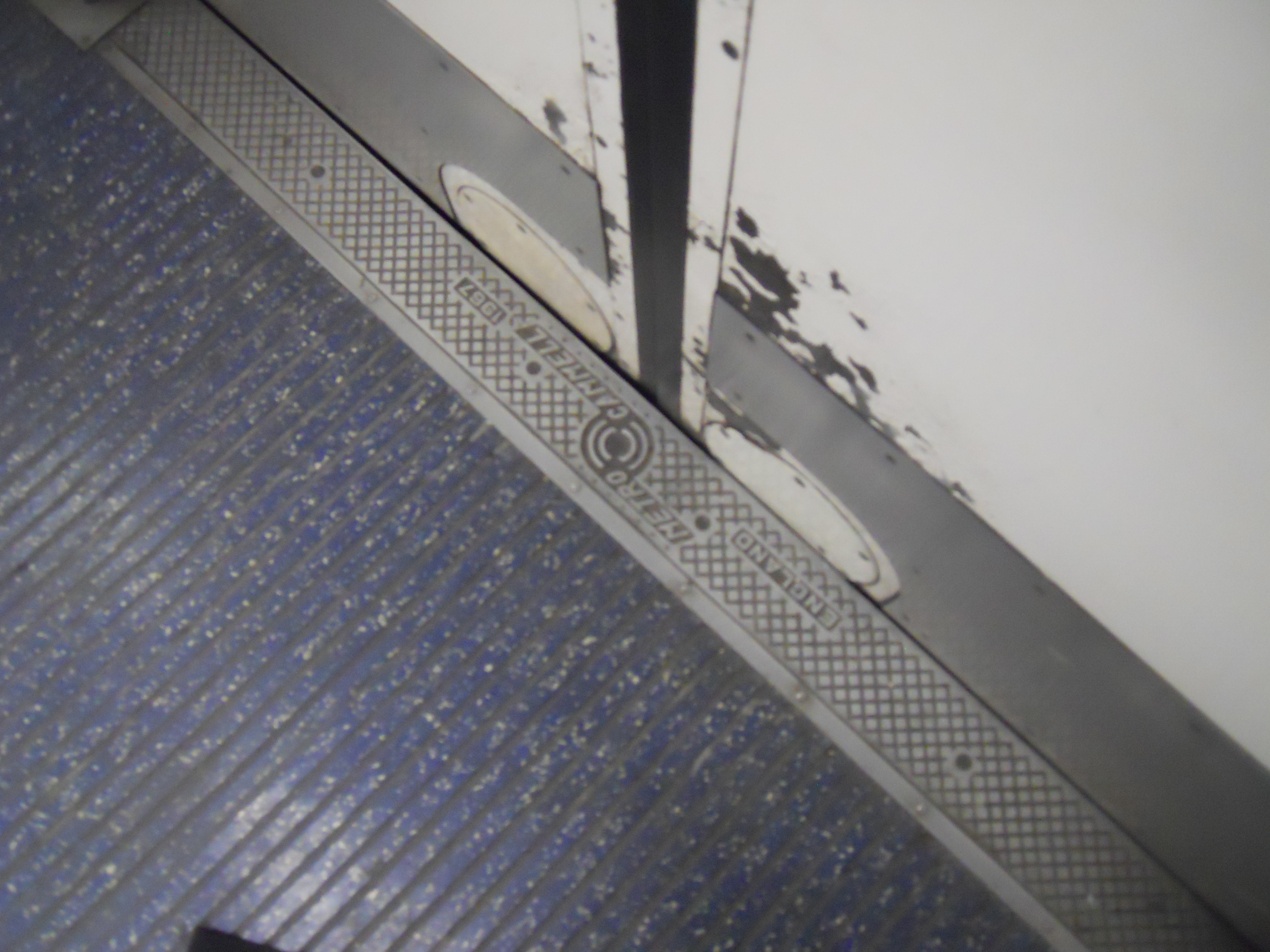
Victoria Line Train Door Plate
Note the date of 1967, which says that the train was built in that year.
Or it was originally intended to, although the plate on the other side of the carriage said 1972. In fact, on the train I took from King’s Cross to Highbury and Islington, there was a mixture of 1967s and 1972s. I doubt it matters, but I do like to see the age of my train!
It is rather sad, but all new trains now seem to be undated.
The Train that Won’t Go Quietly!
There are very few engineering projects in the world, that last a long time, as the technology gets replaced. To me some of the best in the UK are :-
The New River – Built in 1613 to supply London with fresh water, It is still used in part for that purpose nearly four centuries later. Will there be a celebration in 2013?
The Thames Embankments and Bazalgette‘s Sewers in London – These transformed the city and also laid down the basic quality control standards for large construction projects. I seem to remember reading that only one person died in the construction of the sewers, which was a major achievement for the ninteenth century.
The Forth Bridge – Probably the best known bridge in the world. Opened in 1890, it still carries nearly 200 trains a day.
The Thames Tunnel – The first tunnel under a navigable river, that now carries the East London Line under the Thames.
St. Pancras Station – The head of SNCF described it as the finest station in the world. I’ll agree with him. It was originally opened in 1868 and a lot of the original design is still intact.
Welwyn Viaduct – An extraordinary structure in Hertfordshire, that still carries the East Coast Main Line over 150 years after it was built.
We may have structures that last for years but actual vehicles that last more than a four decades or so are rare indeed.
The Mersey Ferries have been around for centuries, but the current three boats are all over fifty years old. I remember them with affection from my days at Liverpool University in the mid-1960s.
The London Routemaster bus was launched in 1956 and although most were replaced by 2005, their are still two heritage routes in central London. I rode on one in September.
The Victoria Line in London has two distinctions. It is the oldest fully-automated railway in the world and it still has some trains dating from 1967. I have travelled on some quite recently and they are still in good condition. at 43 years old.
And then there is the Inter-City 125 or High Speed Train. It may not be as venerable as the other three examples, but then they don’t travel at 200 km/hr or 125 mph over routes that measure hundreds rather than tens of miles. It was also designed as a stop-gap design after the failure of British Railways to get the tilting APT to work.
Now over thirty five years since the trains were introduced, they are being refurbished, re-engined and are still in front-line service all over the country.
On my trip north from Edinburgh to Inverness in the cab of HST, 43313, talked about some of the problems with the trains and added to my knowledge.
The old rather smoky diesel engines have now been replaced in many power cars with modern units.
The rather draughty and noisy doors in the cab have now been replaced to make the working environment second-to-none.
But the slam doors of the Mark 3 coaches with their rather quaint traditional windows are a worry.
But that is now being addressed by sound engineering according to Modern Railways.
Who’s to say when we’ll see the last of the HSTs. I wouldn’t be surprised if some are still running in 2030 or even 2040, as they are classic Darwinian train, that evolves to beat every attempt to kill it off.
In the same magazine, it was also announced that one of the HSTs had run from Plymouth to Paddington non-stop in just two hours forty minutes. That is an average speed of 84.375 mph. London to Paris by Eurostar is 307 miles and takes two hours fifteen minutes at an average speed of 136.444 mph.
So Eurostar is quicker, but it runs on a line virtually without curves and it isn’t thirty five years old.
As Modern Railways said, the Plymouth to Paddington run wasn’t bad for a thirty-five year old, British Rail-era diesel train dismissed as obselete by Labour transport ministers almost a decade ago!
I could talk about pots and kettles, but in a way isn’t the HST a superb two-fingered salute to the bunch of NuLabor morons, who almost bankrupted this country, by their idiotic policies?
The Part-Time Electric Train
Nearly all diesel trains are not pure diesel, where a large engine drives the wheels mechanically, but mostly diesel electric, where the diesel engine generates electricity and this is then used to drive electric traction motors that actually power the train. This may seem a bit complicated, but it isn’t really any less so than the transmission of a hybrid car, such as a Toyota Prius. It does have advantages though in terms of efficiency, acceleration and reliability.
When I went to Sheffield, I travelled in a train called a Class 222 or Meridian. These are diesel-electric multiple units with one diesel engine, one generator and two traction motors in each coach, which are capable of 200 km/hr.
I found the train comfortable, but some have criticised them because of the vibration caused by the diesel engine underneath the coach floor.
It is often said that the best ideas come in the hardest of times and Modern Railways this month had a long comment about converting these trains and the similar Voyagers to a bi-mode diesel-eletric/electric operation.
As on the southern part of their route north from St. Pancras to Sheffield and Nottingham, they run under the wires of the surburban electrics until Bedford, why not add an extra coach with a pantograph and the associated electrical equipment to each train. This would bring a much-needed increase in capacity, but with several other advantages.
- As the train would be electrically powered at the southern end, there would be an increase in efficiency and a decrease in costs and direct carbon emissions.
- There would be considerable savings in the cost of maintaining the diesel engines as these have to be replaced regularly.
- There would be a certain amount of decrease in noise and vibration.
- As to passengers and most staff, they would just be a train that was one carriage longer, there would not be the same familiarisation process and working in, that usually accompanies any new rolling stock.
But the biggest advantage would come, if it was decided that London to Nottingham and Sheffield were to be electrified. As each new section of electric line is added, the trains could immediately use the new line, thus saving more in costs.
Ultimately, when the eletrification was to be complete, you would prefer to switch totally to either new or cascaded electric trains. But you actually have flexibility in when they are built and enter service, as they don’t have to be immediately ready, when electification is completed, but at the time that is optimum with respect to cost, passenger numbers and having a new use for the lengthened and modified Meridians.
So what might seem a crazy idea has a lot of things going for it!
If we do electrify substantial parts of the rail network, these bi-mode trains would not be short-term white elephants after being replaced by electric trains on the London to Sheffield route, as a similar progressive electrification could be applied on the services out of Paddington to Bristol, Cardiff and Swansea, as it has been stated that electrification on this route will be applied in stages. Electrification is also starting between Liverpool, Manchester, Preston and Blackpool, so perhaps Trans-Pennine is another route, especially as at the eastern end it uses the East Coast Main Line.
It also has to be born in mind, that these trains would obviously be modified in the UK, so would create and sustain much-needed jobs.
There has been talk of replacing the HST with a bi-mode train, but the economics of that are very questionable, as that would be complete new trains, whereas the bi-mode Meridian/Voyager is a clever stop-gap. that makes electrification much more affordable.
Even after the electrification is substantially complete, the bi-mode trains would have substantial use on routes, which are effectively branches off the main electrified network, such as Bristol-Penzance, Doncaster-Hull, Peterborough-Ipswich, Edinburgh-Aberdeen, Edinburgh-Inverness, Ely-Norwich etc., where extra capacity is much needed.
They could also be used to effectively prove if a route would benefit from modern trains or a frequent service, by running the trains in diesel mode only.
Why Not Share Taxis?
With a few notable exceptions, I’m not a lover of taxis. If I get a taxi from Cambridge to where I live I’ve been charged nearly £50. But how many times has someone else been doing a similar journey and a share would have been much better?
So I was pleased to see that at Milton Keynes a company call TaxiShareUK is starting such a service.
I hope it works!
It’s Grim Up North!
I am a soft Southerner and a proud Londoner to boot, with the tough genes of a true mongrel. But especially after today’s weather reports from Jockshire, no sane man or woman would want to live north of Cambridge. I might make an exception for Liverpool, as I like my culture to have an edge.
The Oldest Mosque in Australia
In Adelaide, C and I visited the mosque and the associated museum to the Afghan camel drivers, who opened up the middle of the country in the nineteenth century. I have talked to Australians about this part of their history and few actually know of the story. It’s here in an article in the Guardian, which offers advice to those visiting for the cricket.
Australia’s oldest mosque (1888) was built in a back street for Afghan camel drivers employed in the South Australian desert. A simple stone affair with whitewashed brick minarets, it now serves city workers and a new wave of Afghani refugees. You can enter (avoid prayer times) but the wood-lined interior makeover now bears unfortunate resemblance to a Swedish sauna. The camels’ descendants have gone feral but their pure bloodline means they are in demand back in the Middle East. Those not exported can end up as camel pastrami at Wild Oz in the Central Market (wildoz.com.au), which also deals in wild goat, wild boar and, of course, Skippy.
In fact the Afghans, were a mix of people from all over those places where camels are a beast of burden, and as soon as they had done their work, they left, leaving behind the camels, wich quickly went feral. At least the Australians have seen fit to call the train that links Adelaide to Alice Springs and Darwin, The Ghan.
One of my regrets is that when I flew round Australia with C, we only allowed four weeks for the trip. We should have allowed a lot more time. But then C was a typical barrister, who believed that if you were away too long, your colleagues would nick your best cases. We did fly along the southern part of the route of The Ghan from Adelaide to Alice Springs, with stops at Coober Pedy and Yulara. One day I’ll put all of the Australian photos on the web, but sadly, many are missing and I don’t have the negatives any more.
It’s Raining in Adelaide
C and I liked Adelaide, when we went there in the 1980s. But it didn’t rain. In fact in the whole three weeks we were in Australia we never saw any rain at all. This was unusual, as we usually had rain on holiday, just like Queen Liz does!
Adelaide is a unique Australian city in that it was planned by Colonel William Light to be a city with wide streets and lots of green spaces. It is also surrounded by a large area of parkland and has proved to be one of the best laid-out cities in the whole world. There is a statue to his memory called Light’s Vision overlooking the city with this inscription.
The reasons that led me to fix Adelaide where it is I do not expect to be generally understood or calmly judged of at present. My enemies however, by disputing their validity in every particular, have done me the good service of fixing the whole of the responsibility upon me. I am perfectly willing to bear it, and I leave it to posterity and not to them, to decide whether I am entitled to praise or to blame.
Light and his father, Francis, are two of those characters in history, to whom I am drawn. C and I came across the father first in Penang and realised that the founder of the settlement, had been born in Dallinghoo, which was the next village to Debach, where we lived at the time. So the father of the designer of Adelaide was a Suffolk man. In fact, he was the illegimate son of a woman in the village, who was taken under the wing of the local landowner. He certainly was a well-educated and successful man as this extract from Wikipedia shows.
From 1765, he worked as a private country trader. For about ten years he had his headquarters in Salang, Thailand, near Phuket, reviving a failed French trading post. While living there he learned to speak and write several languages, including Malay and Siamese. In 1785, he warned the Thais on Phuket Island of an imminent Burmese attack. Light’s warning enabled the islanders to prepare for Phuket’s defence and subsequently repel the Burmese invasion. For the British East India Company, he leased the island of Penang from the Sultan of Kedah, where many others had failed, and was supposedly given the Princess of Kedah as a reward (other sources state that the Princess was sent to covet Light’s aid on behalf of the Sultan). The multicultural colony of Penang became extraordinarily successful from its inception and Light served as the Superintendent of the colony until his death.
They were an amazing father and son, who from humble beginning made a real positive contribution to the world. We get massive tomes written about obscure and useless politicians, but where is the dual biography of Francis and William Light? A book was written in 1901 and it’s here in PDF.
Let’s hope the rain eases up enough for the Aussies to take their deserved beating!
Travels in the Snow
I had to go to London today, to see the man, who is decorating my new house and make sure everything was OK.
I was dropped at Whittlesford and the trains were running very much to time. As a fallback, I checked that the new Holiday Inn at the station was open, so if I needed to wait for my taxi, then I could do it with a coffee in the warm. It was, so that was probably an omen that I wouldn’t need it.
I didn’t take my normal route to Highbury and Islington from Tottenham Hale, but instead took a bus from Seven Sisters through Stamford Hill and Stoke Newington to the Essex Road. It worked and I had a much shorter walk than I normally do.
Everything was going well, so because of the weather I checked on a few things and walked to Carluccio’s in Upper Street for some lunch. After an excellent risotto, I walked to Highbury and Islington to get back to Totteham Hale.
I won’t say my troubles started there, as compared to many others, I didn’t suffer much. The Cambridge trains weren’t running, so it was suggested by staff that I go to King’s Cross and get a train from there.
Now the company that goes out of Kings Cross is First Capital Connect, which is a different one to that out of Liverpool Street. So I was worried that my ticket might not be valid!
By 16:30, I was in Cambridge, only to find that there were no trains to Newmarket, so I took the bus to the main Cambridge bus station, intending to get a bus to ether Newmarket or Haverhill. It actually doesn’t matter which as there are good taxis home from either, but the ones from Haverhill are slightly cheaper, as the town is closer. There was a large crowd waiting for the Newmarket buses, so as one was just leaving for Haverhill I took it. Unfortunately, it was a slow one, so I had an extensive tour of the many estates that surround the town before I got a taxi home.
If there is anything positive about today, it is that public transport must be flexible and that tickets must be interchangeable, if one service fails. Except for the taxi, which I would have had to pay for, wherever I returned home from, everything was covered by my day retiurn and Travelcard from Whittlesford or my bus pass.
Except for my walk too, everything was clean and warm and as I sat upstairs in the front of the bus from Cambridge to Haverhill, I was able to complete the Sudoku from the Times.
The one thing though that would have improved my journey would have been the unopened Cambridge busway, which surely will make getting from Cambridge station to the city centre aot easier. Or it might do in the future, if has been designed properly. And on that subject, shouldn’t the busway and the trains interface properly with buses that go to inaccessible towns like Haverhill?
Incidentally, it appears that the trains from Tottenham Hale are now running to time, so perhaps my diversion to King’s Cross was unnecessary.
It also seems that the overhead electric trains to the north of London are much more reliable than those to the south using a third rail for power. My engineering knowledge would suggest that overhead electric trains perform better in snowy weather, but I’m happy to be corrected. If this is true, it is rather strange that some railways south of the Thames were electrified using overhead cables, which were then changed for thrd rail. But the history of railway electrification in the UK is as complex as you can get, with innumerable systems, changes of policy and objectives. Read a simple history in Wikipedia.
The Cost of the Cambridge Busway Climbs Again!
It now looks that the cost of the infamous Cambridge guided busway is climbing again according to this article. Possibly to as much as £181million. That looks like a 56% overspend, by my simple accounting methods, but I know politicians use other methods, that spin things in a better light.
 The Anonymous Widower