An Illustration Of East Anglia’s Rail Problems
This article in Rail Magazine is entitled More capacity for Anglia with second locomotive hauled set.
It describes how Abellio Greater Anglia is hiring in two Class 68 locomotives and a rake of three Mark 2 coaches, to maintain services after one of its Class 170 diesel multiple units, was badly damaged in a crash with a tractor at a level crossing in April. There are more details of this in this story on ITV, which is entitled Train carrying 135 passengers crashes at level crossing.
The hiring in of two-brand new locomotives can’t be a very affordable option, but it just illustrates that there is no spare stock available. If say a major bus company needs extra capacity for a big event, contingency plans probably mean a fleet is rustled up from somewhere.
So why isn’t there a pool of say refurbished diesel multiple units available? Most old diesel multiple units are probably only fit for scrap, when they are retired and I doubt any Government since railway nationialisation in 1948, would have allowed train companioes to have a central pool for emergencies.
But the real cause of this particular problem, is the old East Anglian one of level crossings. And a lot of those in East Anglia have trains passing at over 75 mph.
Intriguingly, in The New Trains Arriving In East Anglia, if I got it right that the Breckland Line between Cambridge and Norwich is going to run four- or even eight-car 100 mph electric trains with an IPEMU capability, then something must be done about these level crossings. The infrastructure has already been updated with new signalling and track improvements, but obviously this private level crossing was still being used.
The New Trains Arriving In East Anglia
This article in the Derby Telegraph is entitled Derby workers on tenterhooks over contract worth BILLIONS. (Note the newspaper’s capitals!)
It states that the new East Anglian Franchise could be announced tomorrow, as it is supposed to be settled in June, and that the order for new trains is between Bombardier and Siemens.
I can’t believe that given the current Euro-turmoil in the country, that Siemens will be given this order.
I think that we can assume that based on London Overgroun’s contract for Class 710 trains, where this is said.
In July 2015 TfL announced that it had placed a £260m order for 45 4-car Bombardier Aventra EMUs
That a new four-car Aventra train will cost around £6million. I would suspect that Siemens Desiro City would probably be around the same price.
So for a billion pounds, you would get around a hundred and thirty trains.
As I said in Could Class 387 Trains Do Norwich In Ninety And Ipswich In Sixty?, one twelve-car Class 387 train, could fulfil the franchise requirement of two fast trains a day on the Great Eastern Main Line in both directions. It might even be possible to deliver it, early in 2017, now that it appears production of Class 387 trains might be able to continue.
The Derby Telegragh article talks about Aventra trains, but unlike Class 387 trains, these would not be available until probably 2019, at the earliest.
But Aventras for the flagship London-Ipswich-Norwich route could be delivered with all or part of this specification.
- Up to twelve-cars.
- Walk-through capability. Thameslink’s Bedford to Brighton serrvice will be like this, so why not?
- A specially-design business- and commuter-friendly interior.
- 125 mph capability to give all services Norwich in Ninety and Ipswich in Sixty.
- A buffet car could be provided.
- An IPEMU capability, so a direct Yarmouth service could be introduced.
Some might mourn the passing of the much-loved and well-used Mark 3 coaches, but the Great Eastern Main Line would have one of the best commuting trains in Europe.
I estimate that six sets would be needed to provide two trains per hour in 90 minutes between Norwich and London.
Currently, they have sixteen sets with eight coaches.
If the trains had an IPEMU-capability, which is possible, but of course hasn’t been announced, these trains could also work Norwich to London via the Breckland Line and the West Anglia Main Line, serving Thetford, Ely, the new Cambridge North, Cambridge and Tottenham Hale. Currently, this route would take just under three hours with a change at Cambridge. What time a 125 mph electric train could manage, is pure speculation, but a time of two and a half is probably possible, with some track improvements on the route.
So could we see the current hourly, Norwich to Cambridge service on this route, serving Cambridge North and extended to London? It would give advantages to passengers, the operator and Network Rail.
- The improved connectivity between Cambridge and Norwich would spread the benefits of the Fenland Powerhouse to Norwich and Norfolk.
- Norfolk would get a third direct route to the capital, after the Great Eastern Main Line and the Fen Line.
- Norwich services would have a same platform interchange to Thameslink at one or possibly both Cambridge stations.
- One of the Northern bay platforms at Cambridge would be used more efficiently, as most Norwich services would be through trains.
- The trains could be identical or very similar to those serving the Great Eastern Main Line.
- The route would be available as a diversionary route between Norwich and London, should the |Great Eastern Main Line be closed.
- There would be no major electrification needed.
To provide an hourly service, I think that three trains will be needed.
The Great Eastern Main Line to Ipswich and the western route to Ely, have platforms long enough for twelve-car trains. North from Ipswich, they can certainly take ten-car trains, as that is the effective length of the current stock.
So will the stock be eight- or twelve-car trains? It could be either, with perhaps some platform lengthening on the western route.
The minimum number of trains would be six for the Great Eastern Main Line and three for the western route. It would probably be prudent to call it ten trains.
I think adding in a bit extra for 125 mph and IPEMU-capabilities and a custom interior, that prices could be of the order of.
- £20million for an eight-car train or £200million for ten.
- £30million for a twelve-car train or £300million for ten.
That’s not billions!
Shorter units of perhaps four-car or eight-car formations with an IPEMU-capability, could run the following routes.
- Ipswich to Cambridge
- Ipswich to Ely and Peterborough.
- Ipswich to Lowestoft, if some form of charging could be provided at Lowestoft.
Four trains of eight-cars for these Ipswich-based routes, would be another £80million.
Still not billions!
This leads me to the conclusion, that a large number of other electric trains in the franchise will be replaced.
- I believe for Norwich in Ninety, all trains north of Colchester need to have a 110 mph-capability or better.
- Some trains are very tired, dated and lack capacity.
- Some could have an IPEMU-capability for working the branch lines that don’t have electrification.
In the present franchise there are the following trains working the Great Eastern Main Line and the West Anglia Main Line
All are of four cars.
If all except the nearly-new Class 379 trains, were replaced with Aventras, that would cost about £950million including the IPEMUs for the branch lines.
I think that if they can develop a sensible way of charging trains at Lowestoft, Sherringham and Yarmouth, this would give the following advantages.
- Every train would be a new or nearly-new electric multiple unit.
- Some trains would have an IPEMU capability to handle lines without electrification.
- Every train would be able to use regenerative braking to save energy.
- There would be a large increase in capacity.
- Most services would be faster and not just Norwich and Ipswich to London.
- New trains into Southend to compete with c2c.
- Trains would be available to serve the new Cambridge North station.
- A possible London to Lowestoft service could be run.
- .Services between Cambridge, Ipswich, Norwich and Peterborough could be increased.
- March to Wisbech could be added to the network.
- Diversionary routes from Ipswich, Norwich and Peterborough to London have been created.
- No new electrification of a substantial nature.
- Some quality diesel trains would be released to other operators.
As I indicated earlier, if it was decided to fulfil the requirements of Norwich in Ninety and Ipswich in Sixty, early in the franchise, this could be done with some Class 387 trains.
If this happens, it will be a substantial improvement on the current service.
East Anglia will have been totally-electrified for passenger services, with all the electrification being done in a new, modern factory in Derby.
I don’t know what will happen, but unless something like this does, I can’t see how Bombardier will get the order for billions of pounds of new trains, as reported in the Derby Telegraph.
Engineering is the science of the possible!
Improving London’s Buses
I travel on buses in London a lot and I believe that a few things can be done to make them easier to use and hopefully faster.
1. Allow Central Entry On Buses
New Routemasters allow this and it is a success.
I don’t konw if Routemasters have more fare evasion, than other buses, where you have to pass the driver, but I suspect evasion is not much higher.
Allowing central entry, by placing a reader in the lobby, would undoubtedly speed up buses, as loading would be quicker.
So it would be like providing extra buses on a route.
It would also be easy to test and see what the effects are. A route would just be fitted with extra readers and the before and after revenue would be compared.
2. All New Buses Should Have Flat Floors
New Routemasters have flat floors, which should be standard for all new buses.
3. Put The Bus Stop Number In The Shelter
This would help use the Countdown system to find out when the next bus is coming, especially in wet weather.
4. Put The Bus Stop Number In The Stop Display On The Bus
In common with many bus users, I often take two buses to my ultimate destination, changing at a stop en route, that is common to both routes.
As an example from Kings Cross to my house, I regularly take a 73 or 476 to the Angel, where I pick up a 38 or 56.
If I knew a 38 wasn’t on the way before I got to the stop at the Angel, I might decide to do some shopping or have a coffee before continuing.
5. Better Bus Information On Train And Tube Platforms
When you arrive at an unfamiliar station and know that you’ve got to take a bus to your ultimate destination, it would help if there was bus information on the train or tube platform.
For a start the standard bus and walking map, should be placed on all placed on all platforms, but I suspect there is better information that could be provided.
6. Bus Information At Non-TfL Stations
Stations run by companies other than TfL, work on the principle that if you don’t know the buses around the station, you’re an idiot.
All stations, on the London Bus and Tube map must provide London-standard information for bus users.
7. Legible London Liths And Signs Should Be Outside All Stations
At present this is not universal It should be!
8. The Bus Stop Text System Should Recognise Post Codes
Suppose you’re in an unfamiliar part of London and want to get home.
You would just text the bus stop number and your post code to 87287. and a route would be returned.
Note enough use, is made of this system.
Perhaps the stop number plus “tube” would direct you to the easiest tub station.
9. All Bus Stops Should Have A Decent Mobile Phone Signal
I was always told as a child, that if I was lost in Central London to find a tube station, where there would be help.
Now as most people carry mobile phones, why not make sure that all bus stops have a decent signal, so that they can make contact with someone, who could help.
Perhaps useful numbers should be displayed. Samaritans? Local Social Services?
10. No Smoking At Bus Stops
Why not?
Bermondsey Dive-Under – 27th June 2016
In A First Ride On A Class 700 Train, I went past the Bermondsey Dive-Under.
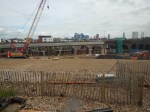
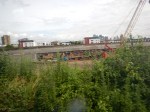
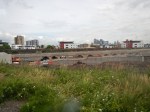
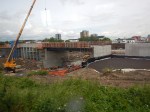
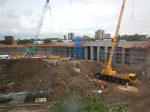

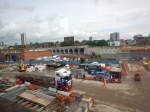
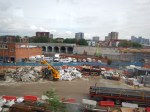
Progress seems to be continuing.I just wonder what is going to be built between the dive-under and the line on which my train was running.
I’m sure Network Rail have got viable plans.
Who Nicked The Display?
There used to be a Next Bus Display on this stop at the Angel.
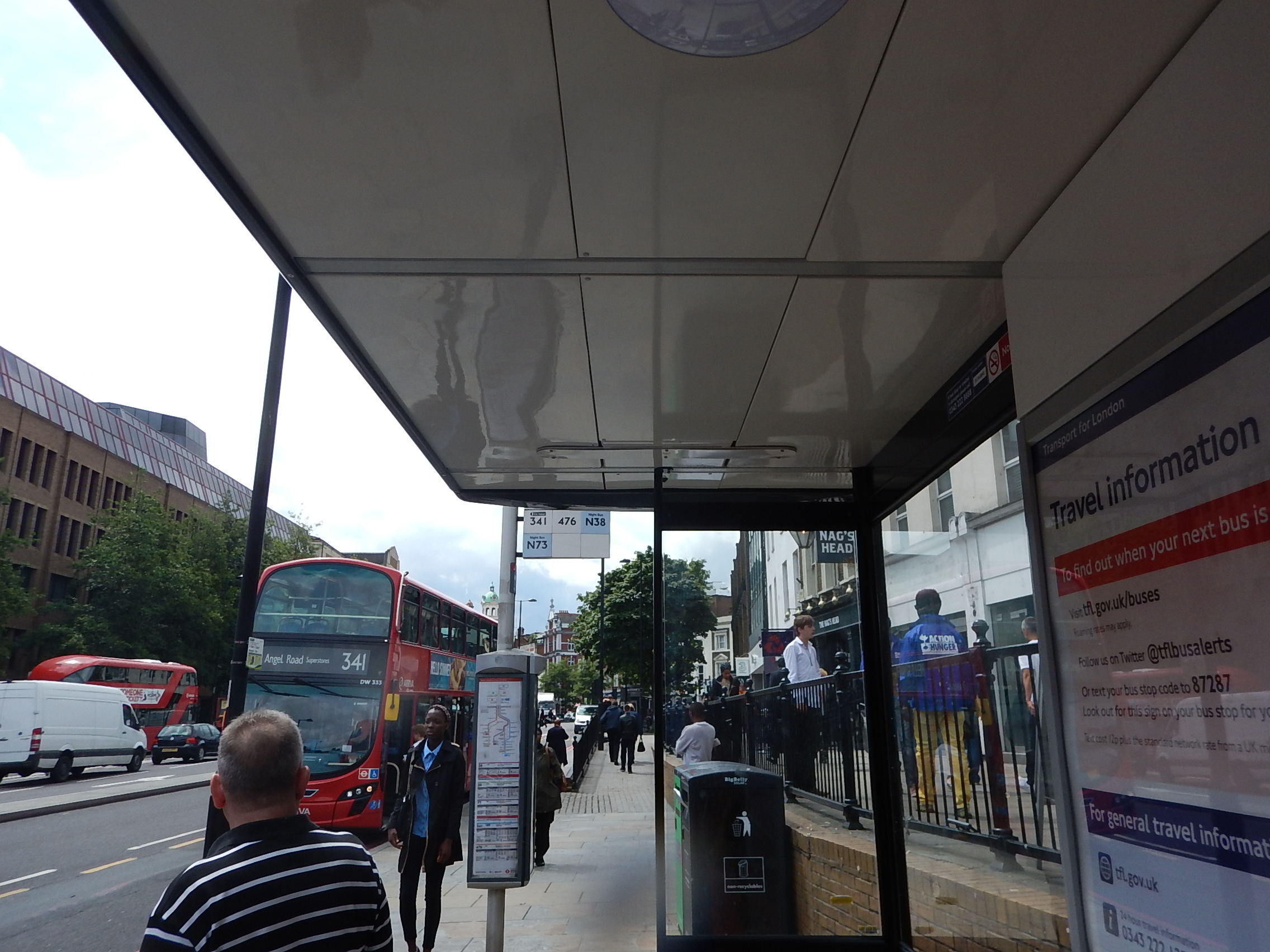
Who Nicked The Display?
Why was it removed?
It is such a pain, as like many others, I’m often returning from shopping to Dalston without a spare hand to text the stop on my mobile phone.
I assume it will be replaced.
A First Ride In A Class 700 Train
Today, I caught the 10:48 between East Croydon and London Bridge stations,. I took that train as this service was mentioned as the first one to be served by a new Class 700 train, in this article on Global Rail News.
As the pictures show it was one of the new twelve-car Siemens trains.
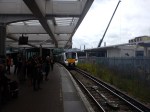

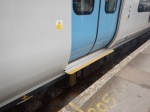
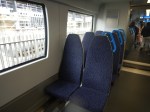
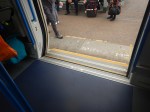

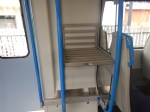
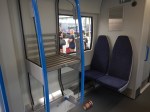
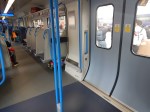
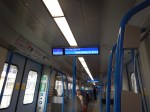

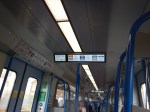
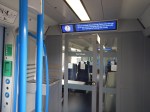
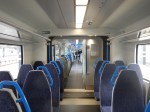


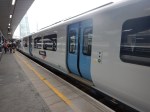
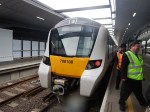
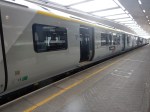
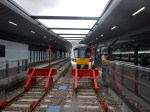
If I would give it a complement it would be competent, as most new trains seem to be these days.
The design features I like include.
- The spacious lobbies.
- The walk-through train.
- 2 x 2 seating.
- The comprehensive information system.
- The extra luggage racks, in addition to the usual racks above the seats.
- The simple colour scheme.
- The trains would work with platform-edge doors.
- Putting First Class at both ends of the train.
Passengers might complain about the following.
- The lack of audible messages. – I liked the quiet, but I’m not blind.
- The lack of tables in Standard Class compared with say the Class 387 trains, that currently work the line.
- The length of the train at 242.6m., if they get in the wrong carriage.
- The high step up into the train.
The last one is possibly to be compatible with other trains and is being addressed at East Croydon station, by raising the platforms. I didn’t go to Gatwick, but imagine large numbers of heavy cases being loaded and unloaded.
It will certainly be interesting to compare the Class 700 train, with Crossrail’s new Class 345 train, that is being built by Bombardier and could be testing later this year, with introduction in May 2017.
The length of the Class 700 and Class 345 trains at 242.6 and 200 metres respectively will certainly fuel the old chestnut about whether double-deck trains would have been better.
As I found with my short trip on a Class 700 train, walking from the back to the front could be a challenge for some. But commuters will develop strategies to make the journey easier.
So some may argue that double deck-trains might be easier on passengers.
But Thameslink and Crossrail have not been built for double-deck trains and certainly the older tunnels couldn’t accommodate them, without complete closure for a couple of years, so they could be rebored.
Both lines serve airports and stations, where passengers are likely to be bringing heavy baggage. This makes loading especially difficult on a double-deck train and delays the service.
Both trains have been designed with large lobbies and the Class 345 trains have three sets of doors on either side of each carriage. But they’ll need this space and doors as the longest trains carry upwards of 1,500 passengers.
These two fleets of massive trains will certainly change London. But I see problems in some areas, that must be addressed on Thameslink.
Stations
To realise the full potential of the Class 700 trains on Thameslink, some stations may need improvements.
Brighton could make for a lot of walking up and down the platform. Travelators?
I also think that Brighton needs a high-capacity East-West transport system to cope with the large number of passengers. Could the East Coastway and West Coastway Lines be connected together by a tunnel or a bridge over the station, which incorporated two connecting platforms?
East Croydon needs more improvements.
A dedicated island platform for Thameslink, as Crossrail has at Whitechapel, would knit all the branches together, so that journeys between any two branches were made easier and station footfall was reduced?
Gatwick is getting improvements, with a new concourse..
St. Pancras only has one big entrance in the middle. Does it need an extra Southern entrance? Or will passengers use stations like Farringdon, Finsbury Park and London Bridge to avoid the badly-designed station.
I certainly will avoid joining Thameslink at St. Pancras like the plague.
Step-Free And Disabled Access
The stations may be step-free, but the train-platform interface is not. However this is said in this document on the Thsmeslink Programme web site.
Platform humps at central London stations will provide level access for swift boarding by wheelchairs and people with buggies or heavy luggage – meaning no more ramps at the busiest central London stations.
I would assume humps would also be provided at stations like Gatwick and Brighton, if it were to be found they were needed.
I suspect, that in the end, humps will be provided at all stations served by Thameslink, as it will ease the logistics of running the system.
Platform Edge Doors
I don’t like platform edge doors as a passenger, but as an engineer, they make loading and unloading trains more efficient.
The Central Tunnel
The big problem with Thameslink, is that we are aiming to get twenty-four trains per hour under London.
Trains will have a schedule and must be driven exactly to those times. As the time between trains is just one hundred and fifty seconds.
So supposing, there was a problem with loading at say Purley and the train was delayed by five minutes, you have a serious problem, that would knock on for some time.
Every possible cause of delay should be eliminated.
- All stations must have humps for wheelchair users.
- Central stations may get platform edge doors.
- Stations must be improved so that passenger flows are not impeded.
- Train reliability must be as close to a hundred percent as possible.
As a Control Engineer, I strongly believe that all trains should be driven automatically.
An illustration of the problem was provided this morning at East Croydon, whilst I was waiting for my Class 700 train..
There were late trains all over the place, due to various problems including power supply, signalling and staff sickness.
, The Thameslink service is going to need all the help it can to get all the trains lined up and on time to go through the central tunnel.
What About Crossrail?
Crossrail has big advantages over Thameslink.
- ; All of the central stations have new platforms, which have been designed to fit the new trains.
- The branches to the four terminals, run for nearly all of their routes on dedicated tracks without other trains.
- The central stations have platform edge doors for safety, which may improve time-keeping on the service.
Overall though, Crossrail is a much simpler design than Thameslink.
Making Crossrail work will be a lot easier than making Thameslink work!
A Second Trip To Wemyss Bay
These pictures show my second trip to Wemyss bay station with its ferry terminal.












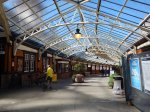
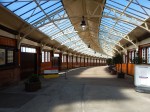
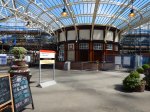
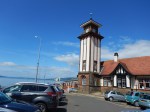
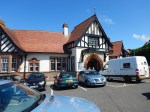
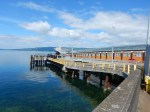


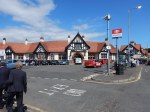


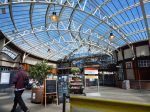
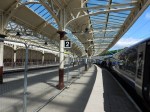




The buildings were designed by the architect; James Miller.
You might ask why this was my second visit to Wemyss Bay. In the 1960s, I caqme up to see Spurs play Glasgow Celtic at Hampden Park in what was a pre-season Glasgow Cup.
I’d arrived early in the morning, after hitching a lift from Gretna in a van that had been delivering newspapers.
So for some reason, I took the brand-new Blue Train to Wemyss Bay station and slept for an hour or so on the beach.
Could Class 387 Trains Do Norwich In Ninety And Ipswich In Sixty?
In Are More Class 387 Trains On The Way?, I postulated that Bombardier may have the capability to build more Class 387 trains, and that they could be used on services between Liverpool Street, Ipswich and Norwich.
Currently, the route is worked by Class 90 locomotives pulling and pushing eight Mark 3 coaches, with the help of a driving van trailer.
There are several problems and possible problems with the current trains.
- The Class 90s are approaching thirty years old.
- The Class 90s have had maintenance issues in the past.
- The Class 90s don’t have regenerative braking.
- The sewage discharge from the toilets in the Mark 3 coaches, doesn’t meet the latest regulations.
- The doors on the Mark 3 coaches, don’t meet the latest regulations or the expectation of passengers.
- The doors must lengthen stops at stations. I wonder what is the difference between these trains and say a Class 390 train!
- Entrance and exit from the Mark 3 coaches is not step-free.
- Ride in the Mark 3 coaches is good, but the quality of the seating and number of tables in standard class, leaves a lot to be desired.
- Wi-fi is not to the standard passengers expect these days.
- Effectively you get eight coaches of passengers in a train the length of ten cars, that is running on a line with 12-car platforms.
- The trains can’t serve Great Yarmouth.
Refurbishment is being applied to the train sets, but will that be good enough?
Updating the line’s, sixteen rakes of eight carriages would be a totally different matter to Chiltern’s creation of their superb sets of six carriages.
- Would fixing the doors and the toilets on a hundred and thirty carriages be economic?
- Is there the capacity to do the rebuild?
- Fifteen trains are probably needed to run the service, so how long would it take to upgrade sixteen trains one after the other?
- New carriages from the only source I know; CAF would mean waiting a few years.
In addition, this is said under proposed developments of the Great Eastern Main Line in Wikipedia.
In November 2013 an upgrade of the GEML to enable London-Norwich express services to achieve an improved journey time of 90 minutes was announced, this indicated that a raised line speed of 110 mph would be required and the replacement of the existing Mark 3 rolling stock with new inter-city rolling stock.
So it looks like Norwich in Ninrty isn’t on with the current trains. Could this be the reason, why the specification for the new franchise specifies just two fast trains per day in each direction?
The East Anglian Express
The starting point for this would be three Gatwick Express-style Class 387 trains working as a 12-car unit.
- Twelve cars would be able to run on the line’s long platforms.
- The Gatwick-style interior, without the extra luggage capacity, would be a good starting point for what is needed.
- It would certainly be able to maintain 110 mph for large parts of the route from London to Norwich.
- An IPEMU version would be available.
- Delivery could be as early as 2018.
What would be the issues raised by replacing the current trains with twelve-car Class 387 trains?
Capacity
Capacity is a problem on the services between London and Norwich.
It is a problem, despite passengers being squeezed in tightly.
At present the current trains have eight carriages, but Class 387 trains on Gatwick Express regularly run with twelve carriages.
I think that we can assume that, twelve-car electric multiple units are possible from London to Norwich, perhaps after some platform lengthening.
I can’t find any reliable figures on the Internet as to capacity, so I’ll have to resort to riding on the trains and counting seats.
Certainly, the Class 387 trains have more tables.
Acceleration
I don’t know if the acceleration of the Class 387 trains or the current trains is better.
But the Class 387 train has a power of 2,250 HP or 750 HP per carriage, whereas the current train has an installed power of just 1,250 HP or 156 HP per carriage.
I know it’s a bit of a comparison between apples and oranges, but it would appear that the Class 387 train has more power per carriage and might accelerate faster.
Braking
It may surprise some people, but if you want a train to run fast over a route with stops, you need efficient and high quality braking systems. The Class 387 train has the latest regenerative braking, whereas the current train has technology from thirty years ago.
As the Class 360 trains, that share the line to Ipswich have regenerative braking, I suspect that some parts of the line is built to accept returned energy, but is all of it?
With Class 387 trains, there is always the option to make them IPEMUs, so that braking energy is stored on the train and used to give extra acceleration on pulling away from the station.
Line Speed
Obviously, the faster the line speed, the quicker the journey time. At present it is 100 mph and the current trains are 110 mph capable as are the Class 387 trains.
So it looks like a bigger increase in performance can come by giving as much of the track as possible a 110 mph line speed.
Remember too, that between Haughley Junction and Norwich, the only significant feature of the line is the stop at Diss, so I would suspect it would almost be 110 mph all the way. As you’re looking for savings of thirty minutes or so between London and Norwich, I wonder if this section of line could be even faster.
Stops
Several factors determine the speed of calling at a station in a train.
- How fast the train can brake from line speed and stop in the station.
- How long it takes the passengers to get off and on the train.
- Good design of the train-platform interface, with wide doors, large lobbies and just a step across all helping.
- How fast the train can accelerate back up to line speed.
- Well-trained staff.
There are obviously other factors like waiting for other trains to connect or clear signals, but these will effect all trains.
Because of their better design, faster acceleration and regenerative braking, I think that the Class 387 trains will save something at every stop over the current trains.
I also think we’ll see stops reduced to an absolute minimum on the fastest trains, which might only stop at Ipswich and Colchester.
Interaction With Stopping Trains
I will make an assumption that London to Norwich trains will never run more frequently than four trains per hour. As it is currently two trains per hour, I think that is a reasonable assumption.
From Liverpool Street to Shenfield, there will be occasional trains stopping at perhaps, Stratford, Ilford and Romford, but with a fifteen minute window between fast expresses, I suspect everything could be fitted in, especially as local trains and passengers will use the frequent Crossrail.
Shenfield to Colchester is the difficult bit, as there are trains to Colchester Town, Clacton, Frinton and Walton to accommodate on the double-track main line.
North of Colchester it gets easier, with the only section with serious levels of traffic being the stretch between Ipswich and Haughley Junction, where freight trains to and from Felixstowe run along the double-track main line.
One way of easing the problem would be to make as many trains as possible on the line capable of running at line speed. The thirteen-year-old Class 360 trains are only capable of 100 mph.
Perhaps the expensive part of Norwich in Ninety is replacing the Class 360 trains with more Class 387 trains or some other 110 mph train?
The Digital Railway
Network Rail’s Digital Railway must surely help in running trains at up to 110 mph on some of the busier parts of the line.
Crossrail
Crossrail is going to have effects on the Great Eastern Main Line.
- Crossrail will mean that between Liverpool Street and Shenfield, a lot fewer trains will stop on the fast lines.
- Would it be possible to have 110 mph running between Liverpool Street and Shenfield?
- Journeys like Diss to Goodmayes and Ipswich to Ilford should be quicker and easier.
- If Norwich services stop at Shenfield and/or Stratford, how many passengers will transfer to Crossrail?
But we will have to wait until Crossrail opens to see how it changes travel patterns.
Stopping At Shenfield
One consequence of swifter stops is that an extra stop at Shenfield might be possible. This would connect to Crossrail, Southend and Southend Airport.
If you stop at Shenfield, there might be less need to stop at Stratford.
But passenger statistics will decide what is best.
Buffet Car
The current service has a buffet car. The Henry Blofelds of this world like to enjoy their train travel, so something better than a trolley service must be provided.
But that is a design issue, not one to do with the actual trains!
If the trains were fixed twelve-car formations, First Class might be in cars 1-3, with a buffet/shop in car 4. Car 1 would be the London end of the train.
Extra Services
There are several services in East Anglia, that could benefit from the intreoduction of new modern electric trains of at least four-cars.
- London to Norwich via Cambridge, Cambridge North and Ely.
- London to Great Yarmouth via Norwich.
- Ipswich to Cambridge and Peterborough
All routes are electrified and would be possible with a Class 387 train with an IPEMU capability.
Delivery And Introduction Into Service
If we assume that the two Norwich in Ninety and Ipswich in Sixty are to start as soon as possible, then it will be a challenging condition to meet.
Suppose, that delivery of just one twelve-car train is possible at an early date, how could it be used?
Currently, the first three trains out of Norwich leave at 05:00, 05:30 and 06:00 taking a few minutes under two hours to Liverpool Street.
Let’s suppose that after running into London in ninety minutes non-stop or with just a stop at Ipswich, it arrives back in Norwich perhaps three hours and twenty minutes later.
The train that left at 05:00 could now form the 08:30 to London and do the trip in ninety minutes, provided it could thread its way through the traffic between Colchester and Shenfield.
Obviously, the 05:30 and 06:00 trains could form the 09:00 and 09:30 trains to London respectively.
But Norwich has got two ninety minute high-capacity East Anglian Express services to London with the delivery of just one 12-car train.
Obviously, in the evening the reverse would happen.
In fact, they might get more than two Norwich in Ninety services, as I doubt the train would sit around all day in a siding. If the pattern of a Norwich in Ninety service every three and a half hours through the day, there would be at least five services possible.
Two new trains would mean that say all on the hour departures from Norwich were Norwich in Ninety, with the existing stock performing as now on the half hour.
Alternative Strategies
As only one train is needed to meet the franchise requirement, are there alternative trains that could be used? The train would need.
- 110 mph or greater top speed.
- Preferably electric power, as diesel-powered would be a backward step.
- At least eight carriages.
- A quality interior.
I don’t think a second-hand train would be good enough, as East Anglia has had enough of hand-me-downs!
The only suitable train, that the new East Anglian Franchise could obtain, would be a twelve-car Class 379 train, which is a close relation of the Class 387 train.
- The Class 379 trains are in service with Abellio Greater Anglia on Stanstead Express and Cambridge services.
- They are only a 100 mph train, but probably could be uprated to 110 mph.
But that would ask the question of what would fill in on the West Anglia Main Line.
The Final Solution
I feel that by using every trick in the book, that a suitable train can be found, that could do Norwich in Ninety and Ipswich in Sixty at least twice a day.
I suspect it would only need one train to meet the franchise requirement.
But two trains a day from Norwich in Ninety and Ipswich in Sixty will not satisfy the passengers for long.
Given that all the 100 mph Class 360 and Class 321 trains on the line, slow everything down, I can see these trains being updated or replaced with 110 mph units.
In addition to the services I mentioned under Extra Services, there are several lines that could benefit from trains fitted with IPEMU technology.
Could we be seeing a large order for Aventra trains or something similar soon after the franchise is awarded. Some trains would need a 125 mph capability for Norwich services and some would have an IPEMU capability for the lines without electrification.
Conclusions
I have come to the conclusion that Class 387 trains can probably do Norwich in Ninety and Ipswich in Sixty from London.
I think though to achieve this, the following must happen.
- Line speed is raised to 110 mph in all places possible.
- Bottlenecks like the Trowse Bridge are minimised.
- Stops will be cut to an absolute minimum on the fastest trains.
- The Class 360 and Class 321 trains must also be replaced with 110 mph trains.
- The Digital Railway will play its part.
I do think though that to get all London to Norwich trains to ninety minutes, that it might need a faster train with a speed of 125 mph on the line north of Haughley Junction, which would be upgraded for perhaps 120 mph.
But I don’t know how much good engineers can squeeze out of the current 100 mph line on the long straights North of Haughley.
Glasgow Central Station
Glasgow Central Station is one of the buildings by the architect; James Miller.

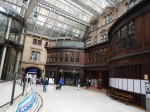

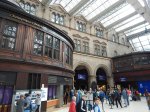
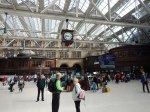
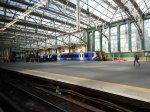
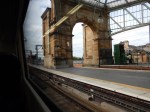
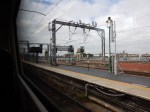
The station appears to be larger than Queen Street station, with more space and seats.
It could do with a few more tickets machines though.
St. Enoch Station
St. Enoch station is on the Glasgow Subway.
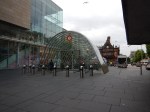
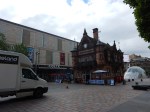
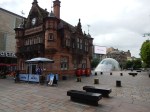
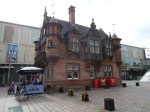
It is one of the buildings by the architect; James Miller
 The Anonymous Widower