A Plastic Seat On A New Routemaster
Not a standard fitting on a new Routemaster, but we were all wondering what this red plastic seat was doing on a 38 bus in this morning’s rush hour.
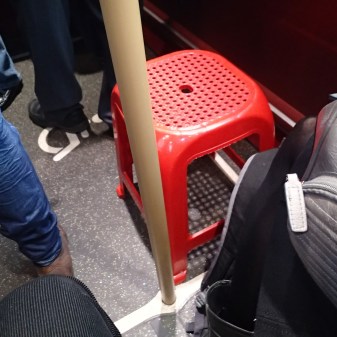
A Plastic Seat On A New Routemaster
The only thing we could think is that it’s a ruse by Transport for London to get more seats on buses.
Another Garden Station On The North London Line
Hampstead Heath and Key Gardens are two stations, with obvious garden or park credentials on the North London Line. Today, I went to Brondesbury Park station and took these pictures.

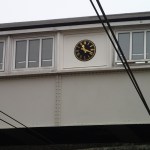
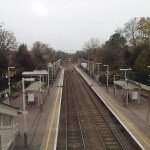
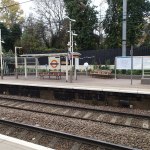
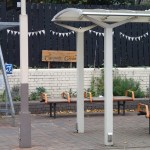
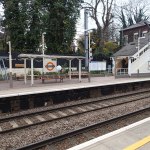
I think that London Overground have done a good job at this station, in refurbishing the buildings and the platforms, without destroying the original character.
I suspect that as there is a sign saying Community Garden, that a local group is responsible for the plants and flowers. On searching the Internet I found a site called the Edible Overground about the gardens at Brondesbury Park.
A Quiet Finsbury Park Station
As Finsbury Park station was quiet I took these pictures.

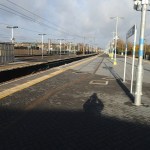
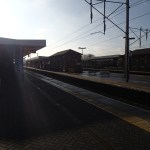
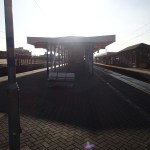
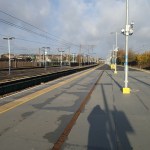
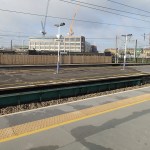
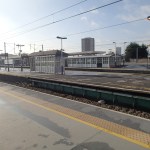


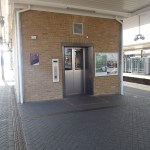
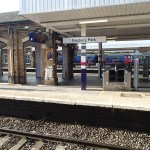

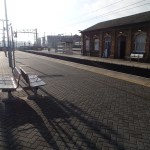
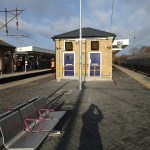
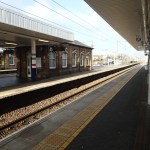
It’s certainly a lot better than it was just a few years ago.
After the full Thameslink service opens in 2018, the service pattern in Finsbury Park will be very different, as instead of terminating at Kings Cross, Cambridge and Peterborough trains will go through the tunnels to places in the south. So will some of these stop here?
Great Northern’s New Livery
This Great Northern Class 365 is all decked out in the new livery.
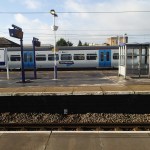
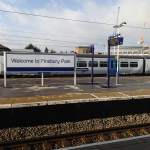
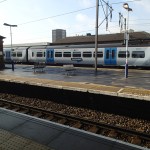
They are also being refurbished, as is described in this section in Wikipedia.
But then the Class 365 is a nice set of trains, even if theyare twenty years old. I’ve travelled in them many times up and down between Cambridge and London.
Crossrail In North Woolwich
After I came across on the Woolwich Ferry yesterday, I got a 474 bus to London City Airport to get the DLR home. I took these photos of the concrete enclosed furrow that will be Crossrail.
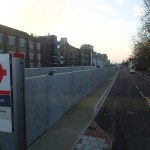
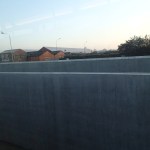

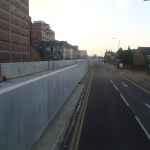
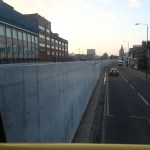

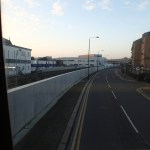
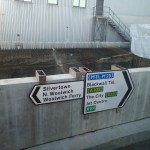
It seems to me that the architect of the Berlin Wall is alive and working on Crossrail.
There is also this map from Google.
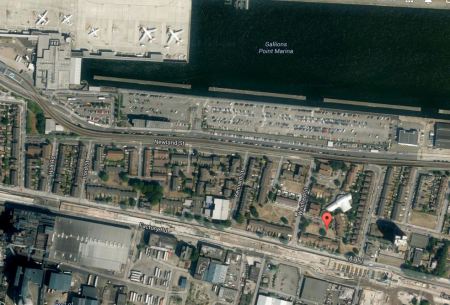
The bus went along the road labelled as the A112.
Match Nineteen – Charlton 0 – Ipswich 1
Unlike Bournemouth, Charlton was only a short trip across the Thames. I actually crossed on the Emirates Air Line.

On The Emirates Air Line
It was then a short ride on a 486 bus to Charlton station.
As I set out, I thought we might have had a chance of a win, but hopes were beginning to fade as a close fought match, which had produced 40 shots according to the BBC, was coming to the end.
But then substitute, Noel Hunt playing his first match for Ipswich, came on and a few minutes after suffering a blood injury, he managed to drill home his first goal for nearly two years.
We certainly all celebrated long after the match.
Getting home everything seemed to be locked solid, so I walked to Woolwich and got the ferry to my side of the River.
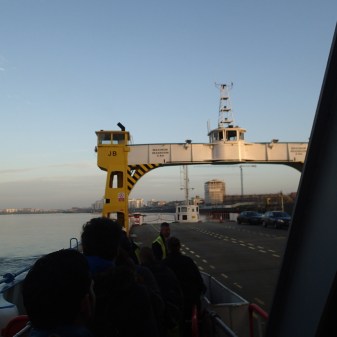
On The Woolwich Ferry
I wonder how many people have flown to a football match and then taking a ferry home.
At least, when I got home around five, I had the pleasure of knowing that Ipswich are now up to second in the Championship.
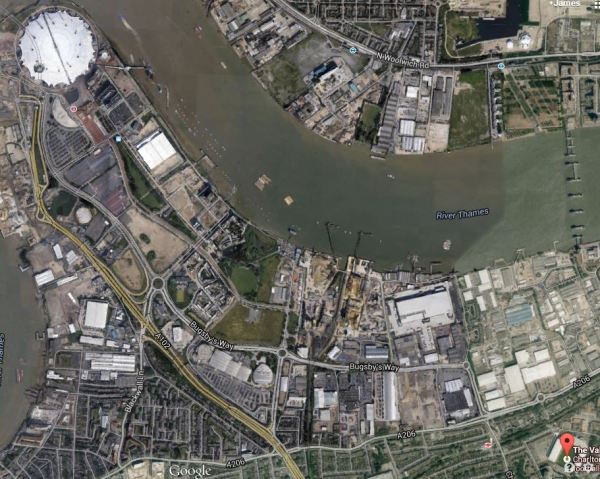
I also looked at the map after I got home.
The O2 To The Valley
Note the O2 in the top left, with North Greenwich station just below and The Valley in the bottom right, with Charlton station close by.
I would estimate that next time, I get stuck there, it will take about half-an-hour to walk to North Greenwich station for the Jubilee line.
Raw Material For A New Train
I wrote a couple of days ago about an innovative use of old London Underground trains, to create the D-Train
So what is the raw material; the D78 Stock like? I took a trip on one from Whitechapel to Kew Gardens, where I took the North London Line home.
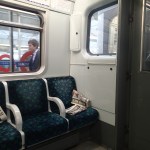

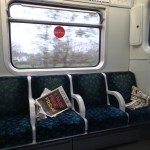
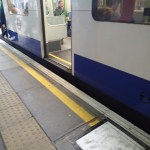
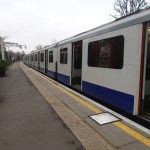
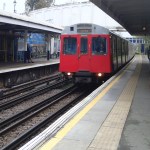
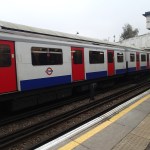
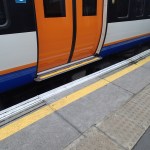
Scrapyard specials they are not! They ride well on rubber coil suspension, with a quality somewhere just short of the S Stock on the Underground. When the train emptied a bit and I got a seat, it made me wonder, why Transport for London are replacing all of them.
Wikpedia says this about their withdrawal.
The stock is scheduled for replacement by S Stock in 2016. It is being replaced about 15 years short of its intended lifespan, as a consistent fleet will allow for frequencies to be increased.
So that’s why. It must also be so much easier for staff on the sections of the line, where it shares tracks with the Metropolitan and Circle lines, that all trains are identical and stop in the same place. Passengers also like the walk-through design of the new S Stock, which eases getting on and off. It also increases capacity by spreading it through the train.
I suppose the main problem is their boxy design, which is not by any means sexy! But you could argue, that they look better than a Class 142. They certainly ride better on those rubber springs.
The more I read about this concept the more I like it.
The designers seem to have taken the approach that a good architect would do, when they’re presented with a Listed building like Kings Cross station and told to make it fit for the next few decades. Every preconception has been thrown out of the window and the designers have just concentrated on a limited set of objectives. These certainly include an affordable, reliable train that meets all the regulations and the expectations of staff, train companies and passeners alike.
But nothing of any substance, can be created without good foundations. The current trains ride well, make the maximum use of the loading gauge and thanks to the refurbishment of the last few years, they have an airy feel, with lots of windows that can be opened for ventilation, if required. I suspect too, that say if you wanted to create some new internal components, a lot of the jigs and mock-ups are still sitting in a shed or are on a computer somewhere.
I particularly like the concept of the power pack. Roger Ford in Modern Railways describes it as being so far off the wall, as to be in next door’s garden. Each driving motor car, will have two fully-enclosed power packs or rafts fitted underneath the train, The engine is a Ford Duratorq, which is built in that centre of railway technology; Dagenham. Vivarail claim that one engine will get the train home, but surely the great thing about having four power packs to a train, means that they can be selectively shut down, when the route allows. The Class 185 trains used across the Pennines, have an Eco-Mode, which selectively adjusts the power to the route, so something similar is surely possible. Computers have been used to control multiple engines according to conditions, fuel economy and power need in aircraft for decades, so I suspect the expertise to create a train that chugs efficiently round the country, is not difficult to find. In the ultimate manifestation, the engine control system would be geared to the ERTMS signalling, when that comes in, so the system would start up and shut down engines in an optimal manner according to traffic.
The power rafts give a tremendous advantage for maintenance. Roger says that taking one out will be a simple ten minute job with a pallet truck, and units will be replaced rather than repaired. Obviously, they’ll be repaired centrally. Vivarail says the concept needs less time in depots
The power raft concept also allows a new raft with perhaps energy storage, like a flywheel to be designed and tested. Given the projected life of the trains, I doubt that a Mark Two power will be developed, but who knows?
The design appears to have an amazing degree of flexibility. Look at this page on the Vivarail web site, which shows some example configurations. Trains can have two or four doors per sides, toilets if required and pictures show the classic four-to-a-table-by-the-window layout is possible.
I also think a seaside or country special would be possible with a large area dedicated for bicycles. Sometimes on Ipswich-Cambridge services, there are bikes everywhere and it is virtually impossible to get in and out.
If I look at the concept from my field of project management it is a dream. Trains arrive from London, as they are replaced by new ones, so for a start there is no storage problem. A separate factory produces the power rafts as required, so materials and cash flow are all as needed.
Even testing and certification is not the extended process it must be with a new train.
There are only a couple of problems that have been flagged up.
Some people think the doors are too narrow. But then, the trains currently run on one of the busiest routes in London and cope well.
Roger worries about the reliability of the power rafts and their Ford engines. I don’t, as if they get the control system right and run the engines efficiently, this will make the task less onerous.
I might flag up another – It’s just a pity, that there aren’t a few more D78 trains to save from the scrapyard.
Another Fare Free Friday
Last week’s Fare Free Friday was a success, as tube usage was a record.

Another Fare Free Friday
So they’re doing it again.
If doesn’t effect me, as I have a Freedom Pass, so every day is free. My Mastercard isn’t contactless either.
It’ll be interesting to see, who benefits most from this marketing exercise!
The Reality Of The East West Rail Link
Earlier this week, I took pictures of the work going on at Bicester to connect the Chiltern Line to Oxford.
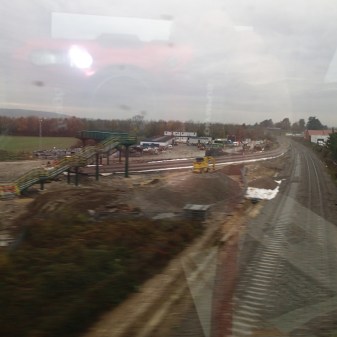
The railway passing underneath the Chiltern Line will become part of the East West Rail Link, which will hopefully link Oxford and Cambridge within the next ten years.
Modern Railways this month has a welcome page to the magazine entitled A Mini Adventure, which describes a promotional trip by Chiltern Railways on the possibly-to-be-reopened Cowley Branch. James Abbott, the Editor, says this.
A railway linking the ‘technology crescent’ – an arc about 60 miles from London stretching from Harwell and Didcot through Oxford and Milton Keynes to Silicon Fen – is well on the way to becoming reality.
He then goes on to say that he can see an East West railway starting at a Reading linked to Heathrow, giving international access for the technology crescent with just one change.
Innovative Engineering To Recycle Trains
I often refer to Pacers; Class 142 and Class 144 as scrapyard specials. They were built in the late 1980s and some units will be thirty years old next year. They have not worn well and they don’t meet the modern disability regulations.
The London Underground D78 Stock is a few years older and after a major refurbishment a few years ago, the trains are still running on the District Line. I travel on them regularly and although they are not as nice as the new S Stock, they still provide an adequate and reliable service across London.
It wouldn’t seem logical to replace the elderly Pacers with rebuilt D78 Stock that was even older.
On the other hand, a group of very experienced railway personnel who feel that these 75 third rail electric trains can with the addition of a couple of automotive diesel engines be converted into diesel multiple-units.
It sounds crazy, but the realisations on the Vivarail website of what they have called the D-train look good. They also don’t look like a D78 to those who don’t know them well. They will even have wi-fi!
To paraphrase one of my own sayings.
Politicians have a theory and try and prove it, engineers have a problem and solve it.
Roger Ford in Modern Railways for December is reporting that in six months time, there will be a demonstrator. He says this.
If anyone can make D78 stock conversion commercially viable, it is this battle-hardened bunch of veterans.
As Roger also reports they have spent a seven figure sum on buying the trains, I have a feeling that we’ll be seeing at least some of these trains for a long time.
In the article and the Vivarail web site, what I see as a big advantage of the trains is not mentioned.
Some estimates say that we need upwards of fifty replacement trains for the Pacers. And that is about the size of the fleet that could be created.
With George Osborne needing an affordable project that benefits many different areas of the country, it would appear that the D-train has arrived exactly on time.
The biggest problem could be getting the public to believe that re-manufactured nearly forty year old trains are up to the job. But at least, as with the Parry People Mover, it’s a train that can be put into service on a real railway to charm the public.
In the same magazine, there is also an article about rescuing some Class 56 locomotives and returning them to active service.
In the UK, we have a shortage of diesel locomotives for freight. We’ve even used a preserved Class 55 Deltic to haul commercial bauxite trains and you sometimes see pairs of Class 20 locomotives like this doing real work. The article explains how new locomotives get used on the premium high-value trains, but for pulling things like engineering and work trains, they are expensive.
A company called UK Rail Leasing has acquired fifteen and intend to return some to service. There is talk in the article about fitting modern engines. But then they did that with that other relic of the 1970s the InterCity125.
Both of these stories are in some ways a tribute to our rail engineering skills of thirty years and more ago.
 The Anonymous Widower