Heathrow and Gatwick Will Cost More
Surprise! Surprise! The BBC is reporting that the proposals for a new runway at either Heathrow or Gatwick will cost more!
The Airports Commission says a second runway at Gatwick would cost £2bn more than the bid suggests.
Two separate plans to expand Heathrow are predicted to cost £3-4bn more.
T’was, ever thus! The first real estimate of the cost of a large project is inevitably more than the back-of-a-fag-packet estimate.
Only when the designers and project engineers work out how the project is to be realised do we get a figure for the actual cost. Usually, in construction projects, this figure can generally be relied upon.
But as I’ve believed for some time, I don’t think we’ll ever build a new runway in the South East.
My Nineteenth Letter In The Times Since 2005
I had a letter published in The Times yesterday in a whole group of letters under the general heading of Don’t deny drivers a glimpse of Stonehenge. It said.
Sir, I have just taken a train to Cornwall and eaten lunch on the way. It was Britain at its best, on a British Rail-era, but well-refurbished high-speed train with superb locally sourced food and the best service.
Who in their right mind would want to drive all the way on the A303, even after the Stonehenge tunnel has been built?
If you want to have a memorable journey like me, see here.
Incidentally, I’m not counting my letters, but someone else is and in the on-line comments to the letter publishes the statistics of all the writers’ letters. As that is nineteen in just under two years, I wonder if I’ll be here long enough to reach my century.
Unlikely!
Selective Door Opening On The East London Line
Selective door opening (SDO) is used in several stations on the London Underground like Baker Street, Camden Town and Moorgate. No-one seems to mind, especially as at stations where it is used, there is usually an automated announcement.
On Friday I saw this notice on the East London Line of the London Overground.
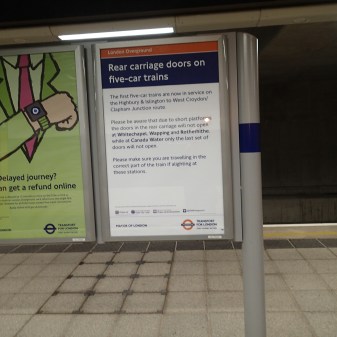
Selective Door Opening On The East London Line
Hopefully, SDO should work well on the Class 378 trains of the Overground. After all the continuous design of the trains will mean that unless the train is very busy, it should be much easier to get to an operational door.
According to Wikipedia, the SDO is controlled by GPS. So we have the door opening on a train running beneath London’s streets, being controlled by a satellite system.
As time goes on, more and more it seems that trains are becoming sentient beings with seats in them!
I wonder how long it will be before a version of the technology used on the 141 bus that counts the passengers, is giving TfL accurate loading information on some of their trains!
Rail Minister Hints At More Diesel Multiple Units
In this article in Rail Magazine, Claire Perry, a rail minister, hints that there may be some more new build diesel multiple units (DMUs). This was said.
Rail minister Claire Perry has dropped a strong hint that the Government is prepared to look again at the possibility of ordering diesel multiple units to beat overcrowding and plug a short-term gap.
It would seem to be logical, if you look at the UK rail network in say 2030 or even a couple of decades after that.
I think it is unlikely that all the small branch lines in the UK, like St. Ives or those in North Norfolk will either be electrified or closed. The only permanent solution will be some form of battery or flywheel two or three coach train with a small on-board diesel engine, which has a range of say forty or fifty kilometres.
So as the dreaded Pacers can’t be made compatible to the new disability regulations and should have been scrapped years ago, unless you employ the Bulgarian and Rumanian Armies to put up electric wires all over the country, something else needs to be done.
If an order for enough two and three car Class 172 trains, were to be announced soon, the closet trainspotter that is George Osborne, will be able to show many diverse parts of the country that he means business. Incidentally, in The Times yesterday, there is a long article by Janice Turner about spending two days following George Osbourne. This is the last paragraph.
Approaching St Pancras, Osborne frowns out of the window. “One of these,” he says, “is the Francis Crick building, a medical research institute, the first thing we approved when we took office.” Down on the concourse, he points to a half-built skyscraper. “There, that’s it,” he says, with satisfaction. And I realise this is how he wants to see himself in the story, striding off back to the Treasury with his brown government box, a man of glass and concrete, if not human hearts.
So does this partly explain, why under the Cameron Government we’ve seen such a spurt in infrastructure, with quite a bit of that for rail? All politicians like to leave a legacy, but it’s just that some leave much better legacies than others.
An order for Class 172 trains, would tick an awful lot of boxes.
- As on the Gospel Oak to,Barking Line (GOBlin), they make an excellent stop-gap train prior to electrification, in that they create good publicity and ridership for the line. It could be argued that the GOBlin wouln’t have been slated for electrification, if London Overground and the Class 172s hadn’t done such a good job on what was one of the worst communter lines in the UK.
- The trains are British-built in Derby by Bombardier.
- As they are already designed and built, the design and certification doesn’t feature on the critical path.
- There is a lot of expertise already in their operation and maintenance.
- They are an easy replacement operationally for a lot of the Pacers and Sprinters.
- If we make a mistake and order too many two-car sets, I suspect they can be easily lengthened to three-cars.
- At the present time, a lot of engineers are working hard to keep the old trains running and trying to get them updated. Ordering new Class 172 trains, would mean that they could do more worthwhile jobs for which there are skill shortages in the UK rail industry.
- In 2018, hopefully London Overground won’t need their eight sets, so those lines currently served by Pacers and Sprinters, will be getting some Class 172s anyway.
The only problem, is unlike Ford Escorts, you can’t just whistle them up immediately. But according to Wikipedia, there has been a lot of talk about potential orders, so hopefully Bombardier at least have a plan to start production in a timely manner. Given too, that the extra carriages for London Overground, are now being manufactured and delivered, Bombardier may have no capacity constraints.
One of the great advantages of at least creating a few standard Class 172s, is that they could be used initially on the worst lines for overcrowding and service, or to promote new services. But say if you put a a set on Burnley to Manchester via Todmorden, would the new route and trains cause overcrowding, just as it has on the Overground?
I wouldn’t be surprised if George Osborne announces some of these trains in his Autumn statement on December 3rd. Even a small number could have a significant effect!
The new Bacon Factory Curve may have had a significant effect on train services in the Felixstowe area, but a new two-car class 172 between the seaside town and Ipswich would probably have more perceived effect on the people of the area.
So will George’s legacy be in fifty years time, the railway commentators and bloggers of that time complaining about the ancient stop-gap Class 172 trains still trundling up and down the branch lines? And will these commentators be praising them, just like I and so many commentators today, praise the nearly fifty-year-old stop-gap Inter-City 125s, still speeding us to Wales, the West |Country, Nottingham and Scotland.
London’s Low-Key New Train Launch
To say that the launch of the new carriages for the London Overground on Thursday was low-key would be an understatement. I have only found one article on the web with a picture and that is in Rail Magazine. They say this.
The first five-car Class 378 for the London Overground network was unveiled at New Cross Gate depot yesterday (November 6).
All 57 EMUs in the fleet are receiving an extra carriage, as part of a £320 million investment boosting overall capacity by 25% – equivalent to an additional 170 passengers per train.
But where are the politicians in the photo?
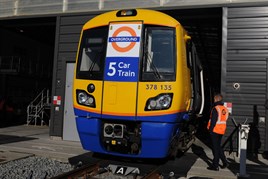
First Five-Car Class 378
It’s not like Boris to miss a photo-opportunity.
In some ways there is a very solid engineering principle behind these Class 378 trains. You should always make sure that anything you design can be adjusted to meet changing circumstances.
London Overground thought that three car trains would be enough for the limited number of passengers on the North and East London Lines. It quickly became obvious that these were inadequate. Either by good design or just plain luck, the trains had been originally built as two end cars with cabs and an unpowered trailer car in the middle. So to go from three to four they just built an extra trailer car and plugged it in, with a few small adjustments to the trains systems.
But even four cars have proved inadequate and now the process is being repeated to create five car trains. This is perhaps a little more complicated, as they have been unable to lengthen some platforms like Shadwell, so selective door opening has been implemented.
In the London Transport Infrastructure Plan for 2050, it states that these lines will have six cars at some point. So how long will it be before another car gets added?
The Rail Projects Keep Coming
I’ve just been reading the rail news sites like Modern Railways and Global Rail News and over the last few days some substantial projects have been announced.
The project that will affect me most is an upgrade to the Great Eastern Main Line.
It’s not any new features, but an upgrading of track, overhead wires and signalling. Network Rail say this.
As part of the upgrade, one of NR’s ‘high output’ machines will begin replacing ballast along the route to ensure the track bed is safe and well-drained. The machine is currently being used to upgrade the Great Western main line, and will move to the GEML in the New Year.
It will also upgrade one track at a time, so it’s unlikely there will be substantial blockades. Traditionally, this sort of work would have meant weekend closures and buses. So Network Rail seem to be doing sometime better.
Network Rail are also replacing the Scarborough Bridge on the Scarborough Branch Line. The work is described here and this is a paragraph.
The bridge, which was originally built in 1845 and then rebuilt in 1875, is now life-expired. Work will see the bridge decks and tracks replaced and a new walkway installed to improve safety for railway workers. The work is part of a £6 million investment by Network Rail.
So it’s only a small project, but I’m sure it’s important to a lot of travellers.
The extending of Chiltern’s network to Cowley has also been announced. I think we’ll see a lot of projects like this, where old lines are given something to do in the next couple of decades.
Network Rail has also announced a £200million project to do more work on the improvement of lines between Edinburgh and Glasgow.
As with the electrification across the North of England, electrification is another prime example of the failure of Central government to do the right thing to create infrastructure and fuel jobs, businesses and growth. This describes the scope of the work.
The companies will work with Network Rail to electrify the main line between the cities, complete route clearance works at Winchburgh Tunnel, infrastructure works at Glasgow Queen Street and Edinburgh Waverley stations and extend platforms at Croy, Falkirk High, Polmont and Linlithgow.
What will fast electric trains running between Scotland’s two major cities, do for the area? Wikipedia lists several benefits including this one.
Service frequencies between Edinburgh and Glasgow Queen Street increased from four trains per hour to six per hour, with the fastest journey time being reduced to 35 minutes. This would have resulted in a total of 13 trains per hour between the two cities across all routes;
Currently, services take from about 50 minutes to an hour and a quarter.
Global Rail News has announced that funding is in place to extend the Manchester Metro to the Trafford Centre.
An aside here is to look at the list of proposed changes and expansions to the Manchester Metrolink. Every council in the area seems to have its own pet ideas and surely this must be best argument for a peacemaker and decision taker in Manchester, like TfL are in London.
I wonder how many more of these projects will be announced before the General Election in May.
The Standard Is Upbeat On The Overground
the Standard today has an upbeat article on the Overground and the lengthening of trains from four to five carriages.
The article ends with this from Mike Brown, who is TfL’s Director of Rail.
Mr Brown said he was upbeat about adding rail capacity as London’s population boomed.
He said: “I’m optimistic we’ll hear some positive comments about Crossrail 2 in the Autumn Statement which is a critical project to relieve congestion at London Waterloo, Victoria and Clapham junction mainline stations.
“I’m also convinced that when we as the Overground take over responsibility for West Anglia routes from May next year and when Crossrail opens people will see the great benefit of the model we operate compared to other (train companies’) franchising models when we focus on delivery, performance and having staff at stations.
“I want to keep up the pressure of more devolution to the mayor.”
In September and October London Overground achieved 95.7 percent punctuality compared to a national average of 90.1 percent.
I think it’s all a powerful argument to duplicate the Overground model all over the country.
I do think that local control of trains, trams and buses, like London has over the Underground and Overground, is a very good thing, as decisions get taken in the area, not miles away where the franchise has its head office.
If you look at Merseyrail, Manchester’s trams and the Newcastle Metro, which have substantial local control, do they work better than some others?
Oxford Takes A Leaf Out Of Cambridge’s Book
When I visited all of the 92 football clubs in England, Oxford was one of the most difficult to get to. I said this.
Oxford, must surely be one of the most difficult stadia to get to from the town centre, even if you have a car. And if you do, you have to actually drive along the by-pass where there are queues of traffic. Of all the taxis I have taken to get to and from grounds, Oxford was by far the most expensive.
But from 2020, it’ll all be different.
According to the BBC, Chiltern Trains are opening up the Cowley branch to passenger trains, which will stop at the Science and Business Parks. Some reports say this will also handle the football ground.
But it is good to see Oxford following Cambridge and having a station at the Spence Park.
The Noisy Class 66 Locomotive
The Class 66 locomotive used on UK railways is not a friendly beast as it makes a lot of noise and smell. There is a Wikipedia section on Cab Design Problems, which says this.
The British trade union ASLEF has complained that the locomotives are unfit and unsafe to work in, citing a lack of air conditioning, and poor seating and noise levels.
I’ve spoken to various Class 66 drivers and many don’t like the working environment, but like things like the reliability.
If you type “Class 66 noise” into Google, you find some interesting articles.
One interesting point about Class 66 locomotives is that they don’t meet the new emission regulations and so no more can be ordered. The details are all here on Wikipedia.
Because of this and the noise and smells the locomotives, I think that they should where possible, not work trains through built-up areas.
Is Everything A Short-Term Fix At Willesden Junction?
In posts yesterday, I highlighted the problems with platform/train gaps and the dreadful interchange at the North London Line platforms at Willesden Junction station.
But is all the work done to lengthen the platforms for five-car trains just a short-term measure, which doesn’t address these problems at all?
Obviously, work has to be done on the low-level platforms and as they don’t have too many problems, except for the step up and down into Bakerloo Line trains, it will make the low-level station a good one with step-free access, a cafe and toilets.
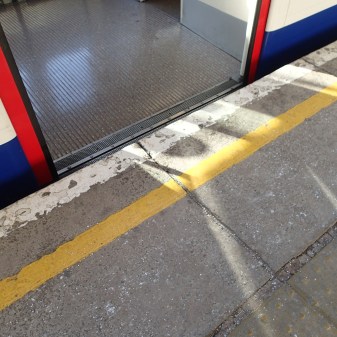
The Tube/Overground Mismatch
But upstairs, I can’t help feeling that solving the problems are virtually impossible, without a complete rebuild of the station. But look at this map of the proposed layout of the lines at Old Oak Common.
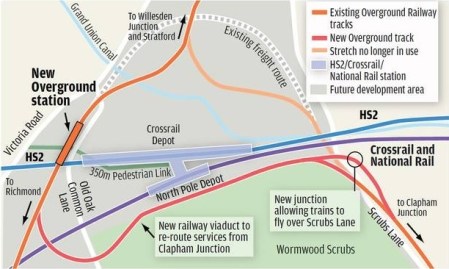
Rail Lines At Old Oak Common
This would link HS2 and Crossrail to the North and West London Lines at a new station at Old Oak Common.
So if the Old Oak Common area is developed with a new station, would this have a knock-on effect at Willesden Junction? This could ich mean that the station had to be changed substantially or possibly was no longer needed.
The big problem is what to do with the interchange between the North London Line and the Bakerloo and Watford DC Lines.
There have been plans for the Bakerloo Line to take over the Watford DC Line north of Harrow and Wealdstone. This would mean diverting the North London Line via Queen’s Park and Primrose Hill.
This would fit in well with the combined North/West London Line station at Old Oak Common. On the other hand, it would mean a few station closures and stations between Queen’s Park and South Hampstead would leave their links to Euston.
Old Oak Common station is still very much at the planning stage and if the ideas get firmed up to a mega-interchange, it should make it easier to sort out the North London Line and the Watford DC Line.
There is also the question of how the Croxley Rail Link will affect ridership on the Watford DC Line. The fastest jouneys to Euston Square from Watford Underground station, are now about 45 minutes, whereas the DC Line takes 52 minutes from Watford High Street. However by going one-stop the wrong way to Watford Junction station, you can do it in 35 minutes. As London Midland runs several trains an hour into Euston in about twenty minutes, this might be a preferred option.
If Crossrail goes up the West Coast Main Line, as is also being proposed, then the trains would surely stop at Harrow and Wealdstone and Watford Junction.
Transport for London have a lot of deep thinking to do.
 The Anonymous Widower