Before Overground – Cambridge Heath
A Pretty Run-Down Station! – Rating 2/10
Cambridge Heath station has little going for it. The only positive thing that can be said about it, is that is not as much of a dump as Bethnal Green station.
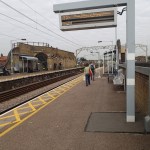
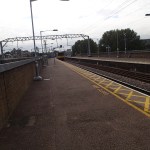
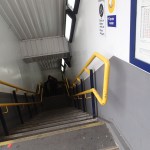
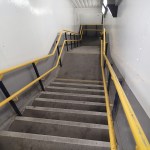
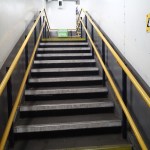
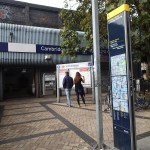
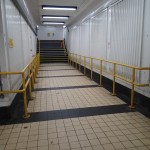
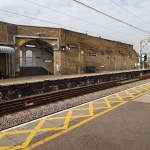
It was reasonably clean and unlike one platform at Bethnal Green, the station did have seats and shelters. But the stairs were even worse!
One point about this station is that it is served by a reasonable number of buses, as this map shows. So if you have difficulty walking, have a baby in a buggy or are carrying something heavy, it may be easier to take a bus to a station with better access.
As it is not the busiest of stations with only 300,000 passengers a year, will London Overground bother to improve the access?
Before Overground – Southbury
A Surprisingly Busy Station With Work Needed – Rating 3/10
I must have been past Southbury station hundreds of times, but I’d never used it until today.
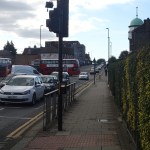

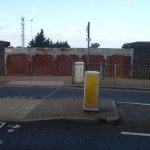
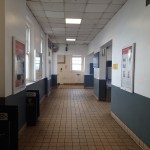

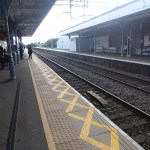
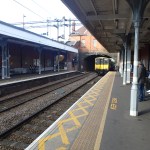
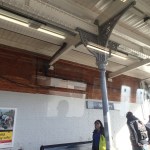
The station is unusual in that, all pedestrian approaches are up-hill.
The station also suffers from being on a busy main road, with badly-placed bus stops and no easy way to cross the road.
These factors and the non-existent step-free access probably accounts for the facts that Enfield Town station, a couple of miles up the road, gets four times the passengers and the next station towards London; Edmonton Green gets nearly six times. Although saying that, it was quite busy, when I passed through!
I wouldn’t be surprised if London Overground put this station at the back of the queue for improvements.
Before Overground – Enfield Town
A Classic 1950s-built Concrete Station – Rating 6/10
I have a long history of travelling through Enfield Town station.
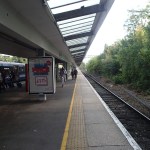

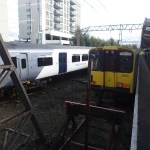
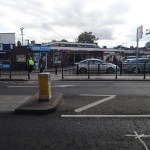
It was built in 1957 and that was probably about the time, I used it for the first time, as it was just a 107 bus ride away from where I lived in Cockfosters.
Coming back from White Hart Lane in the 1960s after seeing Spurs play, you folded the doors back, as you entered the station and when the train had slowed to a flat out run, you jumped. That way, you tended to beat all the other hundreds of people wanting to get a 107 bus home.
London Overground could probably make this station into one of their best, as there are no step-free problems, except a high step into the Class 315 trains. But hopefully, the step up from the platforms to the new trains will be minimised.
Before Overground – Seven Sisters
Rabbits Would Be At Home Here – Rating 4/10
Seven Sisters station is a bad station, that was made a lot worse by tacking a Victoria Line station on with all the subtlety of the worst of 1060s-architecture and design.
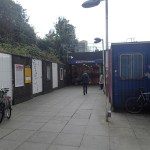
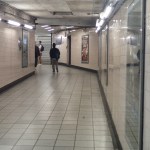
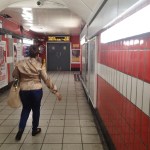
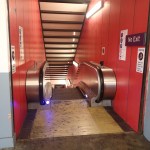

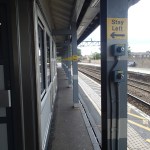
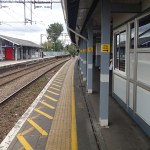
I approached the station on a 76 bus from near where I live.
The first time, I did this, I entered the station from the Tottenham High Road end and went down and up escalators and steep staircases to get to the platform for Enfield Town and Cheshunt.
This time, I stayed on the surface and walked up Seven Sisters Road to the southern entrance of the station.It is a route that is almost as tortuous.
The station itself has some problems that are easily fixed and others like the narrow down platform that aren’t!
I should say that Seven Sisters is a station I avoid, as for me Hackney Downs is an alternative, that although it has long staircases, it wasn’t built for rabbits.
London Overground will have fun, making a customer-friendly station out of this one.
Crossrail, HS2 And The Overground Seem To Be Coming Together At Old Oak Common
There has been a report in the Standard, which talks about how Crossrail, HS2 and the Overground could come together at Old Oak Common, which is an area of London ripe for redevelopment.
The report shows this map.
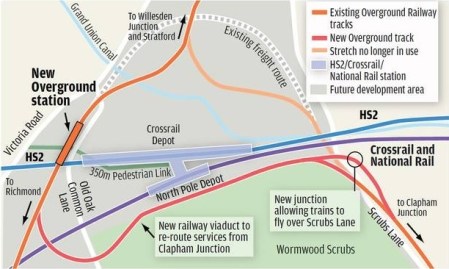
Rail Lines At Old Oak Common
The map is informative and it shows how the West London Line might split from the North London Line at the new Old Oak Common station, rather than at Willesden Junction.
The map though doesn’t show the Dudding Hill Line which joins the North London Line in this area, possibly just south of the new station.
To show the space available in the are, look at this Google Map shoeing the wider area around the proposed station.
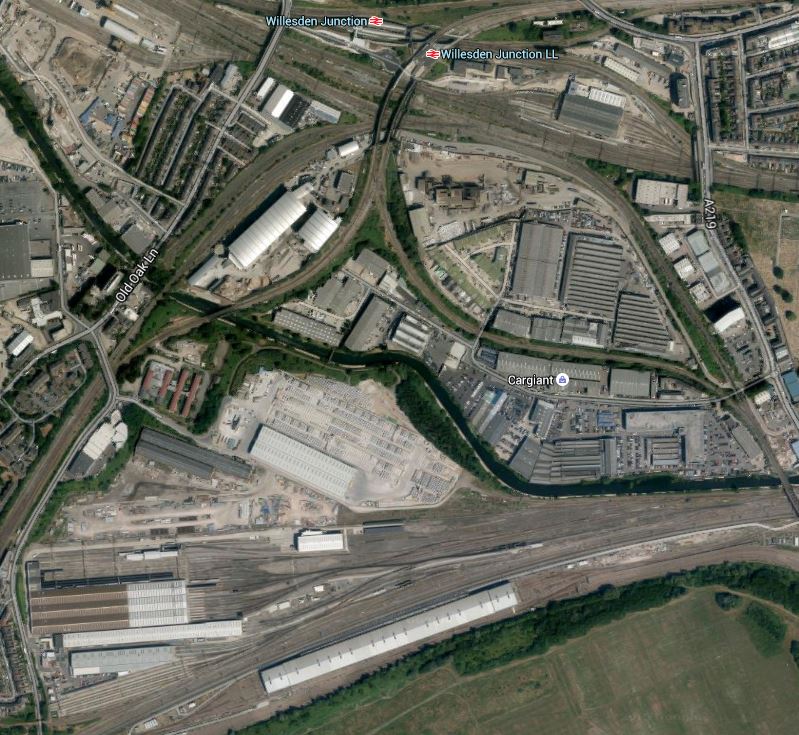
Old Oak Common Area – Downloaded 7th July 2015
There are rail lines everywhere. This second image shows the Southern part of the previous one, along the Great Western Main Line and Crossrail.
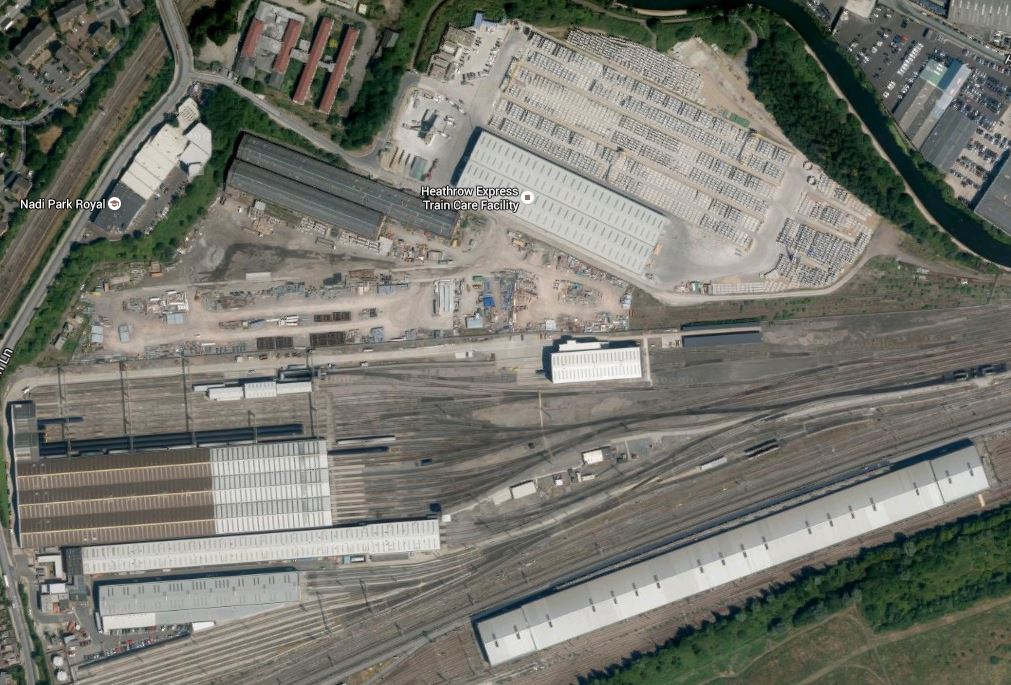
Old Oak Common Detail – Downloaded 7th July 2015
Working upwards from the bottom (South) on this map, you see the following.
1. The long building is the North Pole depot to be used by the new Hitachi Class 800/801 trains, which will be delivered over the next few years.
2. The Great Western Main Line and the future Crossrail tracks.
3. Depots for Heathrow Express and other trains.
4. I think that the large building surrounded by a large amount of grey blobs is the factory that manufactured the tunnel linings for Crossrail.
5. The Grand Union Canal encircles the site.
So could the imaginative minds of the planners at Transport for London have decided to bring the North London Line, an Extended Gospel Oak to Barking Line, Crossrail and HS2 together at the proposed new large development at Old Oak Common? With a little bit more clever design, they might even be able to tie the Central Line into the mix.
I’m all for this personally, as North East London, where I live, will be given a simple route to get to Heathrow and Reading, by just taking the North London Line or the GOBlin to Old Oak Common for Crossrail.
The Night Tube May Be On It’s Way
Transport for London have announced that from the 12th of September 2015, there will be a night service on the tube lines through Central London.
I used the word may in the title of this post, as the dinosaurs are stirring. The RMT general secretary is making threats.
From his statements on this and other issues, it seems he is trying to outcrow, the late Bob Crow.
Liverpool To Manchester Is Getting A Twenty-First Century Railway
One of the scandals of the UK rail network, is the train services between Liverpool and Manchester. The lines from these two cities to London were fully electrified by the mid-sixties and even Glasgow was reached in 1974. The details are on Wikipedia.
But the train services are still run mainly using some of Northern Rail’s scrapyard specials or Class 142 and Class 150 diesels as they prefer to call them. Are there two as important cities anywhere in the world, which has to put up with such terrible elderly rolling stock on a rail route between them.
It has always puzzled me, why this train service wasn’t electrified, as after all both cities are served by electrified main lines.
I have read that both Harold Wilson and Margaret Thatcher didn’t like trains, but surely electrifying the route between Liverpool and Manchester would give a boost to both cities.
On the other hand the other obvious pair of cities ripe for joining by an modern electrified railway are Edinburgh and Glasgow. And of course the original line via Falkirk is still run by diesel trains! You’d think that Blair or Brown would have found the funding for that to buy a few votes in Scotland!
But at last nearly fifty years after it should have been carried out as a follow-on to the West Coast Main Line, construction crews are working on the line. I took these pictures as they are upgrading Huyton station.

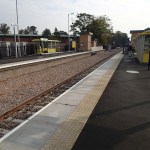
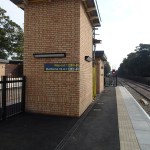
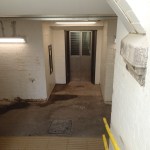
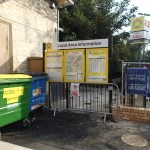
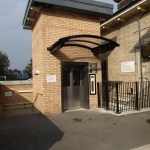
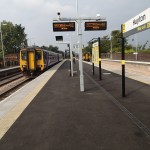
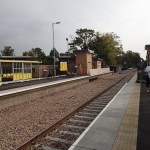
It’s all rather ironic to see this, giving Harold Wilson’s attitude to rail, considering that he was the MP for the area.
I took a train from Huyton to Leyland, so I didn’t see how far the electrification has got from the Manchester end, but work was obvious all the way from Huyton to Wigan North Western station.
There is no reason to believe that Class 319 electric trains will not be running between Liverpool and Manchester, on the planned December 2014 timetable change.
Whatever happens, Huyton will be getting a four-platform station with lifts between the platforms and the existing subway.
If all goes to plan, they’ll be getting an updated service between Liverpool and Manchester.
It’ll be interesting how this all works out by say the end of 2015. And then when all the electrification is completed in 2017.
1. Will the generally two trains per hour service frequency between Liverpool and Manchester Victoria be increased?
Even if they are not, they’ll be longer trains and they’ll be a lot faster. They’re will also be an improvement to the services that stop at all stations on the route, as the Class 319 trains are faster with much better acceleration.
2. As the line between Huyton and Wigan will be electrified, will there be electric services between Liverpool and stations on the West Coast Main Line?
Liverpool has a disadvantage here when compared to Manchester, in that there is significant traffic from Scotland to Manchester Airport. This was the reason that TransPennine introduced Class 350 trains on the Glasgow to Manchester Airport route. So Liverpool will never have as many direct trains from Scotland as Manchester.
At present generally about two trains per hour from Liverpool connect with perhaps a fifteen to twenty minute wait at either Wigan North Western or Preston for Scotland. The problem with introducing direct Liverpool to Scotland services is the lack of paths for trains. So perhaps we might see trains time-tabled to mean the change at say Preston was a simple walk across the platform.
An alternative would be to have two four-car trains from each of Manchester and Liverpool, join together at Preston for going onward to Carlisle and Scotland. Some train companies seem loathe to do this, whereas when done properly as I observed at Cambridge, it makes for an efficient railway.
3. Will the increase in the number of trains available for the route, mean an increase in late night services?
Obviously, there will have to be a need for the trains, but my train back from Wigan, wasn’t just two sad Ipswich fans and a guide dog.
One thing I found, when talking to some fellow passengers at Huyton, was how little some of them knew about the developments going on. Have Northern Rail and Network Rail got their PR right?
Match Eight – Wigan 1 – Ipswich 2
This match was expected to be played on Saturday the twentieth, as my ticket showed.
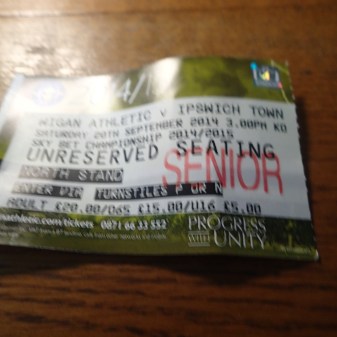
A Ticket With The Wrong Date
But Sky decided to show the match and a few weeks ago, it was moved to Monday the twenty-second. It was actually better for me as it meant I could go to Millwall to see them play league leader; Forest, with a friend.
So as it was Monday night and there were no trains back to London from Wigan after the match, I decided to go to see a friend in Liverpool University and stay the night in the Second City. Partly, this was because there was no acceptable hotel in the centre of Wigan. I would have thought, that given the Orwellian connection, that a decent hotel at Wigan Pier might be a goer. Even a Premier Inn at Wigan Pier would have a certain ring to it.
One point to note for all those living in London, is that I purchased my Liverpool Wigan return ticket on Sunday from the machine at Dalston Junction station.
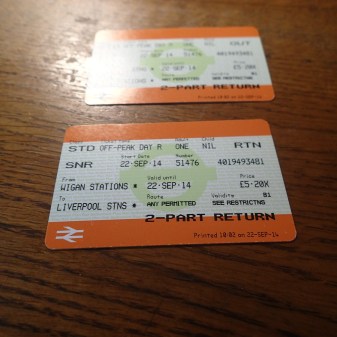
My Liverpool Wigan Tickets
It cost me £5.20 with my Senior Railcard, which is the same price as that on-line from the Northern Rail website. But it is so much less hassle, as you get the tickets at the time you purchase. It’s fascinating to see how old-fashioned ticketing machines are fighting back against the Internet. Although of course, these new ticket machines on the London Overground, are effectively on-line terminals using the Internet to make a purchase.
I’d incidentally bought my First Class ticket to Liverpool from Euston on Virgin for £25.10 a couple of weeks ago. The guy opposite me paid £41 buying the night before. I know I have a Railcard, which cuts my price from £37.65. But my companion only paid a few pounds more booking the night before.
As we got tea, soft drinks and a snack, it just shows what good value some of these First Class tickets are.
I arrived at the match at Wigan about seven after taking a taxi from Wigan North Western. The welcome was its usual friendly one at the stadium and the bag check was an intelligent one. Inside, supporters of both sides weren’t that numerous.
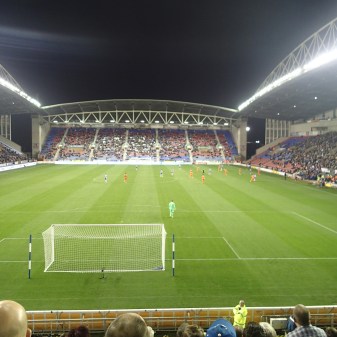
A Sparse Crowd At The Match
But then the match was on Sky. This was Ipswich’s third time this season, so let’s hope it boosts the crowd at Portman Road.
I left the match a few minutes early, so I could be sure of getting a taxi back to the station. In the end a call to a taxi on 01942-242424 brought one immediately, so I had quite a few minutes to wait for my train to Liverpool. But as it was the last one at 22:03, I just had to catch it. Hopefully, when the electrification is complete, one of the benefits will be later trains connecting Liverpool, Manchester, Blackpool, Preston and the stations in between.
Perhaps too, Wigan Athletic could think of improving the transport to and from the ground. The taxis weren’t expensive, but finding one can be a problem, as the first driver told me. He incidentally gave me the number of a rival company to get back to the station.
I suspect that there is a walking route from a bus stop near the ground. It should be indicated at the station. And where is the Wigan version of London’s bus spider map at the station?
As it was the match was a fair result, as I agreed with a fellow Ipswich fan on the train back to Liverpool. He only has limited vision and was escorted to the match by his guide dog; Trigger., who I’d met in 2010 at Crewe. Apparently, Trigger gets a very good welcome at the DW Stadium.
Before Overground – Class 317 Trains
The Class 317 trains are the workhorse of the suburban services out of Liverpool Street. Wikipedia says this about them.
The British Rail Class 317 electric multiple units (EMUs) were built by BREL York in two batches, from 1981–82 and 1985-87. They were the first of several classes of British Rail EMU to be based on the all-steel Mark 3 body-shell.
So they’re no spring chickens, but like actresses of a certain age, they scrub up well, as this picture of the interior shows.
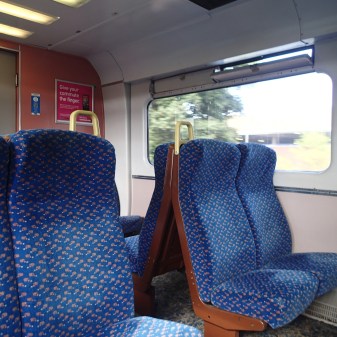
Class 317 Interior
Being based on Mark 3 coaches, they also have a good body underneath, that rides better than many of the much more modern trains.
Plans are possibly afoot to refurbish and fit new traction equipment to some of these trains, but London Overground have said they will be replacing them in 2017.
But whatever happens on the Overground, these Class 317 trains may well be refurbished and find gainful employment somewhere else.
Having seen the superb way that South West Trains’ sister fleet of Class 455 trains have scrubbed up, I would be happy, if the Overground got a refurbished fleet of 317 trains. One of the Class 455 was involved in this incident at Oxshott. I wonder how some of the modern aluminium trains would survive the dropping of a 24 tonne cement truck on top from a height of several metres.
Before Overground – St. James Street
A Station With Potential – Rating 5/10
St. James Street station, is one of those that with a deep clean and a good paint job could become an acceptable station.
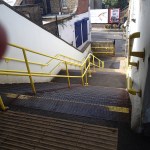
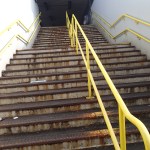


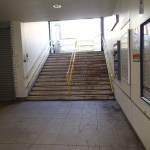
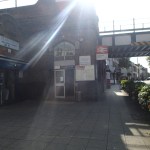
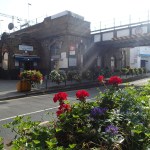
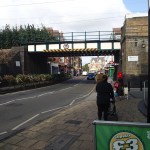

But of course, in the long term, it would need lifts to make the access step-free.
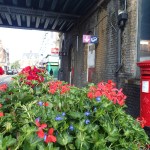
I know the station has a florist, but someone is maintaining a good floral display at the entrance to the station.
 The Anonymous Widower