Paintings by Father and Son
The picture shows two paintings by Arthur Perigal and his son.

Paintings by Arthur Perigal and his Son
The one by the father is on the left and is of the Alba Villa in Rome.
A Letter on Adoption
This was a letter from Ian Storey on adoption in yesterday’s Times.
Babies in need of adoption are not born with racial preferences or prejudices. They are born with a need to be cared for so they can flourish, rather than slip into compromised lives. Every sidelined child can easily become a needlessly tragic tale.
Well said.
C was adopted and was a complete believer in the system, even it did have the odd flaw. But then show me a perfect system for anything and I’ll show you a liar.
Vengeance Plastic Surgery
Another article in the same Sunday Times as the hair article, also says that the biggest growth area in plastic surgery in the United States is post-divorce.
C would have understood that, although she would never have agreed with plastic surgery. Many times, she would come home from court and tell with relish a tale about a client, who in the process of ditching an apalling spouse, had really improved themselves. And it wasn’t just the women, although it usually was! In one amazing case, where a lady was getting divorced after forty years of marriage to a violent man, she told C, she’d just spent twenty pounds on having her hair done and another twenty on a dress. Sums she would never have spent before. She had also just booked a cruise in the sun. This case was also interesting, in that the husband had had a previous marriage of forty years that had also ended in divorce. If we had pre-nuptial psychological testing, some would and should stay single all of their lives.
Why Women Cut Off Long Hair
There is an article in the Sunday Times, saying why women cut off their long hair. I don’t know who writes this rubbish and I suppose I read it, but C and several other women I know cut their long hair, when they had a baby, as they didn’t like all the pulling.
Customer Service – IKEA Style
I like their products but their customer service has an eccentric style all of its own. In my view, it’s crap. Or to be honest, very crap!
I had identified that to solve some of the problems in the kitchen, I needed a nice wall-mounted spice rack. After briefly flirting with the idea of using a design promoted by a well-known celebrity chef, I decided that the IKEA on in their Grundtal range was ideal. The way it was mounted on a rail, also meant that if I found a better solution, the rail could be used to hold something else.
I started out late morning by going to IKEA at Edmonton. It is a surprisingly easy journey from where I live, as a 341 bus from a stop about a hundred metres away drops me outside the door of their store. I found the spice rack on the wall and confirmed it was what I wanted.
But it was out of stock!
So I bought a few pieces and came home.
I should say that I tried to order the spice rack from their website, but it is for buying in-store only. And the only store I could find it locally, was the one at the home of the infamous, Sid and Doris Bonkers; Neasden. IKEA call it Wembley to be a bit up-market, but that area has always been Neasden for me.
At least the web site was showing that eleven or so were in stock, so I took a chance and went, using the 38 bus to get to Green Park and then a Jubilee Line train to the dreaded Neasden. A badly misspelled sign at the station, directed me to walk to IKEA down the side of the railway, alongside the North Circular Road and then over a high footbridge. Light-controlled crossings were non-existent and in at least two places crossing of minor roads was dangerous to say the least.
Welcome to IKEA.
Well not quite yet, as you had to find the entrance and that was very much hidden behind the car park. Alright if you can drive, but then I can’t.
It took me only a couple of minutes to find out that there are lies, damned lies and statistics on IKEA’s website.
So I’d wasted three hours on a wild spice rack chase.
And then of course, IKEA has no quick exit, so they delayed me even longer.
After perhaps twenty minutes wait, at a bus-stop with no information, I got a bus to Harlesden and a train home on the North London Line.
I did find the bin I wanted for my kitchen, or at least the base of it. But it was one of the shop bins and they were not for sale.
This surely is the worst customer service experience I have had in my life.
I still want that spice rack, so if anybody finds one or wants to sell me their’s I’m on!
To add insult to injury, it is now shown as being available at Edmonton.
Seeing Before Buying
With most of my purchases, I always like to look at the product before I buy it. I know if I bought it on-line, I could often return it, but there is all that repacking hassle with a dodgy hand. I’d far rather get it right first time.
This explained my trip on a bus to IKEA this morning.
I should say that what I needed; a spice rack, was also available from a well-known celebrity chef. His product looked better than IKEA, but was of course more money, so in the end IKEA got the business because I could see and touch the product.
I could have used one of the said chef’s consultants, but who needs a consultant to buy a spice rack and anyway I always like dealing with the organ grinder, rather than the monkey.
Make Up for Radio?
Kate Silverton has just disclosed that she went into Make-Up for her morning show on BBC Radio 5.
Does it matter?
No wonder the BBC is inefficient!
Black Swan
There was a pub in a 1950s British comedy called the Black Swan. It was always called the Mucky Duck.
Was it Hancock?
Not sure I can go to see the new film and keep a straight face.
The Minotaur Lives
Imagine my surprise, when a parcel appeared on my doorstep carried by a man who looked like he was doing an impression of Pete Henry, except that he was a few years older than my last recollection.
In the parcel, was about a hundred copies of the infamous Metier Minotaur. This was the edition that had the tall Pete’s picture where he was trying to get into a compromising position with the diminutive Karen, in what looked like the dining room of my old house at Debach with the infamous wallpaper. It was also probably the laste edition as it had Metier’s obituary. On the last page it asked if the hamster really did it.
Pete told me that he had had a vision from God and this had sent him to a dark, satanic print works in Clerkenwell, where in exchange for a fistfull of used notes, he had received these magazines from an atttractive young lady.
So what am I to do with this manna from heaven?
My son died of pancreatic cancer, so these priceless works of great literature will be sold with all proceeds going towards research into the cancer at Liverpool University, where a world-class team has been assembled.
I am not restricting the sales, as the excellent printer, has informed me that if need be he can print enough copies to completely cover every window of the gherkin.
The Improved Staircase
I’ve now replaced a lot of the bolts with brass ones and I think it looks a lot better. But then I’m biased.
Here’s what it looked like.
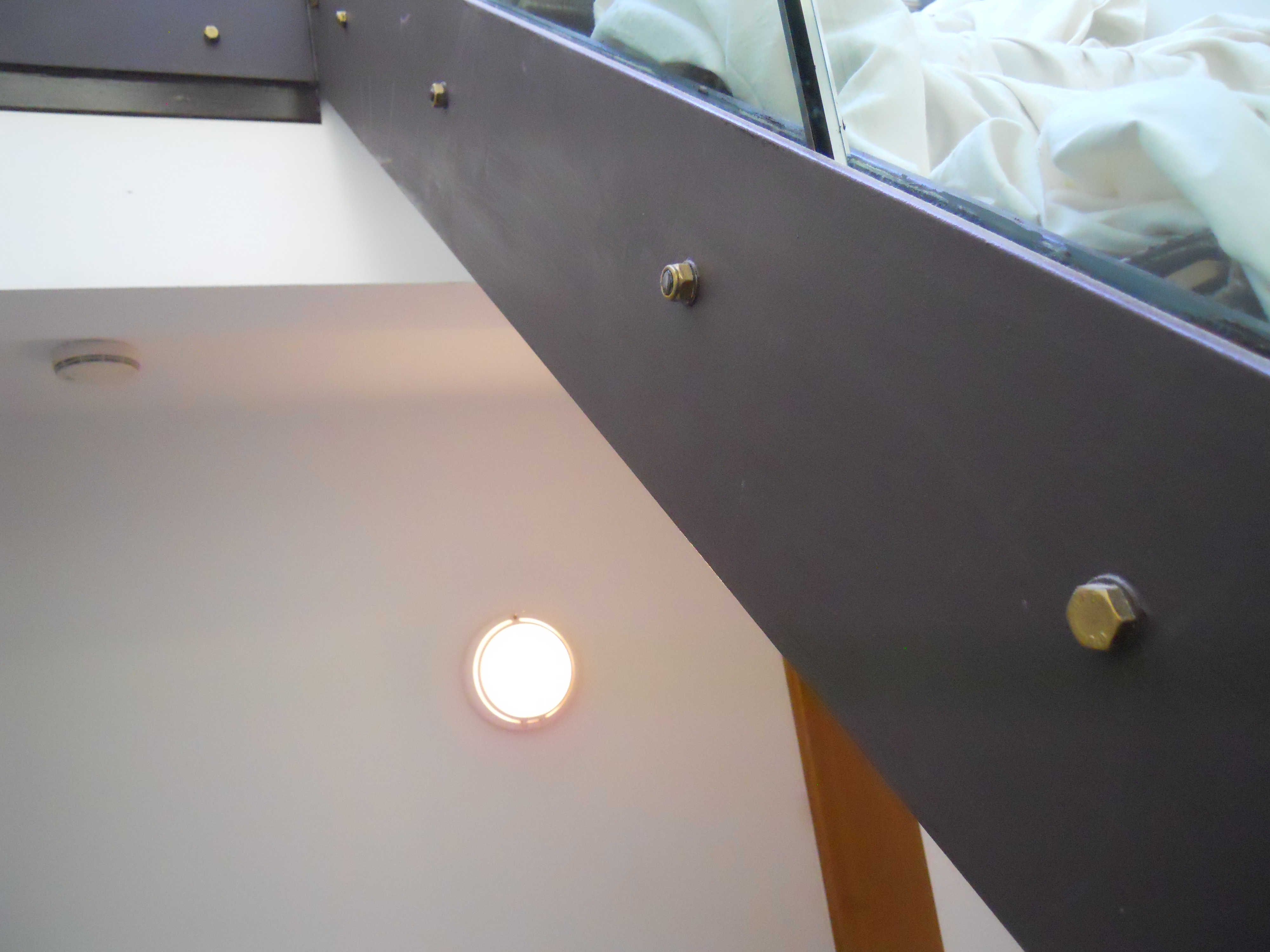
The Old Bolts
This picture was taken today from a similar angle.
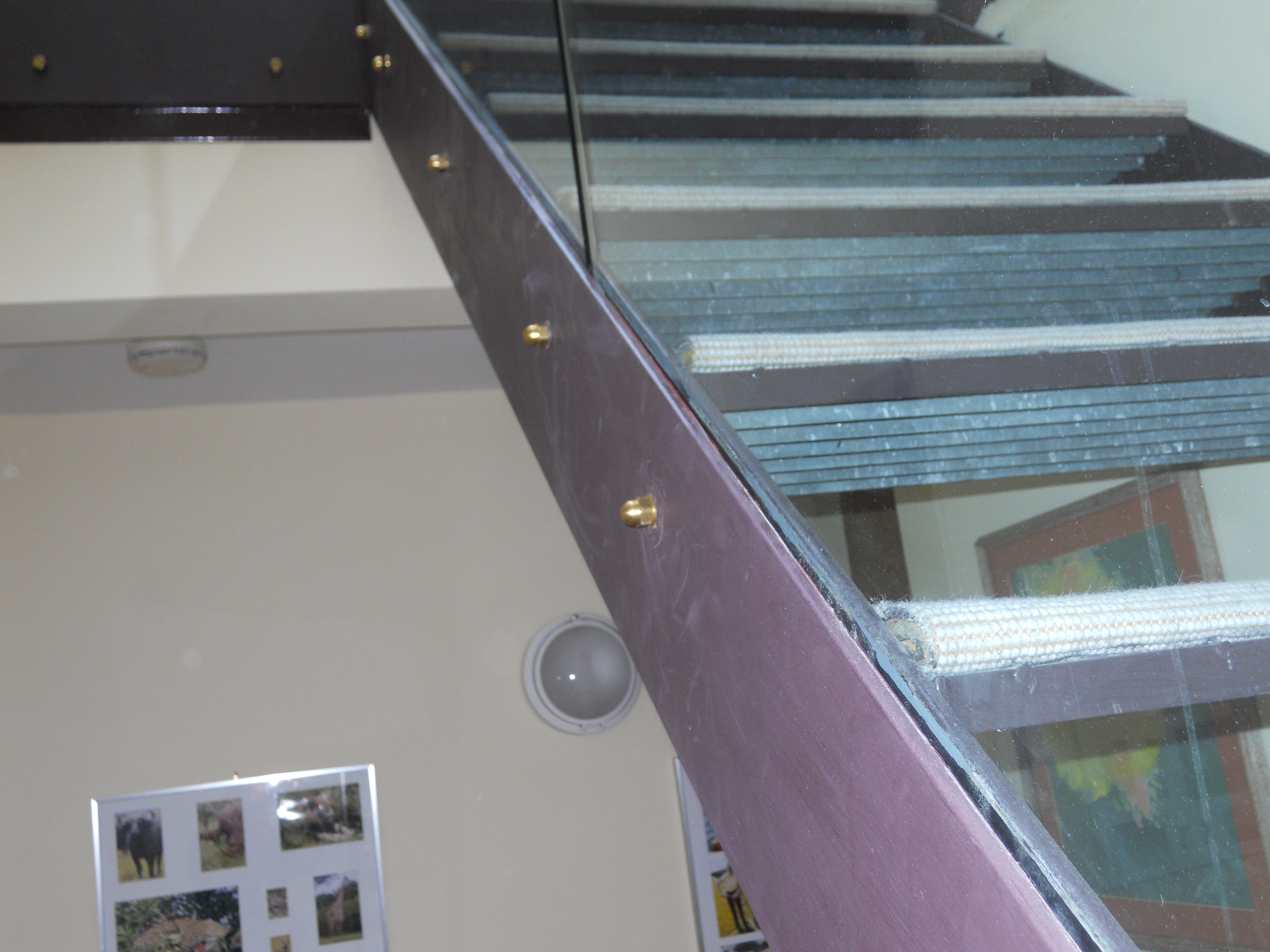
The New Bolts
Note the domed heads of the brass nuts, all round the same way.
But it’s not all perfect yet, as this picture shows.

Not All Perfect
I need to get some special bolts made with domed nuts as heads. This shouldn’t be too difficult. What complicates matters is that the steel is held to the floor using Rawlbolts, so how Jerry got two backwards I don’t know. I suspect that the best way to deal with the problem is to screw the new bolts in using some strong bonding agent.

