Inverness Airport To Get A Railway Station
This article on Global Rail News is entitled Planning application submitted for Inverness Airport station.
This Google Map shows Inverness Airport.
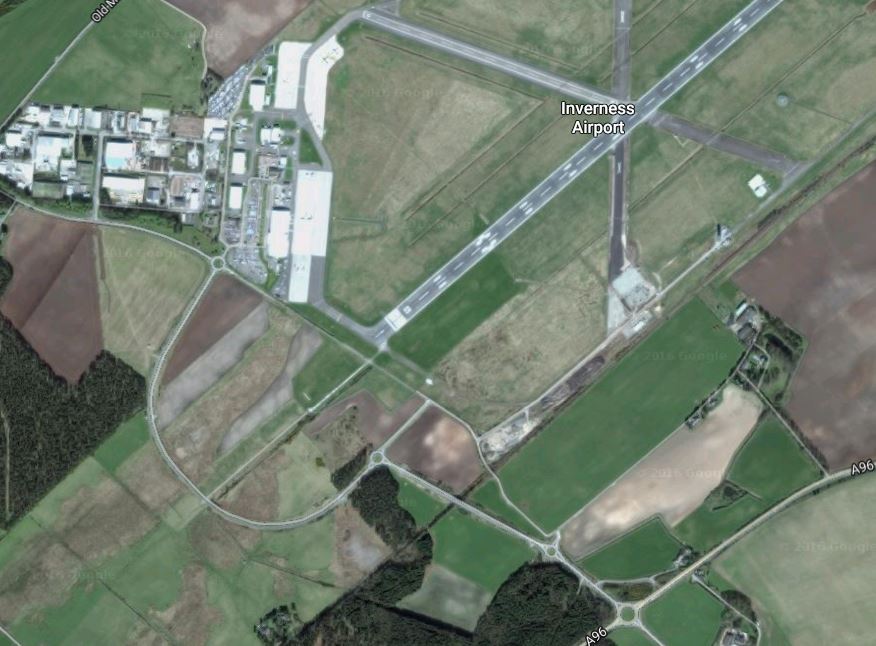
Inverness Airport
Cutting across the map, to the South-East of the Airport and parallel to the main runway is the Aberdeen to Inverness Line.
The station would be a replacement for the closed Dalcross station and Wikipedia has a section on the Proposed New Station. This is said.
In June 2006 a proposal was announced to open a new station at Dalcross, which would serve Inverness Airport and also provide park-and-ride facilities for commuters to Inverness, relieving road congestion to the east of Inverness,[9] and so helping to reduce carbon dioxide emissions. The proposal was still open in 2010, and it was specified that the station could have one platform on the north side of the line, 150 metres (490 ft) long, enough for a six-car Class 170 train.
The Aberdeen Press and Journal also has the story and says this.
The proposed location of the development is adjacent to the C1017 airport access road, between the first and second roundabouts after leaving the existing A96, at the southern corner of the airfield.
The platform will be capable of accommodating high-speed trains with five carriages and two engine cars, as proposed by operators Abellio.
So it would seem that the go-ahead has been given.
Will Crossrail And Its Class 345 Trains Set Mobile Connection Standards For The UK?
Search for “Class 345 trains 4G” or “Class 345 trains wi-fi” and you find reports like this on London Reconnections about the Class 345 train.
This or something like it, is said in several of these reports.
According to the accompanying press notes both free wifi and 4G services will be delivered on board, as will multiple wheelchair and luggage spaces.
It would be very embarrassing for London’s flagship multi-billion pound project, if it wasn’t correct.
So it would appear that I could board a Class 345 train at Shenfield and watch a video all the way to Heathrow or Reading.
But where does this leave Thameslink?
Their Class 700 trains have been designed without wi-fi, 4G and power-sockets as I said in By Class 700 Train To Brighton And Back.
But at least Siemens felt that the Department for Transport, who ordered the trains, were out of step with reality and appear to have made provision to at least fit wi-fi.
This article on Rail Engineer is entitled Class 707 Breaks Cover and it describes the Class 707 train, which is a sister train to the Class 700. This is said about the two trains and wi-fi and toilets.
Thameslink (or the Department for Transport which ordered the trains) decided not to include Wi-Fi in the Class 700s, a questionable decision that has now apparently been reversed. Fortunately, Siemens had included the technology framework in the design so, hopefully, the upgrade will not require too much effort. Suffice it to say that South West Trains has included Wi-Fi in its specification for Class 707s.
Reversing the story, Thameslink Class 700s are all fitted with toilets. However, South West Trains has decided not to include toilets in its Class 707 specification given that the longest journey time is less than one hour and their inclusion would reduce the overall capacity of the trains.
So it appears that Siemens may have future-proofed the trains.
This article on the Railway Gazette describes the third fleet of the Siemens trains; the Class 717 trains for Moorgate services. This is said.
Plans for the installation of wi-fi are being discussed with the Department for Transport as part of a wider programme for the GTR fleet.
So at least something is happening.
But how close will mobile data services get to the ideal that customers want.
- 4G everywhere from the moment you enter a station until you leave the railway at your destination station.
- Seamless wi-fi, so you log in once and your login is valid until you leave the railway.
It will be tough ask to achieve, as it must be valid on the following services.
- Crossrail
- Thameslink
- London Overground
- London Underground
- All train services terminating in London.
And why not all buses, trams and taxis?
On a related topic, I believe that for safety and information reasons, all bus and tram stops and railway stations must have a quality mobile signal and if it is possible wi-fi.
One life saved would make it all worthwhile.
By Class 700 Train To Brighton And Back
Today, I went to Brighton for lunch and a walk on the promenade to get some October sun.
I hadn’t intended to go to Brighton, but just to take the short route across London from St. Pancras to East Croydon, to see if any Class 700 trains were working the route.
However a Brighton-bound Class 700 turned up and just before East Croydon station, the conductor turned up and he offered to sell me an extension ticket to Brighton for £9.95.
So why not? As the day was sunny, I accepted his offer and as he didn’t have the right change of 5p for a tenner, he gave me 10p. in change.
Perhaps, Govia Thameslink Railway’s conductors are doing a PR job to enhance their reputation.
These pictures detail the journey.





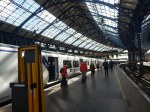

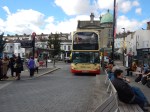
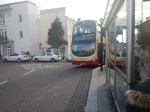
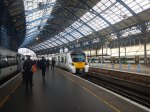
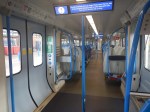
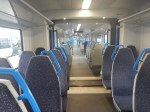
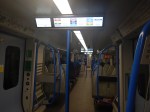

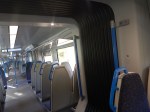





Because the journeys were deep in the Off Peak, the trains weren’t that busy.
I would describe the trains as adequate for the core route from East Croydon to West Hampstead and Finsbury Park, but they do have limitations for long-distance commuters.
- There are no tables or even anywhere to put a drink.
- There is no wi-fi.
- There are no power sockets to charge a laptop or phone.
The new Class 345 trains for Crossrail, don’t have tables either, but they do have wi-fi. But these are short-distance trains and unlike the Class 700 trains, which are taking over from Class 387 trains with tables, most of previous stock that worked from Reading to Shenfield didn’t have tables, wi-fi or power sockets.
Govia Thameslink Railway must be really pleased to get a set of trains, without some of the features their passengers demand.
To be fair it’s not their fault, as these trains were designed to fit a Passenger Focus report which can be found on the Internet, that was written in the dying days of the last Labour Government.
Read the document and draw your own conclusions.
However, all is nor lost!
This article on Rail Engineer is entitled Class 707 Breaks Cover and it describes the Class 707 train, which is a sister train to the Class 700. This is said about the two trains and wi-fi and toilets.
Thameslink (or the Department for Transport which ordered the trains) decided not to include Wi-Fi in the Class 700s, a questionable decision that has now apparently been reversed. Fortunately, Siemens had included the technology framework in the design so, hopefully, the upgrade will not require too much effort. Suffice it to say that South West Trains has included Wi-Fi in its specification for Class 707s.
Reversing the story, Thameslink Class 700s are all fitted with toilets. However, South West Trains has decided not to include toilets in its Class 707 specification given that the longest journey time is less than one hour and their inclusion would reduce the overall capacity of the trains.
So it appears that Siemens may have future-proofed the trains. To this end, when they certify the Class 707 train, they’ll certify the train for overhead electrification as well.
Looking at the way the seats are cantilevered from the side of the train, I suspect that Siemens might also have a table design in their box of delights.
I think you might have a very different usage of the trains throughout the day.
Obviously, in the Peak, the trains will be very full, but during the Off Peak, where there are obviously less passengers, perhaps a couple of tables per car, might prove to be a nice marketing feature to encourage travel.
We shall see what happens, but I can certainly see some improvement carried out to these trains in the next few years.
How To Annoy Customers
I just sent this message to John Lewis Card Services.
I shall be cancelling my card at the earliest possible opportunity.
I have a problem with my left arm, due to it being broken by the school bully and a stroke which didn’t help.
So for convenience, i don’t use any web sites that use the shift keys in passwords.
Why do people do this?
Passwords should always be able to be typed with one hand.
For instance, why couldn’t I use say “donald=13”?
No-one would guess that!
Does Brexit Mean We Need More Runways?
I ask this question, as after I wrote Changing Sides, I’ve had some thoughtful comments.
In 2015, there were seven airports that handled over ten million passengers.
- London Heathrow – 74,985,748
- London Gatwick – 40,269,087
- Manchester – 23,136,047
- London Stansted – 22,519,178
- London Luton – 12,263,505
- Edinburgh – 11,114,587
- Birmingham – 10,187,122
In addition, there are airports like Bristol, Cardiff, East Midlands, Glasgow, Leeds-Bradford, Liverpool and Newcastle, that can take a significant portion of regional traffic.
I can add these comments.
- Manchester is taking traffic from other airports in the North and Scotland.
- In a decade or so, a very high speed rail link could enable Liverpool to provide extra runway capacity for Manchester.
- Birmingham will be on HS2 within a decade.
- Manchester will get HS2 within two decades.
- Six of the top seven airports are getting improved rail links.
- Glasgow is just off the list in eighth, but does Scotland need two airports in the Central Belt?
- Cardiff is not the busiest airport and was in fact 20th.
The Airports Commission said we need another runway in the South East, but will Brexit change matters?
I have this feeling that, Brexit could mean that we actually see more air-routes opening up.
Consider.
- The British will always love their holidays in the sun.
- The UK will always be a destination for tourists and a low pound courtesy of Brexit will help.
- If the regions of the UK get more independence from London, they’ll probably look to attract more visitors.
- On past form, the City of London will survive Brexit, just as it did the Great Fire and the Blitz.
- Brexit could be an excuse for building more runway capacity.
- People love setting up airlines to lose their fortune and those of others.
- Infrastructure like railways and trams will make some airports, easier and more affordable to use.
- Travellers will get more savvy.
On the other hand, the low-cost airlines seem to be saying that traffic to and from the UK will be a lot lower and they are moving aircraft out of the UK.
I have no idea what will actually happen, but we may see some surprising things. I said this earlier.
In a decade or so, a very high speed rail link could enable Liverpool to provide extra runway capacity for Manchester.
Consider.
- The Shanghai Maglev Train has a top speed of over 400 kmh and a length of 30 km.
- Liverpool and Manchester airports are 50 km. apart.
- Liverpool Airport is alongside the Mersey.
Even if this doesn’t happen, we’ll certainly see many airports expand and be easier to use.
The debate on where the South-East gets extra runway capacity has been enlivened by Gatwick saying that if Heathrow is chosen, then they’ll build a second runway anyway.
Consider.
- Building a new runway at Heathrow will need extensive works to the M25
- Gatwick has the space for a second runway and has already shown possible runway, terminal and rail railway station designs.
- Gatwick is already a well-connected rail-hub.
- Both airports will be connected to Farringdon by modern high-capacity rail links.
- Cameron promised no third runway at Heathrow and his election still defines the make-up of Parliament.
- Most Londoners don’t like Heathrow.
- Heathrow probably couldn’t build a third runway, if Gatwick got the Government’s blessing.
We could see the Government give Heathrow their blessing, but Gatwick builds a new runway as well.
Surely two world-class airports for London, would show that a post-Brexit Britain was open for business.
I think many London residents like me, living away from Heathrow, would accept an enlargement at both airports.
You can envisage these scenarios.
Heathrow Gets A Third Runway And A Sixth Terminal
If this was the decision, the following would or could happen.
- The opposition would be vocal and possibly violent.
- Every legal experts in the field would keep the Courts going for decades.
- The moving of the M25 would paralyse the traffic to the West of London for at least a decade. Remember Terminal 5!
- All of the hassle would frighten investors away from a post-Brexit UK
Gatwick would build a second runway anyway.
Heathrow Hub
Heathrow Hub is the independent proposal shortlisted by the Airports Commission. Wikipedia describes it like this.
Heathrow Hub proposes extending both of the existing runways up to a total length of about 7,000 metres and dividing them into four so that they each provide two, full length, runways, allowing simultaneous take-offs and landings. The aim is to complete the construction within five years and with 100% private funds.
Available capacity would be doubled while keeping a percentage of the slots unused in order to alter noise levels. In addition, early morning flights could land much further west along the extended runways so reducing the noise footprint for a large area of west London.[5] Other noise mitigation techniques include using two-stage approaches, and steeper, curved climb-outs.
The Heathrow Hub concept includes a new multimodal air, rail and road interchange located approximately two miles north of Heathrow’s Terminal 5 to accommodate passenger growth. This includes a new terminal, a new railway station connecting Heathrow to the West Coast Mainline and Crossrail and direct access to the M25 motorway.
This image from the Heathrow Hub web site shows the layout with just the Northern runway extended.
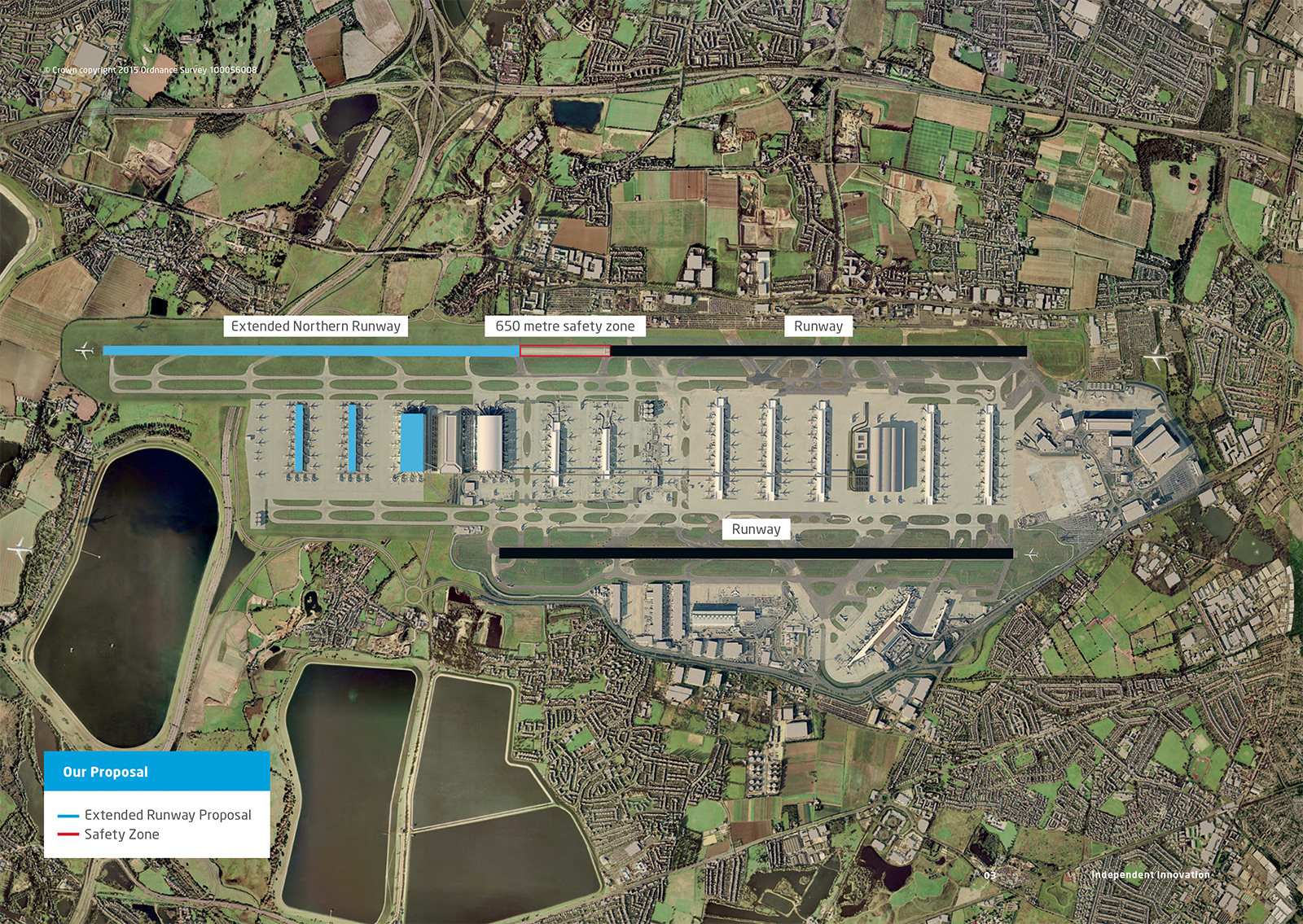
Heathrow Hub Runway Proposal
Note.
- The M25 would just needed to be put in a tunnel, as has been done at Schipol.
- The Southern runway could be expanded later to provide even more runway capacity.
- As aircraft will get smarter and be able to fly more precise paths, more noise will be kept within the larger airport boundary.
With my project management hat on, I believe that the building of the rNorthern Runway extension, a new terminal and all the connecting infrastructure could be built without disrupting the operation of the current Airport.
Heathrow Hub is the joker in the pack and it could be the surprise choice.
But I doubt it.
- The opposition would still be vocal and possibly violent.
- Every legal experts in the field would keep the Courts going for decades.
- Heathrow Airport wouldn’t like it, as they didn’t think of it.
Although, in a post-Brexit world, it could make sense.
Gatwick Gets A Second Runway
In some ways this is the option with the least amount of hassle.
- The opposition at Gatwick would be much less, than choosing Heathrow.
- There would be no traffic disruprion at Heathrow.
But Heathrow would probably fight the decision in the Courts.
I also think, that Heathrow will never give up on expansion, as there is just too much investment in the airport.
Both Airports Get An Extra Runway
This could be the Judgement of Theresa!
- Heathrow would extend the Northern runway, as detailed in the Heathrow Hub proposal, with perhaps another rail-connected terminal between the runways.
- Gatwick builds a second runway and appropriate terminals.
Consider.
- The current two-airport strategy works for London.
- Heathrow and Gatwick will soon have much-improved rail connections with an interchange in Central London.
- Both rail journeys to Central London will be around thirty minutes.
- Both runways could be built without disrupting the existing airports.
- Once the M25 is covered, Heathrow can extend the runway and gets the space for more terminals.
- Few properties would be demolished at either Heathrow and Gatwick.
- Those living around Heathrow would suffer less noise.
- A second runway fits Gatwick’s plans.
- Airlines can choose their best location as capacity increases.
- At least two runways at both airports, surely increases safety.
But the reason, I like this option best, is that it future-proofs, the airports in the South-East for a very long time.
It also creates true competition between the two airports and that can only be to the benefit of the airlines and their passengers.
This article in the Independent is entitled If Gatwick and Heathrow both build extra runways, it could mean the UK becomes future-proofed.
Add future-proofing to my list.
Conclusion
I said we should be prepared for surprises about airports.
I stand by that!
The Crossrail Mile End Park Ventilation Shaft Is Revealed
The hoardings have been partially removed from the Crossrail Mile End Park Ventilation Shaft.




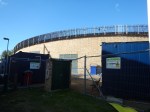

The top line of pictures were taken from the top of a 277 bus, whilst the others were taken a day later from the ground.
It’s certainly starting to look like the visualisation.

This humble ventilation and evacuation shaft could be one of the most-copied features of Crossrail.
The Mayor’s Plans For East London River Crossings
This article on the BBC is entitled Mayor accused of ‘betrayal’ over Silvertown river tunnel.
I made my feeling clear about the tunnel in No To Silvertown Tunnel . I started by saying this.
My personal feelings about the Silvertown Tunnel are that it is irrelevant to me, except that it might help some trucks bring goods that I buy online or at a local shop. Although as a sixty-eight year-old-widower living alone, I don’t think my transport needs through the tunnel will be high.
I don’t drive after my stroke and I like that lifestyle, except when last night it takes me three trains, a coach and a taxi to get back from watching football at Ipswich. But that tortuous late night journey was caused because NuLabor spent my tax money on pointless wars that will haunt us for generations, rather than in extending and renewing our rail system, that will nurture and enrich our future.
I don’t think, that I’ve changed my views much.
The Mayor is actually proposing five river crossings.

Five New Thames Crossings
Here my thoughts on each
Rotherhithe – Canary Wharf Bridge
This is detailed in Wkipedia as the Rotherhithe Crossing or Brunel Bridge.
Wikipedia says this about the location.
The preferred location for the bridge identified in the feasibility study would be between the Impound Lock close to Cascades Tower on the northern (Canary Wharf) bank, and at Durand’s Wharf park on the southern (Rotherhithe) bank.[2]
There is currently a Thames Clippers ferry shuttle between these two points. The Jubilee line parallels the route of the proposed bridge, with the nearest stations at Canada Water and Canary Wharf.
I took these pictures of the current ferry from Canary Wharf pier.
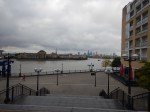



The bridge has its own web site, with a dramatic picture on the home page.
The visualisations show a bridge, that I think few would dislike. I certainly don’t!
- It’s dramatic.
- It would be open to pedestrians and cyclists.
- It would be the longest bascule opening bridge in the world.
- It would allow tall ships to pass through.
But above all I suspect that Marc and Isambard would have approved.
Canary Wharf – North Greenwich Ferry
If Canary Wharf to Rotherhithe can sustain a ferry, then surely a ferry at the other side of Canary Wharf connecting to North Greenwich with the O2, must be viable.
This Google Map shows the Thames between Canary Wharf and North Greenwich.

Canary Wharf And North Greenwich
It is not the longest ferry link, but there are questions to be answered.
- Does the ferry go right into the heart of Canary Wharf or only as far as the bank of the Thames?
- Does the ferry go all round the O2 to North Greenwich Pier or call at a new pier on the west side of the Greenwich Peninsular?
- Will the ferry be fully accessible?
- Will the ferry accommodate bicycles?
- Will the ferry be free, as is the current Woolwich Ferries?
- How many boats will be used?
I think that there could be an opportunity to design an integrated ferry and pier, that would be all things to all users.
It certainly shouldn’t be boring and if possible it should call at the heart of Canary Wharf.
Silvertown Tunnel
In my view the Silvertown Tunnel is just another route for some travellers and possibly their goods to take between the two banks of the Thames.
Categories of traffic across the river through a new Silvertown Tunnel would include.
- Individuals, groups and families, who don’t necessarily need a vehicle. But sometimes choose to take one.
- Individuals, groups and families, who absolutely need to take a vehicle.
- Vans and trucks collecting or delivering goods.
- Buses and coaches
- Taxis, mini-cabs and private hire vehicles.
One thing that has been said about the Silvertown Tunnel is that it will be funded by a toll and some reports have said that the Blackwall and Rotherhithe Tunnels will be tolled as well.
London already has a congestion charging system for areas in the centre and I suspect that this could be updated to charge for the cross-river tunnels.
We’ve never had a toll to get across the Thames in London, with even the Woolwich Ferry being free, so I suspect that a toll would reduce cross-river vehicular traffic.
Remember that, when tunnels were built under the Thames in Central London, there was few quality alternatives with the exception of the Northern and Victoria Lines and the original undeveloped Thameslink.
But over the last few years, cross-river and other public transport has been getting better. And it still is!
Consider.
- In the last year, a lot has been disclosed about Crossrail and its enormous Class 345 trains.
- We’ve also seen the opening of the new London Bridge station and can see the improvements taking place in South London.
- We’ve also seen the arrival of the Night Tube.
- Capacity is being increased on the cross-river East London Line and the Jubilee, Northern and Victoria Lines.
- We have Night Thameslink, so will we see a Night Crossrail?
Other developments will follow.
The only certainty is that we will be seeing a large increase in quality public transport, over, under and on the Thames.
I think for the first time in my life, there could be two competing ways of getting across the Thames; driving through a tunnel or using public transport.
Cost, convenience, needs and possibly an all-singing-and-dancing computer or phone app will tell you where to go.
As I said earlier, if the Silvertown Tunnel is built, it will be just another route for travellers, with perhaps a higher, but fixed cost.
If it is built, I think there should be conditions.
- The Blackwall, Rotherhithe and Silvertown Tunnels should all have tolls.
- Crossrail and Thameslink should have a great deal more Park-and-Ride capacity.
- All buses, coaches, mini-cabs, taxis and trucks in Central London should be low emission.
I also think that large areas of Central London, like the City and Oxford Street should be pedestrianised and some are on track for this to happen.
Much of the decision about the Silvertown Tunnel revolves around politics.
Sadiq Khan, has said he’s in favour of the tunnel with conditions, but he is up against a formidable movement that don’t want the tunnel built at any price.
I also find it interesting, that Ken Livingstone was in favour of the Silvertown Tunnel. But Ken brought in congestion charging.
I wouldn’t be surprised, if there’s some researchhanging aroiund in TfL, that says that a tolled road crossing will cut traffic. But it’s the sort of research no-one would believe.
So perhaps a tolled Silvertown Tunnel with conditions will be a good idea.
But only because there are now alternatives!
Gallions Reach DLR
The BBC article says this about this proposal.
A DLR crossing at Gallions Reach, helping support the development of around 17,000 new homes across Newham and the Royal Borough of Greenwich
It is different to the original proposal of a Docklands Light Railway extension to Dagenham Dock, which stayed on the North bank of the Thames.
This map shows the area of London from Gallions Reach to Abbey Wood.
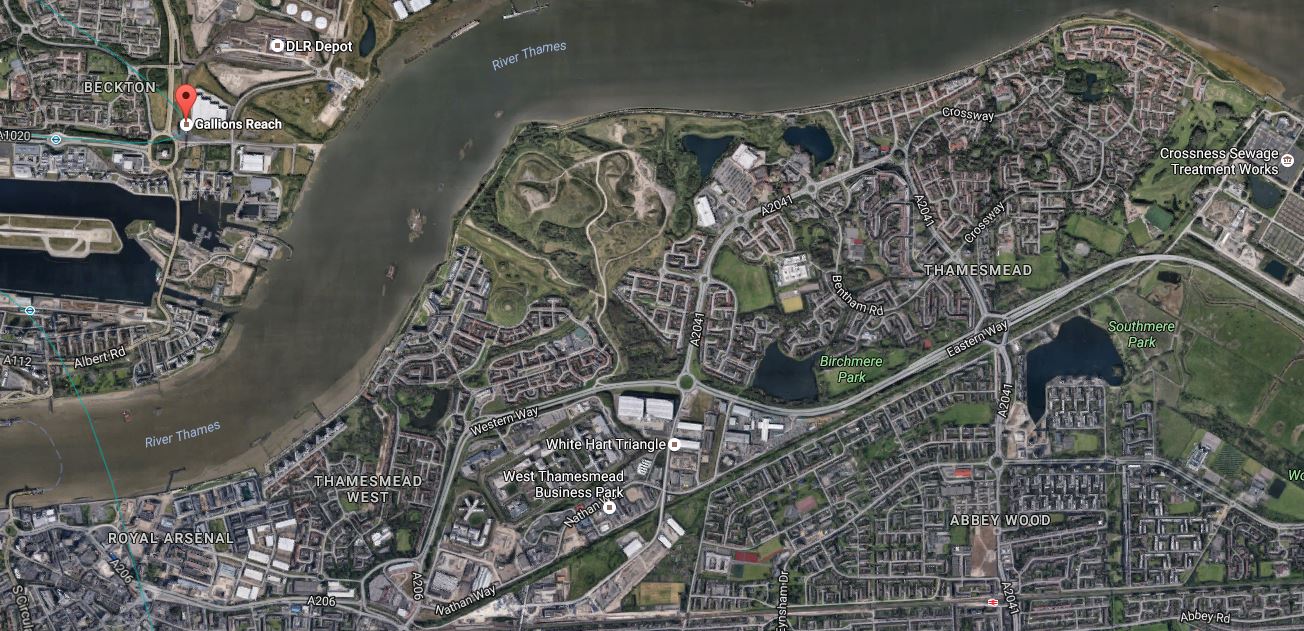
Gallions Reach To Abbey Wood
Note.
- Gallions Reach DLR station is marked with the red arrow.
- Just to the North of Gallions Reach station is the main DLR depot, which would probably be an excellent site to start a tunnel.
- The tunnel would probably emerge on the South bank of the Thames to the West of Thamesmead.
- It could then weave its way along the side of the main road.
- The North Kent Line with Abbey Wood and Belvedere stations runs along the bottom of the map.
- Crossrail could be extended to Gravesend.
- Crossrail should also be extended Ebbsfleet International for European rail services.
If the DLR extension went from Gallions Reach DLR station to Abbey Wood station it will be a loop on Crossrail serving a lot of areas ripe for quality housing and commercial development.
It certainly looks a feasible area to think about taking the DLR.
Barking Riverside Overground Extension
When I first heard about the Thamesmead Extension of the Gospel Oak to Barking Line, I thought it was a good idea.
As it is mentioned in the Mayor’s plans, I suspect that building the extension is getting nearer to reality.
Certainly provision has been made in the design of the Barking Riverside Overground Extension to extend the line under the river if required.
Joined Up Connections
If you take out the Silvertown Tunnel, which is the only one of the five crossings for which you need a vehicle, you get a route along the Thames from Canada Water To Barking.
- Walk from Canada Water to the Rotherhithe – Canary Wharf Bridge
- Cross the Rotherhithe – Canary Wharf Bridge
- Walk to the Canary Wharf – North Greenwich Ferry
- Take the Canary Wharf – North Greenwich Ferry to North Greenwich
- Take the Emirates Air-Line to Royal Victoria
- Take the DLR to Gallions Reach and on to Thamesmead
- Take the Gospel Oak to Barking Line to Barking
It’s an interesting route using various means of transport.
Three Of The Worst Stations In England
On my trip home from Swansea via the Heart of Wales Line and an overnight stop with friends in Ludlow, I came through three of the worst stations, I have encountered in England; Craven Arms, Ludlow and Shrewsbury.
Craven Arms
Craven Arms station has minimal facilities to say the least.
It certainly fails the Gert and Daisy Test.
Gert and Daisy are two elderly and very independent, travel-savvy sisters, who live in different parts of the country. Neither drives and they have arranged to go to see their first great-granddaughter, whose parents live a few miles from the station. Train times mean that they arrive within fifteen minutes from different directions and their grandson has arranged to pick them up when they’ve both arrived.
The one problem in this plan is the station, as there is no comfortable place to wait and there is no mobile signal to send a text message to their grandson to announce their arrival.
Luckily it’s a warm and sunny summer’s day.
I would like to see a law, that every station and bus stop in the country has a decent mobile signal.
In my case, I had to wait half-an-hour on a draughty station with nothing to do, as I had read the paper and there was no mobile signal to use for entertainment.
Ludlow
Ludlow station isn’t that much higher up the facilities league table.
All I needed was a taxi and the information was a set of cards on the counter in the Ticket Office.
But there was no mobile signal and eventually a passing taxi-driver took pity on me.
The station was very much an information-free zone, with not even any signs as to how to find a bus.
But surely, the most serious thing about Ludlkow station was that in the morning, the train informastion displays weren’t working, as I suspect the mobile signal they needed wasn’t available.
My phone certainly wasn’t working and it didn’t work until I got to Shrewsbury.
Shrewsbury
Shrewsbury station may have seven platforms and a few trains, but it is definitely short on facilities as I said in Shrewsbury Station.
What Is To Be Done
I have to admit, that I’ve seen stations like these treated with contempt before.
When I moved back to London in 2010, some of the stations like Rectory Road, Clapton and Manor Park, to name just three were a disgrace.
In those days, they were managed by Abellio Greater Anglia from Norwich and any complaints were put down to whingeing Londoners.
Now that these stations are all managed by Transport for London, things have got much better.
All of the three stations are run by Arriva Trains Wales, so I suspect any complaints about the stations are filed under whingeing English.
Probably too, with trains devolved to the Welsh Assembly, Arriva Trains Wales are probably under close control from their paymasters in Cardiff.
I think that the most important thing to be done would be to put the management of these stations under control of Shropshire County Council.
Incidentally, all of the trains, I rode in the area were busy and my scheduling experience probably says that the area needs more services with more carriages.
Wolverhampton To Shrewsbury
Perhaps the solution at Shrewsbury is to up the frequency of trains between Shrewsbury and Wolverhampton to create better access between the fast-growing West Midlands and Shropshire.
The service at the moment looks to be about two trains per hour (tph), but it is by no means clock face, which has been shown to increase passenger numbers.
Hereford
Going South from Ludlow, the first major city and station you come to is Hereford.
It is much better served by trains than Shrewsbury, with services to London and Birmingham.
In addition to Arriva Trains Wales, services are provided by London Midland and Great Western Railway.
I also think, that now that a new station has been created at Bromsgrove, that London Midland or the new franchisee might have plans to develop services from Birmingham to Worcester and Hereford.
Hereford, Shrewsbury And The Welsh Marches Line
The services between Hereford and Shrewsbury to Birmingham are vaguely similar , with about 2-3 tph, with trains taking between an hour and ninety m,inutes.
But neither service is clock-face and likely to attract customers on the trurn-up-and-go principle. They are more likely to drive to Birmingham or perhaps a Park-and-Ride station like Bromsgrove.
But on the Welsh Marches Line connecting Hereford and Shrewsbury, the service is less frequent and if my experiences at Ludlow and Craven Arms are typical, the information systems and the trains, are not conducive to attracting passengers.
- The trains are fine, but infrequent, crowded and managed by the Welsh Assembly.
- Mobile phone coverage is not much better that the 1980s in Suffolk.
- Broadband is not the best.
Perhaps the solution to the trains is to run a loop service from Wolverhampton to Birmingham via the following stations.
- Telford
- Wellington
- Shrewsbury
- Craven Arms
- Ludlow
- Leominster
- Hereford
- Worcester
- Bromsgrove
If it were run by London Midland, it would be a partial solution to the transport problems of those English towns along the Welsh Border.
Passing Through Shrewsbury Station
Returning from Ludlow, I came back via Shrewsbury station.


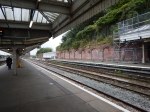
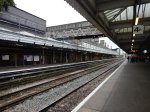
For a important place and railway interchange, the station is really not up to much, with the only facilities being toilets and a Starbucks.
 The Anonymous Widower