One New Change
I said in this post yesterday, that I would go to One New Change to check out the views.

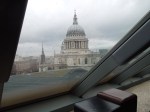
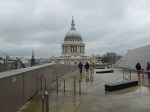

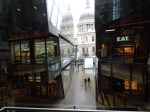





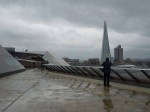
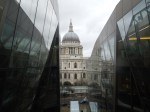


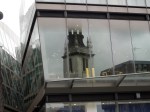


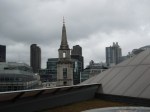

I did this morning and although the weather wasn’t good, the views from the top were stunning. I also had a pot of tea in Madison’s cafe on the roof, which did cost me £3.91. This was worth it, as I got two full cups, sat in very comfortable leather arm chairs and had magnificent views of St. Paul’s.
The charge to go to the roof is a big fat zero and for that you got a lift with views of the cathedral. Surely, if you want to have good views of London from above, this is even better value than walking to the top of Primrose Hill.
I think One New Change could be the prototype in London and other places for this type of development Only six floors high, but with a double basement, it mixes high-quality offices, shops, bars and restaurants, to create a working, shopping and visiting community. Read their ecological statement here. The building is so much better than that monstrous erection by London Bridge station; the Shard.
I know we won’t see it, as the plans are probably fully in place and approved, but wouldn’t a building with this ethos, fit well into the railway lands, between Kings Cross and St. Pancras, which will probablt be filled by more anonymous high-rise buildings.
Leadenhall Market
Despite the awful weather, today was a good day to walk through a virtually empty Leadenhall Market.


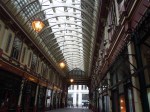
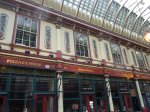
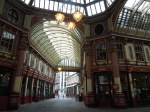


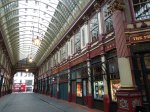

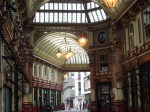
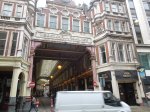
Note the date of 1990. Was that when the art students repainted the inside, as I reported here?
Wet Sundays aren’t generally that nice, but in London, they do mean that you can often walk the streets of the City more or less totally by yourself.
Construction Seems To Have Resumed At The Pinnacle
The cashpoint I used at Tower 42 was opposite the Pinnacle.
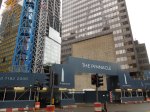


Work seems to have resumed, which must say something about the economy. Although there are reports, that they may be demolishing it and starting again. There’s a piece here in the Architect’s Journal.
No Budget; Employ Students
In the depths of The Times is a story about a walk in the City of London, with the planning officer; Peter Rees. This phrase caught my eye.
As we walk through the ornate arcades of Leadenhall Market he points to the rich roof decoration and says, “the Corporation had no budget for restoration, so I employed art students to do the job.”
Good lateral thinking. They did a very good job too!
The article also says that some of the best views of London are from the roof of One New Change, the new shopping centre in the City by St. Paul’s. I must check! There’s more about it here.
Huddersfield Station Completed The Set For Me!
It wasn’t my visit a couple of weeks ago, but when I visited all football grounds in alphabetical order in 2011, but Huddersfield station was the last of the six Grade One Listed stations still used for trains that I visited.
The others are Bristol Temple Meads, Kings Cross, Newcastle, Paddington and St. Pancras.
The combined list of Grade Two Listed stations and Grade Two* Listed stations is an odd mix. It contains six stations, I’ve either lived near or used regularly; Cambridge, Cockfosters, Felixstowe, Liverpool Lime Street, Oakwood and Southgate.
But the list also includes Bury St. Edmunds, which matches the Abbey ruins and the truly awful Harlow Town.
What Is This Strange Building By The Millennium Mills?
I passed this building whilst riding on the DLR back from Woolwich yesterday.
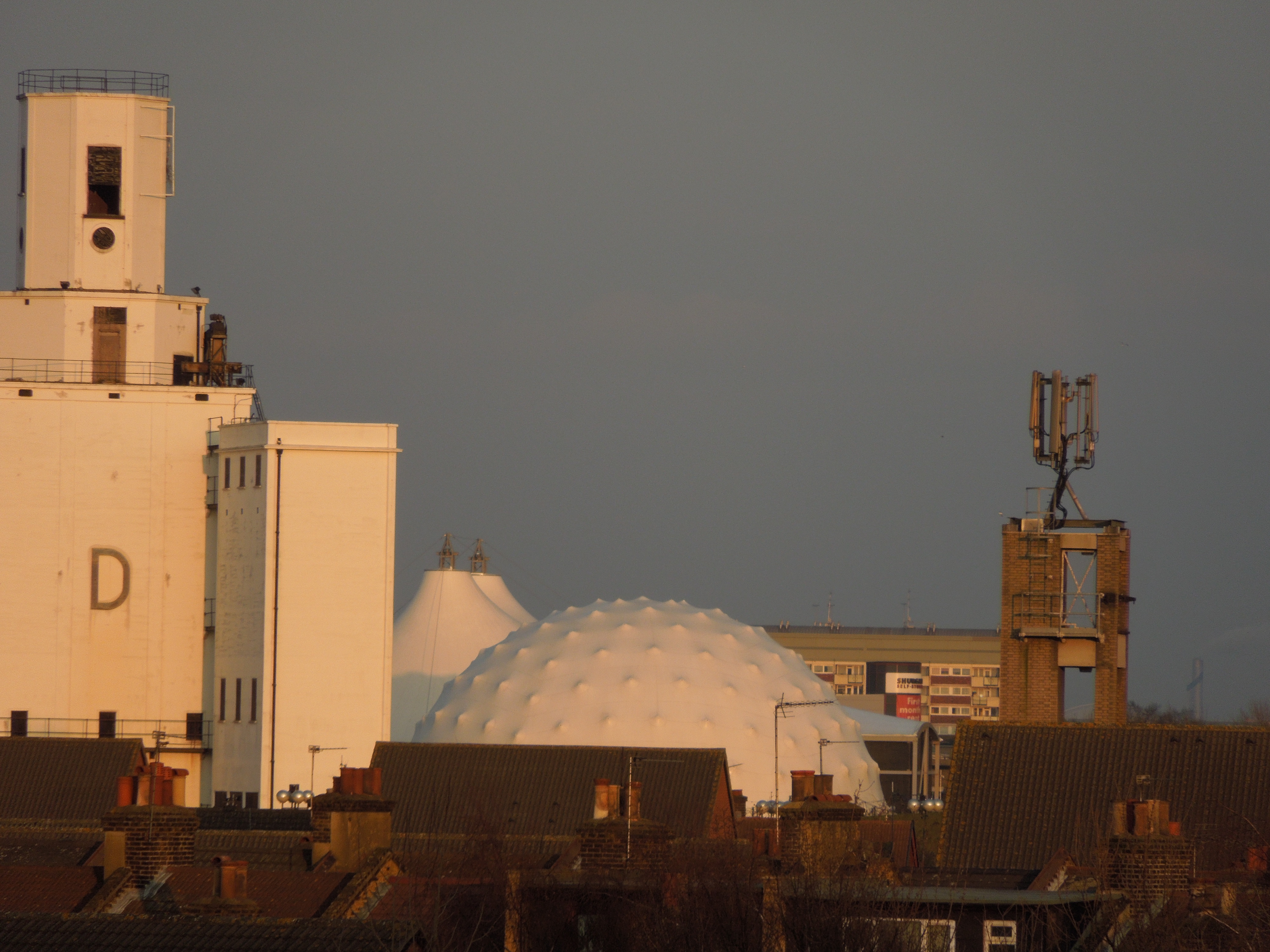
A Strange Building
I must go and find out what it is!
The white building on the left is Silo D by the Millennium Mills.
This blurb with this set of pictures says it is a circus tent.
I think I should go for an explore.
1960s Architectural Failures
Yesterday, I went to or through four stations; Highbury and Islington, Euston, Manchester Piccadilly and Huddersfield.
Huddersfield is a Grade 1 Listed Building which means it is one of the finest buildings in the country. The others are three of the worst examples of how we designed and built stations in the 1960s.
So it got me thinking about what are the worst examples of 1960s architectural design, that I’ve seen. I’ll start with the three I’ve already named.
Euston station – I probably went to Liverpool a couple of times from Euston before the current station was built and I have vague memories of catching trains there during the building in perhaps 1965 to 1967. The design shows classic “Think Small” attitudes as it was deliberately built with foundations that couldn’t support development above. Only twenty or so years later, Liverpool Street station was remodelled, which shows how good design can be applied to old buildings. Since then St. Pancras and Kings Cross have been rebuilt using similar thought processes to those used so successfully at Liverpool Street. One does wonder what would have happened at Euston, if the rebuilding had been a few years later. Euston is now to be rebuilt for HS2 and I suspect they’ll get it right this time.
Euston has another big problem, that you don’t see on the surface. The Underground station is one of the worst in London, with no step-free access, innumerable staircases and escalators and a dingy cramped ticket hall. The only good thing about Euston station is that coming off a train, it’s easy to walk to a bus, as I did last night. But try taking a heavy case on the Underground.
In some ways, Euston’s problems with the Underground should have been solved, when they built the Victoria Line, which opened at around the same time as the new Euston station. It just showed how bad project planning was in those days. The fact that the Victoria line was built on the cheap didn’t help.
Highbury and Islington station – This suffers badly because of the decision to build the Victoria Line on the cheap. Again it is not step-free and it perhaps is one of the worst stations for disabled access in the Underground, as when you get down the escalator, you then have a tunnel and a staircase to get to the platforms. At least the Overground platforms have lifts to the surface. Since I have moved to the area, the station concourse has been opened up considerably and it is not dark and cramped like it was a couple of years ago. To be fair to Transport for London, I think they’ve achieved the improvement without using tons of money. But solving the problems of access to the underground platforms will be very expensive.
Manchester Piccadilly station – This suffers in that it doesn’t have enough platforms and lines. Additionally, of all the main stations in the country, it probably has some of the worst connections to other means of transport. It makes you wonder if it was designed as a cheap stop-gap solution to accept the new electric trains from London. They are spending a fortune on the Northern Hub, but will it get rid of all the hangovers from the 1960s and all the resulting layers of sticky tape? Only time will tell, but judging by the improvement of planning in recent years, it probably will. If you want to read about planning failures in the area, read this Wikipedia topic about the Ordsall Curve, which is a crucial part of the Northern Hub. It would appear that it had the go-ahead ( and money) in 1979.
So that’s dealt with yesterday’s examples, what others can be added to this list?
Kings Cross station – Although not specifically 1960s, but a few years later, this now virtually demolished extension was best described as a wart on the face of the Mona Lisa. The man who designed it, must have had the biggest conservation stopper of all time. I can’t wait until I see the new Kings Cross plaza in the autumn.
Various stations – There were a lot of stations built in the 1960s that I don’t like, although some are listed. I would start with a short list of Harlow Town, Stevenage, and Walthamstow Central. Railways have a lot to answer for, but some of their worst excesses were reserved for buildings like this signal box in Birmingham. Many reckon that Birmingham New Street station is another bad example, but at least the operation of the station seems to be pretty good. In fact the planned reconstruction of the station; Gateway Plus, is all about greater passenger comfort. So yet another 1960s monstrosity will bite the dust. Gateway Plus has this condemnation of 1960s thinking.
The current New Street station was built to cater for 650 trains and 60,000 passengers per day, which was roughly the same usage it experienced when it was first constructed. It was believed that demand for rail travel would decrease. However, it now caters for 1,350 trains and over 120,000 passengers – twice its design capacity. Passenger usage of New Street has increased by 50% since 2000.[2] It is predicted that passenger usage of the station will increase by 57% by 2020.
We do seem to have cut corners for decades and only now the chickens are coming home to roost.
Are Bookings At The Shard Going As Well As Expected?
I ask the question, not because I want it to be unsuccessful, but this evening, I was browsing the on-line copy of The Times and an advert to visit the Shard was displayed.
I would have thought, that given the building’s prominence on the London skyline, it really wouldn’t have needed to advertise that it was open for business.
I did check The Shard’s web site and there did seem to be tickets available for the following two Sundays, although the Saturdays are sold out.
On the other hand with weather like we’ve been having, I might even pass a trip up the building. Even if it was a gift!
But articles like this one in the Daily Mail aren’t very helpful.
I shall probably go to the cable car this Sunday, but there is a slight problem in that the Docklands Light Railway isn’t running to the northern terminal.
The New Kings Cross Piazza Is Emerging
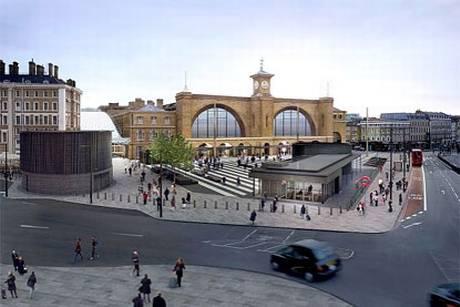
This picture shows what the area in front of Kings Cross station will look like.
Most of the demolition appears to have been completely, as this picture from today shows.
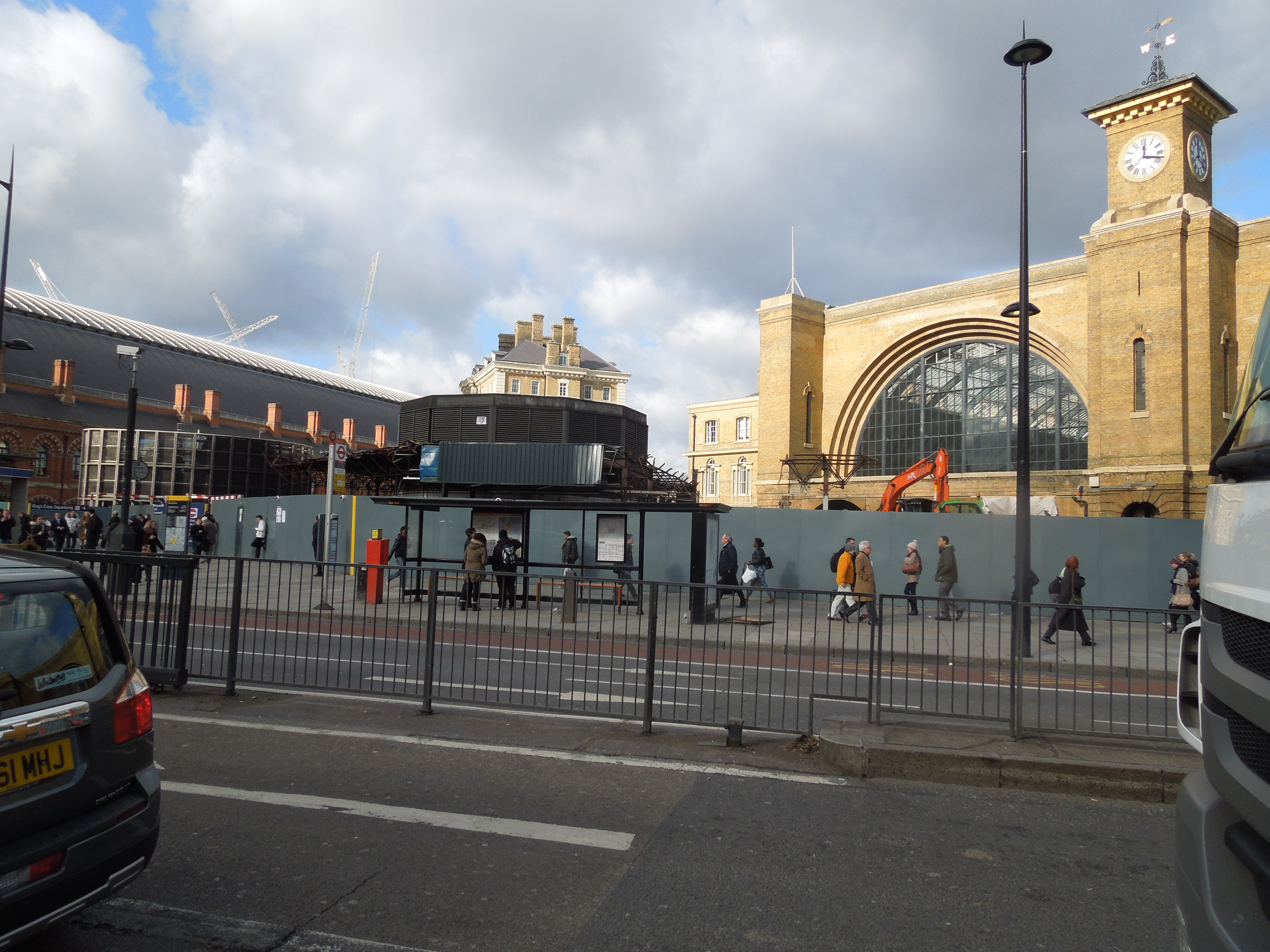
Note the short fat tower to the left of the centre of the picture. This must be the top of some sort of shaft and if you look it is also in the design of the new piazza. I bet the architects are cursing it, very loudly!
What Do You Do With Old Listed Buildings?
The old penguin pool at London Zoo is still there.

It illustrates the conundrum about what you do with old historic buildings, which have outlived their purpose, so well.
In my view it should be taken down, moved somewhere else and used for another purpose. It is totally unsuitable for its designed purpose and it takes up valuable space on a constricted site.
 The Anonymous Widower