The True Cost Of My €100 Withdrawal
I withdrew €100 from a cashpoint in Bishopsgate before I went on holiday.
I got a rate of 1.157 euro to the pound, which for my € 100 worked out at £86.42. I was then charged a Non-UK commission fee of £1.72 and a Non-UK cash withdrawal fee of £1.00. The main transaction incidentally was labelled Ulster Bank.
So as I was in Bishopsgate and did a transaction with a bank in Ulster, surely I was in the UK. So why did I get slapped for an extra charge of £2.72?
On the other hand it was probably a better transaction, than I got in Morocco, when I changed a few pounds into the local dirham.
If I was in charge of this world, I’d create a universal token, that was worth about a pound, a dollar or a euro, that you could use for small transactions on public transport, pay toilets and with street vendors. After all, many machines now accept a one pound or one euro coin.
Getting Euros In The City Of London On Sunday
I’m going on a cruise tomorrow and thought I’d get some euros, as we’re calling at Corunna, Casablanca, Cadiz, Gibraltar and Lisbon.
I did try yesterday to get s0me at the Angel yesterday, but banks don’t seem to keep them. So I took a bus this morning to Bishopsgate to this Euro Cashpoint under Tower42.
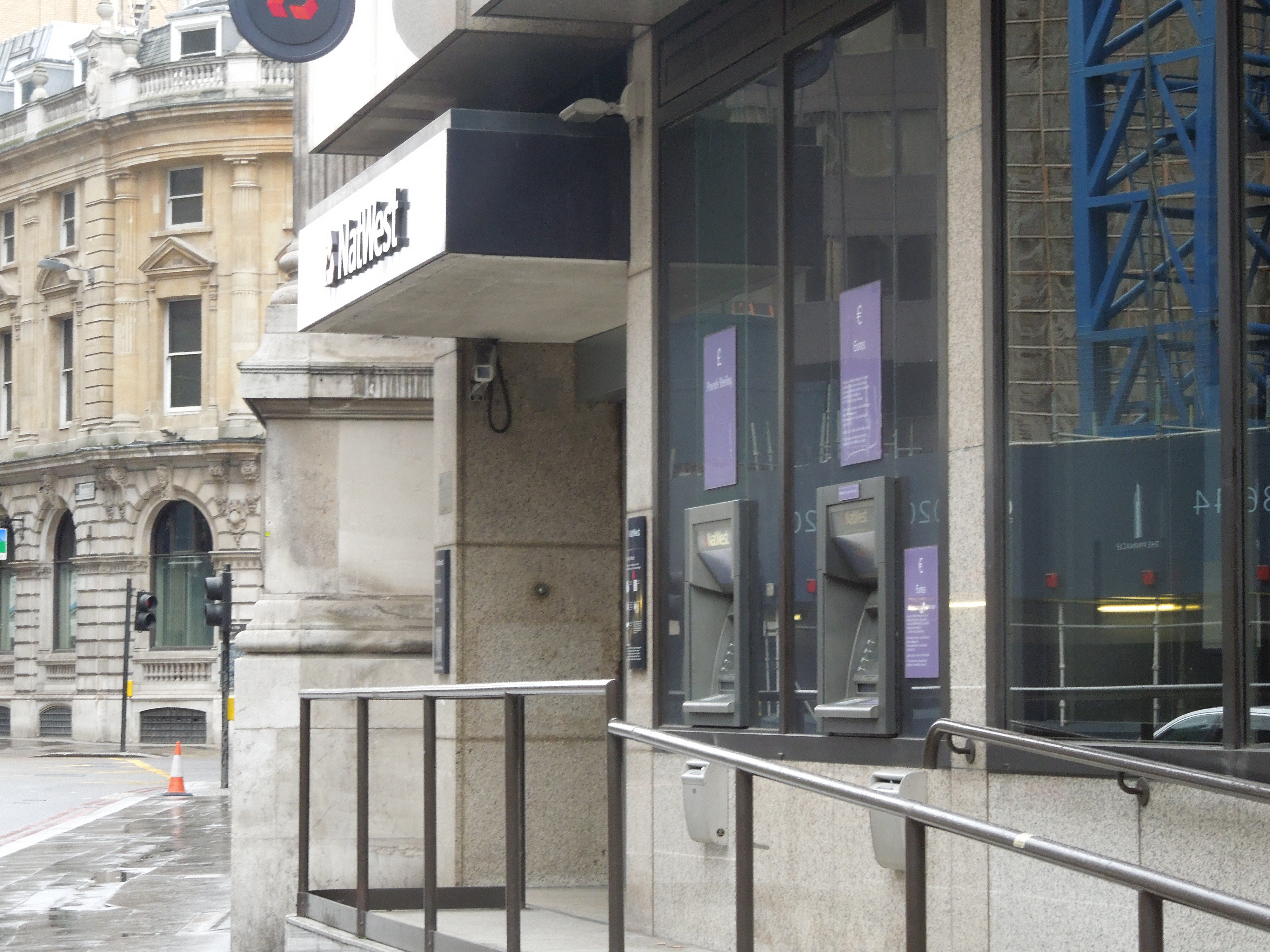
NatWest’s Euro Cashpoint On Bishopsgate
It was a lot less painless than going into and collecting some, as I’m rather allergic to queues.
I’m not sure how much the euros cost yet! But I only needed a few, and I suspect the boat might be a lot more expensive.
David’s Golden Rules And Cyprus
I’ve mentioned my late friend and bank manager, David’s rules before, so how would they apply to the Cyprus bail-out and the problems it has created.
Things have changed since he died six years ago, but the two principles he gave me still apply.
If you a UK citizen or resident, he would never have advised anybody to use a bank that was head-quartered outside of the UK, as you don’t know what external factors will apply in that country.
The second principle, was never to bank with a small bank, that has the possibility of being taken over by a man with a large ego for his own purposes. He said this, when I got an offer from Bank of Scotland, in probably the 1990s. I know that they didn’t have the Fred the Shred problem, but he felt that given the changes that would happen in banking, it might be something I would regret.
Incidentally, he was not against smaller building societies and credit unions, and once told me that he believed the latter would be strong in the future. He was wrong on that, but I think he underestimated the conservatism of the average bank account customer, who are reluctant to change banks.
So if we look at the last few years, his rules would have ruled out banking with the Icelandics, RBS and probably Bank of Scotland too!
I didn’t bank with any of them!
So what would he have thought about Cyprus. He would probably have had a very juicy tale about one of the Cypriot Banks ans of course they do break both golden rules, in that they aren’t in the UK and are two small. They may be OK, if you need a local bank account, but these days, with electronic transfers, you could probably manage it all through the Internet. I don’t know for sure, as I’ve only ever been to Cyprus as a tourist for enjoyment. Nothing in the world, would encourage me to live outside of the UK anyway!
But making account holders in Cyprus take a haircut is something, that will happen elsewhere in the eurozone, as the precedent has now been set.
In fact, if I was George Osborne, I might be having a quiet chuckle, as the Cyprus haircut, might be one of the better things that happen to the UK financially this year. Will those, EU citizens with a dodgy banking system in their country, look even more seriously at the UK as a more benign place to live?
I think too, we’ll see more innovative financial products coming out of the City of London, designed to appeal to those with money in other parts of the European Union. If you’re very rich, these products already exist, but will we see products for say the German engineer or doctor of comfortable means, who wants his money safe, to work for him and give him a comfortable retirement.
Bank Customers To Share Pain Of Cyprus Bail-Out
The Eurozone and the IMF have agreed a deal to bail out Cyprus to the tune of €10 billion, as is reported here on the BBC.
What is different though in this bail-out, is that bank depositors will also have to take some of the pain. The comment from the BBC correspondent; Andrew Walker is as follows.
It has been a long and difficult negotiation, partly because of the reluctance of other Eurozone countries to use taxpayers’ money to help foreign customers of Cypriot banks. Many of them are wealthy Russians.
There are concerns around Europe about whether all that money was legitimately acquired and also about how effective Cyprus is in dealing with money laundering.
The deal involves a levy on bank deposits intended to ensure those investors contribute to the bailout. But it will apply to all deposits – at a higher rate on amounts above 100,000 euros.
I’m personally not that sorry, that laundered money will be effectively taxed, but it does strike me, that this crisis could get a lot bigger, if the Russians get annoyed.
The Banking Sector Is A Turd
Not my words, but those of Simon Walker, the head of the Institute of Directors, as reported in The Times and also here in the Guardian.
He should know given his position.
The Banks Dismal Record On Innovation
I’ve worked on and off with senior banking professionals and those that think about their banking since the early 1970s.
In that time, I doubt, I’ve seen much really good clever innovation, that would have been to the benefit of either the banks or their customers.
I’ll start with a classic from the Midland Bank.
I was putting together a finance company in the late 1980s and the Midland Bank were keen to be a source of bulk money. We of course, had a beautiful little spreadsheet in the format of the time, Lotus 1-2-3.
The guy we were dealing with at the Bank, then said that he had no in-house facilities to examine the data. In their wisdom, the bank had provided those with a multi-user system based on a PDP-11, so they could run their own spreadsheets. Unfortunately, there was no way of uploading your data to their system. The guy we were dealing with had actually bought himself an Amstrad PC so that he could run them at home. Needless to say, we didn’t deal with Midland Bank. But what idiot in the bank, decided that PCs were a fad, when virtually all of their customers were thinking of or actually using them to run their own businesses.
The second is from the same time and applies to all of the banks.
My accountant at the time was pretty good and for years, he’d felt that one of the banes of his life was the lack of connection between the banks and small business accounting. His ideas, were that you could put a two digit code on all of your cheques in a space by the numbers along the bottom. You might put 67 for electricity, 68 for gas etc. These would then appear on your statement, so all the accountant would have needed to do was split everything down in his accounting software, especially if it was possible to get the statement in a simple electronic format.
He felt that any bank enhancing their service in this way, would have been very profitable to themselves, as they could have offered a simple accounting service. He did of course realise it would have lost accountants like him a lot of business.
But banks have done nothing to move into this area, which would have seen them offering a simple and much-needed service.
And then there was Lloyds Bank and their Cashpoints.
I was still doing my management accounting work for Lloyds as I was writing Artemis and someone there, asked how the bank could use a system like Artemis. As they were installing Cashpoints here, there and everywhere at the time, I said Artemis would be an ideal system to plan the roll out of the terminals. I did suggest, Artemis might be used to predict the cash flow and generate the budgets for the program.
I was then told that banks didn’t have cash flow problems as they used customers money and anyway, all of the Cashpoints they needed for the several year program, had already been delivered and were sitting in a warehouse somewhere. How about that for good management thinking?
The Management Accounting software I wrote for Lloyds wasn’t revolutionary in its own right, as any decent programmer could have written it, but the methods under it were far from conservative. An outsider, who had been the Chief Accountant of a major company had been recruited to try to get a hand on the bank’s costs.
It was truly innovative, but it never got beyond a trial, which seemed to end, when most of Lloyds’ staff were moved to Bristol.
One day, I’ll write up more on that work, which probably had a major effect on the design of some of the parts of Artemis.
Why Can’t I Sort My On-Line Bank Statement?
Often at the end of the month, when my current account has too much money in it, I transfer the excess I won’t need to Zopa.
This morning, I wanted to check, that I had put all of these payments into my Excel spreadsheet, that tracks my Zopa lending and calculates the rate I get.
So I logged into my bank account and looked at the on-line statement. I could of course look at it on a page-by-page basis, but where was the feature to sort all of my bank statement entries to bring direct debits to Zopa together?
No-where that I could see! There isn’t a select either to just bring up the debits to Zopa.
It is just not good enough, in this day and age, where a good proportion of the general population is familiar with handling sets of dat in programs like Excel.
I remember in probably about 1990, I was talking to a senior programmer, at one of the big banks. They had made a proposal to senior management to enable customers to get their bank statements on floppy discs. It was technically feasible and they felt it would have been taken up by customers and professionals, who needed to get the data into their personal computers.
These days, it should be second nature for a bank to offer a simple download of your bank statement in an Excel format.
Why doesn’t my bank offer this facility to everybody?
Sensible Banking Advice From Paul Lewis
Radio 4’s money expert, Paul Lewis, has just said this in the wake of more banking problems from RBS and Natworst.
Make sure your girlfriend or boyfriend uses a different bank to yourself.
Now there’s a question for on-line dating sites!
RBS Show Their Standard Of Customer Service Again
Yet again RBS and its subsidiary, NatWorst, have stopped customers from accessing their money, as is reported here on the BBC. They had a similar computer disaster last year.
I’m actually surprised that they’ve still got any customers left to annoy!
Sir Mervyn Suggests Splitting RBS
This is the gist of a story on the BBC’s web site. It’s an idea that might work, although I’m still in favour of liquidating all of the Royal Bank of UK Taxpayers.
On the other hand we could always use it as Danegeld to make unwanted immigrants go home, by giving them shares on condition they went away.
Now there’s an idea for UKIP!
It would solve the problems of immigration and RBS at the same time.
 The Anonymous Widower