New Train Service Connects Finland And Sweden For First Time In Decades
The title of this post, is the same as that of this article on the BBC.
This is the sub-heading.
A new passenger train linking Finland and Sweden has begun running, creating the first rail connection between northern Finland and southern Europe in nearly 40 years.
These three paragraphs add more detail.
Shortly after 05:00 local time (03:00 BST) on Monday, a double-decker train set off from the coastal Finnish city of Oulu, rumbling its way across the border to Sweden.
As the inaugural service crossed the Torne river from Finland and pulled into Sweden’s Haparanda station, it was met by crowds of people waving Finnish and Swedish flags.
The route was initially suspended in the late 1980s to the early 1990s, due to low passenger numbers and technical differences in the tracks between Finland and Europe.
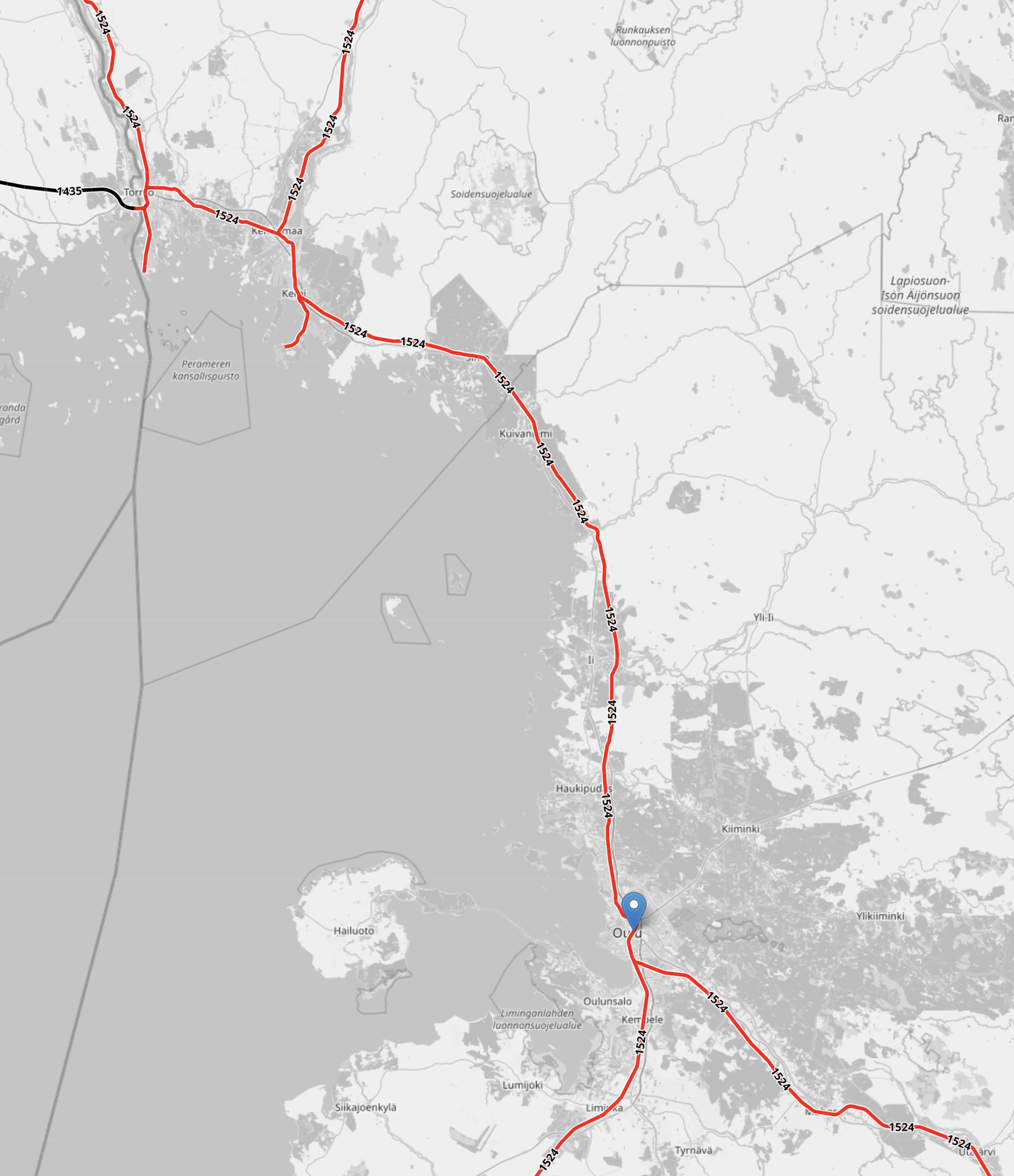
This OpenRailwayMap shows the route between Oulu and Haparanda stations.
Note.
- The map is drawn by track gauge.
- Finnish gauge tracks are shown in red.
- Swedish gauge tracks are shown in black.
- The location of Oulu in Finland is shown by the blue arrow.
- The location of Haparanda in Sweden is at the Eastern end of the black track in the North-Western corner of the map.
- The route seems very much along the coast.
- I wouldn’t be surprised that the sea views are excellent.
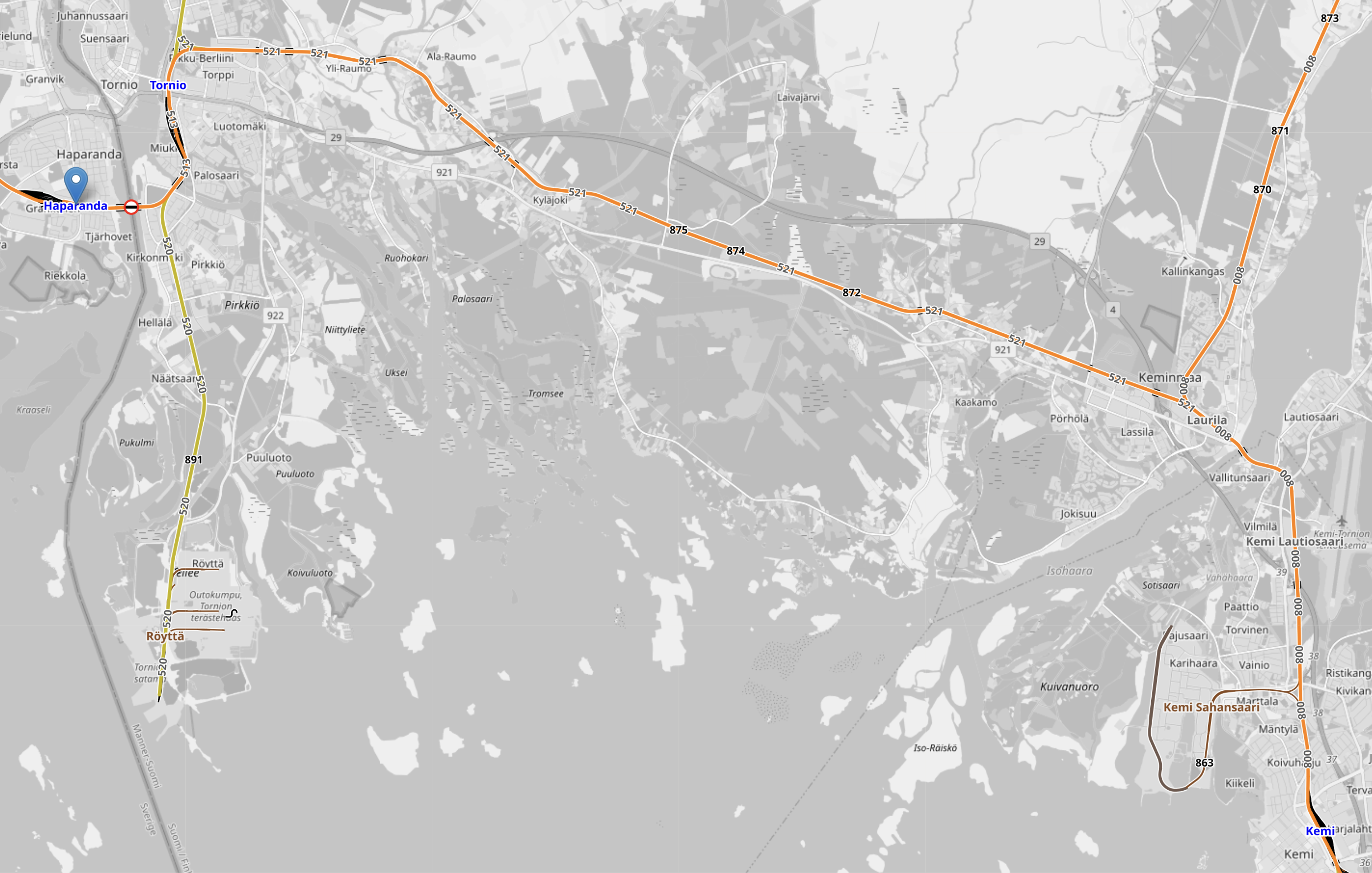
This second OpenRailwayMap shows the route between Kemi and Haparanda stations.
Note
- The location of Haparanda in Sweden is shown by the blue arrow.
- The location of Tornio in Finland is indicated by the blue lettering to the North-East of Haparanda.
- The location of Kemi in Finland is indicated by the blue lettering to the South-East corner of the map.
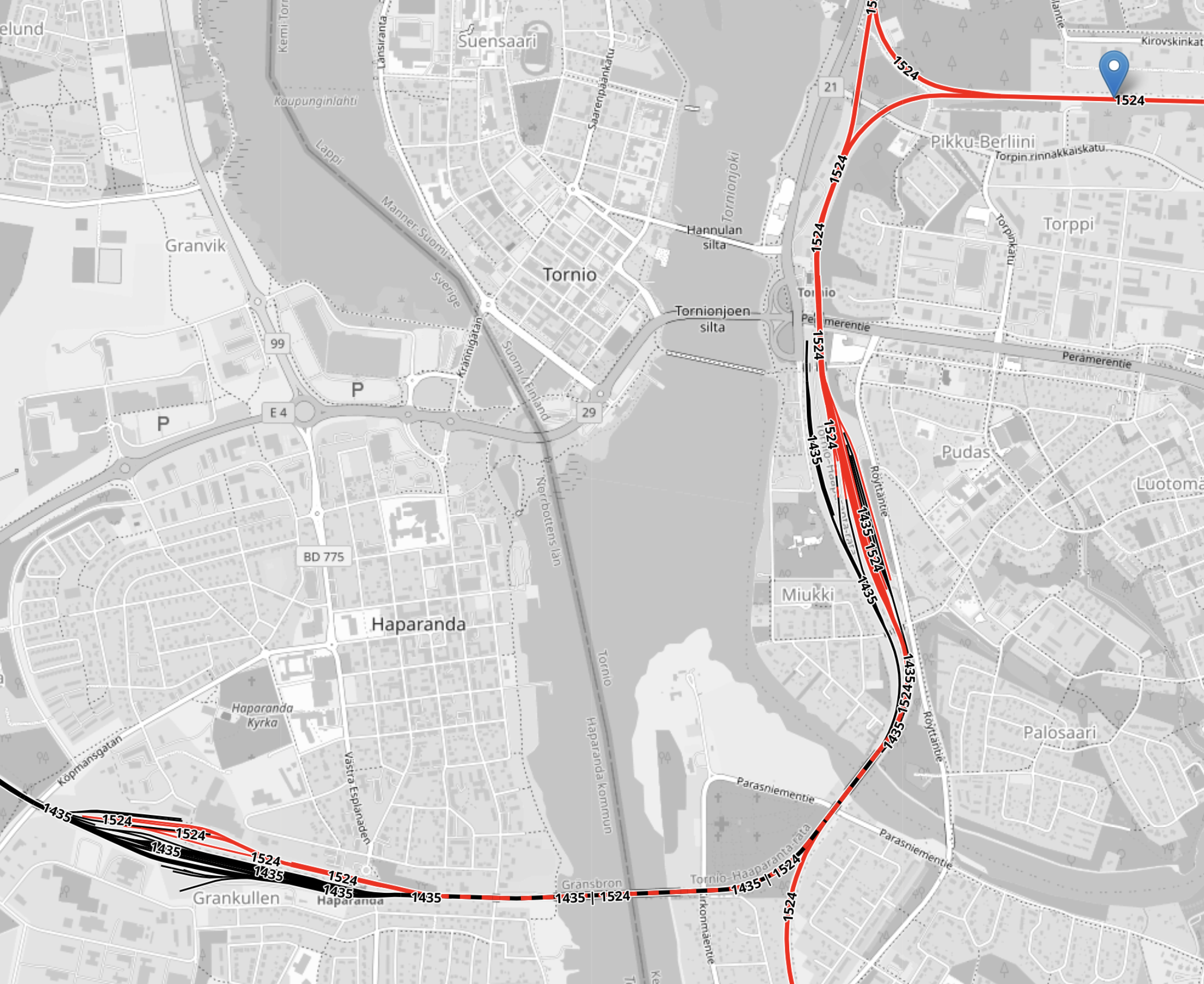
This third OpenRailwayMap shows the route between Tournio and Haparanda stations.
Note.
- The map is drawn by track gauge.
- Finnish gauge tracks are shown in red.
- Swedish gauge tracks are shown in black.
- The track to Oulu in Finland is shown by the blue arrow.
- Tornio station is by the marshalling yard on the Finnish side.
- Haparanda station is by the marshalling yard on the Swedish side.
- The track between Haparanda and Tornio is shown dashed red and black, as it accepts trains of both Finnish and Swedish gauges.
I have some thoughts.
Torne River Railway Bridge
This is is the first paragraph of the Wikipedia entry for the Torne River Railway Bridge.
The Torne River Railway Bridge is a dual gauge railway bridge on the Tornio–Haparanda railway between Haparanda, Sweden and Tornio, Finland; the bridge can be used by the 1524mm gauge trains of Finland, as well the 1435mm gauge trains used in Sweden. A temporary ice river track was built over the Torne River in 1917.
Note
How Do Trains Cross The Torne River Railway Bridge?
I asked Google AI the title of this section and received this answer.
Trains cross the Torne River Railway Bridge on dual-gauge tracks featuring four rails.
This setup accommodates both Finland’s wider 1,524 mm track gauge and Sweden’s standard 1,435 mm track gauge, allowing freight and specialized rail equipment to pass directly between Tornio, Finland, and Haparanda, Sweden, without stopping.
Bridge and Track Design
Dual-Gauge System: Four physical rails are laid on the bridge deck. They interlace the wide-gauge and standard-gauge tracks so different wheel sets fit.
Electrification: The 410-meter truss bridge and connecting line feature overhead catenary wires aligned with Finnish electric standards.
Control and Operations: Train movements across the bridge and its shared dual-gauge sections are managed by Finnish rail traffic control.
Cross-Border Travel
Freight Transport: Freight trains and containerized goods (such as shipments from Outokumpu) use the dual-gauge tracks to move directly between the marshalling yards of both countries.
Passenger Services: While regional passenger train connections operate across the border via the Tornio–Haparanda railway, regular passenger operations involve seamless station transfers at Haparanda rather than continuous through-running for all service types.
It is a simple but ingenious system.
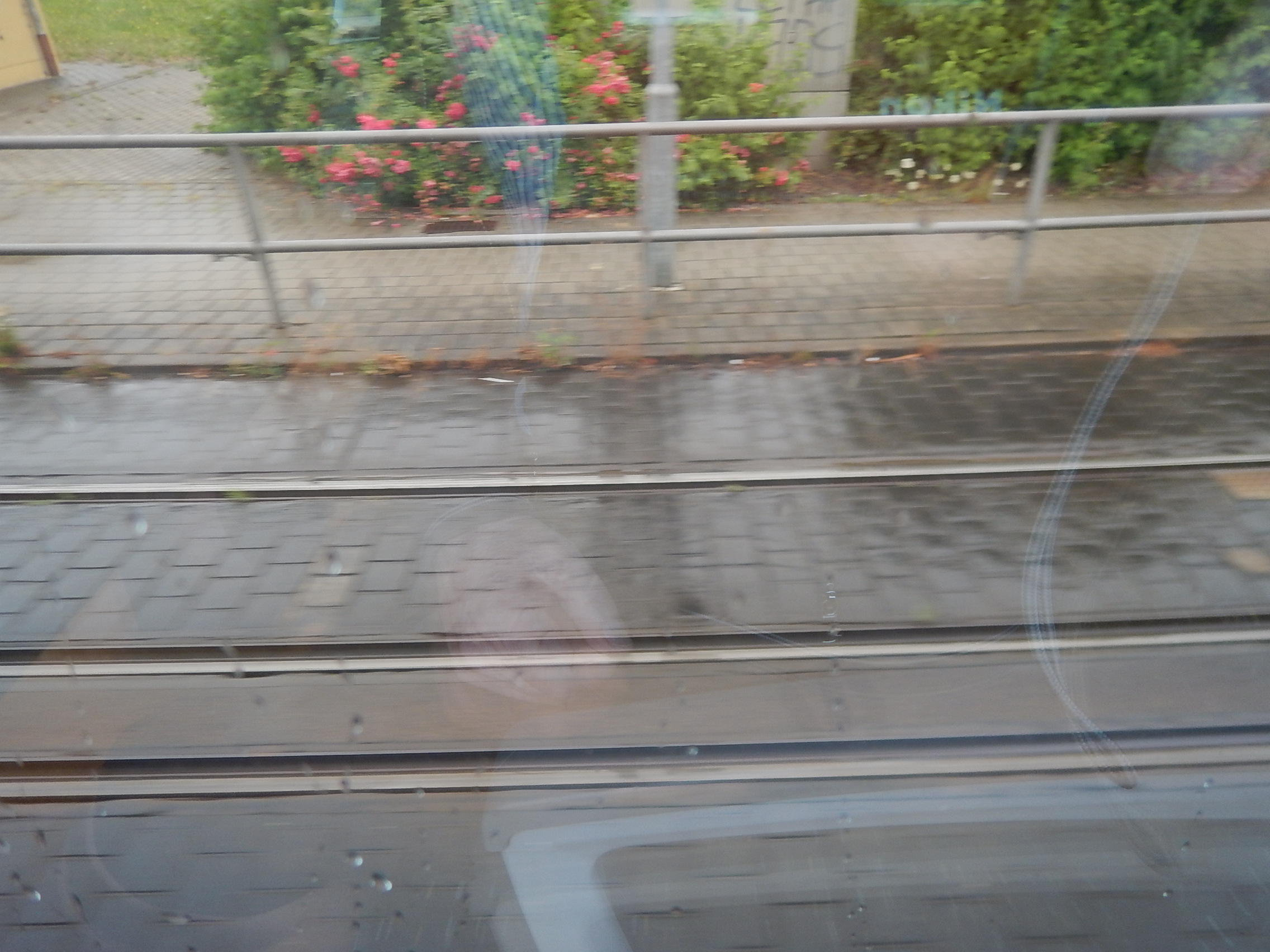
I’ve never seen one anywhere else, although I have ridden on the three rail track at Zwickau.
Note.
- Standard gauge trains use the two outer rails.
- Metre gauge trams use the two far rails, which are a metre apart.
- In the UK, all modern trams are standard gauge, so we don’t have the problem.
But say a narrow-gauge heritage railway wanted to connect into a standard gauge station, I’m sure that the Zwickau system could be used.
Do Other Bridges Use The Same Interleaved Dual Gauge Track As The Torne River Railway Bridge
I asked Google AI the title of this section and received this answer.
Yes, other rail locations use an interleaved dual-gauge track setup (technically known as a gauntletted or four-rail configuration) when two track gauges are too close together to share a common rail.
Why Interleaved Tracks are Used
Gauge Proximity: When the difference between two track widths is small (such as Finland’s 1,524 mm and European standard 1,435 mm, a difference of only 89 mm), a standard three-rail shared setup cannot fit the necessary rail-fastening hardware.
Space Constraints: Interleaving four separate rails inside the same restricted width allows different trains to cross narrow infrastructure like bridges or tunnels without building entirely separate parallel spans.
Examples of Similar Infrastructure
Russia-North Korea Border: The crossing over the Tumen River utilizes multi-gauge configurations to accommodate Russian broad gauge and standard gauge connecting to the port of Rajin.
Historical and Industrial Lines: Short interlaced stretches have been historically deployed on restricted-width civil engineering structures like the Boyne Viaduct in Ireland during structural renewals, or on specific quarry tramways (such as the Ravenglass and Eskdale Railway in the UK) to temporarily interchange standard and narrow gauge wagons.
How Will ‘The Worst El Niño On Record’ Affect The UK?
The title of this post is the same as that of this article on The Times.
This is the sub-heading.
The weather cycle is forecast to push up global temperatures, bring storms to Britain and raise food prices for everyone
These are the first three paragraphs, which outline some predictions.
The weather phenomenon El Niño is shaping up to be an unprecedented “super-event”.
The Met Office said on Friday that the natural cycle, which influences weather and food prices around the globe, is forecast to be the most powerful on record.
There have been other intense cycles recently, notably between 2014 and 2016, but the most extreme was in the 1870s, bringing droughts and famines.
I shall be following the article’s predictions throughout the winter.
My only worry is that the actions of the leaders of China, Iran, Israel, Russia and the United States will make it worse.
Ukraine Is Turning The Tide Against Putin. What Happens Next Should Terrify Europe
The title of this post, is the same as that of this article in The Telegraph.
This is the sub-heading.
A ceasefire in Ukraine would not demobilise the Russian army… It would release ex-convicts.
This is the first paragraph.
Whisper it quietly, but the tide may be turning in the war in Ukraine. Yet what comes next should worry us all.
The article is by a Lib-Dem MP; Mike Martin and it paints a frightening picture of the future.
What Is Putin’s Attitude To Rail Baltica?
Rail Baltica is a railway that the EU is building between Warsaw in Poland and Helsinki in Finland.
This is the first paragraph of the railway’s Wikipedia entry, which gives an outline of the route.
Rail Baltica is an under-construction rail infrastructure project that is intended to integrate the Baltic states in the European rail network. The project envisages a continuous rail link for passenger and freight services with stations from Tallinn (Estonia) to Warsaw (Poland), via Pärnu (Estonia), Riga (Latvia) and Kaunas (Lithuania), with two branches extending from the main line towards Riga International Airport and Vilnius (Lithuania). Its total length in the Baltic states is 870 kilometres (540 mi), with 213 kilometres (132 mi) in Estonia, 265 kilometres (165 mi) in Latvia, and 392 kilometres (244 mi) in Lithuania.
The second paragraph explains the history of the railway gauge in the area
Rail Baltica will build the first large-scale mainline standard gauge railway in the region. Rail networks in Estonia, Latvia and Lithuania mainly use Russian gauge (1,520 mm). These countries’ first railways were built in the second half of the 19th century as part of the Russian Empire rail network. While some railways were built or converted to narrow or standard gauge in the Interwar period between World War I and World War II in the independent or German-occupied Baltic states, these were later converted back to Russian gauge under Soviet occupation rule after 1945.
The Russians do seem to be protective of their gauge.
The third paragraph gives the current status of the project.
As of 2025, the completion of the phase 1 single-track railway from Tallinn through Latvia (Riga) to the Lithuania-Poland border is scheduled for 2030, with completion of the double track railway to follow dependent on funding. Rail Baltica is one of the priority projects of the European Union (EU). It is part of the North Sea–Baltic Corridor of the Trans-European Transport Networks (TEN-T) and it is also intended as a catalyst for building the economic corridor in Northeastern Europe. It has also been proposed to extend Rail Baltica to include an undersea railway tunnel between Tallinn and Helsinki. By 2024, the estimated cost of the project had increased from €5.8 billion in 2017 to €23.8 billion (at 2023 prices).
These are some characteristics of the railway.
Terminals: Warsaw and Helsinki.
Countries Served: Poland, Lithuania, Latvia, Estonia and Finland
Intermediate Stations: 8.
Electrification: 25 kV 50 Hz AC overhead line.
Operating Speed: Passenger – 145 mph.
Freight – 75 mph.
Signalling: ERTMS – L2
Putin’s Attitude To Rail Baltica
Although, I can’t talk to Putin about this, I’m sure Google AI can give us a good idea.
I asked Google AI,”What Is Putin’s Attitude To Rail Baltica?” and received this answer.
Vladimir Putin’s attitude toward Rail Baltica is one of deep hostility, viewing the 500-mile high-speed railway as a strategic, military, and infrastructural threat to Russian influence in the region.
The project, which aims to integrate the Baltic States (Estonia, Latvia, and Lithuania) with the European rail network, is seen by Moscow as an effort to sever ties with the former Soviet bloc and solidify NATO’s presence on Russia’s border.
Key Aspects of Putin’s Opposition:
Military Threat Assessment: The Kremlin views Rail Baltica not just as a civilian project, but as a crucial logistical tool for NATO to swiftly transport troops and equipment to the Baltic region, strengthening the “eastern flank” that Russia challenges.
Destabilizing Russian Sphere of Influence: Moscow perceives the integration of the Baltic States into the European infrastructure system as a direct challenge to its influence and an “imperial project” aiming to detach them further from the post-Soviet space, which Putin seeks to keep within Russia’s sphere of influence.
“Putin-Proofing” the Baltics: The project is explicitly recognized by Baltic officials as a way to “Putin-proof” their countries against Russian aggression by reinforcing their security and economic autonomy, a move the Kremlin strongly opposes.
Infrastructure Isolation: The project enables the Baltic States to shift away from the Russian gauge track (1520mm) to the European standard (1435mm), decreasing their dependency on Russian logistical infrastructure.
While the Russian state has not issued daily commentary on the railway, its overarching aggressive posture toward the Baltics, including threats to Lithuania over transit to the exclave of Kaliningrad and the use of hybrid operations in the region, indicates a fundamental opposition to projects that deepen Western integration, such as Rail Baltica.
The Three Baltic Countries Sign The Largest Railway Electrification Agreement In History
The title of this post, is the same as that as this news item on the LTG Group web site.
This is the sub-heading.
Today in Vilnius, the institutions of the three Baltic countries responsible for implementing the Rail Baltica project signed a historic agreement on railway electrification. The contract, valued at €1.77 billion (excluding VAT), has been awarded to COBELEC Rail Baltica – a consortium formed by the Spanish companies Cobra Instalaciones y Servicios S.A. and Elecnor Servicios y Proyectos S.A.U.
These three paragraphs add more detail.
The electrification of the Rail Baltica European railway is considered the largest cross-border railway electrification initiative in Europe, implemented as a single, joint project.
“Rail Baltica is more than just infrastructure – it is an economic and security link to the West. This contract is particularly important for our integration into the European railway network, enabling smooth passenger and freight transport while strengthening the resilience of the Baltic region. It is our strategic pathway to the future,” said Eugenijus Sabutis, Acting Minister of Transport and Communications of Lithuania.
One of the largest contracts in the history of the Baltic States was signed by the institutions responsible for implementing the project: LTG Infra, the infrastructure company of the LTG Group; Eiropas Dzelzceļa Līnijas in Latvia; and Rail Baltic Estonia in Estonia. Representatives from the ministries of transport and communications of all three countries also gathered in Vilnius for the occasion.
Note.
- The electrification will be to the European standard of 25 KVAC overhead.
- There will be a total of 2,400 km. of electrification.
- High-speed passenger and freight trains will operate on the full length of the route.
- It is planned that the electricity used will be generated from renewable energy sources.
- I feel everybody will be pleased except Putin.
The Russian dictator and war-monger won’t like it, as the railway will not be built to Russian standards.
KCC Leader Writes To The Minister For Future Of Roads About The Increase In Dartford Crossing Charges
The title of this post, is the same as that of this news item from Kent County Council.
Although it is a long letter, it would be wrong to publish only part of it in this post.
As the newly elected Leader of Kent County Council, I would welcome dialogue about the increase in the charge for the Dartford Crossing due to come into effect from September.
The increase is capped at £1, but this represents a 40% uplift on the current £2.50 charge in each direction for those without a pre-pay account. This is the only crossing option east of London until the Lower Thames Crossing is open (in 2032 at the earliest) and so Kent residents and businesses have no viable alternative when using this important route. The alternative is to drive into Greater London, potentially incurring a further charge for the Ultra Low Emission Zone (ULEZ), and the paying even more (£4 each way) to use the Blackwall or Silvertown tunnels.
Whilst most local residents in Dartford benefit from unlimited crossings for a fixed £25 annual fee, this ignores the fact that there is no reasonable alternative route for anyone in Kent making the journey to the Midlands, North and beyond. This is a constraint on the local and national economy.
The Crossing’s accounts for 2023-24 show that cash receipts were £221.6m with operating costs of £134.9m, leaving a net profit of £86.7m. Clearly the crossing is not on the cusp of losing money.
For the increase to be intended to manage demand, without an alternative route there is no way of managing routing, so it will only suppress the journeys for the very poorest in our society. This is hardly equitable. It will also increase costs to the supply chain which will be passed onto customers – furthering the cost-of-living pressures for so many hard-working people.
Our residents still remember that the toll was meant to end when the infrastructure was paid for, but changes in policy mean the charge has continued indefinitely. Effectively another tax for making journeys to work, visiting friends and family, and spending hardearned money at local resorts and attractions.
Given the impact on Kent is so great, there is a strong argument that KCC, as the Highways authority for Kent, should be passported a proportion of this money each year to aid the upkeep of the road network. When one considers the amount of foreign traffic that transverses Kent’s roads, alongside the amount of traffic from other counties within the UK, it is fair to say Kent is the Gateway County. And with that in mind we feel that lack of any financial benefit KCC receives from the Dart Charge needs to be considered as we struggle to maintain our road networks. This new funding stream would enable us to make a tangible difference to the condition of our Local Road Network or help fund major improvement schemes on the Strategic Road Network, including funding towards the new Lower Thames Crossing – unlocking growth and opportunities, and helping to offset the detrimental impact of the increased crossing charge. Kent occupies a strategic position between the UK and Europe, and its transport network is vital for UK supply chains and British businesses, therefore investment in Kent is an investment in the national economy.
I hope you carefully consider this possibility if you move forward with the toll increase.
Yours sincerely
Linden Kemkaran
Linden Kemkaran was elected to Kent County Council as a Reform UK Councillor.
This article on the HuffPost is entitled New Reform UK Council Leader Calls Ukraine War ‘A Distraction’.
This is the sub-heading.
Linden Kemkaran promised to take the Ukraine flag down in Kent’s county council chamber.
These are the first three paragraphs of the article.
A new Reform UK council leader has called the Ukraine war a “distraction”.
Linden Kemkaran, named leader of Kent County Council a week after Reform UK’s sweeping victories in the local elections, appeared to downplay the impact of the largest conflict in Europe since World War 2.
Speaking after she was named as council leader on Thursday evening, she promised to remove the Ukrainian flag from the chamber.
She may have a point about the Dartford Crossing, but her dismissal of Ukraine as a distraction, marks her out in my book as one of Putin’s friends.
Also published today, is this article on the BBC, which is entitled Three men found guilty of Wagner-linked arson attack in London.
As the arson attack took place in Bexley, just over the Kent border with London, I wonder what her view will be on the undoubtedly long sentences these terrorists working for Russia will receive. Are they just a distraction?
How Jewish is Volodymyr Zelensky?
The title of this post, is the same as that of this article on the Jewish Chronicle.
This is the sub-heading.
The Ukrainian President is hailed as one of the few Jewish world leaders not from Israel, but how Jewish is he
The article is a must read, as it gives a valuable insight into what drives Zelensky.
These two paragraphs describe his upbringing.
Zelensky grew up in the Russian-speaking city of Kryvyi Rih, in the eastern part of Ukraine. Like most Soviet Jews, his parents were highly educated but limited in where their careers could go. His father was a professor of mathematics and his mother studied engineering.
Zelensky said he grew up in an “ordinary Soviet Jewish family,” which was to say, not very religious, since “religion didn’t exist in the Soviet state as such.”
We could certainly do, with more world leaders, who understood science and had less religion.
It also publishes a story of four brothers that Ukrainian President Volodymyr Zelensky told Israeli Prime Minister Benjamin Netanyahu at the 75th anniversary of the liberation of Auschwitz.
“Three of them, their parents and their families became victims of the Holocaust. All of them were shot by German occupiers who invaded Ukraine,” he said. “The fourth brother survived. … Two years after the war, he had a son, and in 31 years, he had a grandson. In 40 more years, that grandson became president, and he is standing before you today, Mr. Prime Minister.”
Zelensky has come one hell of a journey and it has been very much a Jewish journey.
In addition to all the pogroms, persecutions and the Holocaust, he would probably know all the various medical problems and diseases, that members of the Jewish faith seem to have suffered, in Eastern Europe.
Today, The Times published an article which is entitled Zelensky: Putin Will Die Soon And The Ukraine War Will End.
IThe article has this sub-heading.
The Ukrainian leader says after Nato summit that the Russian president is near death and fears losing his grip on his people.
I would believe, that the Ukrainian leader is talking from a position, where he is sure of his facts, because of his Jewish heritage and what he knows of Putin’s heritage, which is partly Jewish, and his life and medical history.
Consider.
- As a coeliac, who lost his son indirectly to coeliac disease, I believe that it is a dangerous disease to have, if it is undiagnosed and you are not on a gluten-free diet.
- From some of the stories, I’ve read about Putin, I wonder, if he could be an undiagnosed coeliac. As I spent fifty years of my life that way, I know what it’s like.
- According to the NHS, coeliac disease is much more common in women and backing this up, is the fact that I’ve only ever met two male adult coeliacs.
- Is coeliac disease in Russia, very much a girly disease, that action men, like Vlad the Butcher can’t get?
- If Vlad is an undiagnosed coeliac, there could be something nasty, like a stroke or cancer lurking in his genes.
Given his upbringing, Zelensky is probably giving us, a scientific analysis of the facts about his adversary.
Appeasement 2.0
The low point of Russia’s war in Ukraine is that Trummkopf, has repeated Chamberlain’s mistake at Munich and presented Putin with Appeasement 2.0.
I wasn’t around in the days of Munich and Chamberlain, but my father was well-informed, as he was in Geneva doing something possibly at the League of Nations and heard a lot of the truth about what was going on in Czechoslovakia and Ukraine at first hand. He believed there was little to choose between Hitler and Stalin on the scale of evil.
In the 1970s, I worked with an Jewish Austrian engineer, who was called Samuels, at the GLC, who had escaped from Austria just before WW2 and then spent the war in the Royal Engineers in bomb disposal. After the war, he was an observer at Nuremberg.
He was one of the most amazing people, I’ve ever met and he taught me a lot about project management.
Aggregation In Artemis
One of the features of Artemis was aggregation, which enabled the project manager to total up the resources they’d need for a project.
I might have programmed the original aggregation for Mr. Samuels, but I can certainly remember discussing it with him. He needed it to check that particular sub-contractors weren’t overstreching themselves.
I lost contact with Mr. Samuels, when his wife died and he moved to CERN in Geneva. But he’s one of several people, who helped frame the design of Artemis.
Soviet War Crimes
This Wikipedia entry is entitled Soviet War Crimes.
This is the first paragraph.
From 1917 to 1991, a multitude of war crimes and crimes against humanity were carried out by the Soviet Union or any of its Soviet republics, including the Russian Soviet Federative Socialist Republic and its armed forces. They include acts which were committed by the Red Army (later called the Soviet Army) as well as acts which were committed by the country’s secret police, NKVD, including its Internal Troops. In many cases, these acts were committed upon the direct orders of Soviet leaders Vladimir Lenin and Joseph Stalin in pursuance of the early Soviet policy of Red Terror as a means to justify executions and political repression. In other instances they were committed without orders by Soviet troops against prisoners of war or civilians of countries that had been in armed conflict with the USSR, or they were committed during partisan warfare.
As a teenager, my father used to tell me stories of atrocities by the Soviet Union and told me, he believed Stalin was on a level with Hitler.
One of the worst atrocities was the Katyn massacre in 1940, which is described in this Wikipedia entry and starts with this paragraph.
The Katyn massacre was a series of mass executions of nearly 22,000 Polish military and police officers, border guards, and intelligentsia prisoners of war carried out by the Soviet Union, specifically the NKVD (the Soviet secret police), at Joseph Stalin’s order in April and May 1940. Though the killings also occurred in the Kalinin and Kharkiv NKVD prisons and elsewhere, the massacre is named after the Katyn forest, where some of the mass graves were first discovered by Nazi German forces in 1943.
I haven’t found out, what my father was doing in 1940, but I am fairly sure he knew of the Katyn and other massacres, as he occasionally commented.
Note.
- The involvement of the NKVD.
- The Katyn massacre is a sub-plot in the film Enigma, which has this Wikipedia entry.
I took this picture of a memorial to Katyn in the centre of Birmingham.
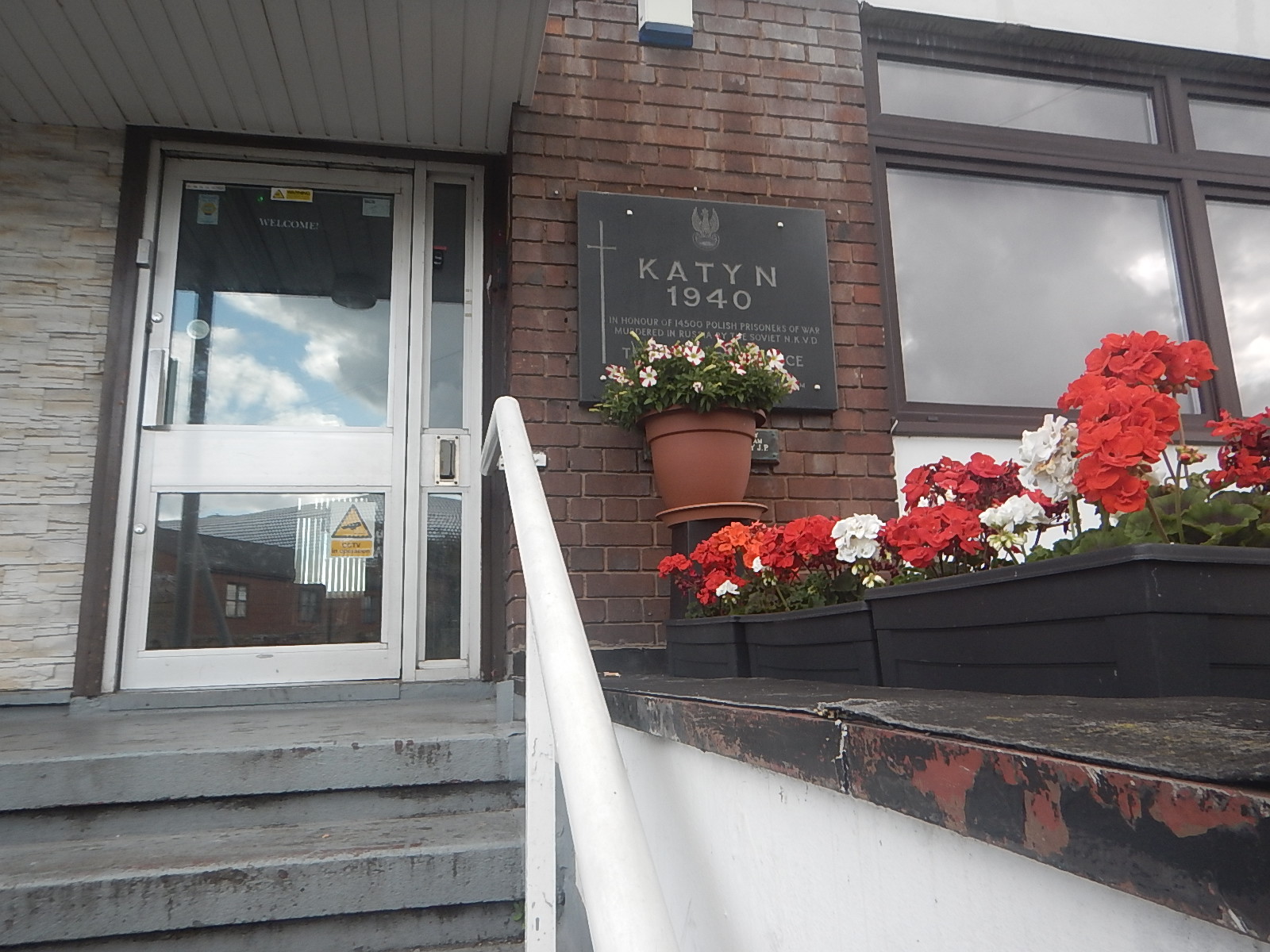
I believe that we ignore the lessons of Soviet behaviour at Katyn, at our peril.
In Vladimir Putin’s Wikipedia entry, there is this paragraph about his parents.
Putin’s mother was a factory worker, and his father was a conscript in the Soviet Navy, serving in the submarine fleet in the early 1930s. During the early stage of the Nazi invasion of the Soviet Union, his father served in the destruction battalion of the NKVD. Later, he was transferred to the regular army and was severely wounded in 1942. Putin’s maternal grandmother was killed by the German occupiers of Tver region in 1941, and his maternal uncles disappeared on the Eastern Front during World War II.
It appears that Putin Senior left the NKVD destruction battalion before 1942. Does that mean he could have been at Katyn?
I do suspect, that Putin Senior told some interesting stories to his son, about the correct ways to deal with your opponents and wage a war.
Conclusion
We are treading a very similar path over eighty years later.
Putin Apologises Over Plane Crash, Without Saying Russia At Fault
The title of this post, is the same as that of this article on the BBC.
This is the sub-heading.
Russia’s President Vladimir Putin has apologised to the president of neighbouring Azerbaijan over the downing of a commercial airliner in Russian airspace, in which 38 people were killed – but stopped short of saying Russia was responsible.
These three paragraphs give more details on the crash.
In his first comments on the Christmas Day crash, Putin said the “tragic incident” had occurred when Russian air defence systems were repelling Ukrainian drones.
Ukraine’s President Volodymr Zelensky said Russia must “stop spreading disinformation” about the strike.
The plane is believed to have come under fire from Russian air defence as it tried to land in the Russian region of Chechnya – forcing it to divert across the Caspian Sea.
Who do you think you are kidding Mr. Putin?
UK And Germany To Upgrade Some Sea Kings For Ukraine
Yesterday, the UK government issued a press release, which is entitled Landmark UK-Germany Defence Agreement To Strengthen Our Security And Prosperity.
This is the sub-heading.
A landmark defence agreement will be signed by Defence Secretary John Healey MP and German Defence Minister Boris Pistorius in London today in a major moment for NATO, and European security and prosperity. It is the first-of-its-kind agreement between the UK and Germany on defence.
This introductory paragraph, lays down the tone and objectives of the agreement.
The signing of the Trinity House Agreement marks a fundamental shift in the UK’s relations with Germany and for European security. This agreement between Europe’s two biggest defence spenders will strengthen national security and economic growth in the face of growing Russian aggression and increasing threats.
It is a wide-ranging document, but in this post, I will concentrate on one topic; Sea King helicopters, which are talked about in this paragraph.
New Ukraine support – new joint work to enable German Sea King helicopters to be armed with modern missile systems as well as work on capability coalitions.
As Ukraine is a mainly landlocked company, I do think it must be a compliment to the Sea Kings’ capabilities that the Ukrainians find the naval helicopters useful.
These three paragraphs from the Wikipedia entry for the Westland Sea King, document the history of operations of the Sea King in the Ukrainian Naval Aviation.
In November 2022, in response to the 2022 Russian invasion of Ukraine the United Kingdom announced they were donating three former Royal Navy Sea Kings to Ukraine. In January 2023, the first Sea King was videoed being used by the Ukrainian Naval Aviation.
In April 2023, the BBC did an interview with one of the co-pilots of a UK donated Sea King to Ukraine. These helicopters served in the Falklands War so they are at least some 40 years old. The co-pilot has said that the Sea King is used for rescuing pilots who have ejected, delivering soldiers, and conducting reconnaissance, among other tasks. One engineer also told the BBC: “They are old…but they have gone through modernisation, and we need them very much. I believe this is just the start of our work together.” The BBC also reports that a third Sea King is being prepared to be sent to Ukraine in the “coming weeks”. The third Sea King HU.5 was delivered to Ukraine in May 2023.
In January 2024, Germany agreed to send 6 further Sea Kings to Ukraine.
I feel the Ukrainians, with their initiative, will find the elderly Sea Kings very useful.

