Ariel On The Bank Of England
I’ve never thought that the actual building for the Bank of England, was much more than a functional one. Wikipedia says this about the building.
The Bank moved to its current location on Threadneedle Street, and thereafter slowly acquired neighbouring land to create the edifice seen today. Sir Herbert Baker‘s rebuilding of the Bank, demolishing most of Sir John Soane’s earlier building, was described by architectural historian Nikolaus Pevsner as “the greatest architectural crime, in the City of London, of the twentieth century”.
I’d thought it was much older.
As you walk alongside the building up Princes Street, it looks very much like an over-grand prison.
There is though, a gilded sculpture on the roof.
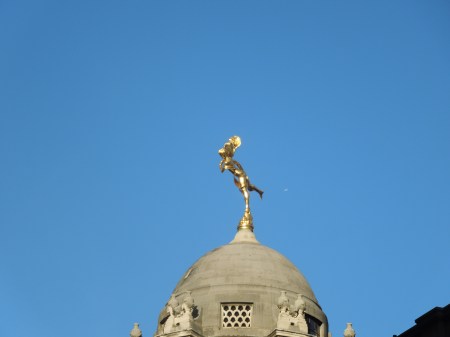
Ariel On The Bank Of England
Surely this isn’t the best place to put a work of art!
Robert Peston On Milliband’s Plan For The Banks
Now that Milliband has actually spoken it is interesting to see what heavyweight commentators are saying. The speech is reported here on the BBC and it also contains these comments from Robert Peston on what would happen if banks were limited as to market share.
Bankers have said to me this would lead to what they call a perverse outcome, that as they approached the maximum size they would dump customers they deemed low quality or loss-making.
It is unclear whether these customers would be able to bank elsewhere.
I wonder how many banks would want me as a customer, given that all I want is a money transfer company. And I don’t buy any other services from my bank, like insurance.
And I don’t see why I should pay for my banking!
Why Milliband’s Bank Plan Won’t Work
Ed Milliband’s plan to cut the Big Banks down to size described here, may be admirable, but it won’t work!
In fact I have a feeling that in a couple of years, it won’t be needed as the Big Banks will be a shadow of their former self.
Take myself, who is increasingly becoming a type of person common in this country.
I only use my bank account for one main purpose and that is to accept and receive money transfers and manage regular payments. They do provide me with a credit card, but it is not one I use daily.
My savings are stored in a separate account, which happens to be a peer-to-peer-lender, but could be a Savings Account anywhere. But more of us, are using innovative ways to keep our savings and this will increase.
I never write cheques and only ever go into a bank branch to use a cash machine, if I want to sit down to organise my money after withdrawing it.
I don’t know what percentage of the population are like me, who effectively use the bank as a money transfer company and possibly an overdraft source, whilst waiting for a payment to clear.
But it must be quite a high figure these days!
We don’t need banks at all and it is a market that people will target in an innovative way. Certainly, if a company, can give me a much better computer system for on-line banking, I’d join them like a shot.
But then banks and innovation are two words that rarely go together!
On the whole I suspect this group of customers, are probably pretty sanguine about banking and in most cases wouldn’t want the hassle of moving. I sometimes think about moving from Nationwide, but what I want is a better computer and support system and how do I find out if it’s what I want? With very great difficulty I suspect!
So Milliband’s banker bashing doesn’t impress, as we probably feel that any new bank would be more of the same grey product.
And anyway, I choose my bank, not politicians.
But a better innovative on-line bank, with a proper computer system, programmed in the UK, supported totally by the Internet and a UK call centre, with no branch premises will come.
Done properly, I’d transfer my business to it and I suspect many others would.
The other thing that would shoot Milliband’s fox, is if regulators made it possible to transfer our bank account overnight or at least in a couple of days, keeping the same account number.
One of the troubles about the next election, is that many of the people who vote will be up to their neck in Wonga and other loans and are the sort of people, a decent bank wouldn’t touch.
Bank Regulator Says Bank IT Systems Are Antiquated
This article from the BBC, tells how a senior regulator thinks that the IT systems of UK banks are antiquated. Here’s the jist.
A regulator from the Bank of England has told the inquiry into Northern Ireland’s banking system that he is a “very long way” from being able to say that UK banks have robust IT systems.
The Prudential Regulation Authority, should publish an on-line list of all the computer failures, that we could all see. After all, you wouldn’t want to transfer your account to a bank with a crap computer system, would you?
Kicking A Bank When It’s Down
I keep all the scamming e-mails, that I get sent, so I can see any trends. If for instance I were to see a large number attacking the bank I use, it would put me on alert, and I’d be very careful in checking my account.
Over the last few months, RBS and its subsidiary, Natwest have had a series of well-documented computer problems. So as customers of this group now seem to be the target of most of my scam e-mails, could it be that the scammers get a higher chance to fraudulently remove money from a customer of a bank, that has a series of computer problems, as this softens customers up.
So perhaps, if your bank continually annoys you with unavailability of the service and security lapses, you should move to one that is more reliable.
Perhaps, the Financial Conduct Authority, should publish a web site, showing all of the failures of banks, building societies and credit cards. Then we’d all be able to sort the good from the bad.
How To Lose Money Bank of Scotland Style
If we thought Fred the Shred and his crew of comedians were a wunch of bankers, this story from the Herald in Scotland is up there with his worst.
The Bank of Scotland loaned £11.2 million to an ex-banker to fund a new stadium for his football club; Dunfermline Athletic. Everybody then went bust leaving Lloyds Bank holding the baby with the gold-plated nappies. Here’s what the article says about the final outcome.
Despite being valued at £11.2m in 2011, the East End Park stadium was sold by administrators KPMG to a fan-led buyout team for just £700,000.
It strikes me, that there has been a bit of hanky-panky here. After all why would a club with average gates of a few thousand want a stadium that holds over eleven thousand? I wonder if Gordon Brown has any links to Dunfermline and its football club!
The RBS Computer System Strikes Again!
Or that’s what it looks like according to this article in the Guardian. Here’s the first part.
NatWest and Royal Bank of Scotland customers have become the victims of another technical glitch that has resulted in many being unable to pay for fuel at Tesco‘s petrol stations. Reports of the problems spread on social media after customers’ credit cards were declined when they tried to pay for fuel.
I still meet people, who bank with Britain’s most accident-prone bank! Why?
Will We Ever Get Rid of This Worthless Bank?
This report in the Guardian is depressing reading for the New Year.
If we look at the figure of £14.5bilion out of pocket, that means that all sixty three million of us will have to contribute around £230,000 each. I know some of that money will come from corporate taxes, but where do the big companies like BP, BT and Vodafone get their profits from?
If we look at the performance of the two state-controlled banks, we see that Lloyds is actually improving both in value and share price, but RBS is still an impossible basket case.
More and more, I’m coming to the conclusion that Gordon Brown’s decision to save RBS was one of the worst pieces of political judgement ever, that ranks with when Neville Chamberlain thought Hitler was a good bloke to be trusted.
I wonder how many idiots, still bank with RBS or their accident-prone subsidiary; NatWorst?
I know of one supposedly sensible guy who does, but he got a mortgage with NatWest, in the good times.
With RBS, the bill would have been lot less, if we’d put the bank down and compensated, all those individuals and companies, who’d lost money as a result.
But if he’d done that, Gordon Brown would have have lost every Labour vote in Scotland to the Nationalists.
He might though have retained power in 2010, as the rest of the UK, would have applauded his courageous action.
Now That’s What I Call A Robbery!
I was once called one of the Top Ten programmers in the world and as that was before I wrote Artemis, it is a compliment to the guy who said it, that he spotted my talent early.
I’ve never attempted to steal any money using a computer, but I have certainly had a few ideas, that I’ve kept to myself, or used in the odd unpublished short story. But this report on the BBC about how a series of cash machines were emptied, is completely unbelievable. Here’s the opening paragraphs.
Researchers have revealed how cyber-thieves sliced into cash machines in order to infect them with malware earlier this year.
The criminals cut the holes in order to plug in USB drives that installed their code onto the ATMs.
Interestingly, the crooks emptied the machines of the higher value notes first, so they could be away quickly.
This illustrates one of the big faults of the euro., compared to the pound. There are so many large notes in circulation, that the currency is a criminal’s and a money launderer’s dream. I don’t like large notes anyway!
I suspect it was an inside job, in that someone who worked for either the bank or the cash machine company was the guy behind it all.
But of course, these days, where software is produced under contract by those in far off countries, is it any wonder you get crimes like this?
I wound never put anything more than working petty cash into a bank or building society, as they’re all vulnerable to be taken out by a gang of clever hackers.
And they are a lot less vulnerable if all those in charge of the computer system and those who program it, are actually employed by the company.
Sadly, this is no longer always the case, as various calamities in the banking industry in the last few years has shown.
Don’t Rob Banks, Because They’re Much Better At Robbing You!
This wonderful statement was made this morning by Justin Urquart Stewart on BBC Breakfast this morning, as he commented on a report saying bank robberies in the UK had dropped by 90% in the past decade.
Justin must be the nation’s most recognisable stockbroker. Or is he the only recognisable one?
 The Anonymous Widower