Europe’s Biggest Battery Storage Project Goes Live In Scotland
The title of this post, is the same, as this article in The Times.
This is the sub-heading.
Zenobe’s site at Blackhillock can store surplus generation for when the wind doesn’t blow and the sun doesn’t shine
These are the first two paragraphs.
Europe’s biggest battery storage project has entered commercial operation in Scotland, promising to soak up surplus wind power and prevent turbines being paid to switch off.
Zenobe said the first phase of its project at Blackhillock, between Inverness and Aberdeen, was now live with capacity to store enough power to supply 200 megawatts of electricity for two hours. It is due to be expanded to 300 megawatts by next year.
I believe we can do better, than install large lithium-ion batteries.
We need to get the pumped storage like Coire Glas, the liquid air like Highview Power and the gravity batteries like Gravitricity going as fast as we can.
They are more environmentally friendly than Tesla’s lithium ion tiddlers and a second generation liquid air battery appears to be 200 MW and 2.5 MWh, so they can supply 200 MW for 12.5 hours.
The Blackhillock battery can do just two hours.
Two of them working as a pair, with a 1 GW wind farm, are as big as a small modular nuclear reactor, so could do the same job, with respect to power supply, using machinery and tank designs, that have been used for decades.
I suspect, that like 1960s coal-fired power stations, they would keep running for fifty years and be simply recycled as steel, copper and other scrap.
Highview Power could make Bishops Stortford famous!
Ørsted Breaks Ground On Innovative UK Battery Energy Storage System
The title of this post, is the same as that, as this news item from Ørsted.
This is the sub-heading.
Ørsted, a global leader in offshore wind energy, has marked breaking ground for its first large-scale UK battery energy storage system (BESS) with a golden shovel ceremony.
These four paragraphs give more details of the project.
Located alongside Ørsted’s Hornsea 3 Offshore Wind Farm, near Norwich, Norfolk, the system will have a capacity of 600 MWh (and a 300 MW power rating), equivalent to the daily power consumption of 80,000 UK homes.
The golden shovel ceremony officially kicks off the construction phase of the project, known as Iceni after the Norfolk-based warrior tribe of the Roman era. It is expected to be operational by the end of 2026.
Preparatory works are now complete and the Ørsted, Knights Brown and Tesla Iceni team will continue with the remainder of the installation.
When completed, the battery energy storage system will be one of the largest in Europe.
Note.
- The batteries themselves are from Tesla.
- The project was previously known as the Swardeston BESS.
- The project will be located near to the Swardeston substation to the South of Norwich.
- The project doesn’t seem very innovative to me, as it appears to be a BESS built from Tesla batteries.
Like many batteries, it is designed to supply power for two hours.
Project Fortress
Project Fortress is described like this in its Wikipedia entry.
Project Fortress (formerly Cleve Hill Solar Farm) is a photovoltaic power station under construction on the Graveney marshes between Faversham and Whitstable, Kent in the UK.
Once operational, it will be the largest solar farm in the UK, generating 373 MW of electricity from 900 acres (360 ha) of vertical solar panels and will also include 700 MWh of battery storage. Because of its size, it is a nationally significant infrastructure project so outside the standard local planning procedure.
Electricity will be exported from the project via the 400 kV National Grid substation at Cleve Hill, constructed to serve the London Array offshore wind farm that lies to the north. Here, a battery array will be placed, that will charge from the sunlight during the day and release the energy at night when it is needed.
It is one of the very few co-located solar farms and lithium ion batteries that are co-located with a wind farm in the UK.
We need more of these to balance our power supplies and improve their quality.
Octopus Energy Generation Acquires 252MW Solar And Storage Projects
The title of this post, is the same as that of this article on Solar Power Portal.
These two introductory paragraphs add more detail.
The generation arm of British energy major Octopus Energy has announced that it has acquired four new solar projects across England as part of a plan to invest £2 billion into renewable energy projects by 2030.
Four new solar farms currently under development have been acquired from renewable energy developer BayWa.re, with a combined generation capacity of 222MW. One of the sites will also play host to a 30MW battery energy storage system (BESS).
On Sunday, there was an Interview with Greg Jackson, who is the boss of Octopus in the Sunday Times, which was entitled Octopus Boss: Split UK Into Price Zones Or Bills Will Keep Rising.
I think we should watch, where Greg splashes his money.
Battery Energy Storage Park Plans Submitted
The title of this post, is the same as that of this article on the BBC.
This is the sub-heading.
A green energy company has pledged to fund up to £40m worth of community projects if a controversial battery energy storage system (BESS) in the North Yorkshire countryside goes ahead.
These three paragraphs fill out the story.
NatPower has submitted a planning application to North Yorkshire Council for the site on farmland near Thirsk.
If approved, the company said it would contribute up to £1m each year for 40 years to local businesses, charities and groups to develop “sustainable communities”.
However, campaign group Thirsk Against Battery Storage (TABS) said local residents remained opposed to the scheme.
If the developers of the BESS can afford to give forty million pounds to the community, there must be substantial sums to be made out of installing batteries like these.
I certainly believe that with the current government’s more relaxed attitude to renewable energy developments in the countryside, that we’ll see more batteries, solar panels and wind turbines on hill tops and behind barns band woods.
More and more bigger houses and small businesses will install solar panels, smaller wind turbines and batteries and find they can be independent of the grid.
‘Europe’s Biggest Battery Farm’ Built On Coal Mine
The title of this post, is the same as that of this article on the BBC.
This is the sub-heading.
Work is under way to create what has been described as Europe’s largest battery storage project at Coalburn in South Lanarkshire.
These three paragraphs add a bit more detail.
Developers say the two huge neighbouring battery farms – one at the site of a former opencast coal mine – will store enough electricity to power three million homes.
Battery Energy Storage Systems (BESS) are being built across the UK to help balance the electricity grid, which is becoming increasingly powered by renewables.
Almost 90% of the electricity generated in Scotland last year was from low carbon sources like wind, solar or nuclear, according to figures from the Scottish government.
A search of the Internet found this paragraph describing the size of the battery.
The CIP BESS portfolio (Coalburn 1, Coalburn 2, and Devilla) will have total power capacity of 1.5GW and will be able to store and supply the grid with a total of 3GWh of electricity, equivalent to the electricity demand of over 4.5 million households, across a 2-hour period.
Note.
- CIP is Copenhagen Infrastructure Partners, who are a large developer of energy infrastructure.
- It appears there are three separate 500 MW/ 1 GWh batteries being developed together.
- The batteries can supply electricity for two hours.
This looks like a sensible project in an area, where there could be plenty of spare electricity.
Competition With Highview Power
Highview Power’s web site has a Projects section, where this is said.
Scotland And The North-East, UK
Highview Power’s next projects will be located in Scotland and the North East and each will be 200MW/2.5GWh capacity. These will be located on the national transmission network where the wind is being generated and therefore will enable these regions to unleash their untapped renewable energy potential and store excess wind power at scale.
I can see Highview Power’s 200MW/2.5GWh liquid air batteries and 500 MW/ 1 GWh Battery Energy Storage System (BESS) competing for the same projects.
However, it does appear at Trafford Energy Park, both types of battery appear to be being installed.
- Carlton Power Secures Planning Consent For World’s Largest Battery Energy Storage Scheme
- Centrica Invests In Renewable Energy Storage Capabilities To Boost UK’s Energy Security And Accelerate Transition To Net Zero
Perhaps the two together give the best response?
Invinity’s New Flow Battery Aimed At Enabling ’24/7 Solar’ For The Grid
The title of this post, is the same as that of this article on Solar Power Portal.
These three paragraphs outline the story.
New vanadium redox flow battery (VRFB) technology from Invinity Energy Systems makes it possible for renewables to replace conventional generation on the grid 24/7, the company has claimed.
Anglo-American flow battery company Invinity launched its new product, Endurium, today. It follows around three years of R&D, testing, and prototyping, during which Invinity has partnered with Siemens Gamesa on technology development.
Designed for high energy throughput with unlimited cycling and with at least a 50% reduction in the footprint required for installation at project sites, the company said it could cost-competitively tackle present-day energy storage markets and emerging long-duration energy storage (LDES) opportunities alike.
This looks like it could be a bit of a breakthrough.
After reading this article, it would appear that traditional lithium-ion battery energy storage systems (BESS) now have another competitor along with Highview Power’s liquid air battery.
Buccleuch Group Submits Plans For 39MW Solar, 10MW Storage Development
These are the two introductory paragraphs.
Solar and storage developer Buccleuch Group has submitted a planning application for a new solar plus storage development near Kettering, Northamptonshire.
The Oakley Bush solar and battery energy storage system (BESS) project is a proposed 39MW solar development, with a 10MW BESS proposed for the site. The application area, which covers 150 hectares of land on the Boughton Estate, could play host to as many as 130,000 ground-mounted solar modules, positioned around 3.5 metres above the ground.
The development is interesting for two reasons.
It Is Being Built With Both Solar Panels And A BESS
As a Control Engineer, I believe renewable power systems should have a battery, to even out the power.
The Batteries Could Be Vanadian Flow Batteries
The article says this about, the use of vanadium flow batteries.
According to the application documentation provided to Kettering District Council, two BESS technologies are being considered for use on-site: lithium-ion batteries or vanadium flow batteries. If vanadium flow batteries are used, the site could have an energy capacity of up to 50MWh, although this will be lower if lithium-ion batteries are used.
In a presentation given at a public information event for the project earlier this year, the developers noted that vanadium flow battery technology is being considered due to its significantly lower fire risk and longer lifespan than lithium-ion batteries. An operational lifespan of 40 years is expected for the site, with construction expected to take 18 months if planning consent is granted.
Note.
- Vanadium flow batteries appear to be larger.
- Vanadium flow batteries have a lower fire risk.
- Vanadium flow batteries have a longer life span, than lithium-ion.
With other batterers coming through, I wouldn’t be surprised to see costs, performance and reliability of batteries improve.
Lakeside Facility Connects To Grid And Becomes UK’s Largest Transmission Connected Battery
The title of this post, is the same as that of this press release from National Grid.
These three bullet points, act as sub-headings.
- National Grid plugs TagEnergy’s 100MW battery project in at its Drax substation.
- Following energisation, the facility in North Yorkshire is the UK’s largest transmission connected battery energy storage system (BESS).
- The facility is supporting Britain’s clean energy transition, and helping to ensure secure operation of the electricity system.
This paragraph introduces the project.
A battery storage project developed by TagEnergy is now connected and energised on the electricity transmission network, following work by National Grid to plug the facility into its 132kV Drax substation in North Yorkshire.
- Lakeside Energy Park’s 100MW/200MWh facility is now the largest transmission connected BESS project in the UK following energisation.
- The new facility will boost the capacity and flexibility of the network, helping to balance the system by soaking up surplus clean electricity and discharging it back when the grid needs it.
- To ensure a safe connection, National Grid, working with its contractor Omexom, upgraded its Drax 132kV substation to accommodate the additional clean power.
- Works included extending the busbars – which enable power flows from generation source on to power lines – upgrading busbar protection and substation control systems, and installing an operational tripping scheme, all of which helps keep the network stable and operating securely.
Owned and operated by TagEnergy – with Tesla, Habitat Energy and RES as project partners – the newly-connected battery will help exploit the clean electricity potential of renewable projects in the region, storing and releasing green energy to power homes and businesses and also helping to relieve any system constraints.
National Grid’s adjacent Drax 400kV substation already hosts the connection for Drax power station – the UK’s largest biomass facility – and will also connect the Eastern Green Link 2 electrical superhighway when it starts importing clean energy from Scotland in 2029.
Drax power station seems to be growing into a large node with several gigawatts of electricity, the UK’s largest BESS, a large biomass power station and the Eastern Green Link 2 electrical superhighway which will import clean energy from Scotland from 2029.
Drax appears to be transforming from the dirty man of the UK into a Jolly Green Giant.
I can see further power stations and sources, storage devices and technology joining the party at Drax.
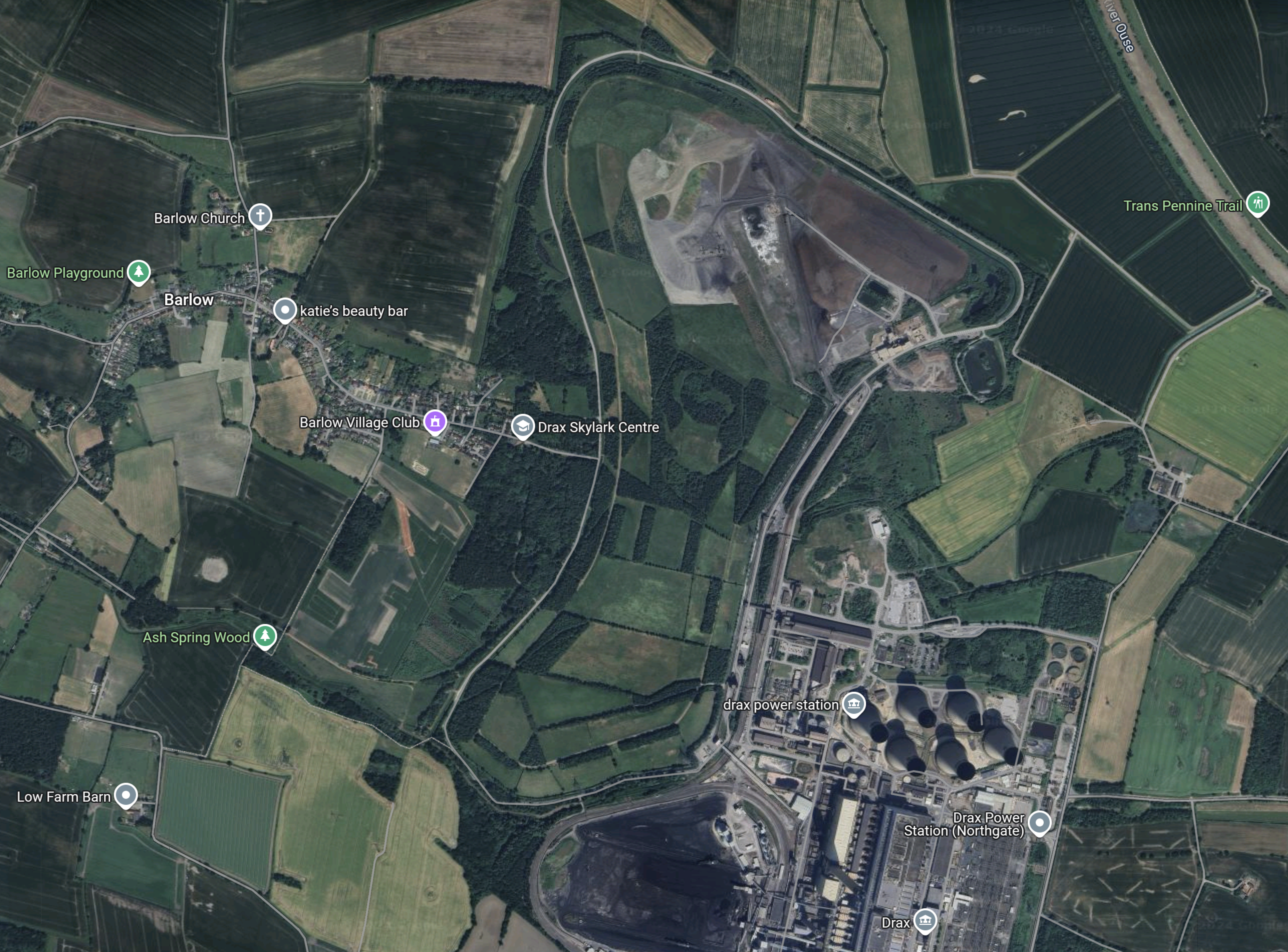
This Google Map shows the Drax site.
Note.
- The cooling towers can be picked out in the South-East quarter of the map.
- The site is rail and road connected, with the River Ouse nearby.
- There is a lot of space.
Surely, Drax would have a big enough space, with a high quality and high capacity electrical connection for Ørsted and Highview Power to put one of their three 200 MW/2.5 GWh batteries, that I talked about in Centrica Business Solutions And Highview Power.
German Firm Plans To Build Britain’s Biggest Solar Farm
The title of this post, is the same as that as this article on The Times.
These three paragraphs outline the project.
The developers behind a controversial solar power project in Oxfordshire have submitted a planning application for what is thought will be the largest such scheme in western Europe.
The site in Botley West is being developed by Photovolt, a German company, and could generate 840 megawatts (MW) of electricity, enough to power about 330,000 homes.
However, the project has sparked a backlash among some local residents, who argue the scheme will blight the landscape.
A map shows the site and it is certainly a large one.
- The Botley West site will cover a total of about 3,200 acres.
- It will pass through 15 villages.
- About 1,235 acres will not be covered with solar panels.
- It has a web site, which gives more information.
- There is also a Stop Botley West web site.
I can certainly understand the opposition.
These are my thoughts.
I Would Add A Battery To The Panels
An added battery would undoubtedly smooth the output of the solar panels. Especially, when the sun is not out to play!
A total capacity of 840 MW is planned for Botley West and in my opinion as a Control Engineer, a sizeable battery is needed.
I would not use a Battery Energy Storage System or BESS based on lithium-ion batteries, as I believe that Highview Power’s liquid air batteries and others offer cost and environmental advantages. But that is one for the accountants and the environmentalists!
I Might Add A Few Appropriately-Sized Wind Turbines To The Farm
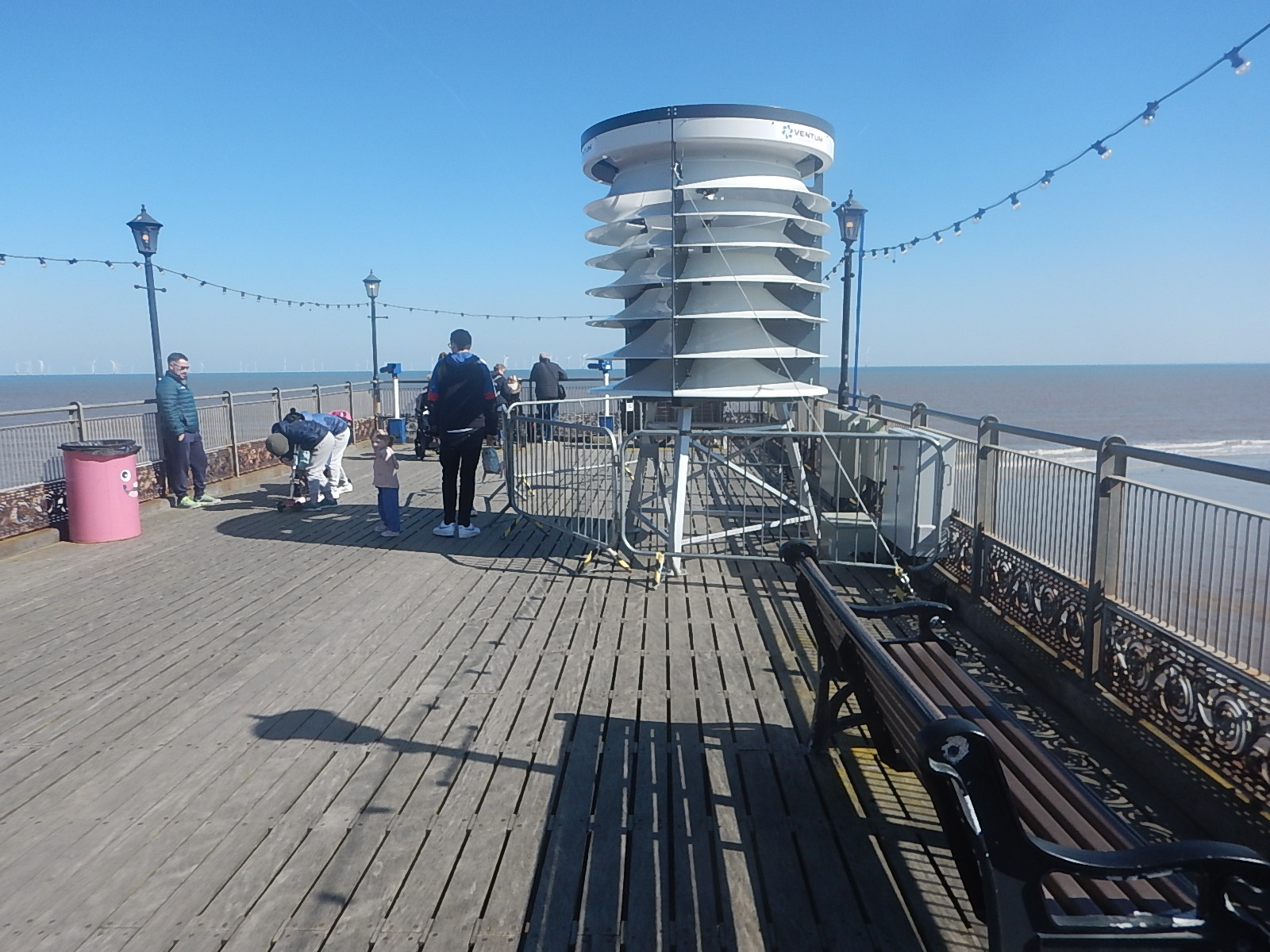
In Skegness Wind Turbine Trial To Light Up Pier In UK First, I discuss using small, vertical wind turbines from a Norwegian company called Ventum Dynamics.
This picture shows a Ventum Dynamics turbine on Skegness Pier.
On the Ventum Dynamics web site, there are several pictures of buildings with flat roofs, that have several turbines on each.
Surely, if you’re installing a comprehensive electrical network, then it should be used to collect all the electricity it can.
I believe that Ventum’s turbines could be alternated in a line with trees, so that they merged more into the countryside. Some experiments need to be done.
I Would Also Fit Solar Roofs To Suitable Buildings
Every little helps!
Conclusion
When mixing solar panels and wind turbines into the countryside, you need to be bold and discard preconceived ideas.
 The Anonymous Widower