Options For High Speed To Hastings
The May 2017 Edition of Modern Railways has an article entitled Kent Capacity Constraints Highlighted.
One sub-section is entitled High Speed To Hastings and it lists options as to how high-speed services could be run to Hastings via Ashford International station and the Marshlink Line.
Before I list the options, I’ll list a few facts and questions about the current service to Hastings, the various lines and stations.
Ashford International Station
This Google Map shows Ashford International station.
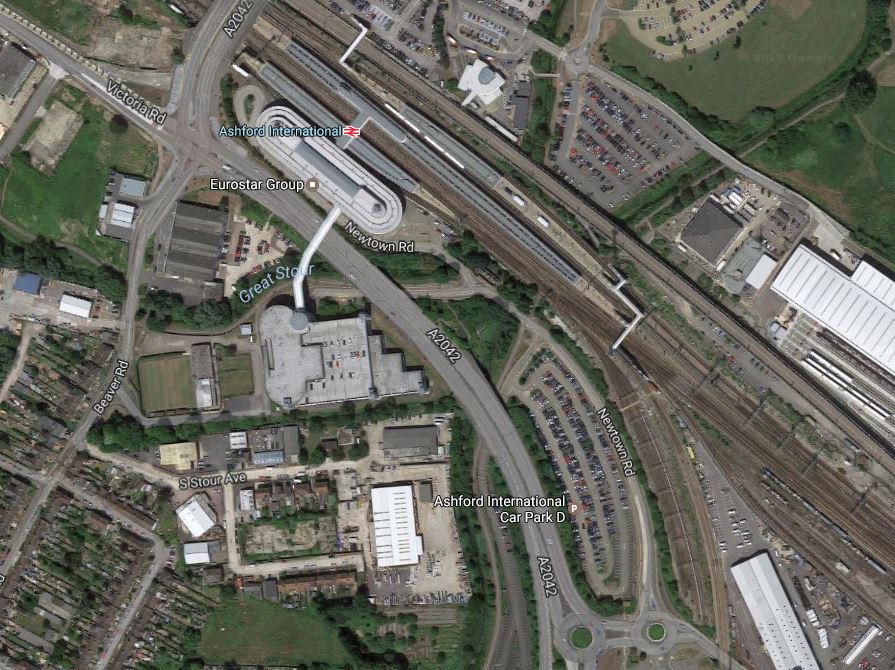
Note the Marshlink Line goes off the map to the East of the two small roundabouts at the bottom.
The biggest factor that needs to be considered is that some form flyover or dive-under may be needed so that trains can run between the Marshlink Line and the two platforms on the North side of the station, where Highspeed services to and from St. Pancras International call.
Will All Highspeed Services Using The Marshlink Line Stop At Ashford International Station?
Consider the following.
- Passengers might like to go between places on the South Coast, like Hastings and Brighton, and Europe, by changing at Ashford International station
- If a voltage change were needed, Ashford International station is already used for this purpose.
I would think it unlikely that services would not stop at Ashford International station.
Class 395 and Class 80x Trains
The Class 395 trains and the various forms of Class 800 trains are all members of Hitachi’s A-Train family.
The Class 395 trains have the following features.
- Dual voltage
- 6-car sets.
- 140 mph on HS1
- 100 mph on DC Lines
- Automatic coupling and uncoupling.
The Class 800 and Class 802 trains have the following features.
- Electro-diesel
- 25 KVAC only.
- 5- and 9-car sets.
- 140 mph on HS1 (Stated in Modern Railways)
- 100 mph on diesel power only.
- Automatic coupling and uncoupling (assumed)
The only difference between Class 800 and Class 802 appears to be the size of the full tanks and manufacturing site.
I would think it unlikely, that Hitachi could not produce a Class 80x train with the following features.
- Electro-diesel
- Dual voltage
- 6-car sets
- 140 mph on HS1
- 100 mph on diesel power only.
- 100 mph on DC Lines
The trains could even have a Class 395 style interior.
Looking at the Class 395 and Class 80x trains, I suspect that these trains could be built, so that they could automatically couple and uncouple with each other.
This coupling ability would be important.
- Hastings and Thanet services could couple and uncouple at Ashford International.
- Class 80x trains could be used instead of Class 395 trains for operational reasons.
- It would make it easier to rescue a stalled train.
There is also this document on the IEP Trains web site, which is entitled Technical & Build Specifications Of The IEP Trains, contains a lot of useful information.
- Five-car electro-diesel trains have three power units.
- Nine-car electro-diesel trains have five power units.
- Electric trains have a small generator that can be used to slowly move a train stranded by overhead power failure to a safe place for passengers to disembark.
Nothing is said about batteries, but Hitachi have run battery trains in Japan.
I would be very surprised, if the A-train family was not designed, so that it could incorporate batteries, when the technology has been sufficiently developed
The Current London To Hastings Timings
Fastest timings I can find are as follows.
- London Cannon Street to Hastings – 1 hour 48 minutes
- London Charing Cross to Hastings – 1 hour 51 minutes
- London St. Pancras to Hastings – 1 hour 36 minutes, which a change at Ashford International
- London Victoria – 2 hours 1 minute.
I think the surprising time is the one with a change at Ashford International.
It takes 37 minutes between St. Pancras and Ashford International and 40 minutes from Ashford International to Hastings, but passengers are allowed nineteen minutes to change trains.
Could Timings On The Marshlink Line Be Improved?
The Marshlink Line has a maximum operating speed of just 60 mph, whereas the East Coastway Line between Hastings and Brighton has an oiperating speed of 90 mph.
Other improvements are needed to improve the timings and oiperation of the line.
- Removal of a couple of level crossings.
- Provision of a passing loop at Rye.
- Some platform lengthening to handle the longest trains that would use the line.
It doesn’t appear impossible to reduce St. Pancras to Hasting timings by several minutes.
Are More Class 395 Trains Needed For Other Routes?
I ask this question, as if they are, then surely a combined order for new trains would be better value.
The Various Options
I shall now look at the various options mentioned in the article in turn.
Option 1 – Electrify Ashford To Hastings At 25 KVAC
This would cost between £250million and £500million.
It would allow the current Class 395 trains to work through to Hastings and as far as Brighton or even Southampton if required.
Voltage changeover would take place at a convenient station, such as Ore.
But how would various groups react to 25 KVAC catenary being strung up all over Romney Marsh?
Option 2 – Electrify Ashford To Hastings At 750 VDC
This would cost between £100million and £250million.
As with Option 1, it could use the current Class 395 trains.
Option 3 – Use Class 802 Electro-Diesel Trains
Class 802 trains could be an interesting option.
Consider.
- According to the Modern Railways article, Class 802 trains would have the same 140 mph performance, as the Class 395 trains on HS1.
- Both trains are Hitachi A trains.
- Class 802 trains would run on diesel between Ashford International and Hastings.
- Class 802 trains would probably be fitted with third-rail equipment to work onward from Hastings.
- No electrification of the Marshlink Line would be required.
- St. Pancras to Hastings could be under seventy minutes.
- Three trains would be needed to provide an hourly service to Hastings.
- A crude estimate gives that one six-car Class 802 train would cost around £12.5million.
I think this option has a big advantage in that if it were possible to run twelve-car trains from St. Pancras to Brighton via Eastbourne, Hastings, Ebbsfleet International and Stratford International stations, the route might offer valuable alternative routes.
Option 4 – Use Class 395 Or Class 801 Trains With Batteries
Either of Class 395 or Class 801 trains could probably be fitted with batteries with sufficient range to take the train between Ashford and Hastings.
Consider.
- Both trains would have 140 mph performance on HS1.
- Trains would run on batteries between Ashford International and Ore.
- The Marshlink Line is not the most taxing of railways, with only six stops.
- Trains would probably be fitted with third-rail equipment to work onward from Hastings.
- No electrification of the Marshlink Line would be required.
- St. Pancras to Hastings could be under seventy minutes.
- To ensure sufficient battery power to bridge Hastings to Ashford, trains could if necessary reverse at Seaford or Brighton.
As with Option 3, it has the advantage of providing an alternative London to Brighton service.
Conclusions
All options require the following to be done.
- Create an efficient connection between HS1 and the Marshlink Line.
- Improve the operating speed on the Marshlink Line.
- Remove a couple of level crossings on the Marshlink Line.
- Create a passing loop at Rye.
- Perform some platform lengthening.
As Options 1 and 2 require electrification and cost more, I would feel they are unlikely to proceed.
The choice between Options 3 and 4 would depend on what Hitachi offer and what the required number of trains cost.
Option 3 based on a Class 802 train would definitely work and could probably be proven with a test run of one of the GWR or VTEC Class 800 prototypes.
But these Class 800/801/802 trains are designed so that the diesel engines can be removed, when they are no longer needed. So could Hitachi replace the diesel engine with a battery pack charged at either end of the route on the 25 KVAC of HS1 or the 750 VDC of the East Coastway Line between Hastings and Brighton.
It’s all about selling trains and a company that had a 140 mph or 225 kph high-speed electric train, that could do perhaps 25 miles or 40 kilometres on batteries, would have a valuable addition to their product range.
A Trip To Seaford
This morning, I took a trip to Seaford station on the Seaford Branch in Sussex via Brighton, to see if I could learn more about the East Coastway Line at Brighton.
I took these pictures.

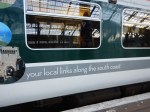
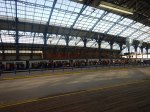


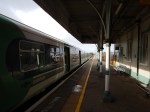

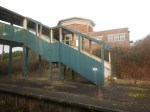







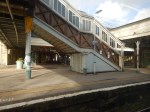

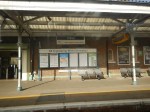
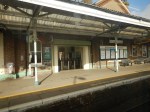

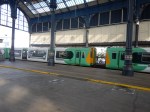
Note.
- The service from Brighton to Seaford is run by 3-car Class 313 trains.
- The Class 313 trains are elderly, but well-maintained and lacking features that passengers expect these days, like wi-fi, information displays, adequate space for bicycles and fully-accessible toilets.
- The train was fairly full on a cold but sunny, Sunday morning around Falmer station, where the University of Sussex and The Amex are located.
- I was surporised at how many people arrived at Brighton on a Thameslink service.
- Lewes station is being given a full upgrade.
- Most other stations are simple affairs, that need some refurbishment.
- It was sad to see the Port of Newhaven so quiet.
- I couldn’t identify the place, where the Wealden Line used to join the East Coastway.
Certainly the route has potential, which will probably be driven by traffic at Falmer station, which has already been upgraded to take 8-car trains.
The trains should be replaced by something like a four-car Class 377 or Class 387, that could run in pairs for busy days at the The Amex.
The question also has to be asked, if the new trains had an IPEMU capability, would it be more affordable to run the Seaford Branch, if the electrification were to be removed.
Match Twenty-Seven – Brighton 3 – Ipswich 2
I like going to Brighton for a match, as the stadium is one of the best and it is just a short walk from the train station. You get comfortable seats, with good views, which can’t be said for many other stadia.
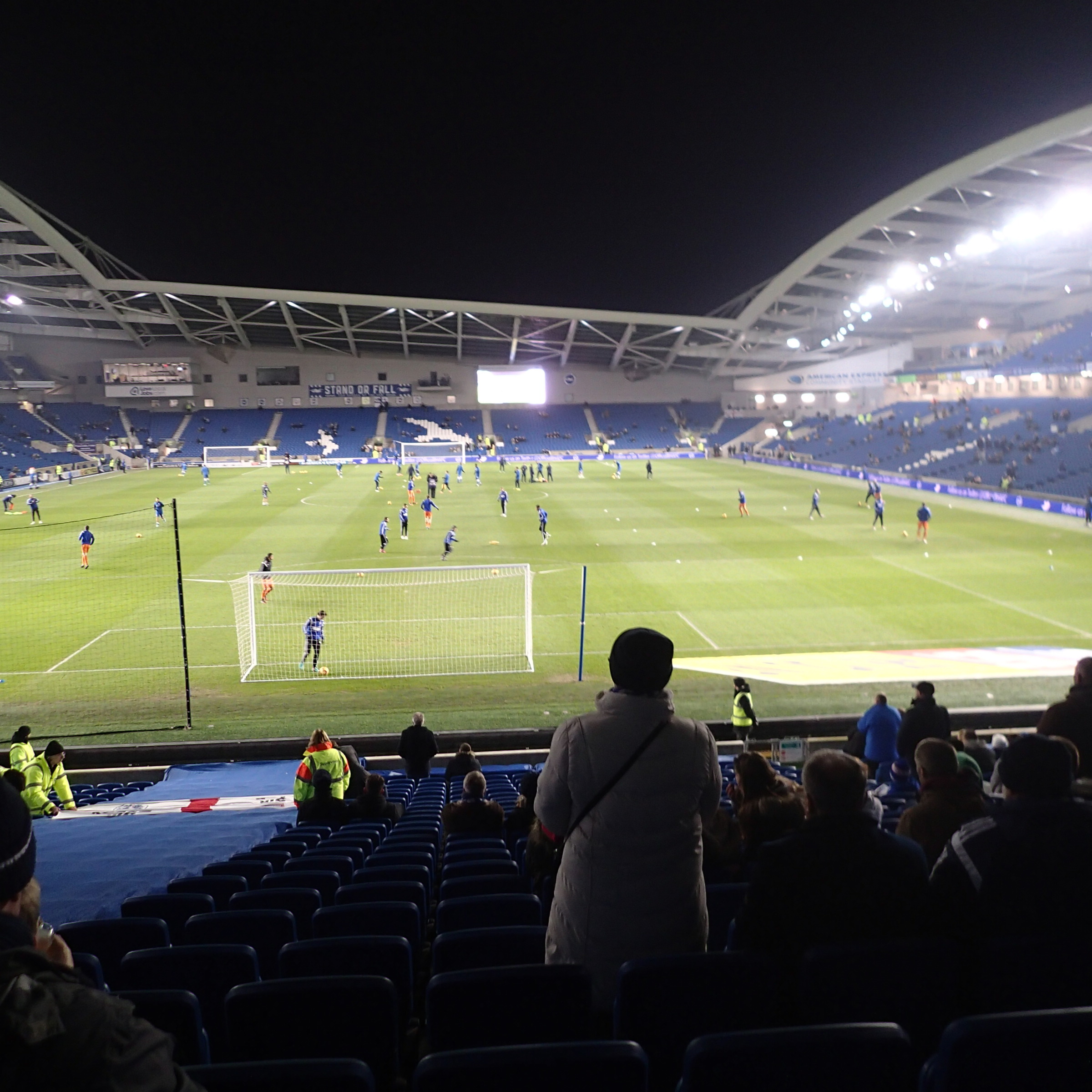
Brighton’s Impressive Stadium
Sadly, Ipswich didn’t put on a display to the quality of some of late and on a bitterly cold night they lost by the odd goal in five.
Those Seagulls Get Everywhere
Some coastal parts of the UK and other parts of Europe have a seagull problem.
But this story from Brighton must be unique, where one of the birds finished second in the 7:10 race according to the photo finish.
Comfy Seats At The AMEX Stadium
The AMEX Stadium is one of the few in the country, that have comfy seats for all.

Comfy Seats At The AMEX Stadium
As you get free train travel in the price of tickets, surely the attitude of the club and the stadium design, did all this contribute to a full stadium.
Sadly for Brighton, Ipswich spoiled their party.
An Ideal Train Ticket For Football
I went to Brighton to see Ipswich Town play in the town, for the princely sum of £7.95 return.
This was the cost of my Senior Off-Peak ticket from East Croydon to Haywards Heath.
I didn’t need to buy the ticket to East Croydon, as that station is in the Freedom Pass area and from Haywards Heath to Falmer for the AMEX Stadium is covered by the match ticket.
I could have done even better, if there had been a chance the match would have not been played, as Southern offer an interesting offer.

Southern’s Money Back Guarantee
But I’ve checked on this Money Back Guarantee and it looks good. For instance, if you book online and elect to pick up your tickets on departure at your outbound station and say the clouds open and you don’t fancy your awful cousin’s barbecue in the pouring rain, you just don’t pick them up and they get refunded.
Rail Travel Along The South Coast
In the last couple of weeks, I’ve travelled along most of the South Coast by train in two trips; one to Bexhill and the other to Littlehampton and Yeovil.
Effectively the South Coast is covered by two main rail routes; the East Coastway line from Brighton to Hastings and the West Coastway line from Brighton to Southampton.
The fastest trains from Hastings to Southampton take five minutes over three hours with a change of train at Brighton. But there are twenty-three stops.
So it could be a journey that only a masochist would take, but at least you’d probably be in a comfortable Class 377 with a trolley service.
Even if you go via Clapham Junction, it will still take nearly three and a half hours.
So it is definitely a journey where most people would drive. But a lot of the roads are dreadful.
So could anything be done to make this journey faster and better?
The Class 377 trains are 100 mph units, but some of the route has a lower speed limit, but as I found on the route, the slow speed is probably more due to the number of stops than the speed of the trains.
The only improvement being talked about is to improve the Marshlink line from Hastings to Ashford, so that high speed services could run between St. Pancras and Eastbourne.
Judging by the troubles that the current Hastings line is suffering from, it would seem that this scheme might be cheaper than sorting out the Jerry-built Hastings line.
If you search the Internet for South Coast Main Line, you find this document from the East Sussex Rail Alliance.
I think we can file that under In Your Dreams.
The Great Eastern Main line has a similar problem of slow speed which is hopefully being solved with the Norwich in Ninety project.
Perhaps a similar approach could be used along the South Coast.
Legible Brighton
Like London, Brighton has gone Legible with lots of liths. Legible Brighton is described here. The page contains this statement.
Research has shown that people are more likely to return to a city if they have found it easy to navigate their way around.
So why are some places, slow to follow the lead of London and Glasgow? Here’s one of Brighton’s liths.
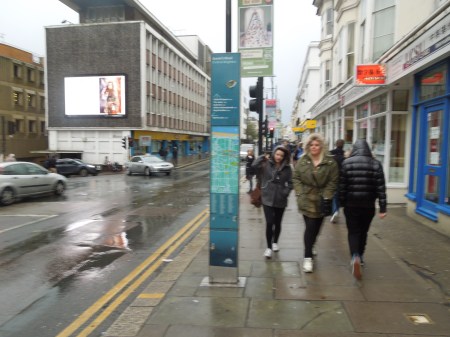
One Of Brighton’s Liths
They are generally fairly simple, like most of London’s.
Back To London In Comfort
I came back to London in a Class 442, branded as a Gatwick Express, although it only stopped at East Croydon and Clapham Junction before Victoria.
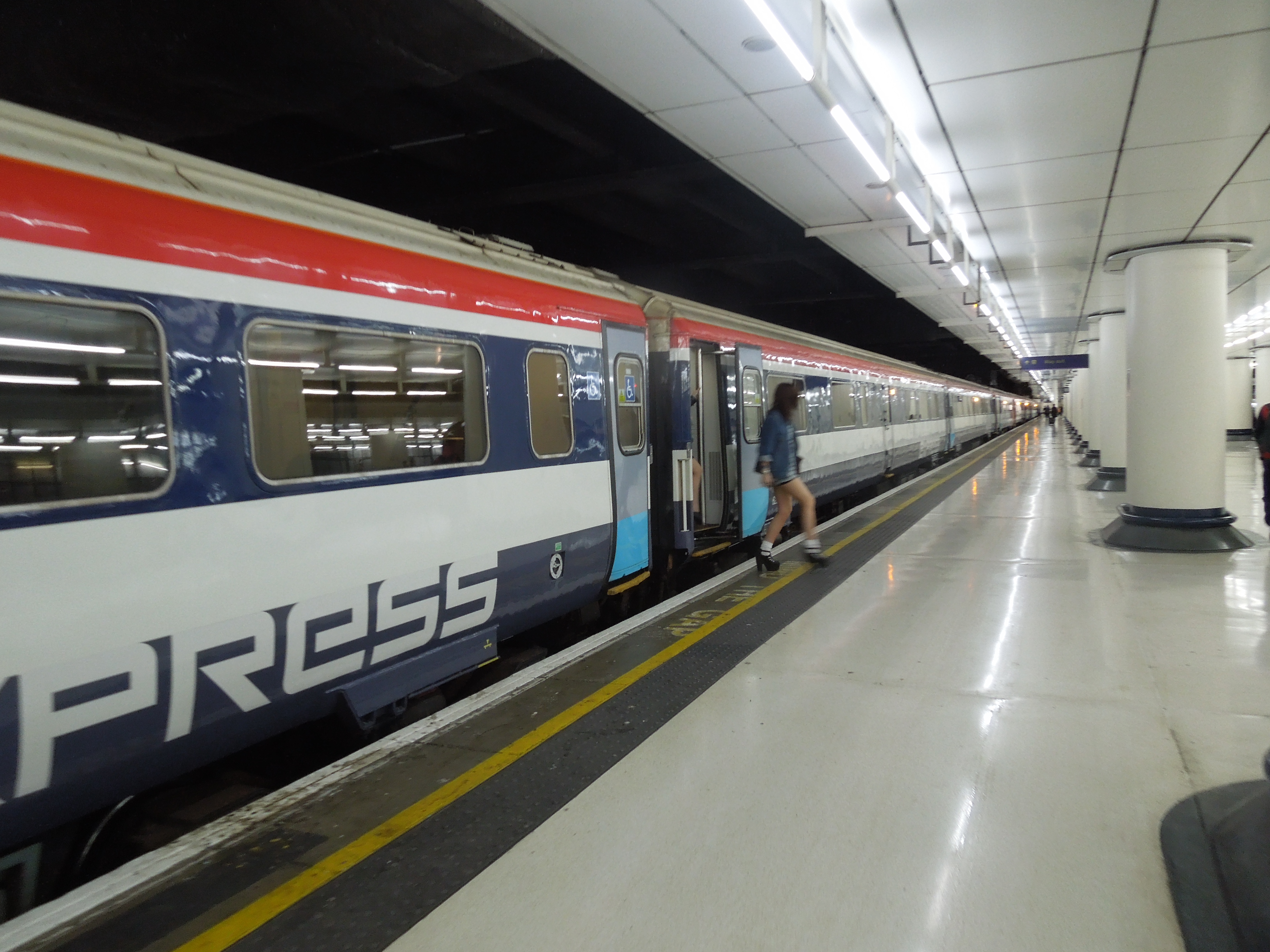
Back To London In Comfort
The Class 442 could be considered an unusual design as it is just a series of legendary Mk. 3 coaches, with electric power underneath. They may be slower than an InterCity 125, but they still hold the world speed record for third-rail electric trains at 108 mph.
I took the train all the way to Victoria, but when London Overground opens to Clapham Junction on December 9th, I’ll be able to use that line to get to Dalston Junction.
I suspect, it will be whatever has the best connections.
 The Anonymous Widower