Getting To The Falkirk Wheel And The Kelpies
I took a train to Falkirk Grahamstown station and then got a pink bus called The Loop.
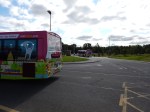

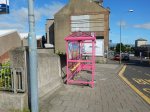
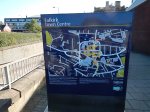
I know it is relatively early days, but information for the bus needs to be improved. You can find the stops easily, but knowing how long to wait is difficult, unless you are psychic. A big poster is needed in every stop, with the times that the buses arrive clearly marked.
The stops should also be clearly marked on the maps on the liths!
This type of tourist bus is crying out for a contactless ticketing system using bank/credit cards. Every time, the bus is used you touch in and at the end of the day your card would be charged appropriately.
In the next few years, this will become the gold standard for small payments and buses like this, that don’t embrace the technology will get lots of complaints.
If the Falkirk Wheel attracts a massive number of visitors, I feel that the area could support a rail station. Look at this Google Map of the lower basin at the wheel.

The Railway Passing The Falkirk Wheel
The railway is the line between Stirling and Glasgow and the bridge across the railway leads to the car park for the Falkirk Wheel.
To actually build a simple station should be fairly easy and visitor numbers and the level of success of the attraction will determine, if the station is ever built.
I think it will be built, as it has so many factors going for it.
Nottingham To Ilkeston And Back
Ilkeston is a town without a railway station and this is said in Wikpedia about the town and its railway links.
Ilkeston has not had a railway station since 1967, despite its substantial population and the fact that the Midland Main Line (formerly part of the Midland Railway, later the LMS) skirts the eastern edge of the town. Due to recent rail reopenings in similarly-sized towns it is now, by some definitions, the largest town in Britain with no station.
So I had to go to the nearest station at Langley Mill and hopefully, I could organise a taxi. I took these pictures on the journey.
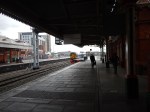

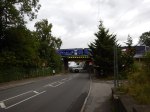
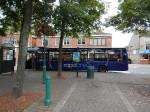
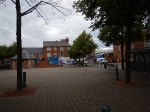
After trying three taxi numbers at Langley Mill and all saying they couldn’t help, I got a bus to Heanor from where I got another bus to Ilkeston. To be fair to the buses, I’ve travelled on much worse services elsewhere in the UK. Cambridge to Haverhill for a start. And I was not issued with a dreaded ticket.
After my meeting, I decide to take the easy route back, so I got an express bus into Nottingham and then use the Nottingham Express Transit to get to the station.
I don’t think that in the twenty-first century, where we’re supposed to use green public transport, that this is the best we can do to get in a reasonable time from Nottingham to Ilkeston.
A related question, is, Is it easier to get to Ilkeston by taking a train to Derby and getting the bus from there?
Crossrail Will Affect The Buses
This article from GetWest London is entitled Improved bus services for Hayes to prepare for Crossrail.
The article talks about how Bus Route 90 is going double-deck and buses through Hayes will be improved as Crossrail, with the new Hayes and Harlington station is constructed
Provision of improved and rerouted bus services will happen at many of the new Crossrail stations.
My nearest Crossrail station will be the double ended giant at Liverpool Street that will serve both the current Liverpool Street and Moorgate stations.
From close to my house I can get a 21 or 141 bus to just outside Liverpool Street station, although coming back I have to walk to Moorgate for a northbound bus.
After Crossrail is opened, I predict that when I use Liverpool Street station, I will get a bus to a stop that will be connected by weather-free subways to any of the existing lines in the area and of course Crossrail. Coming back, these or other subways will connect me to a northbound stop to get a bus home.
I actually suspect to get the bus, it might be best to be at one particular end of a Crossrail train, so that you use an entrance to the station, that is convenient for your bus. Getting the carriage right could save you quite a walk with a two-hundred ,metre long train.
If what is provided, is not better than the current interim arrangement at Liverpool Street/Moorgate, I will be very surprised and will complain like an irate rhinoceros.
Most of the stations on Crossrail are served by London buses, also under the control of Transport for London. So improving the buses, as at Hayes and Harlington will be a matter for Transport for London, with input from the appropriate London Borough.
But what will happen at places like Brentwood, Burnham, Iver, Langley, Maidenhead, Reading, Slough, Shenfield and others,which are outside of Transport for London’s influence.
So that Crossrail has one holistic design from East to West, buses at these outer stations must conform to the rules that apply in the London area.
- Buses must be cashless, with payments either by Oyster, contactless card, concessionary pass or an extension to an orange rail ticket.
- London-style bus spider maps must be provided at all stations.
- A state-of-the-art bus arrival system must be provided in the same manner as in London, either by display or text message.
- All buses must be fully-accessible to match the fully-accessible stations.
- In an ideal world, all buses must display the next stop and be front entrance and centre exit, to help blind and disabled passengers and speed the buses on their way.
Looking at text message bus alerts like TfL’s Countdown, allowing a sixth digit to the text system would probably enable every stop in the South East to be covered.
Incidentally, according to this article in The Guardian, there are less than 500,000 transport stops in the whole UK, so six digits and one text number would cover the whole of the country.
But would the Scots, Mancunians and the Cornish, embrace a system that was designed in and for London?
Crossrail is a rail system, but it is going to affect lots of parts of our lives.
Working Around The Victoria Line Closure
Today, I wanted to go to IKEA and a decent B & Q, so as both are close to Tottenham Hale station, it required a trip to that station or thereabouts.
The problem is that the Victoria Line is closed past Seven Sisters in August, so they can remove the bottleneck at Walthamstow Central that was part of the cheapskate design of the 1960s. Click here for the full story.
So I couldn’t take my usual route of an Undrground train to Tottenham Hale and a 192 bus.
I decided to go to IKEA first, which is just an easy trip all the way on a 341 bus from perhaps a hundred metres from my house. But as I got to the stop, the 341 whizzed past. Luckily it was followed by a 476 bus, which joins up with the 341 at Northumberland Park and hopefully because of the route it takes will get there first.
So I got the 476 and sat upstairs. I was watching to see if the 341 was behind us as we turned off Tottenham High Road and saw the 341 appear behind.
At the next stop I got off the bus to get the 341, only to see that bus go straight past. Luckily, I was able to get back on the 476, so in the end, I went all the way to Northumberland Park, a couple of stops short of IKEA. The bus information saif I’d haveto wait twenty minutes for a 341, so I walked over the level crossing to the Marigold Road stop for the 192. Again my luck was in, as a 192 had just turned up and they were changing drivers.
Coming back, I was carrying a full IKEA bag, and wanted to get to B & Q at Tottenham Hale for a couple of small bits, so I needed a 192 bus. Unfortunately, there was a bit of a gap in the service, but after about twenty minutes, I’d done my hopping and needed to get home.
So I walked back to Tottenham Hale station, hoping that there was a Hackney Downs train due.
Remarkably there was one in a couple of minutes and I just had time to climb over the bridge to catch it.
At Hackney Downs, the train dropped me on Platform 1, so I could either go down into Hackney Downs station and get a 56 or 38 bus, or use the new walkway to Hackney Central, from where I could get a more numerous 38 bus.
As it was a warm day and there was a lift in the walkway, I decided to take the newly-opened route.
I’m glad I did, as it turned out that due to the wire mesh at the top of the sides of the walkway, it was remarkably cool.

I’d surmised it would have been good in wet weather, but I’d never thought I’d be pleased to use it because of the heat.
According to one of the staff to whom I spoke, the walkway is staring to be increasingly well-used as passengers discover it.
I think that we’ll see this type of walkway in other places on the UK rail network.
One thing that helped this morning to get around the Victoria Line closure, which removes a bit chunk of my usual routes to Tottenham and Walthamstow, was London’s superb text message-based bus information system, which like any good system is designed to work on any device that can send and receive text messages.
And it does it all without using any dreaded app.
Before Crossrail 2 – Tottenham Hale
In the near five years since, I moved back to London, Tottenham Hale station has changed for the better, with the addition of a lift to the Victoria Line platforms and the reorganisation of buses, taxis and other traffic around the station.
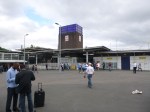


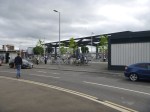
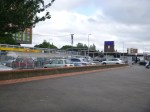
But over the next few years, we should be seeing a lot more changes as this Future section in the Wikipedia entry for the station. The significant section is about Crossrail 2.
In February 2013, the Crossrail task force of business group London First, chaired by former Secretary of State for Transport Andrew Adonis, published its recommendations on Crossrail 2, favouring a route almost identical to the regional option proposed by TfL in 2011. The report was endorsed by Network Rail.
This proposal will see four tracks restored through Tottenham Hale and direct links to South-West London.
This Google Map shows the station and the surrounding area.
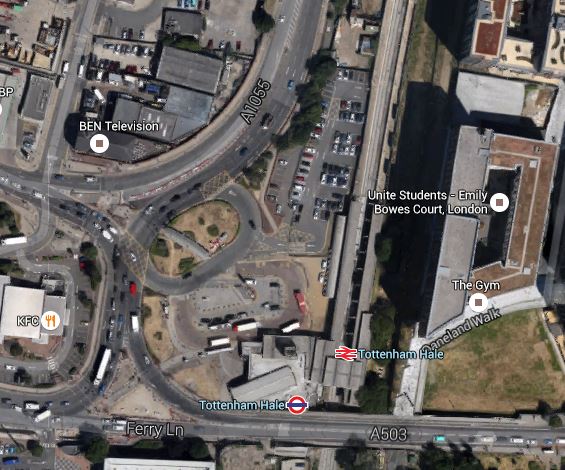
Tottenham Hale Station
This image appears to have been taken before the new Tottenham Hale Bus Station was created and the traffic system was changed.
With all the development going on, putting four tracks through the station will need a very narrow track and platform layout.
On this page of the Haringey web site are more details and an artist’s impression of the proposed station. This picture is shown in an article in the Tottenham Journal.

Proposed Tottenham Hale Station
I would suspect that a wide bridge would extend eastwards from this building over the tracks with lifts and escalators to the platforms. Looking at this image, it does strike me that the the architect has taken some of Charles Holden‘s stations as their inspiration.
Should London Allow All Doors Entry To Buses?
London is unique in the United Kingdom, in that nearly all of the buses have at least two doors.
The standard London buses have a front entrance and a middle exit, which gives the advantage of separating those getting on the bus and those getting off. In addition as the wheelchair ramp is under the middle door, loading and unloading wheelchair-bound passengers is a much less disruptive and much more efficient process.
Last football season in Reading, the bus had to be unloaded to get a wheelchair and its passenger on-board. It delayed the bus by about five minutes. Some fans were getting angry and started a chorus of “Why Are We Waiting”
In contrast in London, I saw an incident, where a passenger in a wheelchair needed to get on and the wheelchair space was full of babies in buggies. The ramp was put down, three buggies were immediately unloaded with no fuss, the wheelchair was pushed in and then two of the buggies were slotted in. The third was folded and carried on. It was all very civilised and in total contrast to the Reading incident. Effectively, the ramp and the pavement creates a very large lobby, which makes it easy for the wheelchair space to be rearranged. In my many trips on London buses, I’ve never seen a problem around the wheelchair bay.
But the biggest argument for a separate entrance and exit bus, was put to me by a bus driver and union rep, I met on a bus in Manchester. He said that because London buses separate entrance and exit, this pushed the low-life away from the driver and they don’t try and steal his money. London buses now don’t accept money and other drivers from places like Scotland and Liverpool have told me they want cashless buses as it cuts attacks on staff.
Additionally in London, we have the three-door Routemasters with an extra door at the rear. All doors have places to touch in with your contactless card, with one each side of the middle door.
Rarely do passengers get in at the two rear doors and not touch-in. If they do, they are often reminded by other passengers, with a knowing look.
Recently, I was at Kings Cross and two buses that get me near my house turned up at the same time; a two-door 476 and a three-door Routemaster running on route 73.
The 476 was in front and empty, but I took the 73, as I felt because it loads and unloads more quickly, it would get me home sooner.
It did! Perfectly illustrating the principle that more doors make a bus go faster.
There is probably an equal split of the type of the bus I can get home from the Angel and I feel that I’m not alone in choosing a New Routemaster if one is following a standard two-door bus. Baby buggy pushers also seem to wait, as it must be much easier to get in the middle door of a new Routemaster.
|As we are well-educated on how to use the buses here in Hackney, I wonder what would happen, if London’s two-door buses allowed entry through the middle door, by putting ticket readers at the door.
Having watched the behaviour of passengers on New Routemasters for quite a few years now, I think it would be worthwhile to try it as an experiment in certain areas of the capital.
We might find it increased the capacity and speed of London’s buses.
Extending Westbourne Park Bus Garage
I have noticed this structure grow over the last few months and have wandered what it is.
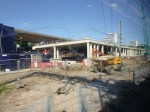

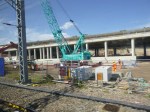


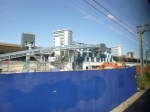
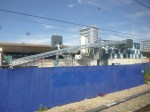
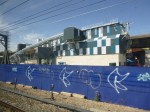
It now looks like it might be the extension to the bus parking area talked about in this article on Tower Transit in Wikipedia. This is said.
A new 180m bus parking area is to be built on a raised platform over railway lines as part of the Crossrail project.
This Google Map shows the garage squeezed under the Westway.

Westbourne Park Bus Garage
I think the Google Map was taken some time ago, as all that appears visible is probably the foundations furthest away from the bus garage.
It’s probably a sensible use for the site, where no-one would probably want to live sandwiched between the Westway and the Great Western Main Line.
It’s also a very good way of using the air space over the railway to effectively create new land.
Life Just Got A Whole Lot More Complicated
Well not really, but when I come home from the Angel, I usually get a 38 bus, which goes a little bit closer to my house. But now they’ve started to Routemasterise the 73 buses.
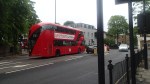

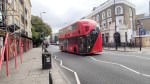
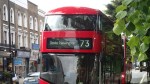
This means I can’t be sure I can distinguish the 38s, which were Routemasterised some time ago, from the thundering red herd on the Essex Road.
New Routemasters should have a top hat, as some of the old RTs of the 1950s did.
The Long Way Back From Rayleigh
For various reasons, I go to a dentist in Rayleigh near Southend.
Usually, it is a simple out and back from Stratford.
But today although it was easy getting there, coming back was a long journey, as a man was killed by a train at Harold Wood according to this report in the Romford Recorder.
I was informed that there would be a long wait at Rayleigh, so as a bus arrived, which was going to Southend, I took that as if the Liverpool Street was closed, I could at least get a c2c train to Barking or West Ham.
It is only when you are forced to take a bus in a strange town, that is information-free and nearly all your fellow travellers are wearing head-phones, you realise how most buses are terrible outside London.
I haven’t been to the centre of Southend since the 1960s, so it was only because my phone told me, that I was somewhere near the centre, that I got off at the right stop, near Southend Victoria station.
After buying my ticket and a drink, I was then informed that the trains were still not running. So I decided to walk to Southend Central station for the c2c train. This Google Earth image shows the two stations.
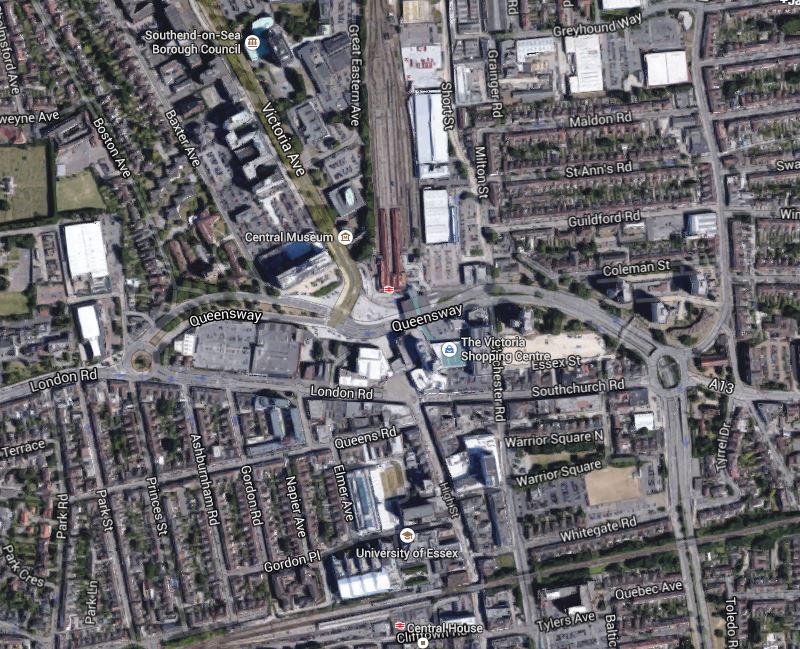
Central Southend
Victoria is at the top and Central is on the railway line that runs across the image.
The walk was easy, if rather windy and after ascertaining that c2c would happily accept my GreaterAnglia ticket, in a few minutes I was on a train to London. These pictures taken on the first part of the journey, illustrate the quality of the weather and how close the line is to the coast.

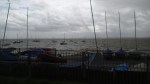


The weather was certainly worse than I encountered on the Cumbrian Coast.
In the end I changed onto the Metropolitan Line at Barking and then came home my usual way via Whitechapel and Dalston Junction.
 The Anonymous Widower