Could IPEMU Trains Use KERS?
I have just read this article on The Business Desk, which is entitled Torotrak’s bus KERS system gets all-clear. The article starts like this.
Torotrak, a developer and supplier of emissions reduction and fuel efficiency technology in vehicles, and Wrightbus are celebrating the successful completion of the in-service trial of the Flybrid mechanical kinetic energy recovery system (KERS) for buses.
The trial was conducted with Arriva, one of the largest bus operators in the UK.
It must have been successful, as other reports say Torotrak shares have risen and the company is expected to start production of the Flybrid KERS in 2016.
I’m probably not the only engineer, who’s wondering, whether the technology can have applications with trains.
My one regret is that I only bought a thousand pounds worth of shares in the company.
Who Parked This Bus Here?
Yesterday, I needed to go between Waterloo and Victoria stations.
According to my mother’s ready reckoner that is four stations; Embankment, Westminster, St. James’s Park and Victoria and one interchange at Embankment.
So at two minutes a station and one interchange at five minutes that is a total of thirteen minutes.
But after a bit of difficulty locating a bus spider map for Waterloo, I found that I could get 507 bus direct to Victoria station, from the Cab Road, which is a very short level walk from the main station concourse.
I waited perhaps two minutes for the bus and it took fifteen minutes for the journey.
So my bus journey probably took just four minutes longer than the Underground, but there were no steps, escalators or changing trains.
The 507 bus also stopped in the forecourt of Victoria station, just a short level walk from the trains.
The forecourt at Victoria station is rather small, so why do they allow buses like these to take up valuable space?

Who Parked This Bus Here?
I think that tourist buses are an unnecessary curse on London’s traffic and they are part of a big industry that rips off visitors and puts them off the greatest city in the universe!
Hopefully, someone will write a guide and an app, which will mean that all the Routemasters can be used as tourist buses, which explore all parts of the City.
I live on the Routemaster-equipped 38 route from Victoria to the romantically-named Clapton Pond and know a lot of the interesting history you pass through from end-to-end of the route.
One decent audio-guide app, would help to consign tourist buses to the dustbin of stupid and unnecessary ideas.
A Better Experience In Milton Keynes
Milton Keynes has never been my favourite place, since I used to take my late son; George, to his boarding school, which inevitably meant a trip round the endless roundabouts. I was then mugged in the city by the street furniture, that I wrote about in A Pedestrian-Unfriendly City.
So when Ipswich were playing MK Dons, I thought I’d give the city one more chance.



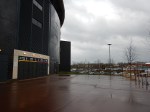

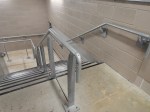









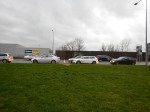
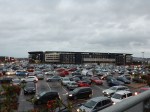
These are a few observations.
- The London Midland train was filthy and swimming in beer. I would assume it was supporters going to London.
- There is no information at Milton Keynes Central station, as to how you get to the ground.
- Bus 1 from Milton Keynes Central station, drops you just a rather cluttered short walk from Stadium MK.
- There are no signs or maps for Away supporters, as to what is the best route.
- Someone told me, that if you drive to the ground, parking costs £7 and you have to pay on-line.
- I’ve never been to a British stadium before, where burger vans and tea stalls outside the ground, were conspicuous by their absence.
- Several of the larger restaurants outside serve gluten-free food.
- The stadium has some of the best handrails I’ve seen in a ground.
- Coming back I just missed a bus and had to wait half-an-hour for the next small but full bus in a freezing cold shelter. I’d have taken a taxi, but there was no sign of a taxi rank.
I’ve never seen a ground, where it is assumed that everyone comes by car or supporters coach before.
I would have been distinctly miserable if Ipswich hadn’t won!
Milton Keynes is going to have to improve the buses. The number one bus, that I caught links Stadiujm MK and Milton Keynes Hospital to the stations at Milton Keynes Central and Bletchley.
This Google Map shows the area of Milton Keynes.
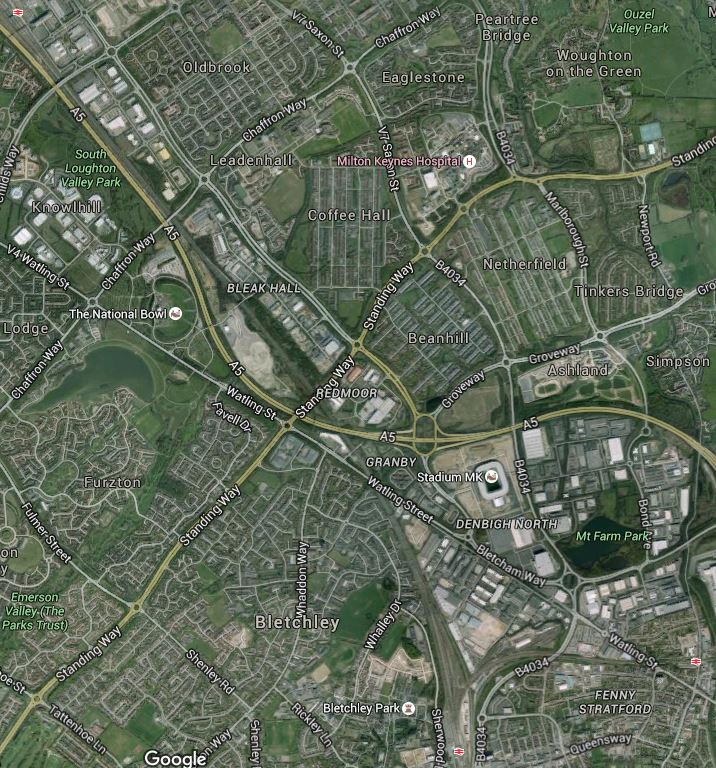
Milton Keynes Stations, Stadium MK And The Hospital
Milton Keynes Central station is in the North West corner, with Bletchley station st the bottom. The other station at the right is Fenny Stratford station on the Marston Vale Line, which will be incorporated into the East West Rail Link.
This map shows the route of the proposed line.

East West Rail Link
Wikipedia talks about extending the Marston Vale line to Milton Keynes Central, but although the track has been created, no trains have run.
Chiltern are also looking to extend their Aylesbury service to Milton Keynes Central via Bletchley, so hopefully this might prompt improvement in the bus services to Stdium MK and the Hospital.
I doubt it will, as Milton Keynes is one of those places where you’re a total loser, if you don’t have car and why should their taxes provide for better bus transport for the disabled, elderly and those that can’t drive.
I think we need a law in this country, that every hospital should have at least a four buses per hour direct service to the main railway and bus stations.
A First Glimpse Of The Planned Hackney Central Station
London Overground are planning an upgrade of Hackney Central station, as I reported in The Redevelopment Of Hackney Central Station.
I went to Hackney Central Library to get a first glimpse of the design.

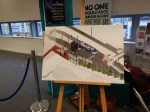


It’s certainly a big improvement on what’s there now. Some points.
- The station is to a modular design, so we’ll be seeing other similar stations.
- There is more space in the station, with the gate line turned through ninety degrees.
- The guys I met from Transport for London (TfL) were referring to the combined station as Hackney Interchange.
- TfL and Hackney Council are working together to get things right in the area.
- There is no entrance on the far side onto Graham Road, which is something I’d like to see.
- There may even be toilets.
- TfL are welcoming comments.
But TfL haven’t created the web site yet. I’ll point to it, when they do.
Improving Bus Connectivity
Like many in London, I don’t live on top of a Underground or mainline rail station. The nearest is Dalston Junction station on the Overground, which gives me good connections to mist the capital with one or more changes.
So I rely heavily on buses to get to and from stations like Angel, Highbury and Islington, Manor House and Moorgate for onward connections.
It is the same with Hackney Central and Hackney Downs stations, which could be united as Hackney Interchange.
The buses are rather chaotic around the two stations and if Hackney Council achieve their laudable aim of creating a proper public space between Hackney Central station, St. Augustine’s Tower and the Narrow Way, using the buses in the area will get more difficult.
Transport for London needs to take a good hard look at buses passing through the area of Mare Street and the proposed Hackney Interchange.
The Dalston Eastern Curve
The lack of an Eastern Curve at Dalston means that westbound passengers on the North London Line needing to go South from Dalston, must change at Canonbury.
I sometimes do this to get to Dalston Junction station, but I also take the 38 bus from Amhurst Road, after crossing the North London Line on the Hackney Central station footbridge.
In The Dalston Eastern Curve, I talked about the curve, but I don’t think it will be rebuilt in the next few years.
A Southern Entrance To Hackney Central Station
Because of its connections to the attractions at Stratford and Crossrail, I suspect that we’ll be seeing more passengers taking the North London Line to and from its Eastern terminus at Stratford station. Especially, when West Ham moves into the Olympic Stadium.
The proposed increase in size and facilities at Hackney Central will be very much needed, for all these passengers.
Many passengers though will need to go South from Hackney Central or along Graham Road, but will be frustrated in having to climb the footbridge to get out of the station on the wrong side of the line.
It is my view that a southern entrance to Hackney Central station would make travel easier for a great many travellers.
In an ideal world, a southern entrance would lead to a light-controlled crossing over Graham Road, to give easier access to the buses.
Batteries Or Flywheels?
Hybrid buses and IPEMU trains need some form of energy storage.
Typical systems generally use batteries. Mechanical devices are discussed in this article in Transport Engineer.
Read the article.
TPOD or Blockade?
This article on the Rail Engineer web site is entitled Preparing The Way For Bath Electrification.
It is a good read and it brings a new acronym into the English language – TPOD. This is said about the change of wording.
Normally, closing a 20 mile stretch of the main line, from Thingley Junction to Bath Station, for six weeks would be referred to as a ‘blockade’ but, during the consultation process, the word blockade became a very sensitive issue. It implied that Bath was closed for business, which wasn’t the case. Therefore, to ensure that tourists were not put off travelling to the city, it was suggested that Network Rail should use a different description for the closure. As a result the acronym TPOD was created – Temporary Period of Disruption! So the work was carried out during a six week TPOD. You’ll get used to it.
Only time will tell, if this friendlier word TPOD becomes accepted. Or will it have the same connotations as Rail Replacement Bus?
But words are important!
As an example, I object to messages on trains and buses using the word terminate at the end of a journey.
It sounds so final!
At least, it seems to be becoming more common for a message like.
This train finishes its journey here.
To be used. Especially, where train staff are giving an announcement.
Other Train, Tram And Tram-Train Manufacturers And IPEMUs
The Aventra IPEMU is a Bombardier product, but I can’t see anything about using batteries in a train being patentable.
In the future we will see a range of energy storage devices based on all sorts of technology for transport applications. Kinetic Energy Recovery Systems describes the technology in Wikipedia
To deliver energy saving in transport, they need to be installed with regenerative braking and some clever control systems.
They are best generally described as kinetic energy recovery systems or KERS.
Applications will include.
- Passenger Cars – A sexy image would sell top-of-the-range hybrid and electric cars.
- Buses – Hybrid and electric buses in cities are the way forward and they’ll need intelligent energy storage.
- Trucks, Vans and other Commercial Vehicles – Why not, if it makes them more attractive to operators and makes vehicles more environmentally friendly?
- Trams, Trains and Tram-Trains – The Aventra IPEMU is just the first.
Looking at KERS in motor sport and Formula One in particular, in Wikipedia, there are several ideas, some of which are based on batteries and others on mechanical systems like flywheels.
As buses, trams, trains and tram-trains tend to be large vehicles with plenty of available space, where quite a large KERS can be tucked away, it is probably not the demanding weight-sensitive application of say motor sport or passenger cars.
So I don’t see any reason why a train or bus manufacturer like Alstom, Hitachi, Siemens or Wrightbus will not fit KERS.
Wrightbus are mentioned in this press release from Torotrak entitled FUEL SAVING KINETIC RECOVERY SYSTEM PROJECT READY FOR NEXT PHASE. This is the first paragraph.
Wrightbus have confirmed that an innovative Kinetic Recovery System (KERS) project, developed in a collaborative partnership and partially funded by Innovate UK, the UK’s innovation agency, is in full service trials with project partner Arriva.
Overall, this project looks very like the partnership that created the IPEMU demonstrator to prove the technology for trains, as it involves a bus manufacturer, a couple of technology or engineering companies, a transport operator and funding from the Government.
Incidentally, Torotrak is a British company with links to BAe Systems.
According to the press release the prototype bus is in service in Gillingham in Kent.
I can’t believe that the other train manufacturers are not looking seriously at KERS.
It is interesting to look at this article from Bus and Coach, which describes the Wrightbus project.
It is complicated mechanical setup, compared to installing KERS in an all-electric tram, train or tram-train, where it is a matter of designing an intelligent control system to link.
- Overhead electric supply at 25 kVAC or 750 VDC
- Third rail supply at 750 VDC
- Traction motors
- KERS
- On-board electrical systems like air-con, lights and passenger displays
The control system would balance the sources and needs according to route and load.
I think that any train manufacturer that doesn’t offer KERS as standard on a train or tram will be an also-ran!
Manchester’s Metroshuttle
Manchester has a network of three free Metroshuttle buses that you can use in the City Centre.
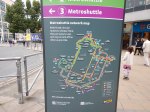

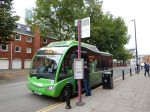
My big complaint about the system is the limited hours. Surely, in a busy City Centre a bus service like this should go on later than 19:00.
I also feel that the stops away from Piccadilly station could be better designed with more information and local maps.
A Mother Of All Traffic Jams
I took this picture from the front on a 19 bus, as I tried to get from Piccadilly to Islington.
The bus was turned round, as it was going nowhere, so I got on a 38, which then promptly overheated, but at least as it was a 38, there was another behind.
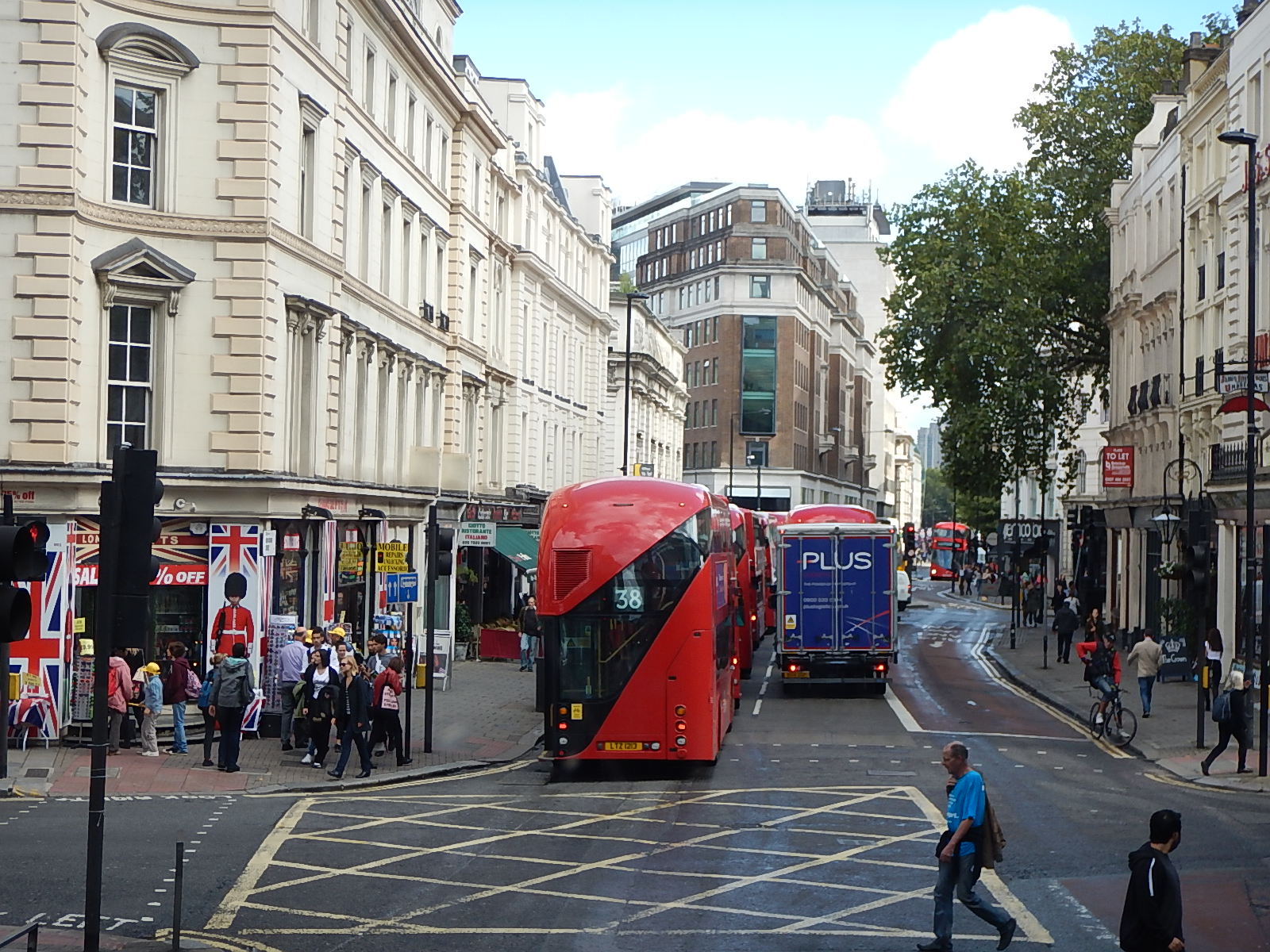
Traffic everywhere and nothing moving.
Traffic everywhere and nothing moving. My bus journey took over an hour.
So what was causing the slow progress? I think it was a mixture of works for services and the Cycle Superhighway.
It was obviously going on all day, as a visitor later in the afternoon complained of similar problems. A friend visiting London also had problems.
You might ask, why I didn’t take the Underground! I needed to get to Angel and as the Victorian designed the Northern and Central Lines so that they didn’t go near Piccadilly. Buses are the only way unless you want to do some tortuous walking in an Underground interchange.
Is Waverley Station Good Enough For Edinburgh?
If you arrive in London Kings Cross station, the experience has been transformed over the last few years. Instead of entering a dark concourse crowded with tired retail outlets in a wood and asbestos shed designed in the 1960s, you now have two choices. You can walk to the front of the train, through the barriers and doors and into a large square with seats, buses and entrances to the Underground. Or if the weather isn’t good, you can take an escalator or a lift to the footbridge that spans all of the platforms and enter the covered Western concourse to make your way to onward transport or to one of many cafes, most of which are upmarket.
Other stations that I know well, like Birmingham New Street, Liverpool Lime Street, Manchester Victoria, Newcastle Central and Nottingham have also been transformed into impressive gateways for their cities. Next in line for substantial upgrading are London Euston and Waterloo, Glasgow Queen Street and Cardiff.
Edinburgh Waverley station has had a bit of a tidy up and it now has a set of escalators to get you up to Princes Street, but it is still a dark, cramped station, with no quality cafes in the station.
If I was to give Kings Cross five stars, Newcastle and Nottingham would get four and Waverley scarcely deserves one.
So to answer my original question. The answer is a definite No!
Waverley And The New Borders Railway
In some ways the new Borders Railway is going to make matters worse, as if it is successful, there will be pressure for more services on the line and there may not be enough terminating platforms at the East end of the station. But at least according to the Layout section in the station’s Wikipedia entry, things are being reorganised. This is said.
Former Platforms 8 and 9, which were substantially shortened for use as a Motorail terminus, the infilled area becoming a car park; since the demise of Motorail services these platforms are used only for locomotive stabling, although the numbers 5/6 were reserved for them in the 2006 renumbering. These are to be extended as full length platforms to accommodate terminating CrossCountry and Virgin Trains East Coast services with the taxi rank closed in June 2014 to make way for these works.
On the other hand, the Borders Railway has removed the need to use one of the worst train/bus connections in the UK.
Currently, if you arrive on a train from London and want to get an express bus to the South or the Borders, this necessitates a climb up flights of steps onto the North Bridge, which with heavy bags is impossible, unless you’re stronger and fitter than most.
Now you walk to the bay platform at the East end of the station and get one of the half-hourly trains to Galahiels, where there is a short walk to the bus station to get a convenient bus to all over the Borders and even to Carlisle.
But it is still a long walk from the bay platforms at the East (3 to 6) to the platforms that go West (12 to 18). And the tram is even further to walk.
Buses And Trams At Waverley
Like many main stations in the UK, no thought has been given at Edinburgh to how to efficiently organise the interface between trains and the buses.
I would have thought that when Edinburgh trams were built that they would have reorganised public transport in the city, so that the trams served the station properly. After all in Manchester, Croydon, Sheffield, Nottingham, Liverpool and Newcastle, local light rail, underground or trams serve the main train stations. Only in Blackpool is a walk needed, but that is being remedied.
In my view there are three places for tram stops at Waverley station.
- At the top of the escalators that take you between the station and Princes Street. But would this get in the way of the posh cars taking people to and from the Balmoral Hotel?
- On Waverley Bridge in front of the station. But where would the tourist buses go to clog up next?
- There also could be a Nottingham-style solution, where the trams cross over the station on a bridge at right angles to the train lines. But this would probably be an impossibly difficult project to design and implement.
The trams do serve Haymarket station and I wonder how many visitors to Edinburgh, use that station instead.
Waverley And Princes Street Gardens
After my trip to the Borders Railway, my friend and I went for lunch in a restaurant by the Royal Scottish Academy facing out onto Princes Street Gardens.
It was not an easy walk from the station as once we’d climbed up the escalators, it took several minutes to get across the busy Waverley Bridge in front of the station to get into the civility of the Gardens. This Google Map shows where we walked.
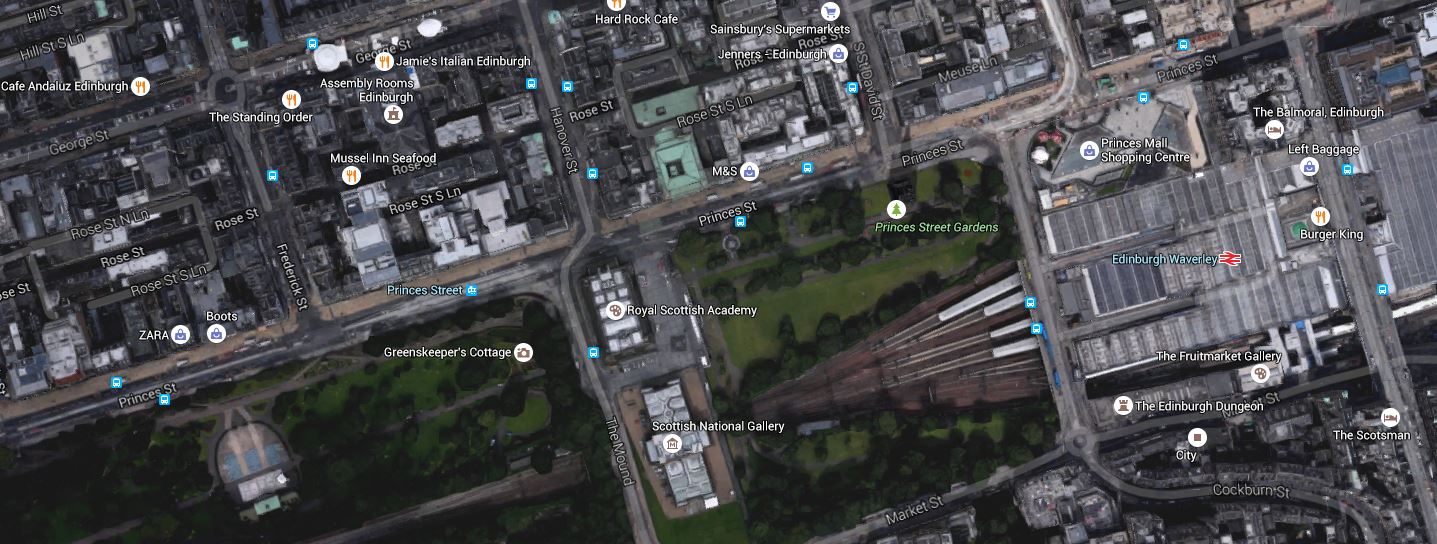
Waverley Station And Princes Street Gardens
Over lunch, I asked my friend, who’d lived in Edinburgh nearly all her life, , why there wasn’t a subway between the gardens and the station. She didn’t know and said there never had been! So as I walked back to the station, I took some pictures.



They show no evidence of a subway that might have been closed.
But they do show that if a subway could be built, then Edinburgh could have a World Class meeting place for when the weather was good.
Sorting The Trams
Seeing the map of Waverley station and the Princes Street Gardens, I have a feeling that if they were designing the Edinburgh trams now, they would be very different.
The difference is that in the last few years, tram-trains have come into general use in Germany. The Germans are getting enthusiastic about their use and large systems are being developed in cities like Karlsruhe, Kassel and Chemnitz.
In the UK, a test line is being added to the Sheffield Supertram, but how could tram-trains help solve the problems of Waverley station?
Trams coming from Edinburgh Airport and the West stop at Murrayfield Stadium tram stop and then move onto the street to call at Haymarket before going down Princes Street. New Class 399 tram-trains, as will be used in Sheffield, would follow the same route as the trams until Murrayfield. Passengers would find the only real difference would be that they had somewhere else on the destination board.
But at Murrayfield they would join the main railway lines and running as trains, they would call at Haymarket and Waverley stations.
The tram-trains could end their journey at Waverley or they could pass through the station and perhaps go on to further destinations like Dunbar or North Berwick. There would be no infrastructure modifications needed East of Waverley station, as the tram-trains would just appear to everything to be just another type of electric train.
If you look at the map in the Proposals for the Edinburgh tram network in Wikipedia, you’ll see this map.
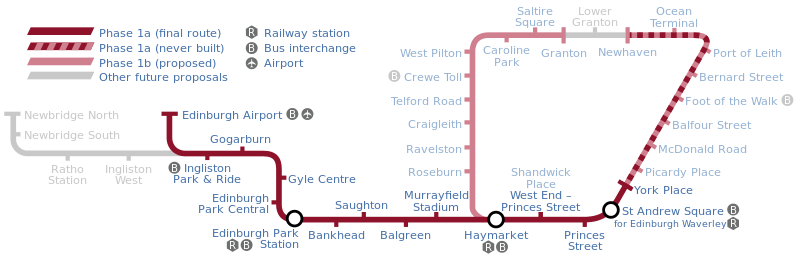
Edinburgh Tram Map
Note there is another Western destinations in addition to the airport and a loop to Newhaven and the Port of Leith. All come together at Haymarket. So services from the West could be run by trams or tram-trains as appropriate and those on the loop would probably be run by trams.
It should also be said, that the tram-trains could go anywhere to the East or West of the City, where there are electrified lines. Even Glasgow!
Edinburgh could have a lot of fun, without digging up the streets too much. Although, they’d probably need to do this, if they were going to extend the tram to Newhaven and the Port of Leith.
 The Anonymous Widower