Centrica Plan Green Energy Hub At Former Gas Power Plant
The title of this post, is the same as that of this news item from Centrica.
These three paragraphs outline the project.
A former gas fired power plant in North Yorkshire is to be turned in to a green energy hub under ambitious plans by Centrica.
The energy company has acquired the four-acre former Knapton Generating Station from Third Energy and plans to develop a 28MW battery on the site.
In addition, Centrica is exploring how Knapton could be used for off-grid hydrogen production, as well as the possibility for solar energy in the surrounding area.
Over the last few months, I’ve written about other small projects from Centrica.
- Centrica Business Solutions Begins Work On 20MW Hydrogen-Ready Peaker In Redditch
- Centrica And HiiROC To Inject Hydrogen At Brigg Gas-Fired Power Station In UK First Project
The company has also announced links with other companies.
- Centrica Announces Hydrogen Ready Combined Heat And Power Partnership With 2G
- Lhyfe And Centrica To Develop Offshore Renewable Green Hydrogen In The UK
- Centrica And Ryze Agree To Develop Hydrogen Pathway
Note, that the first concerns generators and the others concern hydrogen.
The Centrica news item about the Knapton generating station has this fourth paragraph.
The multi-million pound deal is part of Centrica Business Solutions strategic plan to create a 900MW portfolio of solar and battery assets by 2026.
It seems obvious to me that the Brigg, Knapton and Redditch projects fit this Centrica Business Solutions strategic plan, with sizes as follows.
- Brigg – 49 MW
- Knapton – 41.5 MW
- Redditch – 20 MW
I would expect to see Centrica behind several more of these smaller energy projects.
For that reason I have tagged all articles dealing with these projects as Centrica Small Energy Projects.
These are my thoughts about the Knapton generating station.
Third Energy
Third energy’s web site defines Third Energy as an unusual fossil energy company.
- The History page says that Knapton Generating Station was producing electricity using gas from the Vale of Pickering for over 25 years.
- The Net Zero Rise page describes their involvement in the Net Zero RISE consortium with Durham, Leicester and Oxford Universities.
- The Plug & Abandon and Geothermal pages are very much worth a read.
According to the Centrica news item, Third Energy will retain the ownership of the 12 well-sites and associated gas pipeline network.
I shall be watching this company and their developing relationship with Centrica.
The Net Zero RISE Consortium
The Net Zero RISE Consortium has a home page on the Newcastle University web site.
The page has this sub-heading.
Research Infrastructure for Subsurface Energy: an academic-industry partnership to deliver the UK’s first deep test sites.
This is said under a heading of Our Ambition.
This is the most cost-effective way of developing the UK’s first deep test site onshore.
Repurposing wells leverages previous capital investment. Using an onshore site with existing wells and geophysical data:
- eliminates the major cost of drilling and engineering
- reduces uncertainty by drawing on knowledge of the well and surrounding geological conditions
- is safer and easier access than offshore locations
We propose developing three test sites: CO2 storage; H2 storage and geothermal.
This seems to be a very sensible research collaboration and I wouldn’t be surprised to see more companies and universities join.
The Battery
The Centrica news item says this about the battery.
The first project at the site near Malton will be a 56MWh battery which will utilise some of the 41.5MW export capability of the existing grid connection. It’s anticipated the battery would be able to power around 14,000 homes for two hours.
This paragraph would indicate that the battery is supplying just 2 kWh per hour.
A common figure on the Internet is that the average house uses 8 kWh per day, which is 0.33 kWh per hour.
I have a feeling that the figures need correcting somewhere.
Solar Power
The third paragraph of the Centrica news item mentions solar energy.
In addition, Centrica is exploring how Knapton could be used for off-grid hydrogen production, as well as the possibility for solar energy in the surrounding area.
This Google Map shows the site.
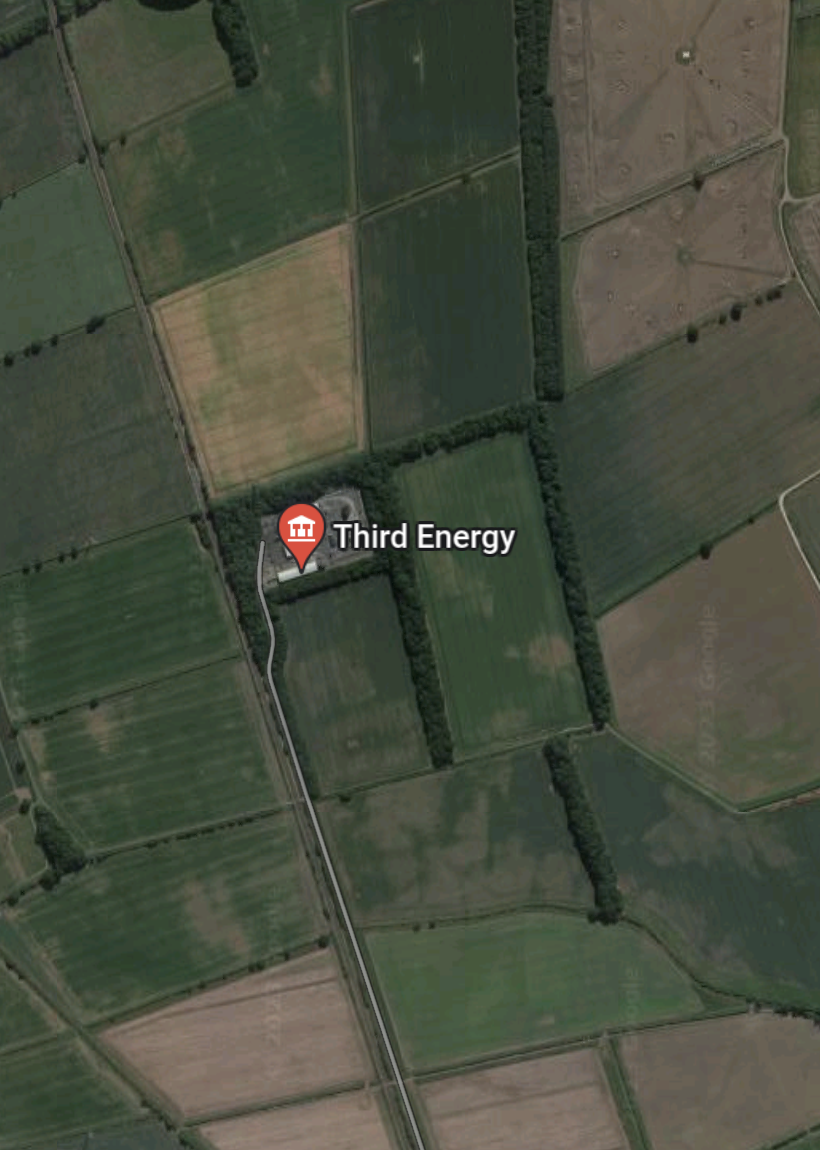
It appears to be several hundred metres to the nearest house.
I have read a very simple rule, that says a hectare, which is about the size of a full-size football pitch can accommodate a MW of panels. Obviously Centrica will have accurate calculations.
Off-Grid Hydrogen Production
The third paragraph of the Centrica news item mentions off-grid hydrogen production.
In addition, Centrica is exploring how Knapton could be used for off-grid hydrogen production, as well as the possibility for solar energy in the surrounding area.
Consider these points about the Knapton site.
- It has been handling gas for at least twenty-five years.
- It is connected to the electricity and gas grids.
- It has connections to a dozen gas wells.
- There would be space for a smaller electrolyser.
- Hydrogen could be exported from the site, by blending into the natural gas grid.
If Third Energy and the Net Zero RISE Consortium develop Knapton as a site for their H2 Storage test well, Centrica and an off-grid hydrogen production facility would be ideal partners.
Centrica could even use the site to try out new ideas.
This appears to be one of those engineering projects, that has been thought through whilst drinking several pints of real ale in a welcoming hostelry nearby.
Geothermal Engineering
This site could be used for experiments with geothermal engineering, but there doesn’t seem many places nearby, that would need a good supply of hot water.
Conclusion
There’s more to this deal, than meets the eye.
Centrica Business Solutions Begins Work On 20MW Hydrogen-Ready Peaker In Redditch
The title of this post, is the same as that as this news item from Centrica Business Systems.
This is the sub-heading.
Centrica Business Solutions has started work on a 20MW hydrogen-ready gas-fired peaking plant in Worcestershire, as it continues to expand its portfolio of energy assets.
These three paragraphs outline the project.
Centrica has purchased a previously decommissioned power plant in Redditch, and is set to install eight UK assembled containerised engines to burn natural gas.
Expected to be fully operational later this year, the peaking power plant will run only when there is high or peak demand for electricity, or when generation from renewables is low. The Redditch project will have the capacity to power the equivalent of 2,000 homes for a full day when required, helping to maintain stability and reliability on the grid.
The engines will also be capable of burning a blend of natural gas and hydrogen, futureproofing the site and helping the UK transition towards a decarbonised energy system.
- The original power station had Rolls-Royce generators.
- Cummins and Rolls-Royce mtu and possibly other companies can probably supply the dual fuel generators.
- Cummins have received UK Government funding to develop hydrogen-powered internal combustion engines.
- This press release from Cummins, which is entitled Dawn Of A New Chapter From Darlington, gives more details on Cummins’ plans for the Darlington factory and hydrogen.
Given that Cummins manufactured sixty-six thousand engines in Darlington in 2021 and it is stated that these containerised engines will be assembled in the UK, I feel, that these engines may be from Cummins.
Centrica’s Plans
This paragraph in the Centrica Business Systems news item, outlines their plans.
The Redditch peaking plant is part of Centrica’s plans to deliver around 1GW of flexible energy assets, that includes the redevelopment of several legacy-owned power stations, including the transformation of the former Brigg Power Station in Lincolnshire into a battery storage asset and the first plant in the UK to be part fuelled by hydrogen.
As Redditch power station is only 20 MW, Centrica could be thinking of around fifty assets of a similar size.
Brigg Power Station
The Wikipedia entry for Brigg Power station gives these details of the station.
- The station was built in 1993.
- It is a combined cycle gas turbine power station.
- The primary fuel is natural gas, but it can also run on diesel.
- It has a nameplate capacity of 240 MW.
Brigg power station is also to be used as a test site for hydrogen firing.
This news item from Centrica is entitled Centrica And HiiROC To Inject Hydrogen At Brigg Gas-Fired Power Station In UK First Project.
These paragraphs from the news item explains the process.
The 49MW gas fired plant at Brigg is designed to meet demand during peak times or when generation from renewables is low, typically operating for less than three hours a day. Mixing hydrogen in with natural gas reduces the overall carbon intensity.
It’s anticipated that during the trial, getting underway in Q3 2023, no more than three per cent of the gas mix could be hydrogen, increasing to 20% incrementally after the project. Longer term, the vision is to move towards 100% hydrogen and to deploy similar technology across all gas-fired peaking plant.
HiiROC’s proprietary technology converts biomethane, flare gas or natural gas into clean hydrogen and carbon black, through an innovative Thermal Plasma Electrolysis process. This results in a low carbon, or potentially negative carbon, ‘emerald hydrogen’.
Because the byproduct comes in the form of a valuable, solid, pure carbon it can be easily captured and used in applications ranging from tyres, rubbers and toners, and in new use cases like building materials and even as a soil enhancer.
It looks to me, that HiiROC are using an updated version of a process called pyrolysis, which is fully and well-described in this Wikipedia entry. This is the first paragraph.
The pyrolysis (or devolatilization) process is the thermal decomposition of materials at elevated temperatures, often in an inert atmosphere. It involves a change of chemical composition. The word is coined from the Greek-derived elements pyro “fire”, “heat”, “fever” and lysis “separating”.
Pyrolysis is more common than you think and is even used in cooking to do things like caramelise onions. This is a video of a chef giving a demonstration of caramelising onions.
On an industrial scale, pyrolysis is used to make coke and charcoal.
I came across pyrolysis in my first job after graduating, when I worked at ICI Runcorn.
ICI were trying to make acetylene in a process plant they had bought from BASF. Ethylene was burned in an atmosphere, that didn’t have much oxygen and then quenched in naphtha. This should have produced acetylene , but all it produced was tonnes of black soot, that it spread all over Runcorn.
I shared an office with a guy, who was using a purpose-built instrument to measure acetylene in the off-gas from the burners.
When he discovered that the gas could be in explosive limits, ICI shut the plant down. The Germans didn’t believe this and said, that anyway it was impossible to do the measurement.
ICI gave up on the process and demolished their plant, but sadly the German plant blew up.
It does look like HiiROC have tamed the process to be able to put hydrocarbons in one end and get hydrogen and carbon black out the other.
I wonder how many old and possibly dangerous chemical processes can be reimagined using modern technology.
It certainly appears that Centrica are not holding back on innovation.
Conclusion
I’ve never run a large electricity network. Not even a simulated one.
But I’m fairly sure that having a large number of assets of different sizes, that can be optimised to the load and the fuel available, creates a more reliable and efficient network.
Heavy energy users may even have their own small efficient power station, that is powered by gases piped from the local landfill.
 The Anonymous Widower