Bristol And South Gloucestershire Set For Seven New Train Stations
The title of this post, is the same as that of this article on Rail Technology Magazine.
These are the first two paragraphs.
Multi-million-pound proposals to breathe new life into Bristol and South Gloucestershire’s defunct railways and reverse the Beeching cuts from the 1960’s, are set to go ahead.
With an investment strategy which proposes £350m for transport over the next 20 years. The West of England Combined Authority (WECA), comprising Bristol city, South Gloucestershire and Bath & North East Somerset councils, is expected to agree investments into a raft of projects at its committee meeting on Friday, June 14.
The improvements include.
- Improving the Severn Beach Line to provide direct services to Bath and Westbury.
- Reopening Henbury station.
- More frequent services to Yate.
- New train stations in Portishead, Henbury, Portway and Charfield.
Note.
- The reopening of Henbury station must mean the reopening of the freight-only Henbury Loop Line to passenger services.
- Portway Parkway station will be built adjacent to an existing Park-and-Ride.
- I wrote about Charfield station in Beeching Reversal – Charfield Station.
It certainly looks like MetroWest is finally getting underway.
Beeching Reversal – Charfield Station
This is one of the Beeching Reversal projects that the Government and Network Rail are proposing to reverse some of the Beeching cuts.
Wikipedia says this about the Proposed Reopening of Charfield station.
Services between Bristol and Birmingham pass through Charfield. There have been discussions about the viability of reopening the station. The costs would be shared between Gloucestershire and South Gloucestershire councils since, although the station would be in South Gloucestershire, the nearby town of Wotton-under-Edge would be a principal beneficiary.
This Google Map shows the village with the Bristol and Birmingham Line passing through.
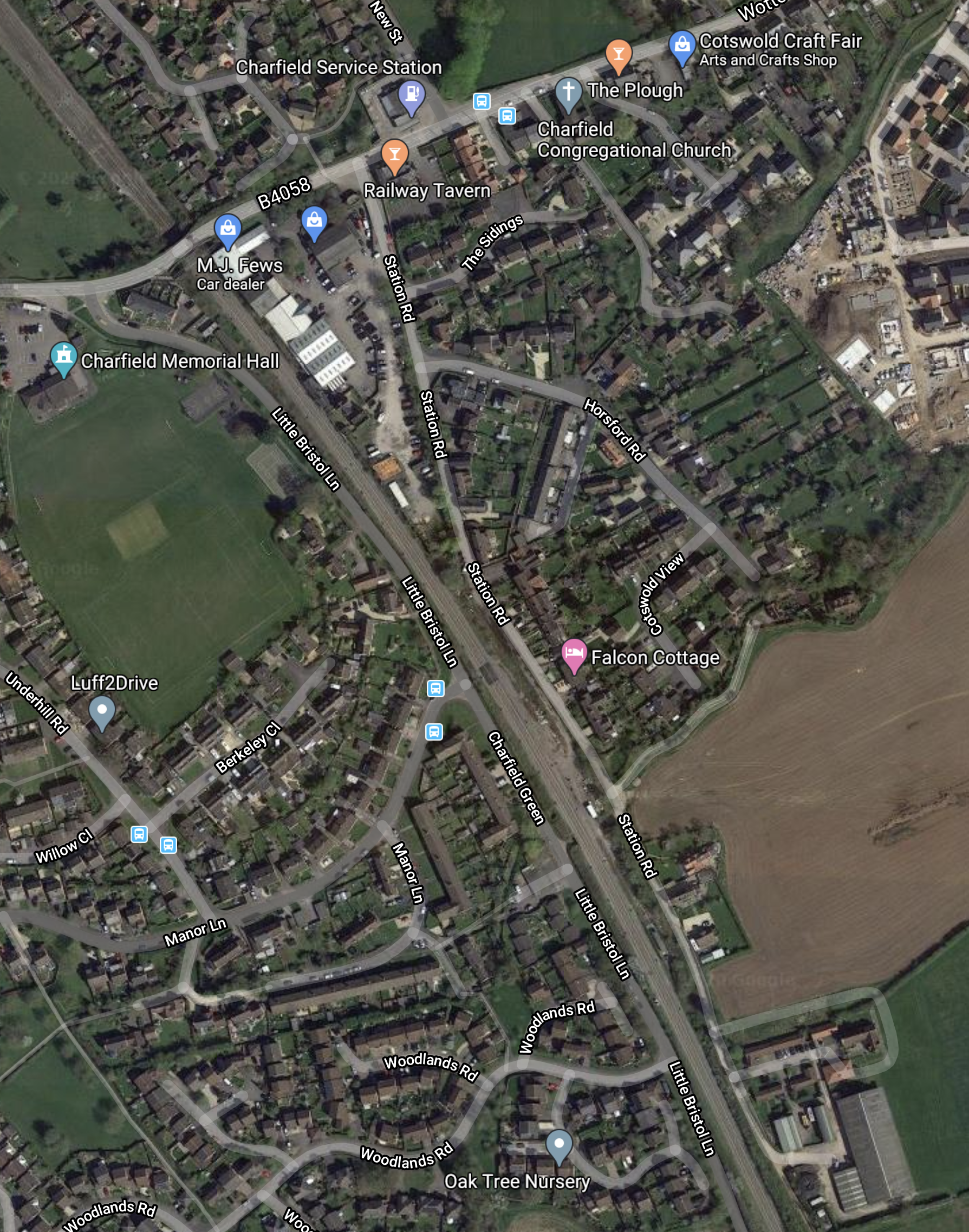
Note, that the road running down the East side of the railway is called Station Road.
There appear to be these services running through the location.
- CrossCountry – Plymouth and Edinburgh/Glasgow via Bristol Temple Meads, Bristol Parkway, Cheltenham Spa and Birmingham New Street
- CrossCountry – Exeter St. Davids and Manchester Piccadilly via Bristol Temple Meads, Bristol Parkway, Cheltenham Spa and Birmingham New Street
- GWR – Great Malvern and Westbury via Bristol Temple Meads, Bristol Parkway, Gloucester and Cheltenham Spa
Note.
All services appear to be hourly.
Bristol Parkway station is thirteen miles away by rail, so is an easy drive, but a very stiff walk or cycle.
Timings by rail from Charfield based on passing GWR trains include.
- Bristol Parkway – 15 minutes
- Bristol Temple Meads – 27 minutes
- Cheltenham Spa – 38 minutes
- Gloucester – 24 minutes
There may be a possibility of improving these times, as the current timetable might have been written for slow trains and a Class 158, Class 165 or Class 166 train can do better.
CrossCountry times include.
- Birmingham New Street – 68 minutes
- Bristol Parkway – 11 minutes
- Bristol Temple Meads – 23 minutes
- Cheltenham Spa – 17 minutes
- Worcestershire Parkway – 32 minutes
I would think, that Charfield station could receive one GWR stopping train and one fast CrossCountry train per hour.
Discontinuous Electrification Between Birmingham And Bristol
Hitachi have changed the rules on electrification, by the announcement of the development of battery electric trains in collaboration with Hyperdrive Innovation, which I wrote about in Hyperdrive Innovation And Hitachi Rail To Develop Battery Tech For Trains.
The proposed train is described in this Hitachi infographic.

It will have a range on battery power of 90 km or 56 miles.
Consider.
- Midlands Connect have ambitions see an extra hourly service between Birmingham and Bristol Temple Meads, with all services running five minutes faster. See Midlands Rail Hub.
- CrossCountry will likely be getting new trains, to replace their exclusively all-diesel fleet. They could be tri-mode trains to make the most of long stretches of electrification on their routes, batteries for short gaps of up to fifty miles and diesel power everywhere else.
- There are electrified stations at Bristol Parkway and possibly Bristol Temple Meads in a few years.
- There is full electrification between Birmingham New Street and Bromsgrove stations.
- Bromsgrove and Bristol Parkway are seventy miles apart.
- There is a possibility, that Cheltenham Spa station will get a charging facility so that London Paddington and Cheltenham Spa services could be run by Class 800 trains converted to battery electric operation.
I don’t think it is an unreasonable prediction to make that Hitachi and other train manufacturers like Stadler with their Class 755 trains, have the technology to run low-carbon services between Bristol Temple Meads and Birmingham New Street stations.
- Trains would leave Bromsgrove and Bristol Parkway with full batteries.
- Quick battery top-ups can be taken at Cheltenham Spa and Worcestershire Parkway stations.
- The fast acceleration of the electric trains will allow extra stops.
I think it would also be possible for GWR to use battery electric Class 387 trains between Great Malvern and Westbury.
Charfield could be an electric train-only station.
Conclusion
The reopening of Charfield station is really a simple station rebuilding and reopening and local passenger forecasts will probably make the decision.
But these forecasts must take into account, the likely partial decarbonisation of the route through the station, which would surely increase ridership.
The new station could also be built with provision for a possible charging facility, in case it might be needed in the future.
 The Anonymous Widower