Improving The Chingford Branch Line
The Chingford Branch Line has a four trains per hour (tph) service between Liverpool Street and Chingford via Hackney Downs and Walthamstow Central stations.
Those that I know who live in the area, have a few simple wishes.
- New trains with wi-fi and other passenger-friendly features.
- More trains to improve services and take the pressure off the Victoria Line.
- A service from Chingford and Walthamstow to Stratford and Crossrail.
- Perhaps some new stations.
- Step-free access at St. James Street and Wood Street stations.
The following sections tackle these wishes in more detail.
New Class 710 Trains
The biggest change to the line will come with the new Class 710 trains in a couple of years time.
Thirty new four-car Class 710 trains will replace the same number of Class 315 and Class 317 trains, that currently work the Cheshunt and Chingford services.
- As the number of trains and their length is the same, the service frequency and capacity will be no worse than at present.
- The trains will be modern and have air-conditioning and all the features that passengers now expect.
- The trains will be fitted with various driver aids to ensure accurate timekeepers.
- Nothing has been said about wi-fi, but most other new Aventras will have free wi-fi fitted, so I suspect it will be fitted or there will be a big argument.
- I am of the belief that all Class 710 trains will be fitted with enough onboard energy storage to handle regenerative braking and short movements not connected to the overhead wires.
- Onboard energy storage would also mean the trains could be fitted with remote wake-up, so that trains stabled overnight at Chingford, can be driver and passenger ready before the driver arrives to start the service in the morning.
It should be noted that London Overground has taken an option for another twenty-four trains. So could some of these trains be added to the fleet on the Chingford Branch to increase capacity and service on the Branch?
The Highams Park Level Crossing
In an ideal world, more services would be provided on the Chingford Branch to Liverpool Street for the following reasons.
- The Victoria Line from Walthamstow Central now has the trains to handle passengers to Central London, but the station doesn’t have the capacity to handle them, due to its cheapskate 1960s design.
- The Chingford Branch has direct access to Crossrail at Liverpool Street whereas the Victoria Line doesn’t connect to London’s new train line.
- The Chingford Branch has direct access to the North London Line at Hackney Downs and the new Class 710 trains, will mean that North London Line services will be increased.
- Crossrail could release extra platform space at Liverpool Street for more London Overground services.
But there is one major problem to increased services on the current Chingford Branch. They must all go through the level crossing at Highams Park Station.
- There is only long detours, if the crossing is closed.
- Extra trains would cause significant traffic congestion.
- Extra trains would mean the crossing would be closed for a large proportion of every hour.
As it is unlikely that the money could be found for a bridge or tunnel at Highams Park, the only thing that can be done, is make sure that all train services be at maximum length, which is probably eight cars.
Obviously, longer trains would help, but in the long term, I’m certain that London Overground would want to run more frequent services between Liverpool Street and Chingford.
I think it is true to say that the train frequency of the Chingford Branch through Highams Park is probably limited by a maximum of eight closures per hour of the Highams Park level crossing, unless the level crossing could be closed or by-passed.
But is maximum use being made of the level crossing closures now?
At present in the Off Peak.
- Trains arrive at Highams Park from Chingford at 14, 29, 44 and 59 minutes past the hour.
- Trains leave Highams Park for Chingford at 08, 23, 38 and 53 minutes past the hour.
I don’t think that this means that a Northbound and a Southbound train can share a single closure of the level crossing. This page on the National Rail web site, shows live departures at Highams Park.
If they could, then that would cut the number of times the crossing closed in the Off Peak by half.
Things that will help, is that the Class 710 trains will have extensive driver aids and probably onboard signalling, so the precise timekeeping that would be required, so two trains shared a level crossing closure, could be a lot easier.
Eight trains per hour in the Off Peak in both direction through Highams Park station is a distinct possibility.
This 8 tph frequency could be continued through the Peak, as it’s probably better than the current timetable.
Eight Trains Per Hour From St. James Street To Chingford
So it looks like that modern Class 710 trains running to a precise timetable could mitigate the problems of the Highams Park Level Crossing and allow eight trains per hour between St. James Street and Chingford.
|As there is no other trains using the branch, except moving empty and some engineering trains to and from the sidings at Chingford, there is probably little to interfere with an 8 tph schedule.
South From St. James Street
South from St. James Street station, the trains go through the Coppermill Junction area and cross the West Anglia Main Line.
The Chingford Branch then joins the line from Tottenham Hale to Hackney Downs, as this map from carto.metro.free.fr shows.

Coppermill Junction
The map shows Coppermill Junction, where the Chingford Branch Line crosses the West Anglia Main Line, that runs North from Liverpool Street to Tottenham Hale, Bishops Stortford, Stansted Airport and Cambridge.
I suspect that there would be a problem fitting another four tph through Hackney Downs station and on to Liverpool Street.
In Rumours Of Curves In Walthamstow, I talked about how two curves would be rebuilt, based on information from an informant with detailed knowledge.
- The Hall Farm Curve would be rebuilt as a bi-directional single-track connection between St. James and Lea Bridge stations.
- The Coppermill Curve would be rebuilt to give a connection between St. James and Tottenham Hale stations.
The Hall Farm Curve is the significant one for passenger services on the Chingford Branch Line, as it would mean that the current service of 4 tph between Chingford and Liverpool Street would be augmented by a second 4 tph between Chingford and Stratford.
- Waltham Forest would get an 8 tph metro service between St. James and Chingford stations.
- There are extensive bus connections at Chingford, Walthamstow Central and Stratford.
- The line has good connections to the Victoria Line, the Jubilee Line, the Central Line and Crossrail.
The only infrastructure needed would be the single-track Hall Farm Curve. If the Class 710 trains were to be fitted with onboard energy storage, this curve would not even need to be electrified.
Conclusion
By using the features of the new Class 710 trains, Chingford can be given four trains per hour to Liverpool Street and 4 trains per hour to Stratford, if a new single-track Hall Farm Curve without electrification is built between St. James and Lea Bridge stations.
Related Posts
Could Electrification Be Removed From The Chingford Branch Line?
Could Reversing Sidings Be Used On The Chingford Branch Line?
Could The Hall Farm Curve Be Built Without Electrification?
Crossrail 2 And The Chingford Branch Line
New Stations On The Chingford Branch Line
Rumours Of Curves In Walthamstow
Will Walthamstow Central Station On The Victoria Line Be Expanded?
Wikipedia – Chingford Branch Line
Could The Hall Farm Curve Be Built Without Electrification?
The Hall Farm Curve was a five-hundred metre curve that used to connect the Chingford Branch Line to the Lea Valley Line, thus enabling direct services between Stratford to Chingford via the new Lea Bridge, James Street and Walthamstow Central stations.
This map from carto.metro.free.fr shows the lines in the area around Coppermill Junction.
Coppermill Junction
It is a much-needed route, as anybody who has taken the bus between Walthamstow and Stratford can testify.
I have heard rumours that it will be rebuilt, but nothing has been published yet.
The last rumour said it would be a single-track bi-directional line, as I wrote in Rumours Of Curves In Walthamstow
If this were to be built, there would need to be appropriate cross-overs, so that the trains could go on the right lines to and from Chingford and Stratford.
As in a few years time, the Stratford-Chingford service would be likely to be run by Aventras and no other electric train would be likely to use the curve, would it not be possible to not electrify the curve.
In Bombardier’s Plug-and-Play Train, I showed that all Aventras will have a certain amount of onboard energy storage to handle regenerative braking and enable short movements using stored energy.
So could the Aventras use their onboard energy storage to navigate the curve? The pantograph could be raised and lowered appropriately in Lea Bridge and St. James Street stations.
Conclusion
Building the Hall Farm Curve without electrification is possible, if Aventras use the line exclusively for passenger services.
Related Posts
Improving The Chingford Branch Line
Could Electrification Be Removed From The Chingford Branch Line?
Could Reversing Sidings Be Used On The Chingford Branch Line?
Crossrail 2 And The Chingford Branch Line
New Stations On The Chingford Branch Line
Will Walthamstow Central Station On The Victoria Line Be Expanded?
Rumours Of Curves In Walthamstow
Last night, Lea Bridge station opened without ceremony, as I wrote in The People Of London Welcome Lea Bridge Station.
I got talking to someone, who knows a lot more about what will be happening to the railways in East London, than I do and when I asked about the Hall Farm Curve, they indicated it could be reinstated soon.
This map from carto.metro.Free.fr shows the lines North from Lea Bridge station.
Lines North Of Lea Bridge Station
The Hall Farm Curve connects Lea Bridge and St. James Street stations.
My informant said the curve would probably be only single-track and signalled to allow trains to go both ways.
With my scheduling hat on, I do wonder if the curve would effectively connect spare capacity on the Northern end of the Chingford Branch to some spare capacity between Lea Bridge and Stratford stations. I think it is probably true to say, that North of Coppermill Junction, the West Anglia Main Line needs more capacity, so this sneaky way to Chingford doesn’t impact.
The limiting factor on the number of trains per hour between Chingford and Stratford would probably be platform capacity at the two ends of the route.
My informant also indicated that the Coppermill Curve could be rebuilt to allow trains to go between the West Anglia Main Line and the Chingford Branch Line.
This Google Map shows the area around Chingford station.
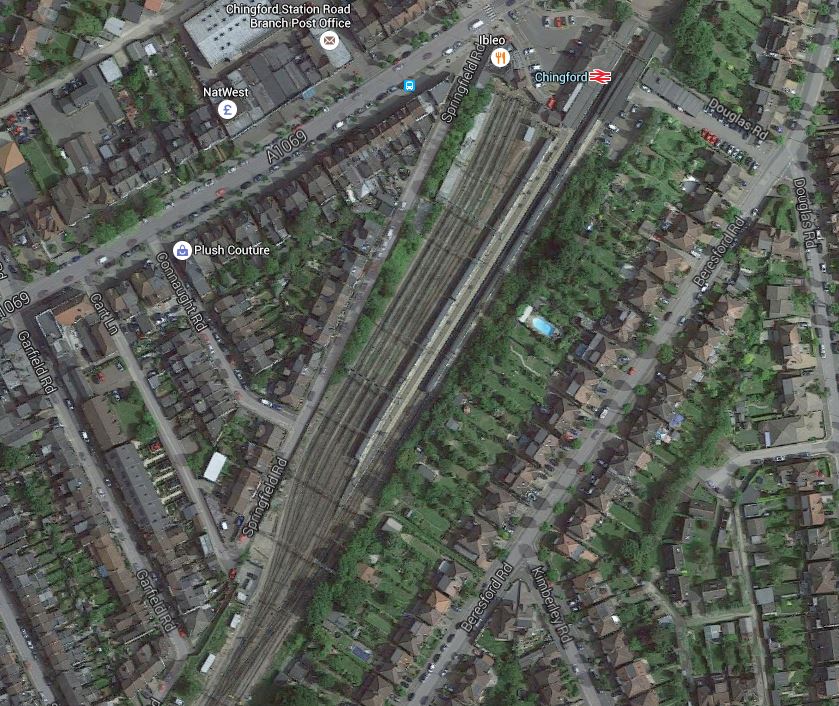
Chingford Station
Note the extensive sidings by the station.
My informant said the main purpose of reinstating a double-track Coppermill Curve, would be to move empty trains to and from Chingford, rather than new passenger services.
But with the design stage of Crossrail 2 well underway, I do wonder, if connecting Chingford station and the related sidings to the West Anglia Main Line, might give Crossrail 2 better options to build the line or provide alternative services, whilst the West Anglia Main Line is rebuilt through the area.
It strikes me that the cost of doing both curves together would be less than only building the Hall Farm Curve and then finding that construction of Crossrail 2 needs the Coppermill Curve.
Related Posts
Improving The Chingford Branch Line
Could Electrification Be Removed From The Chingford Branch Line?
Could Reversing Sidings Be Used On The Chingford Branch Line?
Could The Hall Farm Curve Be Built Without Electrification?
Crossrail 2 And The Chingford Branch Line
New Stations On The Chingford Branch Line
Will Walthamstow Central Station On The Victoria Line Be Expanded?
What Might Have Been At Walthamstow And Woodford
The World Class Engineering And Penny-Pinching Architecture Of The Victoria Line
The Victoria Line is to reverse one of my favourite phrases, an all knickers and no fur coat Underground line.
Underground and remember, it is a totally below the surface except for the depot at Tottenham Hale, it is superb, with some world class engineering.
1. The original 1967 Stock lasted until 2011 and was a real tribute to its designers and builders.
2. The trains run automatically and the line was the world’s first to do this. I remember reading a document about how it worked in 1969 or so and because of the date the automation was largely controlled by thermionic valves and relays.
3. There was quite a bit of innovative design in the layout of the lines, which included the hump-backed stations, summed up here from Wikipedia.
The line has hump-backed stations to allow trains to store gravitational potential energy as they slow down and release it when they leave a station, providing an energy saving of 5% and making the trains run 9% faster
4. The overall concept has proved to be sound, as the line has a very good safety record.
But they certainly didn’t spend a large amount of time, effort and money on the stations. Again from Wikipedia.
When the Victoria line was built, budget restrictions meant that station infrastructure standards were lower than on older lines and on later extension projects. Examples include narrower than usual platforms and undecorated ceilings at Walthamstow Central, Blackhorse Road and Tottenham Hale, adversely affecting lighting levels. At most stations there is still a concrete staircase between the up and down escalators, where an additional escalator could be installed.
Walthamstow Central, Seven Sisters and Highbury and Islington are still truly dreadful stations.
The Bad Stations Can Only Get Better
Hopefully :-
1. The takeover of the Chingford Line by London Overground and the developments in Walthamstow town centre, will result in substantial improvements to Walthamstow Central.
2. Crossrail 2 and the Overground takeover coupled with development could also improve Seven Sisters.
3. Much needed better disabled access, enhancements to the Northern City line and increased passenger numbers will drive a need for the rebuilding of Highbury and Islington.
4. Other stations like Brixton, Euston and Blackhorse Road will have improvements driven by other new and upgraded lines.
Finally fifty years on, the sins of the 1960s are being eradicated.
The Victoria Line Extension To South Woodford or Woodford
But there are no plans to extend the line to Woodford or South Woodford stations on the Central Line which was part of the original proposals. Again from History on Wikipedia.
It had been intended to build the line beyond Walthamstow Central to Wood Street (Walthamstow), where it would have surfaced to terminate next to the British Rail station. Proposals were also made to extend the line as far north as South Woodford or Woodford, to provide interchange with the Central line. However, in a late decision in 1961 the line was cut back to Walthamstow (Hoe Street) station, renamed Walthamstow Central in 1968.
Let’s take a look at the Underground lines in the area. This map from Walthamstow Central to Woodford station is from Google Earth.
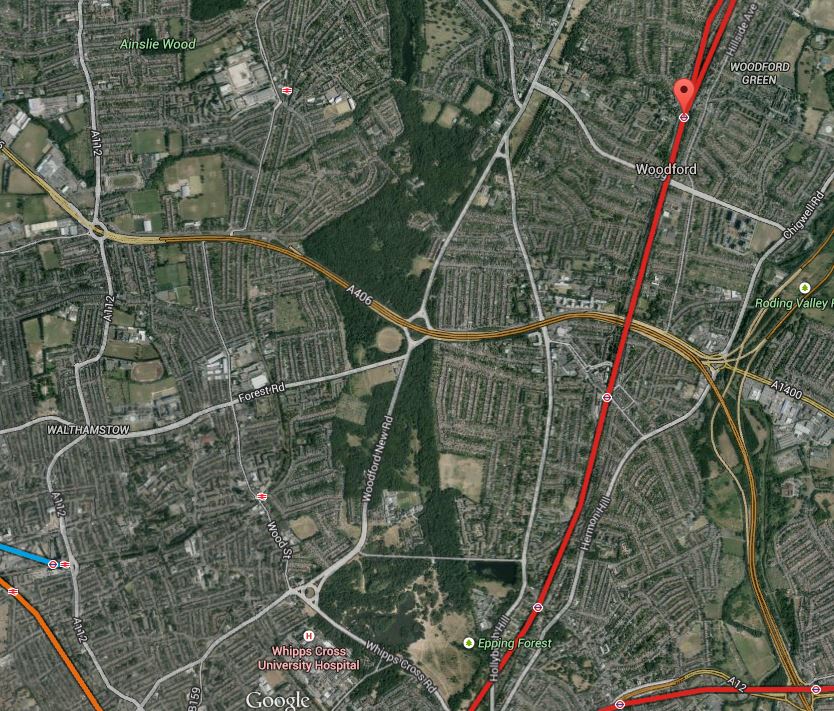
Walthamstow Lines
The red line at the right is the Central Line with South Woodford and Snaresbrook stations shown, in addition to Woodford station to the north of the A406.
The orange and light blue at the left being the Gospel Oak to Barking and Victoria Lines, with the two Walthamstow stations; Central and Queens Road.
The Victoria Line was originally planned to surface at Wood Street station, which can be seen to the north of Whipps Cross Hospital and then presumably cut across the southern part of Epping Forest to the Central Line.
I can’t find an article specifically stating why the extension to Woodford was dropped, but I did find this general article on London Reconnections, entitled Why We Do (And Don’t) Extend Tube Lines. This is two paragraphs.
One lesson quickly learnt by the early entrepreneurs who built early tube lines (and by this, as for the duration of the article, we mean the deep level lines) was that the longer the line and the bigger the network, the more profitable it was. To some extent this may seem obvious – a tube line between only two stations is of limited use (although exceptionally the Waterloo and City line manages to perform this role).
As usage tends to tail off at the extremities, it made sense to have the ends only being a small portion of the line. It also made sense to maximise use of resources. Trains sitting in terminal platforms were not in revenue earning service and a lot of the infrastructure – such as power supply – had large initial costs but the add-on cost for these items when extending the line was not that great.
So it’s generally all about economics and probably in the case of the Victoria Line; government money.
Walthamstow is a large catchment are and it has two routes into Central London and one to the west, two of which will be upgraded in the next few years, so I doubt the Victoria Line will be extended in the near future. This Google Earth image from Wood Street to South Woodford stations, shows the mass of development in between the two lines.
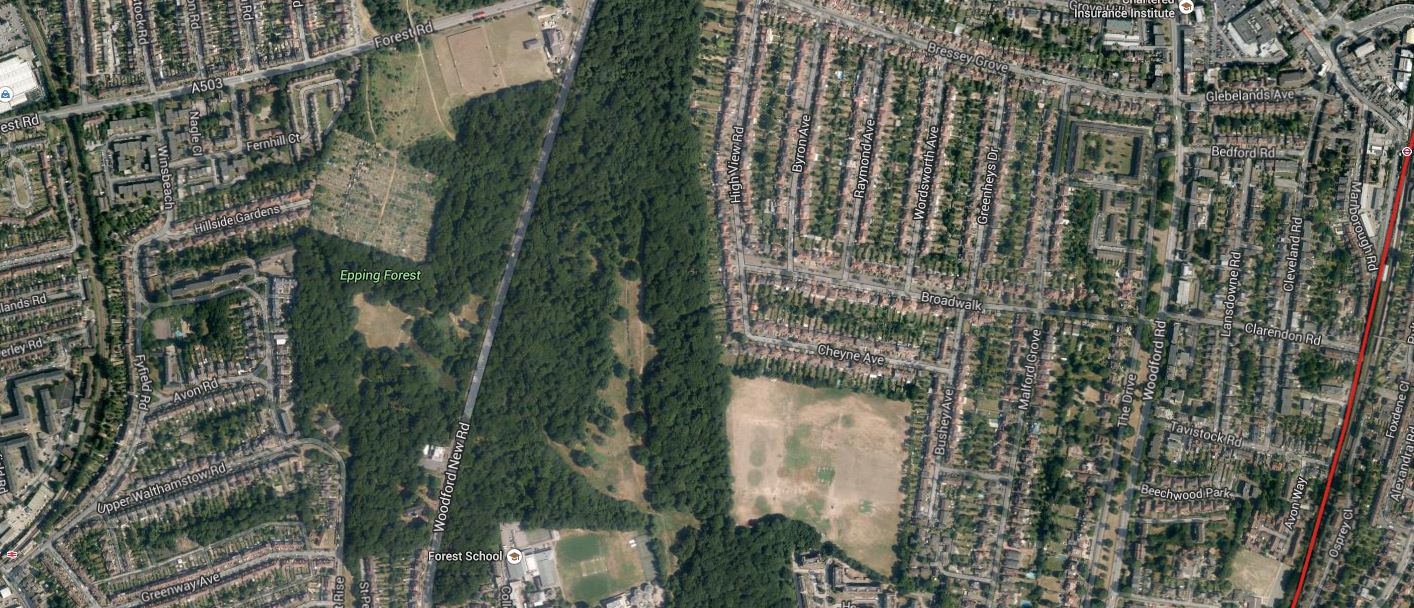
Wood Street To South Woodford
Wood Street station is just visible at the bottom left and South Woodford is at the far right towards the top.
There is also the small matter of putting the line through the green lung that is Epping Forest.
So any extension from Walthamstow Central to the Central Line would probably be in an expensive tunnel.
But there are some other reasons why any extension will not be built as planned in the 1950s.
1. There now appears from this Google Earth image to be little space around Wood Street station.
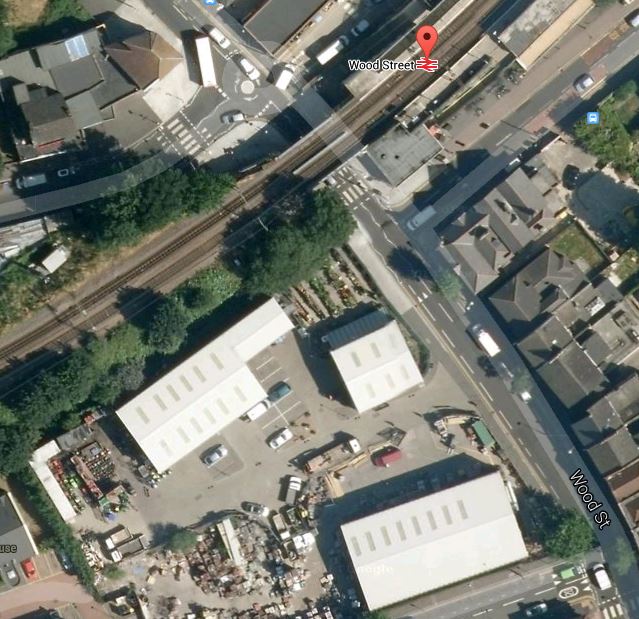
Around Wood Street Station
Although it does look like that some of the buildings around the station were built in recent decades.
This would appear to further rule out a surface route.
2. Walthamstow now has an impressive new bus station, that was built 2005 and is the third busiest in London with twenty-four hour operation.
Buses go all over north east London from the bus station, to places like Wood Green, East Ham, Barnet and Ilford, but there is also a comprehensive local network that covers the area to Chingford and Woodford. This spider map shows all the routes from Walthamstow Central.
3. Crossrail will also have an effect when it opens. How will passengers between Walthamstow and Woodford, get on Crossrail? They have several choices.
What Should Be Done
In my view it would be better to spend money on the following.
1. Adding new routes and extra capacity to the buses in the area, so the in-between passengers will have a choice to go east or west.
2. After May 2015, improving the stations on the Chingford Branch from Hackney Downs to Chingford, with step-free access and better information systems and interchange with the buses in the area.
3. Increasing the frequency of Overground trains to Chingford and possibly running some through to Stratford via the reinstated Hall Farm Curve and the new Lea Bridge station.
4. New trains have been promised and I suspect they’ll arrive in the next few years. However, giving the Class 317 trains a good scrub, some new seat covers and a bit of TLC and they will hold the line in the meantime. On the Chingford branch more services are more important than flash new trains.
5. In the Future Developments section of the Wikipedia entry for the Chingford Branch, it is said that there may be a station at both Forest Road and Chingford Hatch, either side of Highams Park station. This map shows the area.
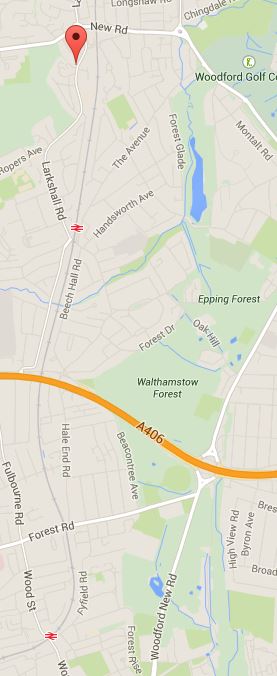
Around Highams Park
The red arrow indicates Chingford Hatch, with the two stations shown being Highams Park in the middle and Wood Street at the bottom.
The Effect Of An Expanded Stansted Airport
However, there is one factor that has been ignored, which would change everything.
And that is if Stansted Airport is expanded.
Plans for this sometimes show another rail link direct to London, which is an extension of the Chingford Branch line from Chingford.
Can Any Conclusions Be Drawn?
I can’t see any reason why the Victoria Line would be extended to join the Central Line, unless a second line is built to Stansted Airport or a similar large project was developed in the area, that required a major sort out of lines.
But the major conclusion is that because of developments that are already in place and others that could easily be implemented there are masses of ways to improve public transport in the Walthamstow area, which are proven and a lot more affordable.
I think that in perhaps ten years time, the following will have been done.
1. The Chingford Branch Line will have upgraded stations and a proper interchange to buses and the Victoria Line at Walthamstow Central.
2. The Chingford Branch Line will be running possibly as many as six trains an hour and a proportion will go to Stratford, rather than Liverpool Street.
3. There will be at least two new stations on the Chingford Branch Line.
4. The bus services based on Walthamstow Central bus station will be expanded.
5. New or refurbished trains will be running the service on the Chingford Branch.
I’m not speculating, just applying logic to see what is possible and history from the East and North London Lines after they were taken over by London Overground.
I shall be very surprised if the Victoria Line is extended to Woodford.
I will not be surprised to see house prices in the area rise astronomically, as they have done here in Dalston.
Good railway connections really seem to bring the best or worst out of house prices.
Before Overground – Chingford
A Terminus In A Meaningful Place – Rating 8/10
Chingford is a proper terminus, with three platforms and a well-equipped station surrounded by a bus station with upwards of half-a-dozen routes, cafes, shops and a real ale pub.
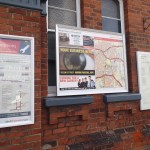


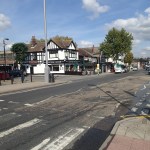
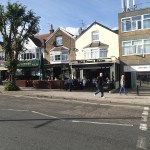

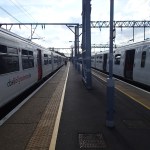
The station doesn’t appear to have any access issues and possibly more trains could be run to and from the station every hour.
 The Anonymous Widower