Will Abellio East Midlands Railway Go Flirting?
Abellio take over the East Midlands franchise in a few days and it will be renamed to East Midlands Railway.
It has already disclosed that it will have three divisions.
- EMR Intercity for long distance services from London St Pancras
- EMR Regional for local services
- EMR Electrics for the London St Pancras to Corby service
It has also confirmed it has ordered thirty-three AT-300 trains for EMR Intercity.
Wikipedia also shows, that the following trains will be transferred to East Midlands Railway.
- Nine Class 156 trains from Greater Anglia.
- Twenty-one Class 360 trains from Greater Anglia.
- Five Class 170 trains from ScotRail
- Four Class 180 trains from Hull Trains
The first three fleets will come from Abellio-run franchises and the last will be released fairly soon, as Hull Trains new fleet is arriving.
Looking at the EMR Regional fleet it will comprise.
- 21 – Class 153 trains
- 24 – Class 156 trains
- 26 – Class 158 trains
- 5 – Class 170 trains
Consider.
- Many probably feel that the Class 153 trains are inadequate.
- Except for the Class 170 trains, these trains are around thirty years old.
- Some of the Class 156 trains, which will be transferred from Greater Anglia, are currently being replaced with brand-new Class 755 trains.
- Abellio are going through extensive fleet replacement exercises in ScotRail, Greater Anglia and West Midlands Trains.
The EMR Regional routes, that they will run are a mixed bunch.
This page on the Department for Transport web site is an interactive map of the Abellio’s promises for East Midlands Railway.
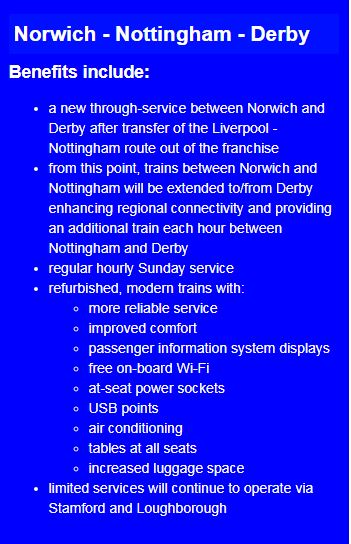
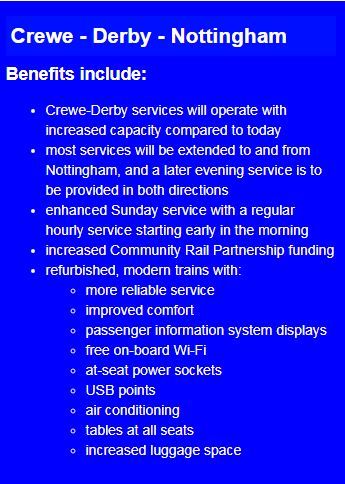
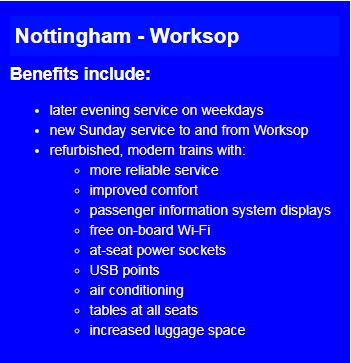
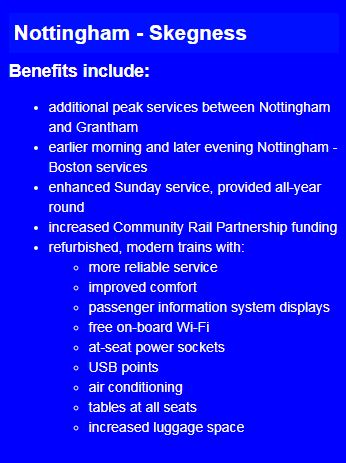
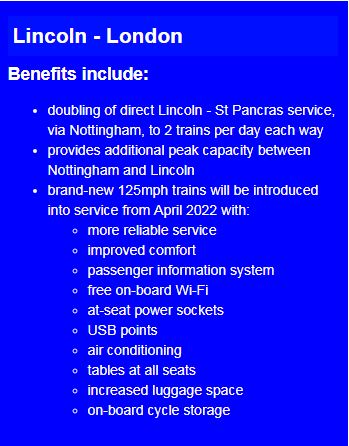
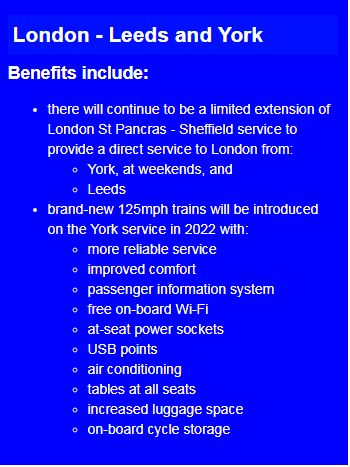
Digging out the blurb for each route shows the following.
Norwich – Nottingham – Derby
Crewe – Derby – Nottingham
Matlock – Derby – Nottingham

Nottingham – Lincoln – Grimsby

Nottingham – Worksop
Nottingham – Skegness
Leicester – Nottingham
 Peterborough – Lincoln – Doncaster

Barton-On-Humber – Cleethorpes

Lincoln – London
London – Oakham – Melton Mowbray

London- Leeds – York
Newark North Gate – Lincoln

I have come to a few conclusions.
The Fleet Is Not Being Expanded Enough To Retire The Class 153 Trains
Consider.
- There are twenty-one Class 153 trains.
- Five Class 170 trains and nine Class 156 trains are being added to the fleet.
Surely, this means that some Class 153 trains will be retained.
Perhaps, the remaining Class 153 trains, will be reorganised into two-car trains to increase capacity.
Extended Services Will Be Run Using New Bi-Mode AT-300 Trains
Services to Leeds and York, Oakham and Melton Mowbray and Lincoln would appear to be run by the new AT-300 trains that have been ordeed from Hitachi.
I’ve no problem with that,but there are three developments that may effect passenger numbers.
- There is a lot of housing development in the Corby, Oakham and Melton Mowbray area.
- There is a very large renewable energy sector developing in North Lincolnshire.
- Sheffield are proposing to add new stations between Sheffield and Leeds, at Rotherham and Barnsley Dearne Valley.
Does the proposed service pattern take this fully into account?
In a way it doesn’t matter, as the worst that could happen, is that East Midlands Railway will need to increase the fleet size by a small number of trains.
Hopefully, they’ll just need to get Hitachi to build the trains!
Most Regional Services Will Be Run By Refurbished Modern Trains
Most services will be run by refurbished modern trains with the following features.
- More reliable service
- Improved comfort
- Passenger information system
- Free on-board wi-fi
- At-seat power sockets
- USB points
- Air-conditioning
- Tables at all seats
- Increased luggage space
Can East Midlands Railway Refurbish Their Augmented Fleet To Meet Their Required Standards?
Consider.
- The Class 170 trains are relatively recent and were built to a high standard, so can probably meet EMR’s standard.
- The Class 158 trains are thirty years old and were built to a high standard, so they might be able to be upgraded to EMR’s standard.
- The Class 156 trains are thirty years old and noisy and old-fashioned, so will need a lot of work to bring them up to EMR’s standard.
- The Class 153 trains are thirty years old and only one car, so would probably be best retired or reduced to an auxiliary role like a bicycle car.
- Only the Class 170 and Class 158 trains can be high standard trains.
- All trains are diesel and only the Class 170 trains are possibly planned to be upgraded to more economical diesel hybrid trains
One additional option might be to refurbish some of the Class 222 trains, when they are replaced by the new Hitachi AT-300 trains on main line services, so they were suitable for the longer regional routes.
Will East Midlands Railway Replace The Fleet?
In their three other franchises in the UK; Greater Anglia, ScotRail and West Midlands Trains, Abellio have opted for replacement of all or a substantial part of the fleet.
So will the same action be taken at East Midlands Railway?
The company could do a lot worse, than invest in a fleet of Class 755 trains like Greater Anglia.
- They could be a mix of lengths, so each route could have a train with capacity for the traffic.
- The trains may be capable of 125 mph running on the Midland Main Line and the East Coast Main Line.
- The interiors meet the company’s requirements.
- The trains could use electrification , where it exists.
- The trains could be fast enough to cover for the AT-300 trains.
- Abellio Greater Anglia will soon have a large knowledge base for the trains.
The clincher could be, that as electrification increases, the trains could fit batteries and generate less carbon.
Conclusion
I wouldn’t be surprised to see Abellio East Midlands Railway buy a fleet of Class 755 trains for their EMR Regional services.
Industry Urged To Decide On Alternative Technology
The title of this post, is the same as that of this article on Rail Magazine.
This is the first paragraph.
The rail industry needs to decide on the right approach to alternative technology as soon as possible, to ensure the industry can continue to reduce emissions.
Speaking to the All-Party Parliamentary Rail Group, Anthony Perratt of the RSSB, outlined how there was a huge opportunity to replace ageing Sprinter trains with new units powered by alternative energy sources like batteries and hydrogen.
The Size Of The Opportunity
Sprinter trains in service of stored in the UK include.
- Class 150 – 135 x two-car, 2 x three-car
- Class 153 – 70 x one-car
- Class 155 – 7 x two-car
- Class 156 – 114 x two-car
- Class 158 – 147 x two-car, 21 x three-car
- Class 159 – 30 x three-car
These add up to 516 trains, with a total of 1035 cars.
In the Wikipedia entry for the Class 710 train, this is said.
TfL announced that it had placed a £260m order for 45 four-car Bombardier Aventra EMUs.
This works out at nearly £1,500,000 for each car of a modern train.
This means that replacement of the Sprinters, with new independently-powered trains, would be project of the order of £1.5billion.
That is a market, that would be very much desired by a train builder.
Battery, Diesel Or Hydrogen Power?
Diesel power is probably not a good idea, if it can be avoided.
The following points about hydrogen- and battery-powered trains should be noted.
- Most hydrogen-powered trains are battery-powered trains, with a hydrogen fuel-cell to recharge the batteries.
- Battery technology is improving fast.
- Systems to rapidly charge batteries will be available in a couple of years.
- Battery-powered trains can use existing electrification to charge the batteries.
- Hydrogen-powered trains may need a large tank for the hydrogen, which limits passenger capacity.
- Hydrogen-powered trains need a refuelling structure, which may be more difficult to install, than a charging system for battery trains.
I feel that innovative engineers will be able to find ways to enable battery-powered trains on routes that need independently powered trains.
Conclusion
I don’t think, that we’ll see many long-term applications of hydrogen-powered trains in the UK.
 The Anonymous Widower