Will Crossrail And Its Class 345 Trains Set Mobile Connection Standards For The UK?
Search for “Class 345 trains 4G” or “Class 345 trains wi-fi” and you find reports like this on London Reconnections about the Class 345 train.
This or something like it, is said in several of these reports.
According to the accompanying press notes both free wifi and 4G services will be delivered on board, as will multiple wheelchair and luggage spaces.
It would be very embarrassing for London’s flagship multi-billion pound project, if it wasn’t correct.
So it would appear that I could board a Class 345 train at Shenfield and watch a video all the way to Heathrow or Reading.
But where does this leave Thameslink?
Their Class 700 trains have been designed without wi-fi, 4G and power-sockets as I said in By Class 700 Train To Brighton And Back.
But at least Siemens felt that the Department for Transport, who ordered the trains, were out of step with reality and appear to have made provision to at least fit wi-fi.
This article on Rail Engineer is entitled Class 707 Breaks Cover and it describes the Class 707 train, which is a sister train to the Class 700. This is said about the two trains and wi-fi and toilets.
Thameslink (or the Department for Transport which ordered the trains) decided not to include Wi-Fi in the Class 700s, a questionable decision that has now apparently been reversed. Fortunately, Siemens had included the technology framework in the design so, hopefully, the upgrade will not require too much effort. Suffice it to say that South West Trains has included Wi-Fi in its specification for Class 707s.
Reversing the story, Thameslink Class 700s are all fitted with toilets. However, South West Trains has decided not to include toilets in its Class 707 specification given that the longest journey time is less than one hour and their inclusion would reduce the overall capacity of the trains.
So it appears that Siemens may have future-proofed the trains.
This article on the Railway Gazette describes the third fleet of the Siemens trains; the Class 717 trains for Moorgate services. This is said.
Plans for the installation of wi-fi are being discussed with the Department for Transport as part of a wider programme for the GTR fleet.
So at least something is happening.
But how close will mobile data services get to the ideal that customers want.
- 4G everywhere from the moment you enter a station until you leave the railway at your destination station.
- Seamless wi-fi, so you log in once and your login is valid until you leave the railway.
It will be tough ask to achieve, as it must be valid on the following services.
- Crossrail
- Thameslink
- London Overground
- London Underground
- All train services terminating in London.
And why not all buses, trams and taxis?
On a related topic, I believe that for safety and information reasons, all bus and tram stops and railway stations must have a quality mobile signal and if it is possible wi-fi.
One life saved would make it all worthwhile.
By Class 700 Train To Brighton And Back
Today, I went to Brighton for lunch and a walk on the promenade to get some October sun.
I hadn’t intended to go to Brighton, but just to take the short route across London from St. Pancras to East Croydon, to see if any Class 700 trains were working the route.
However a Brighton-bound Class 700 turned up and just before East Croydon station, the conductor turned up and he offered to sell me an extension ticket to Brighton for £9.95.
So why not? As the day was sunny, I accepted his offer and as he didn’t have the right change of 5p for a tenner, he gave me 10p. in change.
Perhaps, Govia Thameslink Railway’s conductors are doing a PR job to enhance their reputation.
These pictures detail the journey.
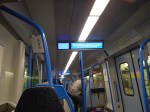
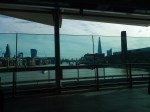
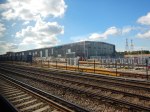
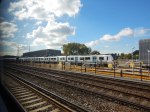
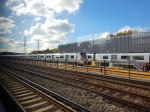
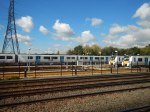
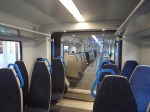
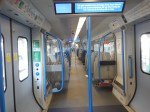
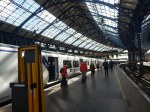
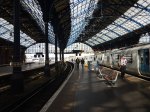
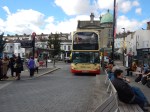
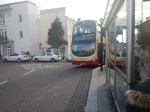
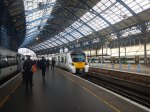
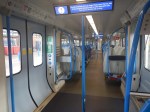
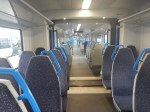
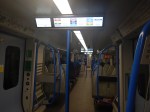
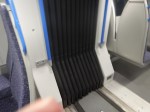
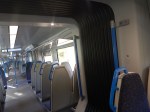
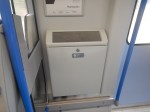
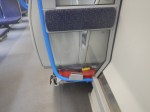

Because the journeys were deep in the Off Peak, the trains weren’t that busy.
I would describe the trains as adequate for the core route from East Croydon to West Hampstead and Finsbury Park, but they do have limitations for long-distance commuters.
- There are no tables or even anywhere to put a drink.
- There is no wi-fi.
- There are no power sockets to charge a laptop or phone.
The new Class 345 trains for Crossrail, don’t have tables either, but they do have wi-fi. But these are short-distance trains and unlike the Class 700 trains, which are taking over from Class 387 trains with tables, most of previous stock that worked from Reading to Shenfield didn’t have tables, wi-fi or power sockets.
Govia Thameslink Railway must be really pleased to get a set of trains, without some of the features their passengers demand.
To be fair it’s not their fault, as these trains were designed to fit a Passenger Focus report which can be found on the Internet, that was written in the dying days of the last Labour Government.
Read the document and draw your own conclusions.
However, all is nor lost!
This article on Rail Engineer is entitled Class 707 Breaks Cover and it describes the Class 707 train, which is a sister train to the Class 700. This is said about the two trains and wi-fi and toilets.
Thameslink (or the Department for Transport which ordered the trains) decided not to include Wi-Fi in the Class 700s, a questionable decision that has now apparently been reversed. Fortunately, Siemens had included the technology framework in the design so, hopefully, the upgrade will not require too much effort. Suffice it to say that South West Trains has included Wi-Fi in its specification for Class 707s.
Reversing the story, Thameslink Class 700s are all fitted with toilets. However, South West Trains has decided not to include toilets in its Class 707 specification given that the longest journey time is less than one hour and their inclusion would reduce the overall capacity of the trains.
So it appears that Siemens may have future-proofed the trains. To this end, when they certify the Class 707 train, they’ll certify the train for overhead electrification as well.
Looking at the way the seats are cantilevered from the side of the train, I suspect that Siemens might also have a table design in their box of delights.
I think you might have a very different usage of the trains throughout the day.
Obviously, in the Peak, the trains will be very full, but during the Off Peak, where there are obviously less passengers, perhaps a couple of tables per car, might prove to be a nice marketing feature to encourage travel.
We shall see what happens, but I can certainly see some improvement carried out to these trains in the next few years.
Bombardier’s Plug-and-Play Train
The heart of any electric train is the electrical system that takes the electricity from the overhead wires or third rail and distributes it to the traction motors that actually power the train. If regenerative braking is fitted, then the same system also handles any electricity generated by braking.
So that is where I’ll start.
This article in Global Rail News from 2011, which is entitled Bombardier’s AVENTRA – A new era in train performance, gives some details of the Aventra’s electrical systems. This is said.
AVENTRA can run on both 25kV AC and 750V DC power – the high-efficiency transformers being another area where a heavier component was chosen because, in the long term, it’s cheaper to run. Pairs of cars will run off a common power bus with a converter on one car powering both. The other car can be fitted with power storage devices such as super-capacitors or Lithium-Iron batteries if required.
Bombardier have confirmed the wiring for onboard power storage to me.
So this could mean, that if the overhead wire or third rail can’t accept electricity generated by regenerative braking, then if batteries are fitted, these can store the energy for reuse, and there will be an energy saving. With a commuter train doing frequent stops, the braking energy at a stop, copntributes to getting the train moving again.
If there is no way to recycle or store the braking energy, it is passed through resistors on the roof of the train, and used to heat the atmosphere.
If you look at just-released pictures of the Class 345 train, the trains appear to have the pantograph on one or more of the intermediate cars, unlike some electric multiple units which have them on the driving cars.
I did find this snippet on the Internet which gives the formation of the trains.
When operating as nine-car trains, the Class 345 trains will have two Driving Motor Standard Opens (DMSO), two Pantograph Motor Standard Opens (PMSO), four Motor Standard Opens (MSO) and one Trailer Standard Open (TSO). They will be formed as DMSO+PMSO+MSO+MSO+TSO+MSO+MSO+PMSO+DMSO.
The snippet has a date of August 13th, 2016, so it’s very much up-to-date. It tells us the following.
- All cars except one, have traction motors, which are responsible for both driving the train and providing a lot of the braking effort.
- The pantograph car is motored, whereas on a Class 378 train it isn’t.
- The only trailer car is in the middle of the train.
- The train has two pantograph cars.
- Would a pantograph car and one or more motor cars work together as was described in the Global Rail News article?
One of the big differences between the Aventra and the previous generation of Electrostar trains, is that many more cars are powered.
- Distributing force along the train could be a very good way of applying greater total force to the track, to accelerate and brake the train faster.
- Distributed power might be better in slippery rail conditions.
- Splitting the power system between cars and using lighter-weight and better-designed FLEXX Eco bogies, may distribute the weight better along the train.
- As there are more traction motors, does this mean they are smaller and possibly lighter and cost less.
I suspect that the distributed power approach has other advantages.
As the two pieces of information gleaned from the Internet are five years apart, I suspect that Bombardier have moved on from this concept of a pair of cars, one with the pantograph, third rail shoe and the converter and one with the energy storage.
I suspect that the electrical and motor systems of the Class 345 trains could be one of the following.
- The whole train has a common power bus and all motored axles are connected to it.
- The train is effectively two half trains, each with their own power bus consisting of four cars in the following formation; DMSO+PMSO+MSO+MSO, with a trailer car without power in between.
These are my thoughts on the two approaches.
- The second approach must have advantages in terms of reliability as there are two of everything.
- The initial trains running from May 2017, will be seven cars, so will they be two three-car trains with a formation of DMSO+PMSO+MSO and a TSO in the middle? This would give a thorough test to all types of cars.
- Going from seven to nine cars, just means adding an MSO to each half-train.
- If necessary, Crossrail will lengthen trains to ten cars. Would they do this by adding another TSO?
- The two pantographs must be at least a hundred metres apart, which could come in handy for jumping gaps in the overhead wires.
- If the half-train approach is used, the two electrical buses would probably be connected together intelligently to share power.
So I wouldn’t be surprised to find, that the Class 345 trains are effectively two half trains working as one.
So how does a concept like this, fit with other train orders and lengths?
Class 710 Trains
The Class 710 trains for London Overground are four-car commuter trains, which will trundle around North-East London. I think they could have a formation of something like DMSO+PMSO+MSO+DMSO, which would fit the published information in the Global Rail News article of an electrical system based on at least two cars.
Incidentally, the five-car Class 378 trains with their three cars in the middle have two powered cars and a trailer car.
I said these trains will just trundle around London, but it would appear that all cars are powered, so I suspect they will accelerate away as fast as the track, passengers and the signals will allow.
As the braking is regenerative and either returns the braking energy to the overhead wires or stores it on the train, the trains will stop quickly and will be very efficient, with rapid stops at all stations.
Obviously, I can’t get any figure for how much time, the Class 710 trains will save say between Hackney Downs and Chingford, but I can show some figures on the eleven intermediate station Crossrail route between Stratford and Shenfield.
This currently takes 36 minutes in a Class 315 train and after Crossrail opens this will be 32 minutes in a Class 345 train.
So it looks like the new trains could save twenty seconds a stop. Not much, but the Shenfield Metro is probably running to a good speed.
Abellio’s Five Car Trains
These five-car trains could be two of the driving cars (DMSO) with a three-car set in the middle, so the formation could be DMSO+PMSO+MSO+MSO+DMSO or DMSO+PMSO+MSO+TSO+DMSO, depending on how much oomph was required.
Like the Class 710 trains, they would have a lot of powered axles and this helps create a specification including.
- 100 mph capability.
- Fast acceleration and braking.
- An exceptional 100-0-100 mph time leading to extremely rapid stops.
They truly are pocket rockets.
Abellio’s Ten Car Trains
These ten-car trains will be similar to the five-car ones with a formation of something like.
DMSO+PMSO+MSO+XXSO+XXSO+XXSO+XXSO+MSO+PMSO+DMSO
where XXSO is anything that the operator wanted, but would normally be a MSO or a TSO.
Interim Conclusions On Aventras
I think I can draw some very important conclusions from what I have said already.
- The Aventra is very different to an Electrostar.
- The concept of having a sub-train of two or possibly three cars as outlined in the article in Global Rail News seems to work well with all of the trains ordered so far.
- The sub-train probably wouldn’t include a driving car, as this would mean that in shorter trains, two types of driving can would be needed.
- The driving cars could be identical except for the passenger compartment and the number of doors.
- The overall design concept is very flexible.
- All trains have a high proportion of motor cars and hence powered bogies, which probably means quick acceleration and good braking.
- Train length can be filled out using additional motor or trailer cars.
- Total train power can be adjusted by choosing the right mix of motor and trailer cars.
I shall now look at various topics in detail.
Train and Car Length
We know very little about the lengths of the cars in the various different Aventras, except these snippets from Modern Railways in September 2016 and some other sources.
- Class 345 trains will have cars around 23 metres with three doors on either side.
- Class 710 trains will have cars around 20 metres with two doors on either side.
- The five-car Abellio East Anglia trains will be 110 metres long.
- The ten-car Abellio East Anglia trains will be 240 metres long.
I suspect that different car lengths and number of doors can be easily handled by a well-thought-out manufacturing process.
Much of the differences between the various fleets will come down to the interior design and equipment specified by the operator.
In The Aventra Car Length Puzzle, I came to the following conclusions.
- The Aventra design is very flexible.
- Driving cars generally seem to be around twenty metres.
- There is an appropriate number of equal length intermediate cars between the two driving cars.
In some ways, it’s almost like a mini-HST.
And just like the HST and Bombardier’s successful Class 378 train for the London Overground, capacity and length is changed by just adding or removing intermediate cars.
I also stated in the related article, that Abellio’s five- and ten-car Aventras for East Anglia, could use these two basic car lengths.
- A 20 metre driving car.
- A 25 metre intermediate car.
My lengths might be wrong, but surely to have just two car types of the same size, gives a degree of design and operational flexibility , that must help the operator to a large degree.
In addition, if all driving cars are roughly the same size between the various Aventras, this must ease manufacture and support of the trains.
Different Driving Cars
First Class seats are expensive on space and fittings to provide and aren’t needed on all services.
If you take the selection of Abellio routes in East Anglia, that will be run exclusively by Aventras, how many destinations will actually need First Class seats?
- Clacton, Frinton and Walton
- Southend
- Bishops Stortford and Hertford East
So as trains like the Class 360 trains have First Class at one end of the formation, will we see at least two types of driving car?
- One with an appropriate number of First Class seats.
- One which is all Standard Class.
I suspect that from the bulkhead behind the driver forward, all driving cars will be more or less identical with a few differences due to operator, route and signalling, but on the passenger side, the layout will be adjusted to the route.
We could even see quick change interiors in the small section of the driving car behind the driver.
After all airliners have been configured in this way for many years, with movable screens to separate Business seats from the riff-raff.
So could we see various configurations of the driving cars?
- First Class
- Standard Class
- Mixed First and Standard Class
- Bicycle Racks
- Heavy Luggage and Parcel Space
- Toilets
- Buffets and shops.
Obviously, the train operator, would make sure that their driving cars were right for the routes they served.
Flexible Train Lengths
Bombardier seem to have possibly used the experience they gained with the Class 378 trains on the London Overground, which have progressively been lengthened from three to four and five-cars since delivery five years ago, just by adding extra intermediate cars.
I suspect that appropriate driving and intermediate cars can be shuffled together in order, to create any length of train from four-cars upwards.
I showed earlier, how the Cl;ass 345 trains could be adjusted as time progresses, so Abellio might benefit from a similar flexibility.
Abellio have ordered both five- and ten-car trains for their East Anglian routes, so could we see trains put into alternative formations, if that suits the route and passenger demand better?
Incidentally, I travel regularly on Virgin’s Pendolinos to the North West and these Class 390 trains have changed in length over the years.
They are a good example of future-proofing a train design, so that formations can change as the routes and requirements evolve.
Nothing would seem to prevent the length of an operator’s fleet of Aventra trains from being changed.
The Aventra Marketplace
I have just found this article in Rail Engineer from February 2014, which is entitled An Exciting New Aventra.
Jon Shaw from Bombardier is quoted as saying this about the market for the Aventra.
We looked ahead for ten years and spoke to potential stakeholders and customers, including the Department for Transport, as well as Transport for London, and all of the operators and train leasing companies and passenger focus groups, and they told us what they thought was going to happen over the ten years ahead. Essentially, four styles of train will be needed. One will be the dedicated metro trains, running all day at high capacity. Then there will be slow-speed and medium speed commuter trains, as we have today. Lastly, there is what we see as a new market, which is high speed commuters – they can serve a commuter market, but when they go onto that main line, they’re going to hit 125 mile an hour and so they don’t delay the main intercity trains.
So it looks like the four current orders fit these markets.
Aventras and Onboard Energy Storage
The article in Rail Engineer also quotes Jon Shaw on onboard energy storage.
As part of these discussions, another need was identified. Aventra will be an electric train, but how would it serve stations set off the electrified network? Would a diesel version be needed as well?
So plans were made for an Aventra that could run away from the wires, using batteries or other forms of energy storage. “We call it an independently powered EMU, but it’s effectively an EMU that you could put the pantograph down and it will run on the energy storage to a point say 50 miles away. There it can recharge by putting the pantograph back up briefly in a terminus before it comes back.
I believe that once the concept of onboard energy storage is accepted, that Bombarduier’s engineers have found other ways to use it to the benefit of passengers, operators and Network Rail.
Aventras and Regenerative Braking
All Aventras have regenerative braking and of the various lines on which they will run, some will be able to handle the reverse currents.
However, other lines may not be able to handle regenerative braking.
If that is the case, then Aventras can be fitted with batteries or other forms of onboard energy storage to handle the braking.
There will obviously be a point where it is more affordable to handle regenerative braking on the train, rather than at the trackside.
Note that the energy generated from braking is easily calculated from the fomula for the kinetic energy in a moving object.
0.5 * (mass) * (velocity) * (velocity)
So stopping a train from 100 mph would release four times as much energy as from 50 mph. On starting again, a similar amount of energy would be need to be given to the train to regain line speed. If this is stored in the onboard storage of the train, then this must be able to hold the energy generated by one stop from the typical line speed.
It is not as onerous an application as actually driving the train for a few miles, as if more energy is needed to accelerate the train, the train will obtain it from the overhead wires or third rail.
The Full Aventra IPEMU
In the Rail |Engineer article Jon Shaw of Bombardier talked about a train with a fifty mile range on the onboard storage. He called it an independently powered EMU or IPEMU.
So what would a full Aventra IPEMU look like?
With sufficient onboard storage the four-car Class 710 train could be used as an IPEMU. The storage would probably give a range similar to that of the Class 379 BEMU demonstration. This would mean the range is at least a one-way trip on the Mayflower Line, which is 11.3 miles or just under dozen miles.
This may not seem to be a very large range, but there are quite a few branch lines, where the out-and-back trip is less than or not much more than a dozen miles.
- Braintree Branch Line – 6 miles
- Coventry and Nuneaton Line – 9 miles – electrified at both ends
- Greenford Branch Line – 3 miles.
- Henley Branch Line – 9 miles
- Marlow Branch Line – 14.5 miles
- Slough to Windsor and Eton Line – 5 miles
All connect or will in a couple of years to electrified main lines. Some even use a dedicated bay platform, which could be wired for charging.
The Mayflower Line is also a line, where the electrification has been simplified to save money.
Only one track is fully electrified and this restricts the services that electric trains can provide. However, if an Aventra IPEMU had a range of just a dozen miles, then with just some new track, possibly a set of points and no new electrification, services could be improved.
Other lines in this sorry or a neglected state include.
- Crouch Valley Line
- Hall Farm Curve
- Sunshine Coast Line and particularly the Walton branch.
How many other Hall Farm Curves are there, where a short chord or line connects or could connect two electrified lines?
But as I said earlier, a dozen miles is a bit limiting. In Abellio’s East Anglia routes, these are the out-and-back distances for some lines.
- Felixstowe Branch Line – 24 miles
- Gainsborough Line – 23 miles
- Mayflower Line – 23 miles
There might also to be less than 25 miles of line without electrification between Haughley Junction and Cambridge.
Looking at these distances, an Aventra IPEMU with a range of greater than 25 miles would be a lot more useful.
But Jon Shaw of Bombardier is quoted in the article in Rail Engineer of saying this.
We call it an independently powered EMU, but it’s effectively an EMU that you could put the pantograph down and it will run on the energy storage to a point say 50 miles away. There it can recharge by putting the pantograph back up briefly in a terminus before it comes back.
So what is available to increase the range?
My original musings in this section started with a four-car Class 710 train. But supposing we started with a five-car Aventra similar than those that have been ordered by Abellio for East Anglia.
The train could have this formation.
DMSO+PMSO+MSO+MSO+DMSO
If both MSO cars had onboard energy storage, it would be a pocket rocket with a minimum range of at least 24 (2×12) miles on batteries!
Note.
- Are two cars with onboard energy storage needed to get sufficient range from the Aventra IPEMU?
- Two cars with onboard energy storage are obviously better than one!
- It would appear that the definitive Aventra IPEMU is a five-car train.
- The 50 mile range quoted by Jon haw could be available through better and larger storage technology.
As a trained control engineer, I know that balancing and controlling all these energy sources and sophisticated traction motors in an efficient and reliable manner will be very much possible and very rewarding for the engineers.
Aventra Is A Smart Train
This article in Rail Magazine is entitled Rise Of The Smart Train
It describes how trains can report faults remotely and make them easier and quicker to service. There is particular mention of Bombardier and the Class 710 trains.
Who is generally responsible for the servicing of a new fleet of trains?
These days maintenance is usually bundled into the lease contract. So a good train manufacturer can make more profits by making maintenance of a train easier and faster.
The smartness is not just about maintaining tracks.
This is from another article in Rail Magazine.
The trains have overhead line monitoring as a standard feature, and track monitoring equipment is also standard. So the operators don’t need to come and ask us to include it – it’s part of the build now.” That can help Network Rail identify, and fix, any problems much quicker.
When will cars report potholes?
There is also this snippet from this article in the Derby Telegraph
The train is also fitted with a “driver assistance system”, which takes into account gradients and route conditions to minimise power consumption.
Trials of the system, using a Class 365, brought a 13% energy saving, Bombardier said.
That could mean a saving in energy costs for the operator or extra range if running on the onboard energy storage.
Aventras Can Be Woken Up By Remote Control
This is discussed in Do Bombardier Aventras Have Remote Wake-Up?.
Regenerative Braking, Onboard Energy Storage And Current Orders
Nothing has been said about how any of the Aventra orders for London and East Anglia will use their regenerative braking, or whether the trains will be fitted with onboard energy storage.
I will consider Crossrail and the Class 345 trains first.
- The contract for the trains was signed in February 2014 after the article in Global Rail News was published in March 2011.
- This page on the Crossrail web site, says that trains will return braking energy to the grid.
- Only Class 345 trains will use the Crossrail tunnels.
- The Western surface section would be served by a variety of trains.
- The Shenfield branch would probably only be served by Aventras.
- The Abbey Wood branch would only be served by Class 345 trains.
- Trains with onboard energy storage would have a limited recovery capability to travel to the next station, in case of an overhead line power failure.
- If the trains were fitted with onboard energy storage, the Old Oak Common depot could have less overhead wires, with positive cost and safely implications.
I think it is also true to say that other advantages apply, if the Crossrails tunnels and trains have been designed as an integrated system.
But I can’t find anything about how regenerative braking will be handled on London’s new line.
I wouldn’t rule out that all Class 345 trains were fitted with some form of onboard energy storage.
These statements will apply to the Class 710 trains, which will run on the London Overground.
- Some of the electrification on the lines on which the Class 710 trains will run probably needs refurbishment and updating to accept the current flows from regenerative braking.
- Will the Gospel Oak to Barking Line be electrified for regenerative braking? I suspect yes, as some electric locomotives will have regenerative braking in the future.
- An IPEMU-capability that handled regenerative braking and gave a range of a dozen miles could be easily fitted to a Class 710 train.
- Two Class 710 trains with an IPEMU-capability could run a four trains per hour (tph) service on the Greenford Branch, if this branch became part of London Overground.
- Two Class 710 trains with an IPEMU-capability could run a 4 tph service on the Romford to Upminster Line with the reinstatement of a passing loop.
- Class 710 trains with an IPEMU-capability could use a Hall Farm Curve without electrification to run between Chingford and Walthamstow to Lea Bridge and Stratford.
- The Class 710 trains will use extended depots at Willesden and Ilford, so being able to be stored and run on lines without electrification could be an advantage.
- Currently some trains are stabled overnight at Chingford. Would remote wake-up be used?
- There may be places, where electrification can be simplified, if all trains had an IPEMU-capability.
A possible advantage is that the short extension to Barking Riverside could be built without electrification, as the length is well within the range of a Class 710 train with an IPEMU-capability.
Logic suggests that all Class 710 trains will have some onboard energy storage.
When considering the five- and ten-car trains for Abellio’s East Anglian routes, I think they can be thought of as several separate fleets for different routes.
- ten-car trains without onboard energy storage.
- ten-car trains with enough onboard energy storage to handle regenerative braking, remote wake-up and limited movement without power.
- five-car trains without onboard energy storage.
- five-car trains with enough onboard energy storage to handle regenerative braking, remote wake-up and limited movement without power.
- five-car trains with enough onboard energy storage to handle a 25 mile trip using the onboard energy storage.
I very much believe that because of the regenerative braking, overnight stabling and other issues, that all trains will have at least one MSO car equipped with onboard energy storage.
So we are left with the following train types.
- ten-car trains with enough onboard energy storage to handle regenerative braking, remote wake-up and limited movement without power.
- five-car trains with enough onboard energy storage to handle regenerative braking, remote wake-up and limited movement without power.
- five-car trains with enough onboard energy storage to handle a 25 mile trip using the onboard energy storage.
This effectively means there is an efficient ten-car train with some onboard energy storage for the following routes.
- London to Southend
- London to Clacton
- London to Colchester
- London to Ipswich – If still required.
Would the ten-car trains need one set of onboard energy storage or two?
An efficient five-car train with some onboard energy storage could be used on less busy routes.
- London to Braintree
- Witham to Braintree. – Shuttle using energy storage.
- London to Harwich
- Manningtree to Harwich. – Shuttle using energy storage.
- London to Walton
- Thorpe-le-Soken to Walton. – Shuttle using energy storage.
- Stratford to Bishops Stortford
- London to Bishops Stortford.
- London to Hertford East.
What is interesting is that for the Braintree, Harwich and Walton route, the same trains can be used as direct trains to London or a shuttle to the main line station. All these branches probably need a bit of work to accommodate a second train.
Does this mean that all stations on the branch can have a 2 tph service to the main line and a 1 tph service to London?
The following routes will need a five-car train with enough onboard energy storage for a 25 mile range.
- Crouch Valley Line
- Gainsborough Line
- Felixstowe Branch
- Cambridge to Ipswich
All services could go to 2 tph if required.
So it would appear that all trains will have at least one set of onboard energy storage and some five-car trains will have two sets to do the longer routes without elerctrification.
Conclusions
I’m fairly certain that all Aventras will use onboard energy storage for the following reasons.
- If the train is fitted with remote control wake-up, some onboard power is needed to get the train ready.
- Onboard energy storage allows depots and stabling sidings to be without overhead wires to save costs and increase safety.
- Onboard energy storage handles the regenerative braking of the train.
- Onboard energy storage can be used to move a train to safety after overhead line or third rail failure.
Even a small amount of onboard energy storage can move the train a few miles or so.
But if this analysis shows one thing, it is how a philosophy based on a series of standard coaches are just connected together to create such a variety of trains, for such different purposes.
From the three train fleets ordered so far we have.
- A nine-car people carrier for 1,500, that can be any length from seven to ten-cars.
- A four-car suburban runabout, in two variants with different power and seating.
- A ten-car fast long distance train, that can take large numbers of commuters to and from work.
- A five-car version of the ten-car long distance train, for thinner routes.
- A five-car fast long-distance train, that can also travel independently for perhaps twenty-five milsl.
The Aventra really is true plug and play.
Siemens And South West Trains Unviel The Class 707 Train
In The Aventra Car Length Puzzle, I talked about the flexibility of Bombardier’s new Aventra trains. The first of these; Crossrail’s Class 345 trains, will hit the tracks in May 2017, when according to the September 2016 Edition of Modern Railways, they will enter service between Liverpool Street and Shenfield.
A month or so earlier,if all goes to plan, South West Trains will start running their new Class 707 trains, which are being built by Siemens in Germany.
This train is described in the following article in the same edition of Modern Railways.
The original in-service date of the Class 707 trains was July 2017, so having lost a bit of credibility with the late entry into service of the closely-related Class 700 trains, are Siemens trying to beat Bombardier’s Aventra into service?
Obviously, there a lot of new trains that will be ordered in the next few years and all tricks will be employed.
Reading, the article about the Class 707 trains, three things stand out thoughtful design, flexibility and future proofing.
- Although, the trains will be third-rail only, the first two trains will be fitted with pantographs during testing, to prove that the concept works. This means the trains could be passed to another operator in the future.
- No toilets are fitted, but all the wiring and plumbing is there, so they can be fitted later.
- Siemens have gone for 2+1 seating rather than longitudinal bench seating as on the Class 378 trains, because of the feet-sticking-out problem.
- The trains fature wide open gangways.
- The trains have air-conditioning.
- Unlike the Class 700 trains, the trains have wi-fi.
- The trains are full of electronics and are information-rich for passengers and drivers.
A lot of what I have said here, also applies to Bombardier’s Aventra.
This is said about the operation of Class 707 trains in Wikipedia.
The Class 707 units are intended primarily for services between London Waterloo and Windsor & Eton Riverside, allowing the Class 458 trains used on those services to be cascaded back to operations to Reading, which will then allow the Class 450s to move elsewhere. The intention is to run these services, as well as others via Staines, and some mainline services to Basingstoke, as ten-car trains with pairs of Class 707s.
So the lack of an end gangway will mean that the trains can’t run as a true ten-car train.
Of the other variants of these trains; Class 700 trains are fixed formations of eight and ten cars, that won’t be working as pairs and the Class 717 trains for Great Northern will have end gangways because of the tunnels they run through.
So I wonder why, South West Trains didn’t go for five-cars with end-gangways or ten-car trains.
Interestingly, Abellio’s order of new Aventra trains for East Anglia includes a mix of five and ten car trains. Will the five-car trains be able to work as pairs and will they be gangwayed? Nothing has been announced yet!
I think the theme running through both train designs, is the customer gets the trains that best fit their method of working.
The Aventra Car Length Puzzle
I think that Bombardier have a very flexible nature to how long a car can be in the new Aventra. This flexible length, could be enabled in part, by the way the trains are built, which I believe used aluminium exclusions and a lot of specialist weldimg. I wouldn’t be surprised that if you wanted a 40 metre long car, then Bombardier would be able to build it.
They now have three orders for the train and they can be summarised as follows.
The information has been gleaned from Wikipedia, Modern Railways and other sources.
Crossrail Class 345 Trains
The Class 345 trains for Crossrail have the following characteristics.
- 9 cars – Wiki
- articulated trains
- 200 metres long – Wiki
- Around 23 metres long cars – MR
- 3 pairs of doors per car – MR
Seating will be a mixture of Metro-style and some groups of four.
This article in Rail Technology Magazine says a lot about the design of the trains. This is said about seating.
“The layout of the seats is also different per different carriage, so where people will crowd there’s more space, and at the end of the trains, where people might not be crowding on, there’s more seats. So a lot of thought has gone into the ergonomics of this train.
“But generally, the average journey on this train will be 15 minutes – so what people want is to be safe, comfortable, and air conditioned, but they really want to get on. Capacity is one of the big drivers – but 450 seats if a really good ratio.”
So perhaps the old Tube rule will apply – If you want a seat go to the front or back of a train.
Dividing nine-cars into a 200 m. long train, gives a car-length of 22.22 m, which is probably good enough for around 23 metres.
But if you assume that the two driving cars are identical and the trailer-cars between them are 23 metres long, you get two 19.5 metre driving cars at either end. Given that the train is articulated and there is a need for a Crash-worthiness crumple zone at both ends of the train, it could be that so that the middle trailer cars are identical as they are in the Class 378 train, that the end driving cars are slightly shorter, which could be structurally stronger.
If the two driving cars are 20 metres, then you get a trailer car length of 22.85 metres.
Could it be too that all different facilities like wheelchair spaces and transverse seating are in the driving car?
I also have this feeling, if I remember correctly, that if you can cantilever a heavy weight forward in the nose, that this helps dissipate the kinetic energy in a crash. It’s why car engines are often placed as far forward as the design will allow.
This statement can be found a couple of times on the Internet including in this article on Railway Gazette.
There will be a mixture of ‘metro-style’ and bay seating, with four wheelchair spaces and a number of multi-use spaces with tip-up seating to accommodate prams or luggage.
Only a detailed look inside a finished train will find out what they are really like.
London Overground Class 710 Trains
The Class 710 trains for London Overground have the following characteristics.
- 4 cars – Wiki
- articulated trains (?)
- Around 20 metres long cars – MR – Similar to Class 378 trains
- 2 pairs of doors per car – MR
Seating will depend on where the trains are deployed and will be Metro or traditional, although the September 2016 edition of Modern Railways says its all longitudinal. Passengers won’t like that between Liverpool Street and Cheshunt.
Abellio East Anglia Trains
These trains haven’t been allocated a class yet and this is the best description from this article in Rail Magazine describes the trains.
The Bombardier units will be based on the Class 345 Aventras being delivered for Crossrail, but with the focus on seating capacity rather than standing space. The trains will come in two versions: ten-car and 240 metres long; and five-car and 110 metres long. All will be electric.
Note, if these train and car lengths are correct, the cars are longer than for the Class 360 trains and a ten-car Aventra is as long as a twelve-car Class 360 train.
I think it would be reasonable to assume, that the driving and trailer cars for both length of trains are identical, as this would give the operator various advantages.
- Having only one type of driving car must ease driver training and rostering.
- Servicing will surely be easier to organise.
- If say a route needed a six-car train, then an extra car could be easily added.
Three different ways of calculating the car lengths can be used.
Method 1 – If d is the length of the driving car and t is the length of the trailer car, you get two simultaneous equations.
2d+8d = 240
2d+3t = 110
These give a trailer car length of 26 metres and a driving car length of 16 metres.
I don’t think that sixteen metres is too feasible, even if Bombardier could build one.
Method 2 – The driving cars are 20 metres long.
This car length would be a compromise driving car length that would work with both Class 345 and Class 710 trains, to give identical driving cars across all trains.
The length of a trailer car will be as follows.
- 10-car – 25 metres.
- 5-car – 23.3 metres.
What is intriguing is that if 25 metre trailer cars were used in a five-car train, this would give a train length of 115 metres. So two five-car train running as a pair, would fit any platform able to take a ten-car train.
Method 3 – The trailer cars are a fixed length.
- 20 metre trailer cars would give 40 and 25 metre driving cars for 10-car and 5-car trains respectively.
- 23 metre trailer cars would give 28 and 20 metre driving cars for 10-car and 5-car trains respectively.
- 24 metre trailer cars would give 24 and 19 metre driving cars for 10-car and 5-car trains respectively.
- 26 metre trailer cars would give 16 and 16 metre driving cars for 10-car and 5-car trains respectively.
I suspect there’s a compromise in there somewhere, that will allow both types of car to be all of the same length.
I suspect that it could be 20 metre driving cars and 25 metre training cars, as indicated by Method 2.
Consider.
- Both train layouts, allow two five-car trains to fit a ten-car platform and if they can, work as a pair.
- As with the Crossrail trains, I wonder if the driving cars will have all the specials like disabled toilets, wheelchair and bicycle spaces and First Class seating.
- You could even have different versions of the driving cars. First Class, bicycle, accessible toilet etc.
- Perhaps only one First Class seating area is needed per train.
- Would all routes need bicycle spaces?
- If the trailer cars were longer, then this would mean there could be a more relaxed interior with more space for tables.
Again as with the Crossrail trains, only a detailed look inside a real train, will show the car lengths and the interiors.
Conclusion
It all leads me to the conclusion that Bombardier have a very flexible design.
- Pictures show the driver’s cab to be generously-sized.
- Pictures show that the driver’s cab might be cantilevered outwards from the train, which would increase crash-worthiness.
- I’m tending to believe that driving-cars will all be the same for the driver, but the space behind the cab will be used for special parts of the train like disabled toilets, bicycle spaces and First Class seating. The latter is traditionally placed at one end of many EMUs, anyway.
- Trailer cars might be of a flexible length between 20 and 26 metres long.
- Saying you could only have one length of trailer and dtiving cars would be so Henry Ford
- The number of doors in each car can be two or three pairs.
Bombardier have attempted to allow the customer to procure a train to their precise needs.
But overall, I’m still puzzled.
Are The Doom-Mongers Starting Up About Crossrail?
The title of this article in the Standard is Hatton Garden jewellery district ‘faces extinction over Crossrail rent rises’
So what?
Did the owners of sweat shops in East London complain, when new clothing factories set up with more enlightened attitudes to their workers in Victorian times.
You bet they did!
But just as the City has reinvented itself with Canary Wharf, Hatton Garden will have to move on and change to survive.
Some won’t like it, but hopefully what emerges will be stronger and probably a lot more legal, with regards to tax and money laundering.
I also was accosted by a station-man at Shenfield, who said that everybody would hate the new trains, as you’ll have to stand all the way to London.
The design of the trains appears to be such, that seats will be more numerous at the ends of the trains, with metro style seating and a lot of standing in the middle.
This layout is so that when the train is running in Tube-mode between Stratford and Paddington, there is enough capacity for those wanting to do a couple of stops.
But those boarding in the suburbs will probably get a seat all the way to the centre. In the morning peak, there would appear to 16 trains per hour (tph) to Central London.
I do wonder if the RMT will have it in for the new Class 345 trains, as they have a degree of automation, never seen before in trains in the UK.
Some of this automation, will mean very different methods of working, but will be essential to obtain Crossrail’s frequency of 24 tph.
Enthusiasm For Class 345 Trains
I have read several articles on the new Class 345 trains for Crossrail.
This article from Railway Technology Magazine, which is entitled There has never been a ‘better designed’ train than Crossrail, is particularly enthusiastic.
This is said.
There has never been a train “better prepared or better designed” in the UK than theCrossrail train, London Underground’s managing director Mark Wild told RTM at a visit to Bombardier’s testing facility in Derby.
Speaking to RTM after the first Crossrail train, Class 345, was unveiled and taken for a ride across the Bombardier test track for the first time, Wild sang the many praises of the state-of-the-art vehicle, calling it a “world-class train” for passengers.
“It’s a sensational train. I’m so pleased to see it – it’s so exciting,” he said. “I’ve been lucky enough to be involved with other train procurements in my career and this is definitely the best. This will be a big success – obviously it has to be tested thoroughly, but it is already looks great.”
But of course the proof of the train, will be in the riding.
I can’t wait, until May 2017, when they will start running between Liverpool Street and Shenfield.
I think that Bombardier, Crossrail and TfL are handling the introduction of the trains into service in a way, that means they can handle any teething troubles.
Consider.
- Liverpool Street to Shenfield is a self-contained line.
- By the end of this year, Liverpool Street to Shenfield will have had the extended platforms completed and the power systems upgraded for Crossrail.
- Bombardier have a facility for servicing trains at Ilford, so the testing will be on their door-step.
Bombardier are also introducing the trains as seven cars, as the platforms at Liverpool Street are too short. But after their lengthening of the Class 378 trains on the Overground, this process probably has no fears for the company.
It will also mean, that when the platforms are lengthened, this can be done at a time, when all the trains are going through the central tunnel.
But to me, the platform lengthening at Liverpool Street has more to it.
The Services section for Crossrail in Wikipedia is saying that only four trains to Gidea Park in the Peak will use Liverpool Street.
Lengthening the platforms for just four trains does seem a lot of work just to allow the standard trains to enter Liverpool Street.
Obviously, if there is a problem like a broken-down train in the tunnel, the ability to use Liverpool Street station as an alternative destination will be valuable.
Or could it be that there are other plans to perhaps run Crossrail trains to Southend Victoria?
I feel the latter would make a lot of sense.
- The Southend Victoria route, gets much needed new trains.
- Southend Airport gets a premium service.
- The use of the upgraded Crossrail route is increased.
- These trains could perhaps just stop at Stratford, Ilford, Romford, Gidea Park and Shenfield.
- They could be mechanically and electrically identical to the Crossrail trains, but with a more appropriate interiror.
This is only the same as is happening on the Western Branch, where other services are using Crossrail’s tracks to go to Paddington.
Crossrail is going to be a lot bigger than a cross-London railway called the Elizabeth Line.
More On Class 345 Trains
In an article in this month’s Modern Railways, which is entitled 345 Counting On It, Ian Walmsley gives more details of the new Class 345 trains for Crossrail.
Ian uses phrases like.
Let’s get this out of the way first before I start enthusing (and I will) – personally I don’t like the interior colours.
Now I will go into full enthusing mode,
The bogies are the FLEXX Eco Bogie B5000-derivative inside-frame design similar to that on the Meridian (probably the only good thing about Meridians in my view)
The bodyshell is brilliant, and I say this as a passenger and an engineer.
The train is a fine piece of work.
He finishes by saying that he thinks the train will be a success for Bombardier.
Ian also throws in a few clues as to where Aventras might end up.
The 125 mph Aventra
Apparently, 125 mph Aventras are a possibility.So we could see High Speed Trains with similar performance to an InterCity 125, based on a train originally designed for commuters across London.
The High Speed Train With Batteries
One thing that Ian doesn’t mention about the Class 345 trains is whether they will be fitted with onboard energy storage. But he does say this.
Most braking will be done electrically, regenerating power to the grid.
So the answer is probably no! But it should be noted that Bombardier have told me that all Aventras are wired to accept onboard energy storage.
This raises the interesting possibility of the High Speed Train running on batteries.
I think that this could be a surprisingly large market.
Think of the routes which consist of two types of line.
- A high speed electrified line, which permits trains to travel at 100-125 mph.
- A secondary or branch line without electrification, that is up to about forty or fifty miles long.
On a quick look, I can think of these routes.
- London Liverpool Street – Ipswich – Lowestoft
- London Liverpool Street -Norwich – Yarmouth
- London Kings Cross – Bradford
- London Kings Cross – Harrogate
- London Kings Cross – Huddersfield
- London Kings Cross – Hull
- London Kings Cross – Lincoln
- London Kings Cross – Perth
- London Kings Cross – Sheffield
- London Kings Cross – Sunderland
- London St. Pancras – Hastings – Eastbourne – Brighton
- London Euston – Blackpool
- London Euston – Chester
- London Euston – Huddersfield
- London Euston – Shrewsbury
- London Waterloo – Exeter
I am assuming that electrification is at 2016 mileage.
As electrification increases more and more routes will be possible using a High Speed Train with batteries to extend the route away from the main line.
Merseyrail
Ian mentions Merseyrail as another target.
They would appear to be a good match to Merseyrail’s specification, that I wrote about in Is Liverpool Planning To Invade Manchester By Train?
- Merseyrail are looking to buy energy-efficient trains.
- Merseyrail stated in Modern Railways that they were seriously interested in having IPEMUs.
- Merseyrail want to expend their network and routes to Preston, Manchester via Kirkby, Chester via the Halton Curve and Wrexham via the Borderlands Line are very IPEMU-friendly routes.
- Merseyrail needs trains that are certified for working in tunnels.
- Merseyrail needs trains that can work on both third-rail and overhead electrification, which the dual-voltage Class 710/2 Aventra trains for the London Overground can do.
- Ian feels the train’s low weight could be enough to avoid sub-station upgrades.
In addition, the modular nature of the Aventra design means that Merseyrail could have a mixture of train lengths and voltages to optimise their procurement and operating costs.
East Midlands Trains
Ian says this about using Aventras for East Midland trains electrics.
As a 125 mph unit it would cope well with Corby commuters and the ‘Master Cutler’ crowd. – It is all about the interior.
I think there are other factors, that could be useful, if some or all of the trains were an IPEMU variant.
- I think Corby could be reached from St. Pancras by an IPEMU using the existing electrification.
- Running on batteries through the Derwent Valley World Heritage Site, might avoid tricky negotiations with the heritage lobby.
- Services could be extended past the current terminals of Nottingham and Sheffield.
Using Aventra IPEMUs would enable a whole new method of railway electrification.
Starting from Bedford, the electrification would be performed northward and as each section was completed, the Aventras could reach twenty or thirty miles further.
So electric train services would arrive at a town earlier than by using traditional methods.
Europe
Ian finishes the article with.
With the new design, Bombardier can take them all on. I think we will see this product platform around for many years, capitalising on the succes of Electrostar, and who knows, maybe even exporting to Europe? 345 – count on it.
If Bombardier have the right product, why not?
Crossrail Trains Will Have Auto-Reverse
I am a control engineer and I have worked in industrial automation on and off since I was sixteen, when I had a summer job in the electronics laboratory at Enfield Rolling Mills at Brimsdown.
One of the problems of running a railway to a high frequency, is that when you get to the terminus, the driver has to get off the train, walk to the other end and then step-up into the other cab. So a couple of minutes or so is wasted. On some lines, where drivers change over, there are delays and extra costs. It is one of the reasons, why train lines sometimes have reversing loops, like the Piccadilly Line at Heathrow and the Wirral Line underneath Liverpool.
It is also why, there has been talk of extending the Victoria Line in a large loop to a single platform at a new station under Herne Hill. I wouldn’t be surprised if when they extend the Northern Line Extension to Clapham Junction or the Bakerloo Line to Lewisham, that they use loops with single platform stations. The layout has the following advantages.
- The driver stays in his seat and drives the train normally.
- Stations are more affordable as they only have one platform.
- Passengers always go to the same platform and get the first train.
- It might be possible to dig the reversing loop with a single tunnel boring machine.
It is such a simple concept, I can’t understand why it isn’t used more.
Crossrail has a different problem in that all branches, except Heathrow, end on the surface and the Class 345 trains are two hundred metres long. So running a train every two minutes or so, means that drivers have a lot to do in the turn-round including a 200 metre walk.
The Class 345 trains are designed to incorporate auto-reverse. This extract from this article in Rail Engineer, which is entitled, Signalling Crossrail, explains the concept.
A new facility called ‘auto reverse’ is being provided at Westbourne Park (no station) for turning the 14 trains per hour in the reversing sidings. The driver selects ‘auto reverse’ on leaving Paddington station and walks back through the train, obviating the need for drivers to ‘step-up’. By the time the train gets back to Paddington (about a mile) the driver should be in the other cab ready to form the next eastbound departure.
The facility has the capability to turn round a full 30 tph service. There is just time for the driver to walk back through the train whilst in the reversing siding but doing so on departure at Paddington gives that extra time that will also help recover from perturbation.
Essentially, the driver does his walk whilst the train is travelling to the reversing siding. It must have other advantages.
- The driver can check the train as he walks.
- Cleaners can get on at the actual terminus and then get off again with the usual rubbish.
- Someone who goes to sleep, just gets an extra ride into the reversing siding and out again.
It’s a very simple piece of automation, which as the extract says, enables a full 30 tph service and makes recovery from delays easier.
The only problem, I can see is that the drivers’ unions could insist that a driver is in the cab at all times.
It would appear that the system will be used by Crossrail at Abbey Wood and Paddington.
I also suspect that the driver will have a rudimentary train controller to stop the train in an emergency.
 The Anonymous Widower