Are Rail Passengers Enthusiastic About High Speed Rail?
I ask this question, as in some ways it is a continuation of a conversation I had with a fellow First Class passenger, whilst we were waiting for our Manchester train on Saturday in the Lounge at Euston.
He asked if I’d ever flown to Manchester from London. I said no and he said he wouldn’t either, as the trains were good enough. So we were two satisfied Virgin riders.
But we were both travelling on a Saturday and I bought my ticket some weeks ago on-line.
So what if I needed to go urgently to see someone tomorrow, how much would it cost?
Looking on the Virgin web site this morning, I can get a ticket to Manchester from Euston for £67.50, if I leave on the 10:00. The cheapest flight available on British Airways in the morning is £211. But there is one big difference, with Virgin the ticket is a First Class Advance, which includes an unlimited baggage allowance and free drinks and snacks. I’d also get a third off the £67.50 as I have a Senior Railcard.
The conversation was typical of many, I’ve had with savvy passengers on British trains, not always in First Class. Moans include the overcrowding and the quality of on train snacks and drinks. But with most passengers going a distance, there is generally no problems with the price. Obviously, passengers would like to get there quicker, but in the UK in recent years, I’ve never heard anybody complain about the length of the journey, on trips to and from Glasgow, Edinburgh, Cornwall and Wales.
You might get the odd comment, about looking forward to a slight speed-up, but no-one has ever mentioned that they can’t wait for a High Speed train to whisk them to say Edinburgh at 200 mph.
I think that passengers choose a train that meets certain criteria. It must be convenient and comfortable, at a keen price and so long as it is fast enough no-one seems to care. I remember, once being told by a one of First Great Western’s Customer Service Agents, that one of the common question they get asked is “Is the train going to be an InterCity125?”
I must admit, that one of the reasons, I travel on Chiltern to Birmingham, is that the trains are comfortable and spacious, Mark 3 coaches, rather than the cramped Pendelinos. My only problem, is that Euston is easier for me to get to, than Marylebone.
So you pays your money and takes your choice.
Obviously, we’d all like to get there a few minutes sooner and to illustrate this, at Bolton, I had a long chat with a fellow Ipswich fan, who like me was looking forward to the implementation of the Norwich in Ninety improvements.
When HS2 is built to Birmingham, I do wonder if I’ll use it! A lot will depend on the trains, being comfortable and spacious, and I’m not going to pay a silly price to save a few minutes. I’d also be more likely to use the line, if I could just hop on the Overground at one of the Dalston stations and then change across the platforms at say Old Oak Common.
Convenience is everything! Especially, when there is a comfortable, affordable alternative! Which there will be!
If you look at the only high speed link we have, that to Paris and Brussels, through the Channel Tunnel, it obviously meets a lot of passengers’ criteria. But it did take some time to get popular, as I believe it will with HS2.
The interesting thing, will be how successful, the new electrified line to Bristol and South Wales, is in attracting passengers, after it opens hopefully in 2017. There will be new Class 800/801 trains, but I have my doubts, they will be liked as much by passengers as the forty-year-old InterCity125s.
The Great Western Main Line, like the West and East Coast Main Lines, will be a genuine 200 kph plus line, that because of signalling developments will be able to run faster than current services.
All three lines by the end of this decade will share some characteristics.
1. Fast, frequent services in modern trains at speeds up to 140 mph.
2. Services will stop at a convenient intermediate stations, like Crewe, Doncaster, Swindon, Newport and many others.
3. If the current trend continues its upward curve, on-board service will be better.
4. All classes will have free on-board wi-fi.
These services will set a very high bar for services on HS2 to achieve.
The more, I read about HS2, the more I’m convinced that it is needed more on capacity grounds than anything else. And especially, the capacity the line will release for freight! It will certainly find it difficult to offer some of the reasons we use the trains we do today.
So to answer my original question, I think the current answer is no. But in a few years time, there may be a different answer. Unless of course all of the negative publicity about HS2 convinces a government, that it is not worth the trouble.
Electrification Of Manchester To Preston Via Bolton
My trip to Bolton today, beautifully illustrated that the Manchester to Preston line needs to be electrified and the Ordsall Chord needs to be built. This chord would allow trains to serve both Manchester Piccadilly and Victoria stations as they pass through the city.
Trains do run directly between Piccadilly and Horwich Parkway, but going to the match, I did want to take some pictures in Manchester, so I walked to Victoria and got the train from there. Hopefully, when the scheme is fully implemented, all of the stations served by the line will get better connections at Piccadilly to and from the South.
Wikipedia says this about services between Horwich Parkway and Manchester
Northern Rail: there is a half-hourly service Monday to Saturdays northbound to Preston, with hourly extensions to Blackpool North and southbound to Bolton, with trains running alternately to Manchester Piccadilly or Manchester Victoria. An hourly service continues onwards to Stockport and Hazel Grove.
Trans-Pennine Express: one train per hour calls in each direction throughout the day, northbound to Blackpool North and southbound to Manchester Airport.
I think after the Ordsall Chord is built, it is reasonable to assume that a good proportion of the services will call at both Manchester stations. Certainly, it has been stated that Manchester Airport services will do this.
The train I got to the match from Victoria was one of Northern Rail’s better elderly diesel units, but coming back I was in one of TransPennine’s modern Class 185 trains.
After electrification of the line, I suspect there’ll be a bit of a reallocation of routes between the two train companies and most services on the line will be run by refurbished Class 319 trains. These are four carriages to a trainset and they can also be run in eight and twelve coach formations, so they can run services based on the newly-electrified lines in a very flexible manner, suited to the traffic.
I personally think that the train service between Manchester and Blackpool is totally inadequate at just a couple of rather pedestrian trains per hour.
As electrification is likely to bring a raising of speed limits and a larger pool of bigger and much better rolling stock, I would think that in a few years time, the Manchester-Blackpool service will bear no relation to the terrible one it is today.
At present it is not just the Manchester-Liverpool and Manchester-Preston-Routes that are being electrified. In their description of the electrification in this report, Network Rail show this map.
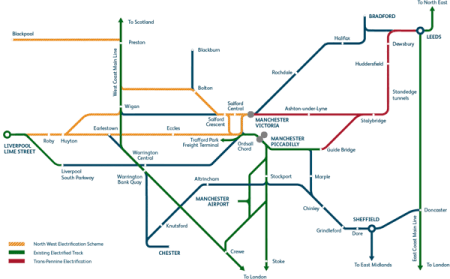
Northern Electrification Map
Note how Wigan-Liverpool via Huyton, Manchester Victoria-Leeds via Huddersfield and Guide Bridge-Stalybridge are also shown as going to be electrified. As is the Windermere Branch Line, which is not shown on this map. All are costed and funded, but there have been a few engineering problems, meaning that the Manchester to Liverpool services didn’t start when they should have done. The problems are reported in the Liverpool Echo.
Network Rail has admitted the long-awaited launch of electric train services between Lime Street and Manchester Victoria and Manchester Airport will now be postponed until next year, possibly as late as February.
The serious delay has been blamed on “unexpected ground conditions and technical issues” encountered while installing the overhead catenary wires on the 184-year-old former Liverpool & Manchester Railway mainline, said Network Rail.
This will only be the start of the revolution.
As there are 86 Class 319 trainsets, that are to be split between the North and the Great Western Main Line, I’m sure that enough sets can be found to run a good service between the following destinations, when the current electrification plans are complete.
- Liverpool-Blackpool
- Liverpool-Lancaster, Carlisle and Scotland
- Liverpool-Leeds/Newcastle via Manchester Victoria
- Manchester-Blackpool
- Preston-Windermere
Services from Liverpool, that go North up the West Coast Main Line, don’t run at present, except to Preston and Blackpool. But if the lines are all electric, subject to the paths being found, I think that one of the operators will run direct services between Liverpool and Glasgow. Failing that Liverpool to Blackpool services will probably be timed to connect with services to both Scotland and the South at Preston. Or perhaps some of the First TransPennine services between Scotland and Manchester , could divide and connect at Preston. But whatever happens travel between Liverpool and Scotland will be a lot easier.
Once electrification gets to Leeds, this will enable services from Manchester and Liverpool to go all the way to Newcastle, opening up more possibilities for new services.
I don’t believe that this will be the end of the development of electric services in the North.
The Class 319 trains currently ply between Bedford and Brighton, which by road is about 120 miles. So they should be capable of serving the slightly shorter distance between Liverpool and Hull. It would seem they are capable of travelling across the North of England reliably. As they are 100 mph electric trains, they certainly wouldn’t be slower on the route than the current Class 185 trains and probably only slightly slower than the new Class 350 trains, that First TransPennine use on Manchester-Scotland services.
In a few months time, electric services between Liverpool and Manchester will commence, probably followed about two years later by electric services from Liverpool and Manchester to Preston and Blackpool.
If the North like their refurbished trains running on electrified lines, it will be hard to resist the pressure to put in more electrification.
If Network Rail can get its act together on electrification, I think that by 2022, the number of electrified lines in the North will be greater than currently planned.
The route from Manchester to Sheffield by the Hope Valley Line will probably be a priority, as when the Midland Main Line from Sheffield to Doncaster, Nottingham and London is electrified in 2020, it will open up all sorts of routes like Liverpool and Manchester to Nottingham and the East Midlands.
If Hull to Leeds and Doncaster is electrified, then this opens up the possibility of electric Liverpool and Manchester to Hull services via Leeds. The BBC has this report about ministers backing the electrification.
The government has backed plans to electrify the Hull to Selby rail line.
Transport Secretary Patrick McLoughlin said he was making £2.5m available to take the project to the next stage
First Hull Trains is planning to spend £94m electrifying 70 miles (112km) of track to improve connections with the wider rail network.
Work is already under way to electrify the line from Manchester to Leeds, York and Selby and is due to be completed by December 2018.
This one will happen, as First Hull Trains wouldn’t spend £94million of their own money, if they didn’t think they’d make a decent return. They are probably trying to get their hands on some of the InterCity225s that will be made redundant by the new Class 800/801 trains.
It is almost if a hundred miles per hour railway across the country is fighting its way to birth by stealth, aided by some refurbished over twenty-years old British Rail rolling stock.
An interesting aside is what will happen to the thirty one InterCity225s. I have heard a rumour that some will be cascaded to the Greater Anglia Main Line to run London to Ipswich and Norwich services currently run by Class 90 locomotives hauling Mark 3 coaches.
I haven’t travelled in an InterCity225 for some months, but the last time I did on a short trip to Peterborough, they did not appear to my untrained eye to be scrapyard fodder yet.
As they are genuine 200 kph high speed trains, could we see them providing fast services from Liverpool to Newcastle and Hull in under two hours? Politicians and comedians may well have poked fun at British Rail for years, but now that we have a UK cash flow shortage, who are stepping up to the plate to help out our impoverished railways? A whole series of British Rail trains like the InterCity 225s and Class 319. No-one should forget the refurbished Class 315, Class 317 and InterCity125s, which will fill other gaps in the bad planning of our railways in theThatcher, Blair and Brown decades.
The only problem with the InterCity225s, is that they may be too long for some of the stations across the Pennines. But solving that is in the grand scheme of things a relatively minor problem for good engineers, architects and construction teams. Also, as they get replaced will some end up on the West Coast Main Line providing direct services to Blackpool?
Once the basic spine across the country is complete and running high-capacity services fast electric services between Blackpool, Liverpool and Manchester, in the West and Leeds, Hull and Newcastle in the East, two things will happen.
Politicians will press Network Rail to create a genuine high speed railway or HS3, across the country, as they love high profile projects, by which they will be remembered.
But more importantly, all of those connecting lines across the North will be prime candidates foe electrification, so they can be home to some more Class 319s.
HS3 will eventually be created, but only when the new electrified service is in need of more capacity.
I think that the electrification in the North is an unstoppable series of projects, that will only finish, when all lines are electrified.
Talking to people on the trains to Bolton yesterday, I don’t think the passengers know how their lives will change, when what is certainly going to be implemented happens.
One very extensive traveller, I met on the train between Manchester Victoria and Horwich Parkway, didn’t realise that the new electric trains in a couple of years would be larger units that the current diesels. He also had travelled on Thameslink to his daughter in South London and actually thought the current trains on that route were pretty good. He hadn’t realised that these would be running after a basic refurbishment all around Manchester.
And then on the trip back to Piccadilly, I met two young ladies, who were coming all the way from Eskdale to see the Who in Manchester. They didn’t kow that the branch to Windermere is going to be upgraded and said that it would have made their journey today a lot easier.
The rail industry in the North needs to spread the word. I have a feeling that the Class 319s, when they start operating in a few months between Liverpool and Manchester will start the process.
Sheffield To Cambridge By Train
As I wanted to have lunch with an old friend in Cambridge I came home the slow way by taking a train from Sheffield and then changing at Ely.

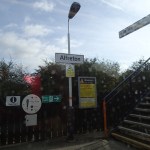
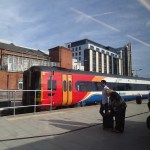


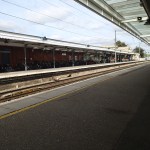
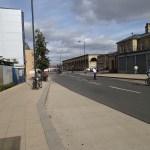
The journey took five minutes over three hours, which included a waits at both Nottingham and Ely of over ten minutes.
I doubt we’ll see any improvements in this service in the next few years, but it really was a slow journey in a two coach Class 158 trains. Perhaps as some of the InterCity 125 are released as the new Class 800 trains are delivered, we might see services like Liverpool to Norwich run by these trains. After all a lot of the route between Liverpool and Norwich in a few years time will allow trains at over a hundred miles per hour.
There has been talk of electrifying the cross-country routes from Ipswich to Peterborough via Ely, specifically for freight. I think it will happen, but until Liverpool to Sheffield and Nottingham to Grantham are also electrified, it could be many years before electric trains cross from one side of England to the other.
Crossrail, HS2 And The Overground Seem To Be Coming Together At Old Oak Common
There has been a report in the Standard, which talks about how Crossrail, HS2 and the Overground could come together at Old Oak Common, which is an area of London ripe for redevelopment.
The report shows this map.
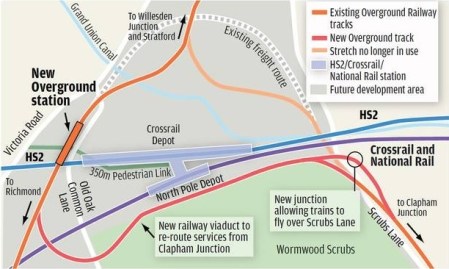
Rail Lines At Old Oak Common
The map is informative and it shows how the West London Line might split from the North London Line at the new Old Oak Common station, rather than at Willesden Junction.
The map though doesn’t show the Dudding Hill Line which joins the North London Line in this area, possibly just south of the new station.
To show the space available in the are, look at this Google Map shoeing the wider area around the proposed station.
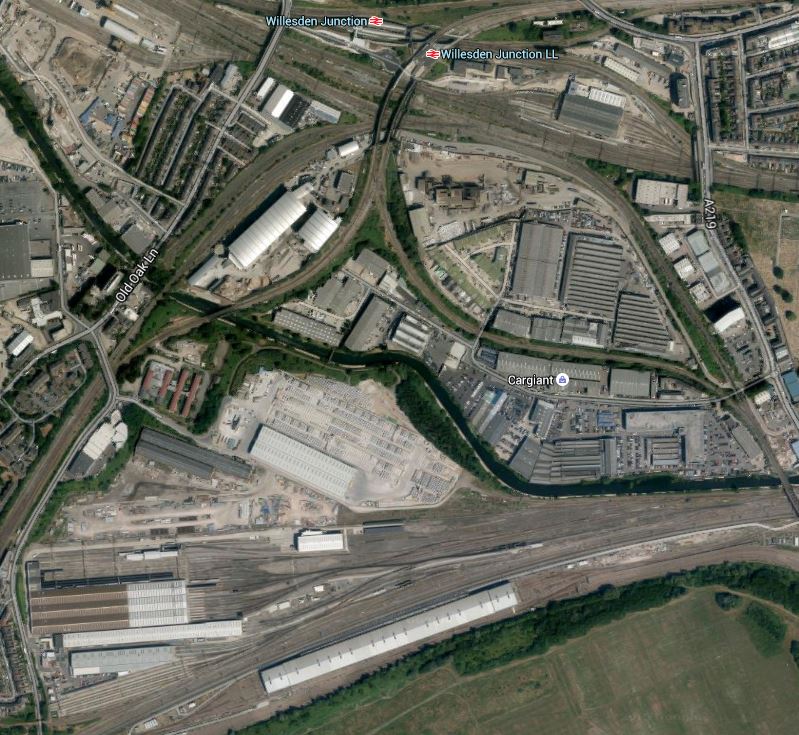
Old Oak Common Area – Downloaded 7th July 2015
There are rail lines everywhere. This second image shows the Southern part of the previous one, along the Great Western Main Line and Crossrail.
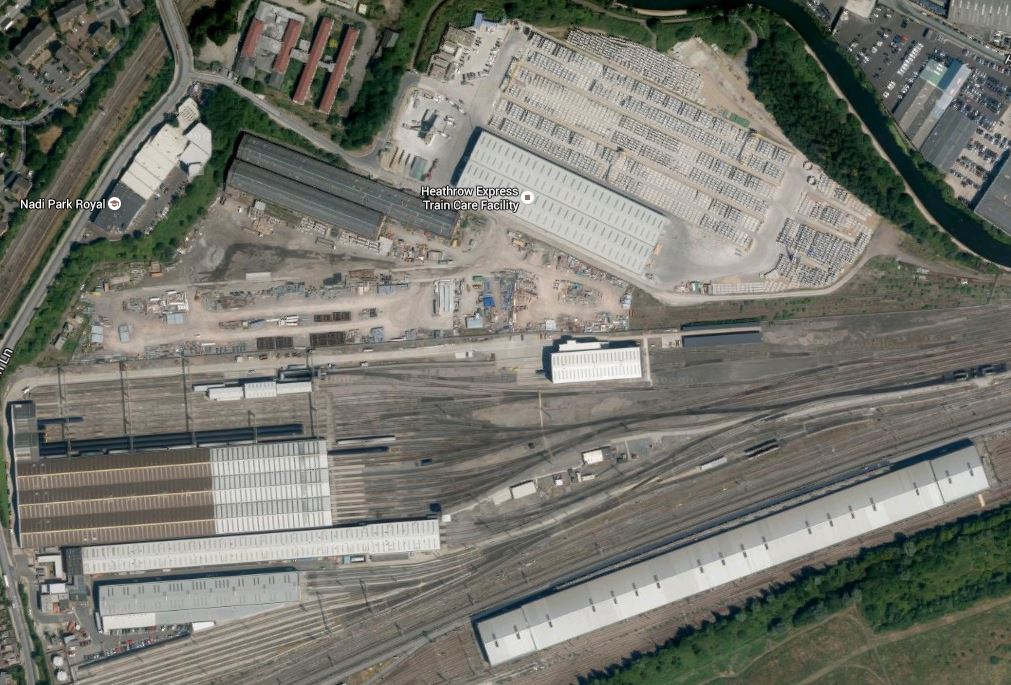
Old Oak Common Detail – Downloaded 7th July 2015
Working upwards from the bottom (South) on this map, you see the following.
1. The long building is the North Pole depot to be used by the new Hitachi Class 800/801 trains, which will be delivered over the next few years.
2. The Great Western Main Line and the future Crossrail tracks.
3. Depots for Heathrow Express and other trains.
4. I think that the large building surrounded by a large amount of grey blobs is the factory that manufactured the tunnel linings for Crossrail.
5. The Grand Union Canal encircles the site.
So could the imaginative minds of the planners at Transport for London have decided to bring the North London Line, an Extended Gospel Oak to Barking Line, Crossrail and HS2 together at the proposed new large development at Old Oak Common? With a little bit more clever design, they might even be able to tie the Central Line into the mix.
I’m all for this personally, as North East London, where I live, will be given a simple route to get to Heathrow and Reading, by just taking the North London Line or the GOBlin to Old Oak Common for Crossrail.
Reasons To Go Virgin Or East Coast
I went up to the Commonwealth Games on the 08:30 Virgin out of Euston arriving on time at 13:01 give or take a minute or so.
The best thing about going Virgin before 09:00, is that you get a proper breakfast, which includes a gluten-free option. I had plenty of tea, some delicious scrambled egg and smoked salmon and a glass of juice.
I didn’t get my gluten-free roll though!
As I was meeting someone in Glasgow, who’d come through from Edinburgh, I could have gone up with East Coast and then across to Glasgow with her.
But it would have meant an earlier start and I had to see the builders.
I think it’s true to say that if you’re going to Glasgow or Edinburgh from London, it’s probably better to go direct. But even so, the distance between the two big Scottish cities isn’t great, with the fastest trains taking between fifty minutes and an hour.
So as Virgin run twenty trains a day up the West Coast and East Coast run eighteen and the fastest trains take about the same four hours sand a bit, it’s very much a case of you pays your money and takes your choice.
The trains are different with Virgin running tilting Class 390 trains and non-tiliting diesel InterCity 125 and electric Inter City 225 trains. My preference is for the non-tilting trains.
The only certain thing is that in the next few years, train routes between England and Glasgow and Edinburgh will gain more capacity and will get faster.
As an example, over the last year, Transpennine Express has introduced new faster Class 350 electric trains to and from Manchester. I thought I heard several northern families in Glasgow, who looked like day trippers up for the Games.
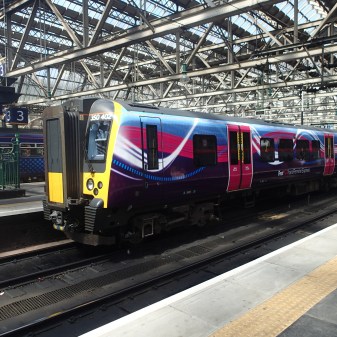
A Transpennine Class 350 In Glasgow
So is this illustrative of how fast, comfortable, high-capacity railways change our lives?
The biggest changed will be Network Rail moving to in-cab signalling, which will allow running over 200 kph on both the West and East Coast Main Lines. This could bring the journey time from London to Scotland much closer to the magic four hours, using the current trains.
When I went to Edinburgh recently by easyJet, security problems meant that I took five and a half hour from my home to Edinburgh city centre. So a four hour journey will be fast enough to give the planes a run for their money. But not everybody goes between London and the major Scottish cities and possibly the biggest beneficiaries of a faster service will be those who have easy access to intermediate stations like York, Peterborough, Preston and Carlisle.
The biggest problem will be track and train capacity on the East and West Coast routes. On the West Coast, there will probably be a further increase in the Class 390 fleet and on the East Coast the Class 800 and 801 are coming.
As with so much on Britain’s railways, the elephant-in-the-room is freight, which is increasing substantially. So will we see extra routes and tracks opened up to held the freight through, just like we have with the GNGE between Doncaster and Peterborough via Lincoln. Of course, we will!
Perhaps, in Scotland, we might even see the return of freight to a Waverley line extended to Carlisle.
Then there is the Edinburgh Glasgow Improvement Program, a project that seems to have lost its way a bit recently. But the main aim of getting about a dozen services every hour between Edinburgh and Glasgow, with some taking just over half-an-hour must be a goal for Scotland.
 The Anonymous Widower