Disused Oil Wells Could Enhance Compressed Air Storage
The title of this post, is the same as that of this article on The Engineer.
This is the sub-heading.
A new study has shown how geothermal energy in abandoned oil and gas wells can boost the efficiency of compressed air energy storage by nearly 10 per cent.
These are the first two paragraphs.
Developed by researchers at Penn State University, the geothermal-assisted compressed air energy storage (GA-CAES) system harnesses the existing infrastructure of abandoned oil and gas wells (AOGWs). Compressed air is pumped into the wells, where geothermal heat raises its temperature and compresses it further. Published in the Journal of Energy Storage, the study showed how geothermal energy could increase round-trip efficiency by 9.5 per cent.
“This improvement in efficiency can be a game changer to justify the economics of compressed-air energy storage projects,” said corresponding author Arash Dahi Taleghani, Professor of Petroleum and Natural Gas Engineering at Penn State.
The Professor also says it could be a “win win situation!”
Trump must have nightmares about stories like this, especially, when the scientists have a name, that labels them as an immigrant.
First Offtake Deal Signed For 500MW/4,000MWh Advanced Compressed Air Energy Storage Project In California
The title of this post, is the same as that of this article on Energy Storage News.
These three paragraphs explain the deal.
Advanced compressed air energy storage (A-CAES) company Hydrostor has signed a power purchase agreement (PPA) for one of its flagship large-scale projects in California.
Central Coast Community Energy, one of California’s several dozen Community Choice Aggregator (CCA) non-profit energy suppliers, has signed a 200MW/1,600MWh energy storage PPA with a 25-year term with Toronto-headquartered Hydrostor for its Willow Rock Energy Storage Center.
That’s just under half of the output and capacity of the planned 8-hour, long-duration energy storage (LDES) facility, which is designed to be 500MW/4,000MWh. This is its first offtake deal, but the company is in discussion for others to take the rest of the plant’s available resource.
The article says that Hydrostor aim to have the plant online by 2028.
This segment describes their current projects.
It is currently working on large-scale projects with around 9GWh storage capacity in total across two sites in California as well as another in Australia.
Together with Willow Rock in Kern County, Hydrostor is developing the 400MW/3,200MWh Pechos Energy Storage Center in San Luis Obispo County, California, and the 200MW/1,500MWh Silver City Energy Storage Center in Broken Hill, New South Wales, Australia.
On its UK Projects page, Highview talks about a 200MW/2.5GWh facility in Yorkshire, which puts the two companies in similar markets, with Hydrostor appearing to have slightly larger systems under development.
Conclusion
It will be interesting to see how this technology progresses and which company does best in what is a very large energy storage market.
Meet The British Inventor Who Came Up With A Green Way Of Generating Electricity From Air – In His Shed
The title of this post, is the same as that of this article on inews, which is written by the respected BBC journalist; Tom Heap.
This is the first two paragraphs.
In 25 years of reporting on the environment, I’ve become unshakably convinced in the seriousness and urgency of tackling climate change, but also rather dismayed that our successes in reducing greenhouse gases and promising scientific breakthroughs go largely unreported.
I’ve seen super plants that improve photo-synthesis, cows that belch less methane and next-gen solar panels. But there is one individual who deserves to be as famous in green-tech as Elon Musk for how his invention could help stop global warming.
The man is Peter Dearman from Bishop’s Stortford and his invention is the technology behind Highview Power, that is building a 250 MWh liquid air battery at Carrington, near Manchester.
Highview Power Breaks Ground on 250MWh CRYOBattery Long Duration Energy Storage Facility
The title of this post, is the same as that of this News page on the Highview web site.
The page shows this picture of diggers doing, what they do.
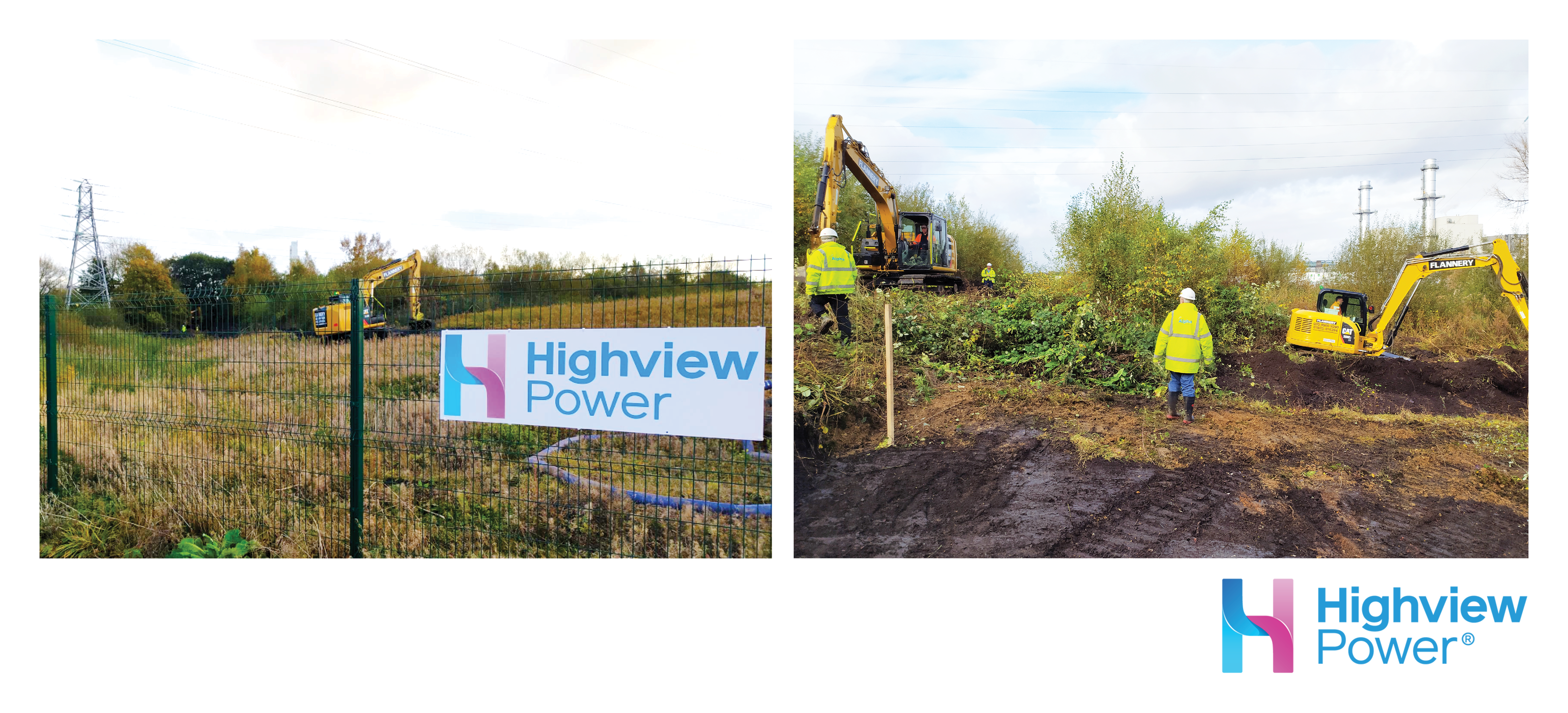
Note the two towers in the background of the image on the right. They look like the towers of Carrington power station, which are shown on this page on the FK Group web site, who built the 884 MW CCGT power station.
This Google Map shows the site of the power station.
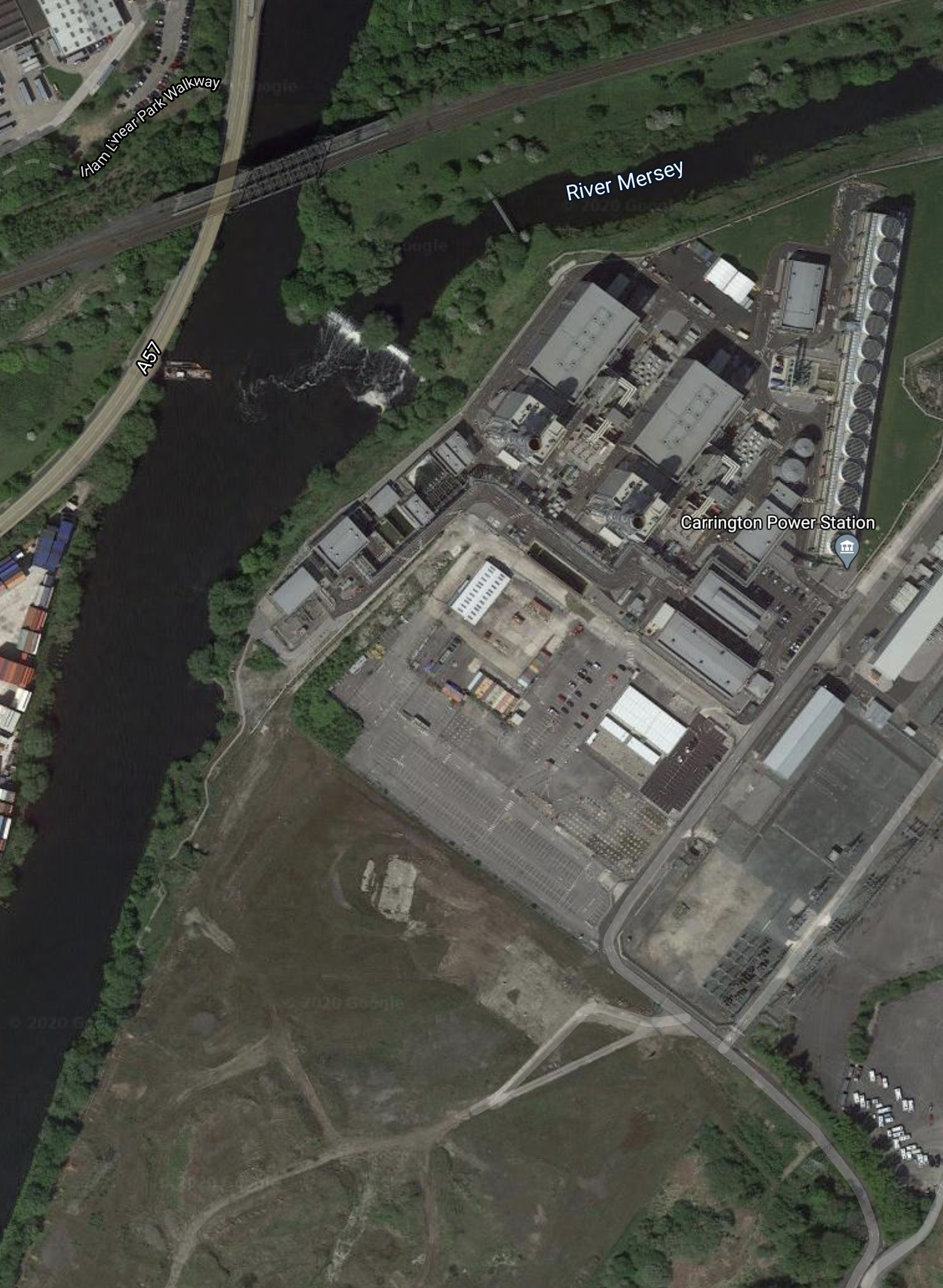
On a larger scale map, you can pick out the towers from their shadows and it looks to me, that Highview’s 250MWh CRYOBattery is being built on the vacant site to the South of the power station.
Consider.
- The vacant site looks large.
- I’ve read somewhere that Highview’s CRYOBatteries are expandable by adding more tanks.
- They certainly have space to add lots of extra tanks and a 884 MW power station on the doorstep to fill them.
- All the heavy equipment and components to build Carrington power station were brought in by barge using the River Mersey and the Manchester Ship Canal. Will this method be used again?
This seems to be a site that would be ideal for a very large battery.
UK Energy Plant To Use Liquid Air
The title of this post, is the same as that of this article on the BBC.
This article about the technique is different, as it details some of the human back-story in these three paragraphs.
The system was devised by Peter Dearman, a self-taught backyard inventor from Hertfordshire, and it has been taken to commercial scale with a £10m grant from the UK government.
“It’s very exciting,” he told BBC News. “We need many different forms of energy storage – and I’m confident liquid air will be one of them.”
Mr Dearman said his invention was 60-70% efficient, depending how it is used.
Mr. Dearman is now a passive shareholder in Highview Power, who are building the plant.
The Most Important News Of The Day
It has nothing to do with that soon-to-be-ex President across the Pond, except that he would brand it a waste of money and a fantasy.
If he did call it a fantasy, he’d at least know something about fantasy.
This article on Recharge is entitled Work Starts To Build World’s First Commercial Liquid-Air Energy Storage Plant.
These are the first two paragraphs.
Work has started to build the world’s first commercial liquid-air energy storage facility near Manchester, northern England, along with a visitor centre that aims to turn the pioneering project into a tourist attraction.
A joint venture between UK-based Highview Power and independent solar/natural-gas plant developer Carlton Power will build and operate the 50MW/250MWh “CRYObattery” — which may later be expanded to add more storage — in the village of Carrington, close to Manchester United’s training ground.
The visitor centre will open in the first quarter of 2021, with the plant planned to start operation in 2023.
- That seems to me to be an ambitious time-scale.
- On the other hand, the plant appears to be composed of well-proven readily-available components, so it will not be too challenging.
Whether Trummkopf likes it or not, construction of the second plant in the Democratic-voting state of Vermont, will surely be starting in the near future.
- He would like the fact that at 50MW400 MWh, the American battery is larger.
- He wouldn’t like the fact, that it is replacing a coal-fired power station.
- It will give eight hours of full-power as opposed to Manchester’s five.
- As both plants are rated at 50 MW, I suspect the two plants are identical on the energy generation side.
- Vermont would just have more tanks to store the liquid air.
It is my view, that these two, will be the first of many.
Will BALDIES Save The World?
I just had to use this new acronym, I’ve just found on the Internet.
BALDIES are Build-Anywhere-Long-Duration-Intermittent-Energy-Storage.
Dr. Gerhard Cromme Joins Highview Power’s Board of Directors
The title of this post, is part of the title of this press release from Highview Power.
This is the introductory paragraph.
Highview Power, the global leader in long-duration energy storage solutions, is pleased to announce that Dr. Gerhard Cromme, former Chairman of the Supervisory Board at Siemens AG and ThyssenKrupp AG, will join its Board of Directors.
I think this could be a game-changing appointment.
Hydrostor Announces Australia’s First CompressedAir Energy Storage Project Secures Funding From Arena And South Australia Renewable Technology Fund
The title of this post, is the same as that of this article on the Australian Energy Storage Alliance.
This is the introductory paragraph.
Hydrostor Inc., a leader in Advanced Compressed Air Energy Storage (A-CAES), is pleased to announce that its subsidiary, Hydrostor Australia Pty Ltd, has been awarded a combined total of $9 million of grant funding from the Australian Renewable Energy Agency (ARENA) and the Government of South Australia Renewable Technology Fund for Australia’s first A-CAES project, to be sited at a mine outside of Adelaide—the Angas Zinc Mine near Strathalbyn, currently in care and maintenance.
I’ll answer a few questions.
Who Are Hydrostor?
They appear to be a Canadian company based in Toronto according to their web site, which has this prominent statement.
Hydrostor is the world’s leading developer of Advanced Compressed Air Energy Storage (A-CAES)
projects, enabling the transition to a cleaner, more affordable and more flexible electricity grid.
There is also a video on the home page.
What Technology Do They Use?
This description is from the AESA article.
The technology works by using electricity from the grid to run a compressor, producing heated compressed air. Heat is extracted from the air stream and stored inside a proprietary thermal store preserving the energy for use later in the cycle. Compressed air is then stored in a purpose-built underground cavern, which is kept at a constant pressure using hydrostatic head from a water column. During charging, compressed air displaces water out of the cavern up a water column to a surface reservoir, and during discharge water flows back into the cavern forcing air to the surface under pressure where it is re-heated using the stored heat and then expanded through a turbine to generate electricity on demand.
An animation describing Hydrostor’s A-CAES system is available on YouTube.
I found the video worth watching, as it answered most of my questions.
Where Could Systems Be Installed?
This paragraph from the AESA article talks about the location of the energy store in South Australia.
By selecting the Terramin Angas Zinc Mine, the project will repurpose existing underground mining infrastructure as the A-CAES system’s sub-surface air storage cavern, benefiting both the electricity grid in South Australia and the local community by converting an unused brownfield site into a clean energy project that drives economic development. Hydrostor acknowledges Terramin Australia Limited’s support in developing the project and the technology’s beneficial application to South Australia.
I can think of a couple of mines in the UK, where such a system can be installed.
Conclusion
Hydrostor’s technology is standard process engineering, with all components and construction techniques well-proven in many decades of use.
I shall be watching Hydrostor with interest.
 The Anonymous Widower