Work Starts On Crossrail’s Victoria Dock Portal
I went and had a look at this important work earlier in the week.

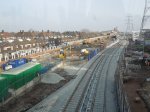

The Victoria Dock Portal will give access to a short length of tunnel connecting this part of Crossrail to the site at the Limmo Peninsular.
As the tunnel will be bored from Limmo to Victoria Dock and the site is alongside the DLR and overlooked by the bridge at Royal Victoria station, you might get a chance to view the tunnelling machine as it emerges.
There is a very good time-lapse video of the construction here.
An Excellent Popular Article On Crossrail
The Sun newspaper is not generally associated with well-written articles about major construction on the railways.
But this article, is one of the best for general consumption about CrossRail I have seen.
And Now Berkeley Homes Get In On The Act
Crossrail is setting new standards in the way it distributes information about Europe’s largest project and London’s new railway.
And now Berkeley Homes, who are developing the site at Woolwich Arsenal with new homes and a new station, have published a time-lapse video, which shows the construction of the enormous station box, where the railway tunnels will go. It has been embedded in this web page on the Crossrail web site.
It is definitely worth watching.
I shall be going to the Open Day for the station box on February 27th, if I can get a ticket.
Following Crossrail
There are a series of articles on the Crossrail web site.
If Crossrail builds the tunnel as well as it distributes information about the project, we’ll have no worries about the project looking like it says on the tin.
I find it unsurprising that the most viewed article is this one, which shows aerial views of various locations.
The Latest Proposal For Crossrail 2
Crossrail 2 has been around since the early days of the twentieth century, but it is only now that Crossrail is well underway, that a serious proposal for a north-east to south-west cross London railway has been brought forward. It’s here on the BBC.
Crossrail 2 will be a lot easier than Crossrail.
When we were planning North Sea Oil platforms in the 1970s, every few years the cranes, barges and drills would be a lot bigger. So for a start, the tunnelling machines available to Crossrail 2, will be an order of magnitude bigger than those for Crossrail. I suspect if you look at the map for Crossrail 2, the two machines will start at Hackney and come out at Wimbledon or vice-versa, as there is no major junction in the middle like Farringdon, where the machines will have to be extracted or turned.
The project engineers for Crossrail 2, will probably take advantage of all the tricks they have learned on the previous project.
But if they follow the design published yesterday, there is tremendous simplification in the design, with much simpler-to-build stations in Central London. One is the very large double-ended station at Euston-Kings Cross. Why we don’t have more of these, I do not know!
I think, an early start is needed.
Building A Station Like A Caisson
I was at the new CrossRail station at Canary Wharf today and took these pictures.
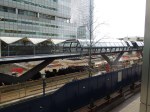


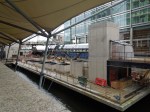
They show the enormous concrete block of a station and the walkway, that will connect it to the area of Canada Square and its offices.
Note how the main building looks almost like one of the giant caissons used for Mulberry Harbours, that were used in the Second World War to invade Normandy.
These giant Phoenix caissons, were actually built in these docks, after they had been drained and filled with sand. They were then floated out for the invasion. I’ve actually been in several of these amazing concrete structures in The Netherlands, where they were used to fill the last gap in the dykes after the North Sea Flood of 1953. They are now a museum, dedicated to the floods and those who perished.
It’s rather strange how history is repeating itself in a similar manner. I suppose though, that the engineers know that the ground is strong enough to take the weight of the station.
It does look from this web page on the Crossrail web site, that Canary Wharf Crossrail station is going to be worth the wait until 2018, although it will be substantially complete by the end of this summer.
The highlight of spring and summer will be the tunnelling machines passing through on their way to Farringdon station.
Creation Of Crossrail At Custom House
The Crossrail line through Custom House is unusual in that because it is close by the DLR, you can see all of the work as the new railway is being installed.

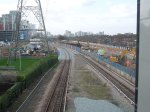


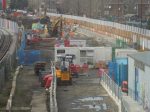

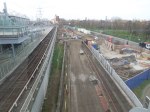
It is very much unusual to see a modern railway being created, but as the pictures show, you can get a good view of London’s new railway as it is created.
The pictures were taken from the three stations; Royal Victoria, Custom House and Prince Regent. It will be interesting to see how the view changes as Crossrail is built.
There’s more about Custom House station on this web page on the Crossrail web site.
Should London Improve The Sub Surface Tubes?
London’s three sub-surface lines; Metropolitan, District and Circle, are getting new S-Stock trains, but you do wonder if investment in the stations along their core route would improve things no end and perhaps even add more capacity to the lines. It should be said incidentally that the new trains will add more capacity and when they are running at full speed, they should give a further increase in passengers carried.
The part I know best is the Hammersmith and City and Circle lines from Whitechapel to Paddington.
Kings Cross St. Pancras station has already been rebuilt and has good access from the two main line stations and to the three deep lines that meet at the station. It will be even better in a few months, when the buses have been reorganised around the new square opening outside. We tend to forget about buses, but they are often an invaluable way to get to your required train line.
Whitechapel, Liverpool Street, Moorgate, Barbican, Farringdon and Paddington stations are all on Crossrail and will probably go through a lot of changes to improve access over the next few years. The stations from Liverpool Street to Farringdon, will effectively be connected to two giant double-ended stations on Crossrail, so interchanges to the Central and Northern lines and Thameslink will be greatly improved. In fact, when you look at journeys made in the eastern part of Central London, you can see how Crossrail will transform them. Even a journey as mundane as Liverpool Street to London Bridge will be a lot easier, as you’ll just dive into the Crossrail station to walk to the Northern line at Moorgate. I’ll probably use that route to get to my 141 or 21 bus from Liverpool Street to get home.
The next station is Euston Square, which is one of those stations on the London Underground, that was built in the wrong place. They didn’t even rectify the problem, when the current Euston station was built in the 1960s, by moving it in front of the station, like the corresponding station at Kings Cross St. Pancras. Probably all that could be done is to put lifts into the North entrance to the station and improve the walking route from the main line station. When the main line station is rebuilt, Euston Square station will probably be part of the rebuilding.
Great Portland Street station is typical of many of the Central London, sub-surface stations. Short double staircases lead down to two platforms on either side of the tracks. Lifts or escalators could probably be installed, but I suspect a clever engineer or architect could do better.
Baker Street station is one of the architectural gems of the Underground and doing anything to improve it will be difficult. The junction to the east of the station also makes things difficult operationally.
Edgware Road station, is one that needs significant improvement, although as with many of the sub-surface stations, space is limited. Since the Circle line, stopped being a circle in 2009, the station has become a nightmare, as many visitors can’t understand that you have to change trains to continue round.
Paddington station, when it is fully rebuilt and Crossrail has been opened, may help with the problems of the sub-surface lines. If I come into Paddington from say Bristol or Cardiff, I will take the bridge at the back of the train and walk to the Metropolitan line, from where I get a train to Moorgate for a bus home. But when Crossrail is running from Reading to Moorgate, I might take that route instead, by changing trains at Reading. I suspect that many commuters from Reading, will go direct to Central London stations on Crossrail. After all, that was one of the reasons for which the line is being built.
So it would seem that on the Northern part of the lines, only Edgware Road and Euston Square stations need substantial improvement.
Lots Of Orange At Custom House Station
I took these pictures at the site of the new Custom House Station for CrossRail today.

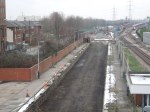
It doesn’t look as if there has been much progress, since I last visited, but then buildings are always slow to start as foundations have to be done correctly.
As you can see right into the construction works from an overbridge linked to the DLR platforms, it is one of those few building sites, where the public gets a good look at what is going on.
London Underground Stations To Avoid
Londoners all have the Underground stations they don’t use. Here’s a few of my list.
Green Park – I was talking with a friend last night about my experience here yesterday and she also said she doesn’t use the station either, although she has to when she goes to the Royal Academy. I don’t as I will use a 38 bus from the stop just around the corner from my house. Outside of the rush hour, it’s almost as quick and I have to get a bus to Highbury and Islington station to get the Underground anyway.
Kings Cross St Pancras – It may be fully step-free, but it’s another station with endless subterranean passageways and I still get caught out by going to the wrong end of the platform, when getting off a train. If you want to exit, it’s better to go to the Euston Road exits, as that way it’s generally a short walk and an escalator. Following the recommended route puts you in the endless passageways. But again, I have the luxury of a 30 bus direct to the station. When they finish the plaza in front of the station, bus access will get much better, so this station, should improve overall later this year.
On the other hand changing between the deep lines isn’t too bad, which can’t be said for Green Park.
London Bridge – This is another station, designed by an architect with shares in a shoe company. I would never change Underground trains here and avoid getting on them as well. It used to be much easier, when the 141 bus ran from the new bus station. It doesn’t at the moment, as after they’d built it, the sewer collapsed, but in a few weeks it will be different.
Victoria – This is another on the list at present, but probably only until the station and the Underground interchange has been rebuilt in a few years.
Bank – This is another station that I avoid at weekends to change onto the DLR, but it is much better during the week. It’s also improved over the last few ears, with several extra escalators. It will also get better in the future, as I believe it’s getting some more lifts.
Camden Town – It’s just so busy with all the markets and the tourists they attract. It had been slated for rebuilding completely, but nothing is on the cards at the moment. I either use a bus or the Overground to Camden Road station to get there.
I’ve already had a couple of suggestions from a friend.
Mile End – I know this one well and used to use it a lot, when my son lived round the corner. My friend suggests you should avoid it because it is a suicide hot-spot and because of it’s depressing decor. But I’ve always found it a good way to get onto the District or Metropolitan lines from the Central or vice-versa. It also has a very useful black cab rank outside the station, which is rare on the Underground.
Edgware Road – This is the subsurface station, which can be a nightmare as it is the gap in the Circle line. I’ve waited there in the past for a lot more than several minutes to turn the corner to the south. I was talking to station staff at Kings Cross and the new Circle line layout generates a lot of queries, especially from those, who are visiting London after several years.
You will notice, that I often do a split journey using a bus at one end. I also know the bus stops pretty well, so for example, if I was returning home from say Paddington on the Metropolitan line, I’d go to Moorgate station and get a 141 bus from there, as the stop is by the station. In a similar way, say if I was going to Wembley, I’d take a 56 bus to Barbican station and get the Metropolitan from there.
I do hope that Crossrail doesn’t muck up the bus connections too much. After all, it would be easy to go to Heathrow, by getting a 141 bus to Moorgate and then getting Crossrail direct to the airport.
You will also notice that two of the stations I avoid are on the Jubilee line. I don’t think, it was the best designed of the Underground lines and we are paying the price that shoddy design. Spectacular some of the stations like Canary Wharf , Westminster and North Greenwich might be, but couldn’t a proportion of the money been better spent at the interchanges like Green Park, London Bridge and Bond Street.
Westminster always amazes me, as I walk through its subterranean structures. But then it is in effect the foundation of Portcullis House; that grandiose monument to Parliamentary excess.
 The Anonymous Widower