The Easy-Entry Spacious Class 378 Train
London Overground’s Class 378 set a high standard for commuter trains.
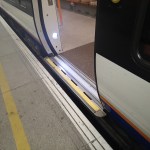
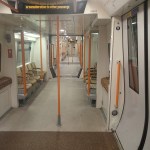

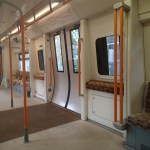
Note the step-free walk-across entry, the longitudinal seating with lots of space for standees and the articulated joint between carriages.
Do We Need Double-Deck Trains In The UK?
You regularly see articles like this one in the Guardian extolling the virtues of double-deck trains. Here’s an extract.
Consultants have drawn up blueprints for double-deckers up to 400 metres long, carrying more than 1,000 passengers, on the network. Supporters of high speed rail say tackling the limited capacity offered by existing lines is crucial.
Greening told the Sunday Times she was excited by the idea of “continental-style double-decker trains that immediately give you more seats and more space”. The trains could have glass viewing ceilings and meeting areas.
Have any of these advocates of double-deck trains ever travelled on one?
They may work on the Continent, but UK railways are different to the rest of the Continent and probably the rest of the world, in that we’re increasingly going for walk-in step-free access to our trains, whereas everybody else has low platforms and several steps up into the train, as I pointed out in this article. In the article I quoted from the specification issued by Crossrail for their Class 345 trains.
Wide through gangways between carriages, and ample space in the passenger saloons and around the doors, will reduce passenger congestion while allowing room for those with heavy luggage or pushchairs.
From what I have read here on First Capital Connect’s web site, the Class 700 might be very similar.
If you’ve ever tried to get in and out of a French, German or Italian express train in a hurry, you will realise that they’re designed to different principles. And they are a total nightmare with a heavy case, in a wheelchair or pushing a buggy. And I’m generally tslking about single-deck trains.
You must also consider the Health and Safety aspects of double-deck trains. If the British public felt they were dangerous and didn’t like the climbing up and down, they would get angry and Disgusted from Tunbridge Wells would get his computer out.
But the biggest problem of double-deck trains is that they need infrastructure clearance everywhere they might go. So if say you might want to run say one of the trains to an important event off its usual haunts, you would have to make sure that line was cleared to accept it.
With normal height trains, like the Class 800, they are designed as go-anywhere trains, that can accept the far corners of the network.
You could argue that the double-deck trains would only stay on high speed or high-density commuter lines, but then for reasons of efficiency trains they must also be able to run on other lines.
Double-deck trains are one of these ideas that look good to politicians, but create more problems than they solve.
This Icelandic Crossing Has A Secret Button
As I can’t drive because I have a slight eyesight problem to the left, I always look to see how the countries I visit cater for the blind at road crossings. In the UK, we increasingly find secret buttons under the controls, as described here on the BBC web site.
I must admit that I was surprised to find this crossing control in Iceland.

This Icelandic Crossing Has A Secret Button
It certainly is a little development, that I’d like to see everywhere.
The Icelandic National Museum
The Icelandic National Museum was worth a visit. It is a modern building above the city and the displays are well laid out and highly informative with copious notes.
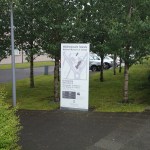



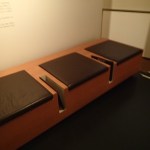
Note the picture of the curious three-seater seat, which could be mistaken for a luxury three-hole commode. There were several like these and the slots in the sides hold descriptions of the exhibits around you. This was a clever idea, that other galleries and museums could borrow.
There is also an excellent cafe with free wi-fi and perhaps more importantly for some, proper teapots.
What Do The French Do For Commuter Trains?
The French equivalent to the Class 345 for Crossrail, also has a version built by Bombardier called the Z 50000 Francilien.
What probably shows more of this train is this excellent YouTube video.
Looking at the video and comparing the images with say travelling in a familiar Class 378 on the Overground, you notice several differences.
The biggest difference is that the French train is wider and taller in cross-section than the British train. This is due to the much more generous Continental loading gauge, which the designers of the train have used to their advantage.
Another big difference is getting into and out of the trains. On the Class 378 and probably the Class 345, it’s just a simple step across, but on the French train, an extra step emerges from the train and it’s a double step into the train. How would the French train cope with platform edge doors, like those that will be installed on Crossrail? I ask this question as European safety legislation insists on these in all stations in tunnels.
The Trains For Crossrail And Thameslink
London’s two new cross-town railways; Crossrail and Thameslink will both be fully opened around the end of this decade.
So it would seem logical that the two lines might share the same trains.
But it is not as simple as that!
All sorts of factors like delaying of projects, the slightly different natures of the two lines and the decision of Siemens, who won the contract for the Thameslink trains, to withdraw from Crossrail, because of a lack of capacity, mean that we now have two separate train fleets; Class 700 for Thameslink and Class 345 for Crossrail.
Although separate train fleets, it does look that the design philosophy of the two trains is very similar. Take this paragraph from the specification issued by Crossrail for their Class 345 trains.
Wide through gangways between carriages, and ample space in the passenger saloons and around the doors, will reduce passenger congestion while allowing room for those with heavy luggage or pushchairs.
From what I have read here on First Capital Connect’s web site, the Class 700 might be very similar.
So it would seem that four of London’s important new train fleets will be walk-through. In addition to the Class 345 and Class 700, the Overground’s Class 378 and the Underground’s S Stock are build to similar principles, although the latter two trains, probably expect more standing passengers.
One advantage of these trains is that they can be designed to line up with the platform edge, as the Class 378 generally do, which enables a simple step across the gap into or out of the train. At some stations, like Willesden Junction, on the Overground, the alignment is bad and you certainly notice the difference. So I will hope that the two new train classes line up with the platforms! As on Crossrail and Thameslink most stations will only be served by one type of train, I suspect that it could be possible.
In my view, if we are to have a step-free railway, then all station-train interfaces, should be a simple step across.
Another advantage of this type of train, is that you can walk inside the train to less-crowded areas or perhaps to your preferred door for exit at your destination. I do this regularly, when I take the short hop from Highbury and Islington to Dalston Junction stations on the Overground, as I get in at the front and get out at the back, due to the layout of the two stations.
This walk-through capability will be essential for Crossrail, where the trains and platforms will be 200 metres long. One of Crossrail’s engineers told me, that she felt some people might not like the trains because of their length and the long walks in stations. I don’t think regular users will mind so much, as they’ll develop a strategy that works for their journey. But will a tourist dragging a heavy case going from say Heathrow to Bond Street, be so happy after walking a long distance to get out the station.
The various proposals for new deep-level Underground trains seem to have through gangways like this proposal from Siemens.
So is a de facto standard for train design emerging, where trains have through gangways, flat floors and wide doors with no-gap step-across access?
I think it is and it will be to the benefit of all rail users, including the disabled and those pushing buggies or dragging heavy cases.
Looking at the pictures I took of Siemens Underground proposal, it seems the design fits such a standard!
A secondary advantage of this design is that it should tighten up stopping time at stations, thus making it easier for trains to keep to schedules.
An Iconic Picture Of A New Routemaster
I like this picture and report from the Wrightbus web site.
It shows a new Routemaster outside the Northern Ireland parliament building at Stormont, all decked out in pink for the visit of the Giro d’Italia.
The picture says so many things, some of which are political, but to me it shows how if you get the design of anything right, that stimulates the economy and creates jobs. But also as the report about the New Bus for West Yorkshire shows, these classic designs, look great in any colour, although black might be a bit much, as London has shown.
Transport for London’s Two Iconic Brands
I have a Google Alert for the word Overground to pick up any stories about Transport for London’s newest railway system the Overground. The link is to the official site and on a straight Google search, it is number one in the list.
It’s only rarely that the Google Alert picks up a news item, that is not about the Overground.
So how does the Underground fare in Google searches. As with the Overground, the official site for the Underground is first in the search list. On the first page, there are only a couple of pages that are nothing to do with the London Underground.
Even the word Tube typed by itself into Google, produces virtually a complete page of information about the Underground.
I suspect that London’s two iconic brands; Underground and Overground, together with their nickname Tube have one of the best worldwide recognitions.
Frank Pick, who led London Transport in the early days and oversaw the creation of the original corporate branding, will be laughing through history.
Who would have thought that a man from Spalding, who qualified as a solicitor, would have become one of the people with the greatest influence on the look of today’s London? Only Christopher Wren and Joseph Bazalgette come close.
Some More Self Winding Clocks
I first found two of these at Tooting Bec some years ago.
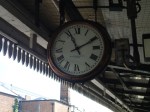
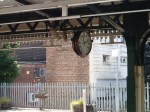
Golders Green station has a pair, which appear to be in good condition.
I wonder how many are still installed and in full working order. According to this section in the Wikipedia article on the Self Winding Clock Company, there were originally 600 and installation started in the 1900s.
Long may they continue to give passengers the time!
 The Anonymous Widower