Devizes Station Would Need To Be Part Of Wider Rail Plan
The title of this post, is the same as that of this article on Railway Gazette.
These two paragraphs outline the current status.
The construction of a Devizes Gateway station at Lydeway is unlikely to represent value for money as a standalone project, but it could be viable as part of a wider rail improvement programme, a study has concluded.
The feasibility study undertaken by Wiltshire Council, Devizes Development Partnership, GWR and Network Rail built on a strategic outline business case submitted to the Department for Transport under the Restoring Your Railway Fund programme in November 2021.
The Department for Transport will now decide what to do next.
I think there are other issues on the route between Reading and Taunton.
The Current Train Service
The only passenger services using the Reading and Taunton route are these three trains, which all have a frequency of one train per two hours (tp2h).
- London Paddington and Exeter St. Davids – Calling at Reading, Newbury, Hungerford, Pewsey, Westbury, Castle Cary, Taunton and Tiverton Parkway
- London Paddington and Plymouth – Calling at Reading, Taunton, Tiverton Parkway and Exeter St Davids
- London Paddington and Penzance – Calling at Reading, Taunton, Tiverton Parkway and Exeter St Davids
Note.
- London Paddington and Exeter St. Davids takes a few minutes over two hours.
- London Paddington and Plymouth takes a few minutes over three hours.
- London Paddington and Penzance takes a few minutes over five hours.
- The Reading and Taunton route is a double-track railway with a 110 mph operating speed.
- London Paddington and Newbury is electrified.
- The last two trains alternate to give Plymouth an hourly service.
- After Exeter St. Davids, trains have a sophisticated stopping pattern to give all stations served a good service.
From several trips along the line, I have the impression, that it’s a route, where drivers can get the best out of the trains.
Electrification
The line would benefit from electrification, in terms of journey times and decarbonisation.
But could this route be run by battery-electric trains?
- It is 89.7 miles between Newbury and Taunton.
- It is 120.4 miles between Newbury and Exeter St. Davids.
- It is 52.1 miles between Exeter St. Davids and Plymouth.
- It is 79.4 miles between Plymouth and Penzance.
- London Paddington and Newbury is electrified.
- Taunton, Exeter St. Davids, Plymouth and Penzance stations could have a charging system of some sort.
This Hitachi infographic shows the specification of the Hitachi Intercity Tri-Mode Battery Train.

Consider.
- Two trains go between Newbury and Taunton without stopping.
- The Exeter St. Davids service stops three times.
- Newbury and Taunton non-stop took 75 minutes at an average speed of 72 mph
- Newbury and Taunton with three stops took 78 minutes.
- All trains currently appear to be nine cars.
I suspect that Hitachi’s Intercity Tri-Mode Battery Train could go between Newbury and Taunton with a great deal of ease.
How many diesel engines and batteries would the train have?
Normally, nine-car Class 800/802 trains have five diesel engines.
So how many will be replaced by batteries?
The infographic says one engine will be replaced, so if that is a five-car train, it looks likely that a nine-car train could have two batteries.
But Hitachi could be playing a long game!
In Stadler FLIRT Akku Battery Train Demonstrates 185km Range, I wrote about how the FLIRT Akku has a range of 115 miles.
If Hitachi can squeeze 125 miles out of a nine-car Class 800 with two or three battery packs, they will outrange the FLIRT Akku and be able to run between London Paddington and Penzance on batteries, with some topping up on the way.
We mustn’t forget the engineers at Hyperdrive Innovation, who are designing and building Hitachi’s battery packs.
They will be ultracompetitive and know the range required to get battery-electric trains to Penzance.
I suspect that when the range of the nine-car battery-electric Class 800/802 is revealed, it will astonish everybody!
Bedwyn Station
Bedwyn station is served by an hourly shuttle train to and from Newbury, run by a diesel train.
The station used to have a direct service from London, but now passengers change at Newbury.
A Station For Marlborough
I investigated this in A Station For Marlborough, where this was my conclusion.
With the next generation of electric train with onboard energy storage or IPEMUs, a Marlborough station on a new Marlborough Branch Line can be used to create a two tph service to and from Paddington to replace the current one tph service from Bedwyn.
So a new Marlborough station would be a win for all those using stations on the Reading to Taunton Line to the East of Pewsey.
I also wonder how many other similar services can be developed by extending a service past a main line terminal to a new or reopened branch line, which is built without electrification and run using trains with onboard energy storage.
In answer to my posed question in the last paragraph, I suspect it is quite a few!
Devizes Gateway Station At Lydeway
I wrote about this proposed Devizes Gateway station in Reinstatement Of Rail Access To Devizes Via A New Station At Lydeway.
After writing Was Baldrick An Essex Man? about the building of an avoiding line at the new Beaulieu Park station North of Chelmsford, I do wonder, if it would be an idea to incorporate one in this proposed station, if there is a need to increase capacity.
This Google Map shows the station site, where the A342 crosses the railway.
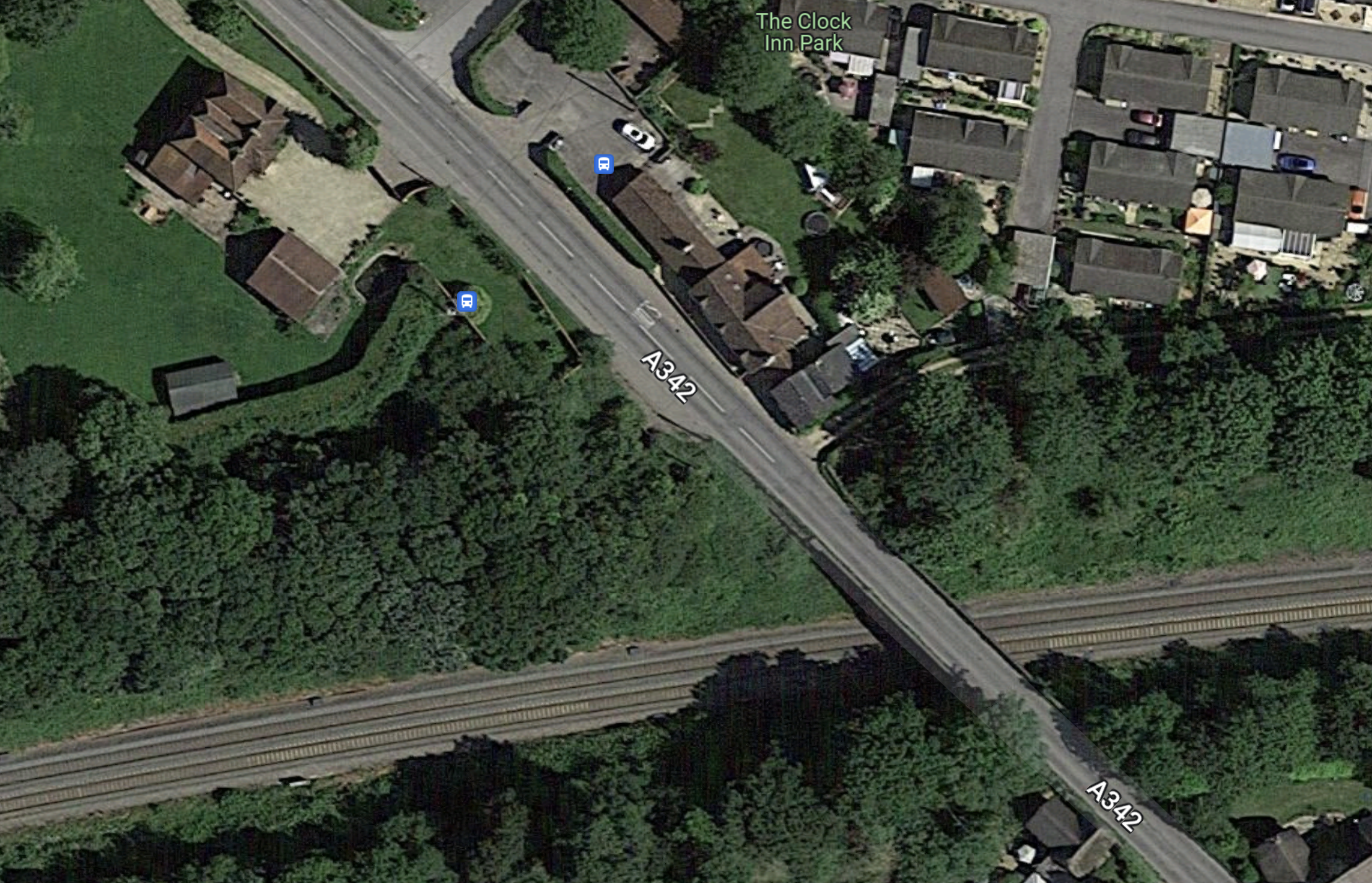
I suspect a third track can be squeezed in.
Westbury Station
Westbury station is a busy station, where the Reading and Taunton Line crosses the Wessex Main Line.
This map from OpenRailwayMap shows the lines in the station.
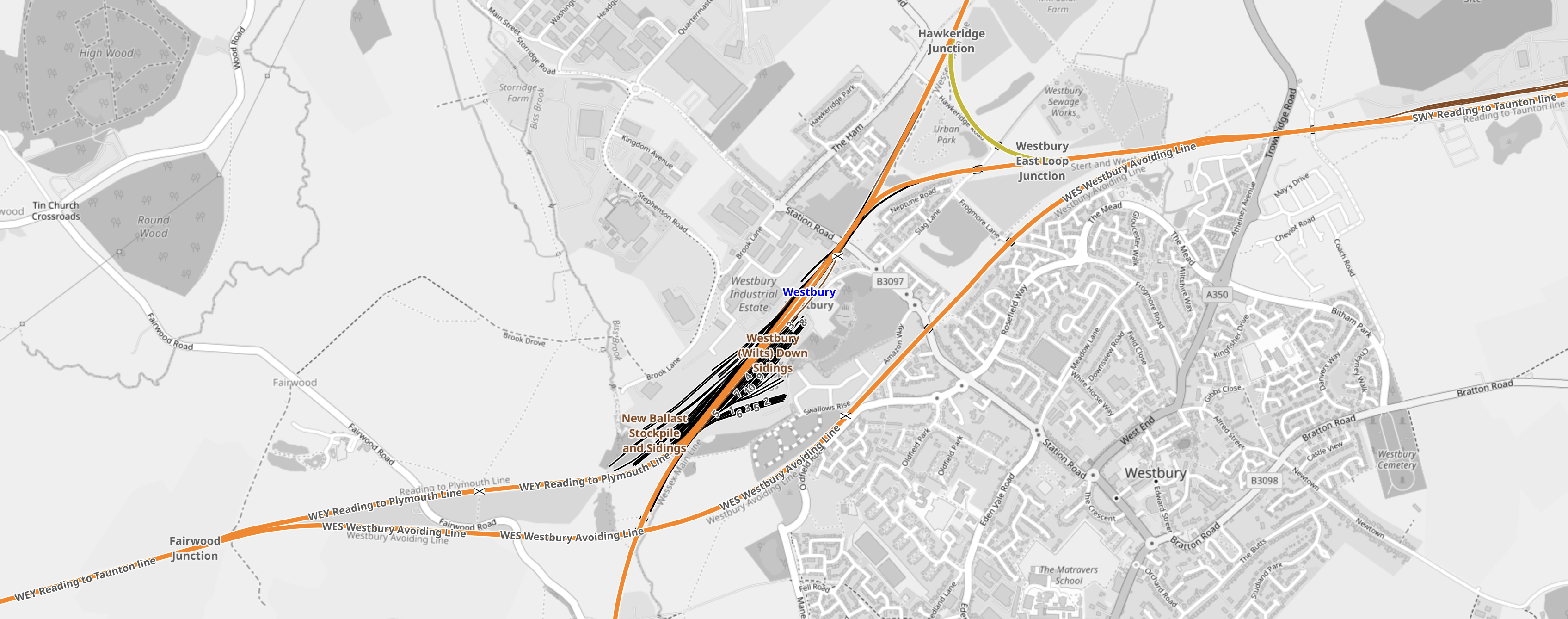
Note.
- The blue lettering indicates Westbury station.
- The two major rail routes are shown in orange.
- The Reading and Taunton Line goes East-West across the map.
- Note the avoiding line South of Westbury station.
- Reading is in the East and Taunton is in the West.
- The Wessex Main Line goes North-South across the map.
- Bristol is in the North.
- Salisbury and Southampton is in the South.
In Westbury Station – 30th July 2020, there are some pictures I took of Westbury station.
This section in Wikipedia says this about the Future of Westbury station.
The line to Westbury is not due to be electrified as part of the 21st-century modernisation of the Great Western Main Line. Although local councillors support it, the extension of electrification beyond Newbury to Westbury was assessed as having a benefit–cost ratio of only 0.31.
On the other hand this document on the Network Rail web site, which is entitled the Devizes Gateway Interim
Feasibility Study, suggests that another platform might be added at Westbury station.
Castle Cary Station
Castle Cary station doesn’t seem to have any well-publicised problems, so please tell me if you know of any.
Frome Station
Frome station is described in its Wikipedia entry as an unusual station and one that is Grade II Listed.
I suspect, it could do with some more services.
Somerton Station
I wrote about a new Somerton station in Somerset: Plans For New Railway Station On Levels.
Track Improvements
I suspect if Network Rail were improving the route between Reading and Taunton, they know of some places, where they could do some work.
Service Improvements
Consider.
- There is probably a need for a stopping train between Newbury and Taunton, which calls at all stations.
- It might terminate at the London end, at either London Paddington or Reading.
- It might be a battery-electric train.
- An hourly frequency would be ideal, if the track and signalling could handle it.
- Charging systems would be positioned as needed.
The train would interface with other Great Western services to Bristol, London Paddington, Gloucester, Salisbury, Southampton and Weymouth.
Oy could also interface with the Transwilts services.
Conclusion
This could be developed into a very useful network for Wessex.
Reinstatement Of Rail Access To Devizes Via A New Station At Lydeway
This is one of the successful bids in the First Round of the Restoring Your Railway Fund.
Devizes is a growing town without a railway station.
The Wikipedia entry for the former Devizes station, says this about providing a new station.
Although Devizes was denied a railway station due to its stagnant population, as of 2017 the population had grown to 31,000, which could warrant its re-establishment. However, much of the vital land agreements and rights of way were sold off reducing the chances of reinstatement. An alternative plan has been proposed: to build Devizes Parkway Station at Clock Inn Park, three miles east of Devizes on the Reading–Taunton line, near to the site of the original junction for the branch at Etchilhampton.
It appears to have been taken from Baldrick’s book of cunning plans, where you create a virtual branch line using the A342, travellers’ personal transport and a shuttle bus service.
This Google Map shows the position of the station site at Clock Inn Park, with relation to Devizes.
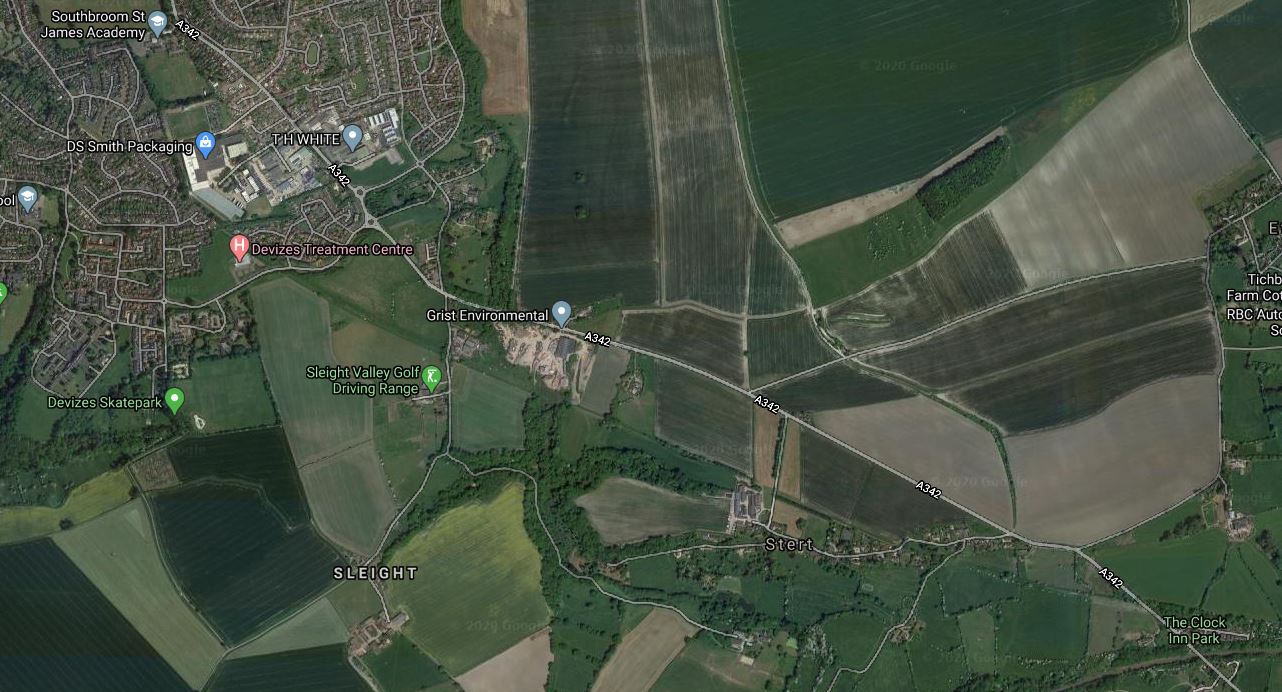
Note.
- Devizes in the North-West corner of the map.
- Clock Inn Park in the South-East corner of the map.
- The A342 road connecting the town with the station site.
This more detailed Google Map shows the station site.
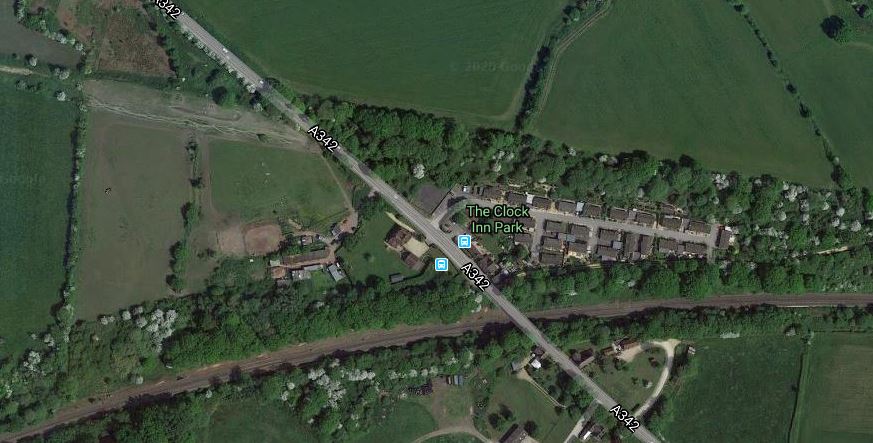
Note.
- The A342 going diagonally across the map.
- The Reading-Taunton Line going across the map.
- There’s even bus stops by the station site.
As the site could be fairly generous, I think a station with adequate parking could be created.
The Train Service
The train service is currently two hourly on this route between Paddington and Exeter St. David’s stations.
Perhaps, with an extra stop and more passengers, the service could be increased to hourly.
Another alternative would be to run battery-electric trains on the route between Paddington and Westbury, that called at all stations West of Newbury.
- Trains would use the electrification between Paddington and Newbury and would leave Newbury with a full battery.
- This service would be an extension of the current hourly service to Bedwyn station.
- Between Newbury and Westbury stations is forty-two miles of unelectrified lines, which should be possible with a battery electric version of the Class 802 train.
- Charging facilities would be needed at Westbury station.
- Between Paddington and Westbury stations takes one hour and thirteen minutes.
- Hitachi are quoting a ten minute charge time for one of their battery-electric trains.
- The trains would turn at Westbury station, which has refreshments and toilets for the crew.
- No extra electrification would be needed to run electric services to Westbury.
I think it could be feasible.
The Concept Of An Electrification Island
Westbury could be what I would call an electrification island.
Consider
- The Reading-Taunton Line passes through the station.
- The Wessex Main Line both passes through the station.
- The town of Westbury has a population of around 17,000 and some substantial heavy industries, so I suspect that it has a robust electricity supply.
- Taunton is 47 miles away.
- Newbury is 42 miles away.
- Weymouth is 59 miles away.
- Bristol Temple Meads is 40 miles away.
- Swindon is 32 miles away.
- Hitachi are claiming a range of between 55 and 65 miles for a battery-electric train.
Suppose the two routes through the station and perhaps for up to ten miles away from the town, were to be electrified.
- A battery-electric train turning back at Westbury would pan-up in the station and charge the battery. Leaving the station, the driver would leave the pantograph up for acceleration and then make sure pan-down was performed before the end of the electrification.
- A through battery-electric express between Paddington and Exeter would pan-up when under the electrification and pan down before it left the electrification.
- It might be prudent that all passing expresses stopped in Westbury station, to make sure, trains didn’t stop with a flat battery in the middle of nowhere, until procedures were seen to be totally reliable.
- A battery-electric train to and from Weymouth would probably need to run for about 45 miles between the electrification island at Westbury and the third-rail electrification at Dorchester Junction.
I believe that a well-designed electrification island at Westbury coupled with perhaps electrification between Exeter and Taunton, would enable battery-electric trains to work the following routes.
- Paddington and Exeter
- Westbury and Bristol
- Westbury and Weymouth
- Westbury and Swubdon
I suspect that Transwilts services could also be run by battery-electric trains, as they could charge at Westbury, Swindon and other electrified stations.
Conclusion
Devizes Parkway station would appear to be a simple way to provide a new station, at a town that has grown substantially since the days of Dr. Beeching.
Did Dr. Beeching and the Government of the day, have a view on population growth in the UK? They certainly didn’t take it into the account in their rail closure program. Or if they did, they got it spectacularly wrong!
 The Anonymous Widower