Before GOBlin Electrification – Leyton Midland Road
Leyton Midland Road station is a tidy station, but it has steep stairs and no lifts.

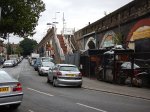
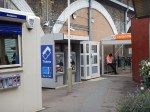


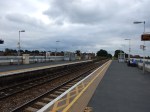
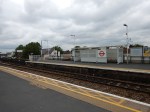
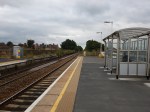
As the pictures show, the platforms are probably long enough for the new four-car trains.
Electrification Of Britain’s Railways Isn’t Easy
There are a lot of reports in the media talking about the delays in electrifying railways in the UK, like this report in the Yorkshire Post, which talks about the Trans Pennine and Midland Main Line schemes.
I have just found this report in the Rail Engineer, which talks about a forty-four day closure of the important Winchburgh Tunnel between Edinburgh and Glasgow to prepare for electrification as part of the Edinburgh Glasgow Improvement Program. The report starts with this paragraph.
A legacy of the rapid early growth of Britain’s railway network is that the UK has one of the world’s most restrictive loading gauges. As a result, typically half of the cost of British electrification projects is the civil engineering work to adapt structures to provide clearance for wires and pantographs.
As anybody who’s ever got to grips with any old building, what it looks like on the surface is very different to what is underneath.
The project described in the article is challenging to say the least. This extract describes the building of the tunnel.
Winchburgh tunnel lies at the eastern end of a five- kilometre long cutting. It is 338 metres long and was opened in 1842, having taken two years to complete. When digging the cuttings and tunnel, the contractor, Gibb and Sons, removed 200,000 tons more rock than expected and consequently made a loss.
The tunnel was cut through dolerite rock, mudstone and shale. In the middle on the nineteenth century, these oil shale deposits once made West Lothian one of the world’s biggest oil producers. This shale was also a factor in an unfortunate accident during tunnel construction in 1839 when a man was severely burnt by firedamp.
The cutting is crossed by two streams, west of the tunnel. A twin four-foot diameter cast-iron inverted syphon was provided to carry Myers Burn under the railway. Swine Burn crosses the cutting on an aqueduct that had to be re-decked as part of the EGIP electrification works. Downstream of the aqueduct is a pumping station, which drains the cutting west of the tunnel. This is an area with significant drainage issues, some of which are addressed by the tunnel works.
So making it large enough for electrification wasn’t easy. As is typical on a project such as this, concrete slab track was used. You don’t see it much on UK railways, as where it is used is generally in tunnels and other places, where you have tight clearances.
In the Winchburgh tunnel slab track was used and they are also using an overhead rail system to get the power to the train.
In searching for a good article about slab track, I found this article on Balfour Beatty’s Rail web site, which is entitled Polyurethane Slab Track.
Balfour Beatty have worked with Herriot Watt University to create a method of using polyurethane to create a method for strengthening track in awkward places.
One example describes how a bridge was improved to cope with modern loads.
While George Stephenson was a forward thinker, even he didn’t predict freight trains running at 80mph with 25 tonne axle loads over his bridge. So he hadn’t calculated for those stresses. The bridge has done a good job of coping with them for 190 years, but it was getting a bit tired.
The article also highlights that Network Rail has 25,000 masonry arches, so you can see why there must be a need for such a technique.
The technique has also been used to increase the headrom for electrification in a tunnel on the Midland Main Line.
It’s all impressive engineering.
Where Are The Wires?
I took this video between Twyford and Reading stations.
There is no sign of the overhead wires that will be needed for Crossrail and the electrification of the Great Western Main Line.
To be fair to the comntractors, there was a lot of activity past Reading, so perhaps for various reasons the stretch near London has been left to last. Perhaps they want to get all the trackwork like the Action Dive-Under and the Stockley Flyover completed first!
There may have been lots of steelwork and a few wires between Reading and Didcot, but there wasn’t anything on the Cherwell Valley Line to Oxford.
Electrification May Be In Trouble Elsewhere, But The Brummies Keep Marching On
Electrification may well be in trouble with the Government delaying Trans Pennine and Midland Main Line electrification and having a strong look at that on the Great Western Main Line.
So I was interested to read this article in Rail Engineer about how a consortium is electrifying the Chase Line between Walsall and Rugeley. This is the first three paragraphs.
With electrification being high on everybody’s consciousness, the schemes to electrify the Great Western and Midland main lines have been getting all the attention. Similarly, the works in the North West and Scotland have been proceeding apace and gaining publicity but the scheme to electrify the railway from Walsall to Rugeley has managed to stay ‘under the radar’.
The scheme is, in fact, a significant step in the direction of developing the public transport system in the West Midlands by improving services on what was a relatively-forgotten part of the network. Due to be completed by December 2017, the project will allow electric trains to run between Birmingham New Street and Rugeley via the Cannock lines, providing passengers with a more reliable, efficient and greener service.
In fact, the scheme will revitalise a line which, not so many years ago, had no regular passenger services at all.
It goes on to describe how the scheme is progressing with a lot of cooperation between the various parties and not much of the usual drama.
So it would seem that not all electrification projects end up in trouble.
I shall go and take a look!
There is one fly in the ointment, though and it is detailed here in Wikipedia. This is relevant paragraph.
Gavin Williamson, Conservative MP for South Staffordshire, has campaigned to limit the speed of trains through Great Wyrley and Cheslyn Hay when the line is complete. He has written to transport secretary Patrick McLoughlin, requesting confirmation that trains travelling through these areas will not exceed a speed of 45 mph. He has also requested that “environmental mitigation measures” be put in place to reduce the potential impact of the electrification on residents in South Staffordshire. Network Rail had previously said that electric trains are quieter, greener and cleaner, reducing carbon emissions.
So, if in the future, you are fed up with your electric train crawling along, send your complaints to the local MP.
The Welsh Could Be Having A Lot Of Fun Playing Trains In The Cardiff Valleys
After my trip to Ebbw Vale Town yesterday, I started searching the Internet to see what projects might be in the pipeline for rail lines in the Valleys up from Cardiff.
There are a lot of routes spreading out from Cardiff, to places all over South Wales.
Currently, all lines are operated by a mixture of various types of diesel multiple unit, but David Cameron announced that the lines will be electrified in this report on the Government web site, published in November 2014. He said this.
I am delighted to announce today that we are going to press ahead with the electrification of the Valley Lines. After years of neglect, this part of Wales will finally get the infrastructure it needs with faster, more modern, more efficient trains and the impact will be huge.
Spreading the employment opportunities from Cardiff and out to the Valleys and helping hardworking people from all parts of this great nation to get on. This has only been possible because of the UK government and shows our long-term economic plan in action and working for the people of Wales.
It would be assumed that this will go ahead and it will be overhead electrification. The trains could be refurbished Class 315 electric multiple units, if this statement on their future on Wikipedia proves to be true.
On 31 May 2015, the fleet will again be divided with 44 (315818-315861) moving to TfL Rail (MTR Crossrail) with the Shenfield Metro services and the other 17 (315801-315817) to London Overground with the Lea Valley services. As most duties of the 315s will be taken over by new Class 345 Aventra trains once Crossrail is built, it has been suggested that the 315s could be cascaded to the Wales and Borders passenger franchise to be used on Valley Lines services in the Cardiff area following electrification
They may be nearly forty years old, but they aren’t bad trains and perhaps more importantly sixty-one trains will start to come available from London local services as the electrification is completed. In January, In January, I posted an article entitled Transport for London Get The Cleaners, Painters And Engineers Ready For The Shenfield Metro, so I would envisage that they will be cascaded in the best condition London could manage.
These trains are also all four carriages, so there would be more seats on the lines, if the electrics worked a similar timetable to the current diesels.
It is interesting to read this article on Wales On Line entitled Could electrification herald an expansion of the Valleys Lines trains? This is said for a start.
John Rogers, chairman of Railfuture’s South Wales branch, said: “The Welsh Government has a statutory duty to be an ecological government. Electrification brings lower maintenance costs and faster acceleration of trains. There’s historical evidence that electric trains are very popular and lead to increased patronage.
“It doesn’t make sense to electrify to a certain point and then say later, ‘We’re going to add another two or three miles. Can you come back and electrify it?’”
Don’t I just know it that when electric trains prove popular as here in East London, it is a non-stop struggle to increase the capacity to keep up with demand, by continually lengthening the Class 378 Trains on the London Overground.
So for a start, the Cardiff Valley Lines will probably eventually need all of those sixty-one trains, which can work in eight-carriage units on the busier lines if necessary.
They’ll also probably need to increase the car parking and bus frequencies at the outlying stations.
The Class 315s biggest advantage over the current diesels other than ecological and passenger comfort and space ones are that they possess better acceleration and Braking performance, although they have nominally the same top speed.
In the same article on Wales On Line this is said about the proposed extension to Hirwaun.
In February 2011, Network Rail delivered a report which the WG had commissioned into extending the Aberdare service to Hirwaun along a track now used only for occasional freight trains. The report estimated the infrastructure cost at £17m, which would include a loop line at Aberdare.
There is only one track for trains in both directions between Abercynon and Aberdare, with trains using a loop line at Mountain Ash to pass each other.
The loop is positioned to allow trains to leave each station along the line at the same minutes past each half hour.
A diesel train could not run from Mountain Ash to Hirwaun and back in time for the next service to follow 30 minutes later. Therefore an extra train would be needed for the Hirwaun extension, along with a new loop and extra signalling equipment for trains to pass each other at Aberdare.
The only scenario explored in Network Rail’s report was a service operated by today’s Sprinter and Pacer diesel trains, which date from the 1980s. However, modern electric trains would accelerate and brake faster for each station call, and promise to cut many minutes from journey times in the Valleys.
So electrification could deliver other benefits.
The article also suggests that the line I used to Ebbw Vale Town could be simpler if it were electrified.
A study by consultants for Network Rail in 2010 said the planned extension northwards from Ebbw Vale Parkway might involve constructing two tracks at the future Ebbw Vale Town station. This would incur the costs of building two station platforms and installing signalling equipment. Diesel trains would then be able to depart from the new station every 30 minutes, alternately to Cardiff and Newport.
In June 2011 Network Rail delivered a report on the Ebbw Vale line to the WG, again based ,on the service being provided by Sprinters, which said two platforms might be needed at Ebbw Vale Town. It seems likely, however, that only one track and one platform would be needed for electric trains.
I think they’ve started to create some of the new infrastructure, so the doubling of platform and stations might happen anyway.
The article finishes by listing several places, where lines could be extended.
3. Treherbert to Blaenrhondda or Blaencwm
Other sources talk about.
1. Reinstating a service to Abertillery.
2. Llantrissant to Beddau
3. St Fagans to Creigau
4. Routes out of Brigend via Tondu.
There’s certainly a lot of disused railway lines for the Welsh to speculate on. But then there were an awful lot of collieries.
So it looks like the Welsh are going to have fun in the Valleys.
In some ways it reminds me of the buzz that was felt where I grew up in Enfield in North London, when they electrified and extended the Lea Valley Lines in the 1960s.
It does all illustrate how electrification of rail lines isn’t as simple as you think, as it seems to give opportunities for more services and generate addition passenger traffic, that have other consequences.
I think the only thing we can say with any certainty, is that if the electrification goes ahead and the Class 315 trains are cascaded, then transport in and around the Welsh capital will be vastly improved.
Northern Electrics Increase Services
Today the Class 319 trains started running services from Liverpool Lime Street to Manchester Victoria and Wigan North Western.
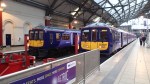
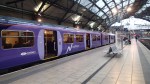
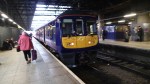
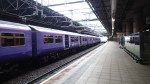
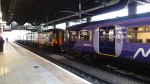
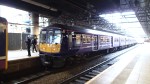
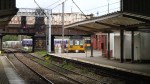
I took the pictures when I rode the 07:20 train from Liverpool to Manchester and some later when I returned to Manchester.
When I was travelling to Preston on the Sunday from Liverpool, my Class 156 train on the slow line between Wigan North Western and Preston was passed on the fast line by a Class 319 doing about a hundred. I estimated it was going fast as a couple of minutes later a Class 390 Pendolino roared past.
So it got me thinking, as to why some of the Wigan North Western services from Liverpool don’t go to Preston, as the tracked are electrified.
Then today, a student in Burnley asked me the same question, because as he said, it would make travelling from Burnley and Blackburn to Liverpool a lot easier.
There’s probably a very good reason, why they don’t!
I also asked a driver how they liked the Class 319s. He replied by saying they were waiting for more services to start out of Manchester.
He also said they were a bit bouncy on Chat Moss, where Network Rail had had trouble putiing up the overhead wires.
I have a feeling, that as Northern Rail get a few more Class 319 trains, they may do a bit of reorganisation of services around Preston.
Suppose :-
1. All Northern Rail trains between Liverpool Lime Street and Preston were to be run via Wigan North Western to a frequency of at least twice an hour by Class 319 trains. This might release some Class 156 trains.
2. The Blackburn service via Accrington, Burnley and Todmorden is extended to Preston and possibly to Blackpool North to connect with the Liverpool trains.
3. The Colne to Blackpool South service would also connect.
4. As more lines get electrified, the services would be optimised.
There’s also probably a good reason, why during the closure of the Farmsworth Tunnel, that the service via Todmorden isn’t extended past Blackburn to Preston. It could probably be something as simple as that when they planned the closure, the Todmorden Curve didn’t exist.
An Excursion To Windermere
I caught a train from Preston direct to Windermere to have a look at the town.

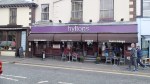




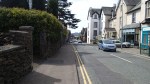
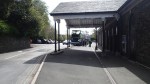
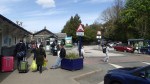
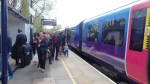

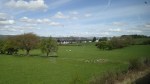
I walked from Windermere station to the town, which is a couple of miles downhill and rather badly signposted. Coming back I took a taxi up the hill, as I wanted to catch a train, which was dead on time and dumped me right in it at Oxenholme. But that wasn’t their fault and as expected there was a ready Virgin waiting.
I should note, that I had an excellent gluten-free lunch at Hyltons close to the lake.
The Windermere Branch Line is almost an oddity on the UK rail network, in that it is a very simple out-and-back line with no passing loops from Oxenholme that runs a better than hourly service using modern trains ( Class 185 trains). Signalling at present is non-existent and it relies on just one train being on the line at a time.
So now sixteen million pounds is going to be spent to electrify the line. Unless the line is given a modern signalling system and a better track layout, this won’t in itself give a better train service, than that at present.
Could the one platform Windermere station cope with anything more than a half-hourly four coach train?
So I suspect there is another motive behind electrifying this line.
The line has to be operated by diesels at present and this may give problems about where the trains are stabled at night, as they will need to be refuelled. And where would you park it overnight, as there is no siding at Oxenholm, so you’d have to leave it in a platform at either end of the line.
Currently, I suspect the first train in the morning comes in from Preston and then the last train of the day goes there for fuelling and an overnight clean and service.
My train direct from Preston to Windermere actually split at Preston, with the front half going to Blackpool. When Blackpool is electrified and electric trains serve that route, this splitting will not be possible, as you’d need to send a diesel train to Windermere, unless the branch was electrified.
Does an electric train working the branch give much greater flexibility in planning the schedules and providing a top class frequent service?
I think it probably does.
The only alternative to electrifying the Windermere branch is to use a battery-assisted electric train, like the one I rode in at Manningtree. But although that technology appears to be very successful, no train company would have just one of these, as what happens when it fails?
Removing One Hundred And Seventy Years Of Inadequate Design
The Manchester to Preston railway is san important line in the North-West of England, that was completed in 1841.
To say that is not fit for purpose is a total understatement, as it is not electrified and has a speed limit of just seventy-five miles per hour.
Finally, the line is being electrified and the speed limit will be raised to a hundred. From December 2016, hopefully refurbished Class 319 trains will be speeding from Manchester via Bolton and Preston to Blackpool and possibly Windermere.
The major problem on the line are the twin tunnels at Farnworth. They have a history of make-do-and-mend and are too small to take the overhead wires and Network Rail have come up with a practical solution, that should last several hundred years at least. This Google Earth image shows the ends of the tunnels with respect to the location of Farnworth station and the A666.
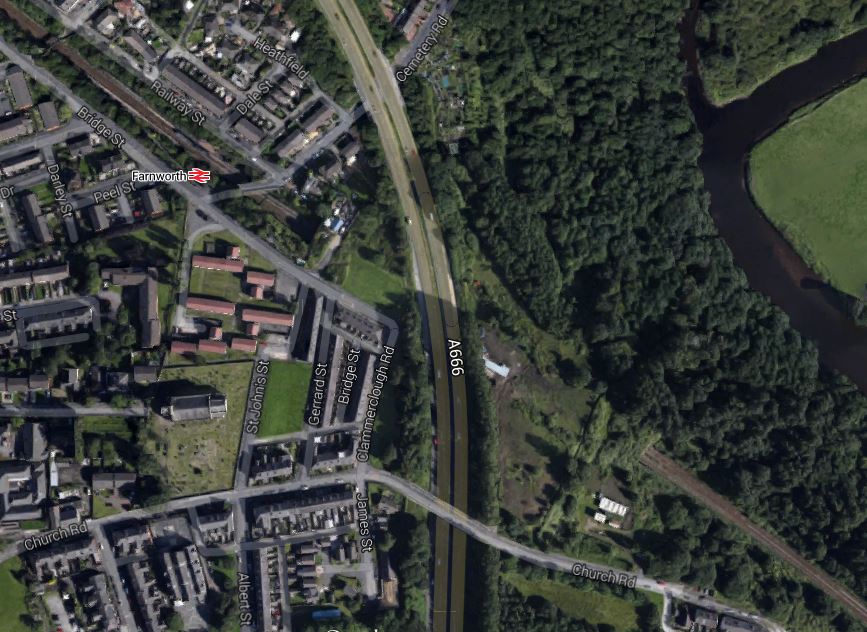
Farnworth Station And Tunnels
The smaller of the two tunnels will be refurbished and given a concrete lining, so that during the works, there will always be one track for trains. They will then bore out the larger tunnel, so that it is big enough to take two tracks and the overhead lines.
This will require that between May and October this year, there will be significant disruption to rail passengers. The whole project is described in this article in the Bolton News. It may cause a lot of disruption, but the passengers seem philosophical, as these paragraphs from the article show..
Jeff Davies, part of the newly formed Bolton Rail Users Group, said: “The station closures are the bad news, but there is good news here actually.
“It is the beginning of big investment which could take us out of the present problems and the companies have been at great pains to minimise inconvenience and ensure that Bolton people who work in Manchester will still be able to get there.
Perhaps this is because Network Rail have done their public relations well, if this YouTube video entitled Rebuilding the Farnworth Tunnel is anything to go by.
It all goes to prove that politicians should have sorted out the mess that are the railways of the North many years ago.
Why the North Needs Electrification And Pacer Eradication
Huddersfield is one of these classic Northern towns and cities that do not have a direct train to London.
In the past, when Ipswich have played there, I’ve either taken a fast train to Manchester or Leeds and then taken a train across in a twenty minute ride or so ride.
A typical trip via Leeds takes about ten minutes under three hours, with one via Manchester Piccadilly taking perhaps ten minutes longer.
On my trip north to Huddersfield, because I wanted to do take some photos in Sheffield and because the West Coast Main Line was closed, I decided to go via the old steel city from St. Pancras. With just one change at Sheffield this journey takes ten minutes short of four hours.
So imagine, you were perhaps a businessman needing to go to Huddersfield to check something out or a fan going from London to see your team play Huddersfield Town, would you bother?
I probably wouldn’t except for the fact that I got First Class tickets to Sheffield £36.30. That was Advance tickets with a Senior Railcard and I did buy them several weeks ago, but both journeys were in two hours, so it was probably good value.
I then took a local train from Sheffield to Huddersfield on the Penistone Line, with the journey taking over an hour in a dreadful Class 142 Pacer, as it meandered through the Yorkshire countryside, stopping at stations with interesting names like Wombwell, Denby Dale and Silkstone Common.
At least I wasn’t alone, as I shared the journey with an Ipswich-supporting student and another guy, who like me had been to Loverpool University. So at least it was an entertaining journey.
When you arrive in Huddersfield, you aren’t greeted by some dreadful pile of bricks, which has suffered the excesses and poor imagination of British Rail’s in-house architects, but a regional station that is second to none and is up there with Kings Cross for grandeur and setting.




Huddersfield station deserves a lot better than it is currently getting. The Wikipedia entry, says this about the views of those who knew about architecture, trains and stations.
The station frontage was described by John Betjeman as the most splendid in England and by Sir Nikolaus Pevsner as ‘one of the best early railway stations in England’.
The only blot on the station, is that in front is a statue of one of Huddersfield’s most famous sons; Harold Wilson. When he was Prime Minsister, he could surely have done more to put an electrified railway across the Pennines from Liverpool and Manchester to Sheffield and Leeds via his home town. Wilson also has the dubious claim to fame in that despite the recommendations of Beeching, he was Prime Minister, when the only electrified line across the Pennines, the Woodhead Line was closed to passengers in 1970.
But things could be getting better.The number of Trans Pennine trains has been increased in the last couple of years and the Huddersfield Line from Manchester to Leeds has been funded for electrification by 2018.
Six fast electric trains every hour between Leeds and Manchester via Huddersfield will be a big improvement in terms of speed and capacity, even if for a few years, they are just refurbished Class 319 trains. For example, journey times between Manchester and Leeds via Huddersfield will be down to forty minutes.
I find it rather ironic, that an electric train based on a design started under Wilson’s Prime Ministership, which was designed for the mountains of the South East, has such an important role in the exorcising of his sins as regards to railway electrification across the Pennines. It probably shows that engineers know a lot more about providing good infrastructure than politicians. But although Class 319 trains may be ugly buggers, underneath and behind that extremely tough steel bodywork, lies all the suspension and power systems to create a comfortable, fast and reliable train, that rides with all the smoothness and finesse of a top of the range car. The one I rode on in Liverpool recently had certainly scrubbed up well.
But this 100 mph electrified railway across the Pennines will be ruined for many, if there is no improvement in feeder services on other routes, which are generally worked by the dreaded Pacers.
To be fair to Northern Rail, yesterday’s example did have new seats and had been smartened up, but that doesn’t alter the fact that they should be sent to the Army for use as targets in gunnery practice.
Take the Penistone Line on which I travelled to Huddersfield. It has four major stations at Sheffield, Meadowhall, Barnsley and Huddersfield, with a host of what look like to be well-maintained stations in smaller and often rural communities. A Pacer trundling along the line once an hour is not exactly a passenger-magnet.
Northern Rail probably don’t have enough trains to provide a more frequent service, but surely in an ideal world, there should be at least two trains an hour along the line. Hopefully, with electrification in the north and transfer of trains from other parts of the country, in a few years time, we’ll see a better service on the line, provided by something like Class 172 trains.
Around the end of this decade, Sheffield will be electrified to London and fast electric trains will do the journey in well under two hours. As Huddersfield will also be electrified, the electrification and modernisation of the Penistone Line and the related Hallam Line between Sheffield and Leeds , could be a logical step to take. In fact the recent report on Electrification in the North has recommended this.
This would open up all possibilities for services, such as providing direct electric services from Leeds, Barnsley and Huddersfield to London via Sheffield and the HS2 interchange at Meadowhall, in addition to very much improved local services.
I look forward to the day when voters in London and the South East start moaning about all their money being spent on electric railways in the North. Hopefully by then, London’s Mayor will have a lot more freedom on how to fund railways in the capital.
Flimsy It’s Not!
Some of the overhead electrification installed in recent decades has been rather less than robust. These pictures show some of the structures on the Great Western Main Line and Crossrail.


If you compare these pictures with those that I took at Eccles in October 2013, they do seem to be of a similar standard.
Hopefully, this current electrification won’t have some of the problems of projects that were done earlier.
 The Anonymous Widower