Bus and Tube Information at Euston Station
When you arrive at the station in a city or town, you often need information to complete your journey to your final destination.

Bus and Tube Information at Euston Station
Most London stations have information booths like this provided by Transport for London at Euston station. I’ve never found such a booth in Manchester Piccadilly and I meant to check Liverpool Lime Street today, but forgot.
They say this about buses at Liverpool Lime Street on the National Rail website.
‘Arriva’ and ‘Stagecoach’ operate a network of daily, frequent bus routes around the city and also to nearby towns. For route maps and timetables: http://www.arrivabus.co.uk and http://www.stagecoachbus.com/merseyside
Liverpools main bus station (on Roe Street) is about 4 minutes walk from Lime Street station.
So should I assume there is no booth. How do you find out what bus company you need?
The same web site gives this for Euston.
Bus route maps are available from Transport for London’s website.
There is no mention of the excellent booth, although the link does point to bus maps for Camden.
There is also no way to contact the National Rail web site, to kick them into line. So we are just Self Loading Cargo left to our own devices.
The Rubbish Talked About HS2
I listened to some of the phone-in about HS2 on Radio 5 this morning, but gave up after most of those in the discussion, weren’t letting facts get in the way of a good selfish argument.
So here’s a few facts and my observations.
The West Coast Main Line is rather a nightmare. It is overloaded now and longer and bigger trains would probably only mop-up a small amount of the increase in passengers that will happen in the next few years. In my travels any Virgin train to or from Glasgow was severely overloaded and this section needs action now.
It was intended that the speed limit on the line would be increased, but because the line isn’t very straight, the cost would be high both in monetary terms and also in blockades whilst it was upgraded. Wikipedia says this about the reasons for the bad design of the line.
Because of opposition by landowners along the route, in places some railway lines were built so that they avoided large estates and rural towns, and to reduce construction costs the railways followed natural contours, resulting in many curves and bends. The WCML also passes through some hilly areas, such as the Chilterns (Tring cutting), the Watford Gap and Northampton uplands followed by the Trent Valley, the mountains of Cumbria with a summit at Shap, and Beattock Summit in southern Lanarkshire. This legacy of gradients and curves, and the fact that it was not originally conceived as a single trunk route, means the WCML was never ideal as a long-distance main line.
The East Coast Main Line is better, but it doesn’t solve the problem on the western side of the country.
So those who talk about increasing the capacity on the West Coast Main Line had better look at the engineering problems involved.
Christian Wolmar, a respected commentator on rail, said on television this morning, that the money for HS2 would be better spent on improving local tranport in cities and large towns, by providing trams and better bus services. He has a point, but there is one fault in his argument.
If we take Manchester as an example, where the tram system is being substantially developed, this will make it easier for long distance travellers to get to Manchester Piccadilly and the West Coast Main Line. If trams are frequent and have substantial car parking outside of the city, it may well persuade many more to take the train rather than driving.
So in fact, his plan will in the long term increase the long distance train traffic increasing the need for long distance services from Manchester and in a decade or so for HS2.
More passengers will also be brought to the line, by improvements to cross country and branch lines. Some of these like Manchester to Leeds are scheduled to be electrified and this can only attract more passengers to the fast London lines, where their local station has no connection.
One point on this is that Network Rail is investing in a special overhead line installation train, that can install a mile of overhead wiring every night with only minimal line closure. This will mean that some lines where only a marginal case exists now, will be electrified. An example is possibly from Felixstowe to Nuneaton via Peterborough, which would allow freight trains to be electric hauled all the way to the North of England and Scotland.
Another big problem is freight, which most would feel is better carried by rail to and from the ports to where it is needed. A few years ago, Felixstowe had just three freight trains a day out of the port. Now it’s a lot higher. Much of the freight will come and go through Felixstowe, Southampton and in the future the new London Gateway development and it will need to be either collected from and delivered all over the country. This would add greatly to the number of freight trains going everywhere. Many of course, will have to go up to Birmingham, the North West and Scotland.
So whatever we do we’ll have to find some way to take the freight north or alternatively free up the West Coast Main Line, by building HS2. Or do we put more trucks on the motorways and clog them up?
Those that propose upgrading the West Coast Main Line with longer and bigger trains, forget one problem, that under the current plans also applies to HS2. And that is what to do with the totally inadequate station at Euston. Of London’s main stations it is one of the worst, as I said here. It will have to be rebuilt whether we build HS2 or not. It really doesn’t have the good ongoing transport links that Kings Cross, Liverpool Street, London Bridge and Paddington have or in some cases will have after Crossrail.
In fact it could be argued that if HS2 has a station at Old Oak Common, this might be a better London terminus for that line, as it links to Crossrail, the Great Western Main Line and possibly Heathrow.
There are also a lot of technology that will make HS2 better from an engineering, environmental and passenger point of view.
For a start tunnelling technology has improved substantially in the last decade or so. If you look at the speed of building the Crossrail tunnels, I think that this shows a big increase to the similar tunnels bored for HS1. Having listened to Justine Greening’s statement in the House of Commons, this improvement is being used to put more of the line underground. We may actually be getting to the point, where tunnels are cheaper to build that lines on viaducts.
We also know a lot more about how to minimise problems when we build large projects. Crossrail for example seems to be causing a lot less problems with construction than HS1 did. Admittedly, it has caused a bit of a problem at some Central London station sites, but no more than say the average large building site or an office block.
Project management has also got a lot better over the last few decades and it is much more likely these days that a large contract is built on time and on budget. Provided the politicians and the civil servants don’t stick their oar in too much and change the specification, it will be all right in the end.
As the Sunday Times pointed out at the weekend design is getting better and the trains on HS2 could be a lot better than Eurostar. We might also see other technologies like anti-noise cutting the noise signature of the trains.
It has also been said that passengers won’t use HS2 because it will be too expensive and too much hassle. But here is where technology will help, in such things as buying tickets, where hopefully we’ll see a touch-in touch-out system like Oyster.
So the doom-mongers will continue to knock HS2, but it has a lot going for it.
The trouble with rail projects, is that if we had a referendum about spending £32 billion on rail or the same amount on roads, the public would vote for the roads. But within a few years they’d be just as gridlocked.
Getting Between Kings Cross/St. Pancras and Euston
London’s three major stations that serve the North and of course the Continent; Kings Cross, St. Pancras and Euston, are all close together on the Euston Road.
The first has been superbly rebuilt, the second is approaching the end of a major redevelopment and they now share probably the best Underground station in London. But Euston is rather isolated from the other two, with several ways to get between them.
- You can take a rather unpleasant walk along the busy Euston Road.
- You can use the Metropolitan or Circle lines, but this means a walk to or from Euston Square at the Euston end.
- You can dive into the Underground and take the Victoria or Northern lines, but it is not step free at the Euston end, and not recommended with a heavy case. Both deep stations are also easy places to get lost or confused.
- Going from Euston to Kings Cross or St. Pancras is quite easy by bus 30, 73, 205 or 476, which you catch in front of Euston station, but the reverse journey means you have to cross Euston Road twice.
- There are of course taxis. But not everyone can afford them.
As I had time to spare at Kings Cross, before I caught my train to Hartlepool, I decided to investigate and found a map which showed there was a fairly simple direct walking route that avoided the pollution and traffic of the Euston Road.
I started by walking through St. Pancras station and exited by the cab rank onto Midland Road, with the intention of going down Brill Place.
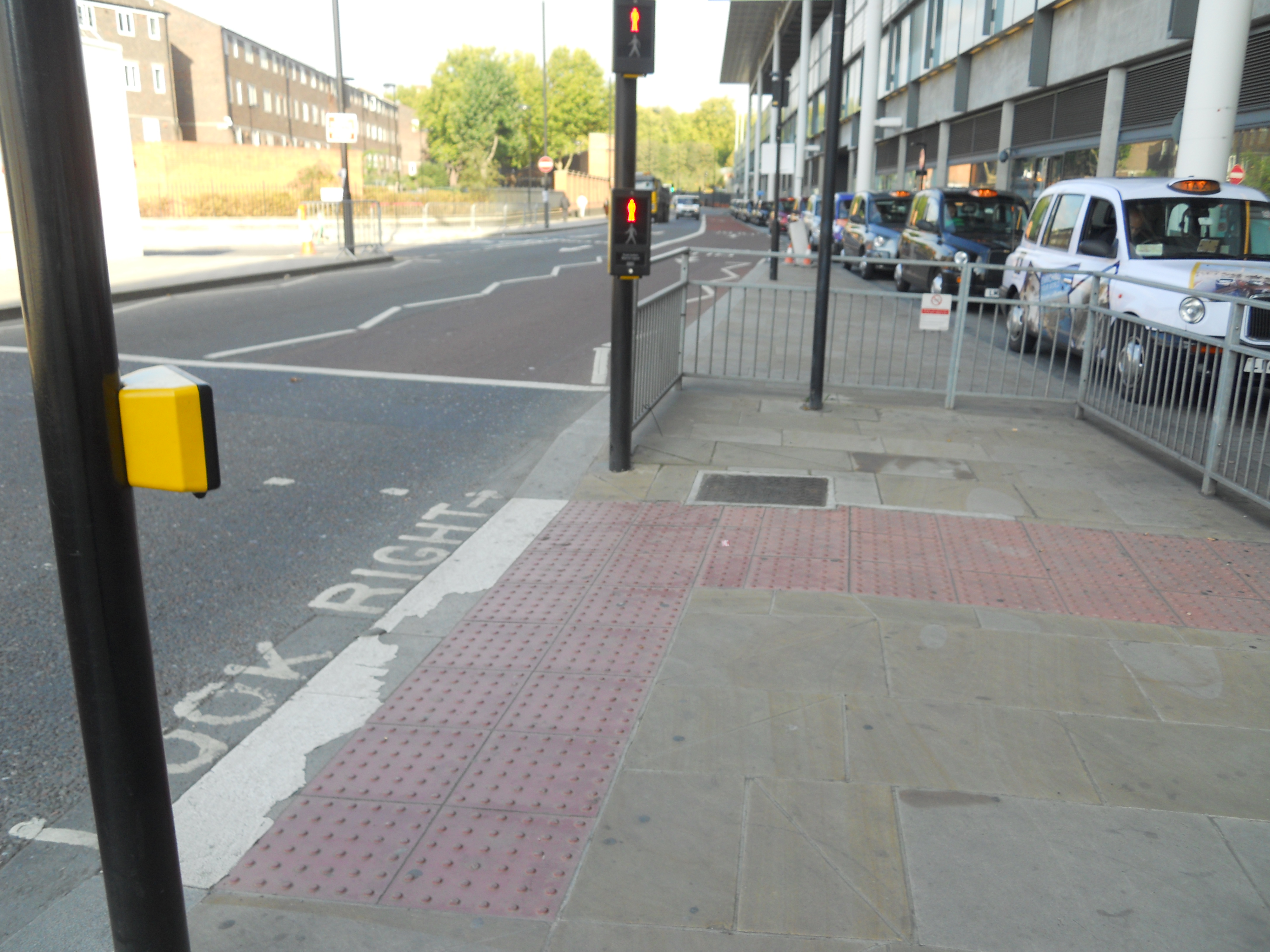
Crossing Midland Road
There is a light controlled crossing, but it is rather blocked by badly placed railings and the cab rank. Brill Place, which is the start of the road to Euston is on the left.
Brill Place is flanked on one side by the new Francis Crick Institute and on the right, there is a small pleasant park, which could provide an oasis from the crowds in the stations.
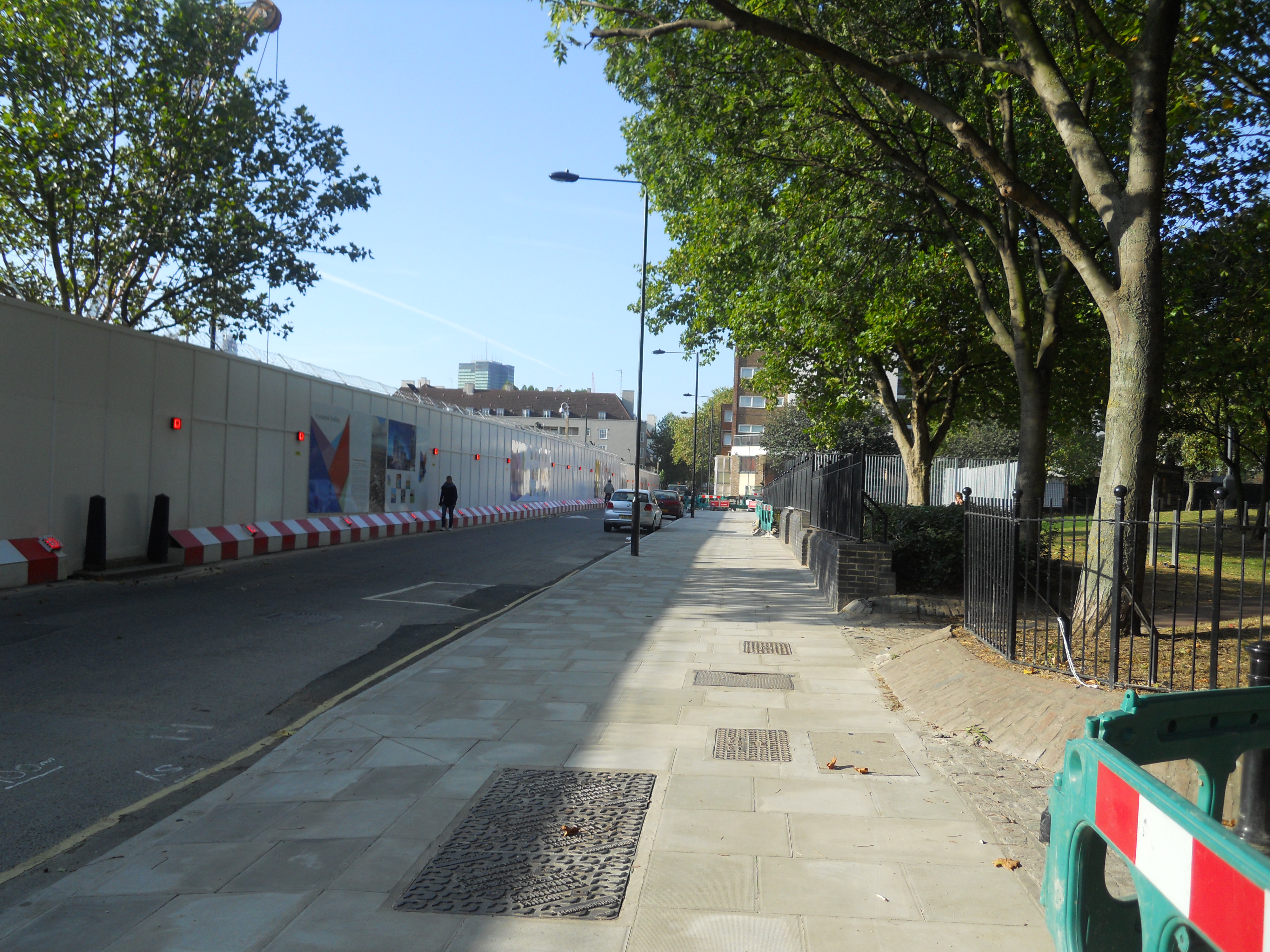
Brill Place
Brill Place itself, is not a grotty dusty road lined by parked cars, but a wide tree-lined avenue that leads on to Phoenix Road.
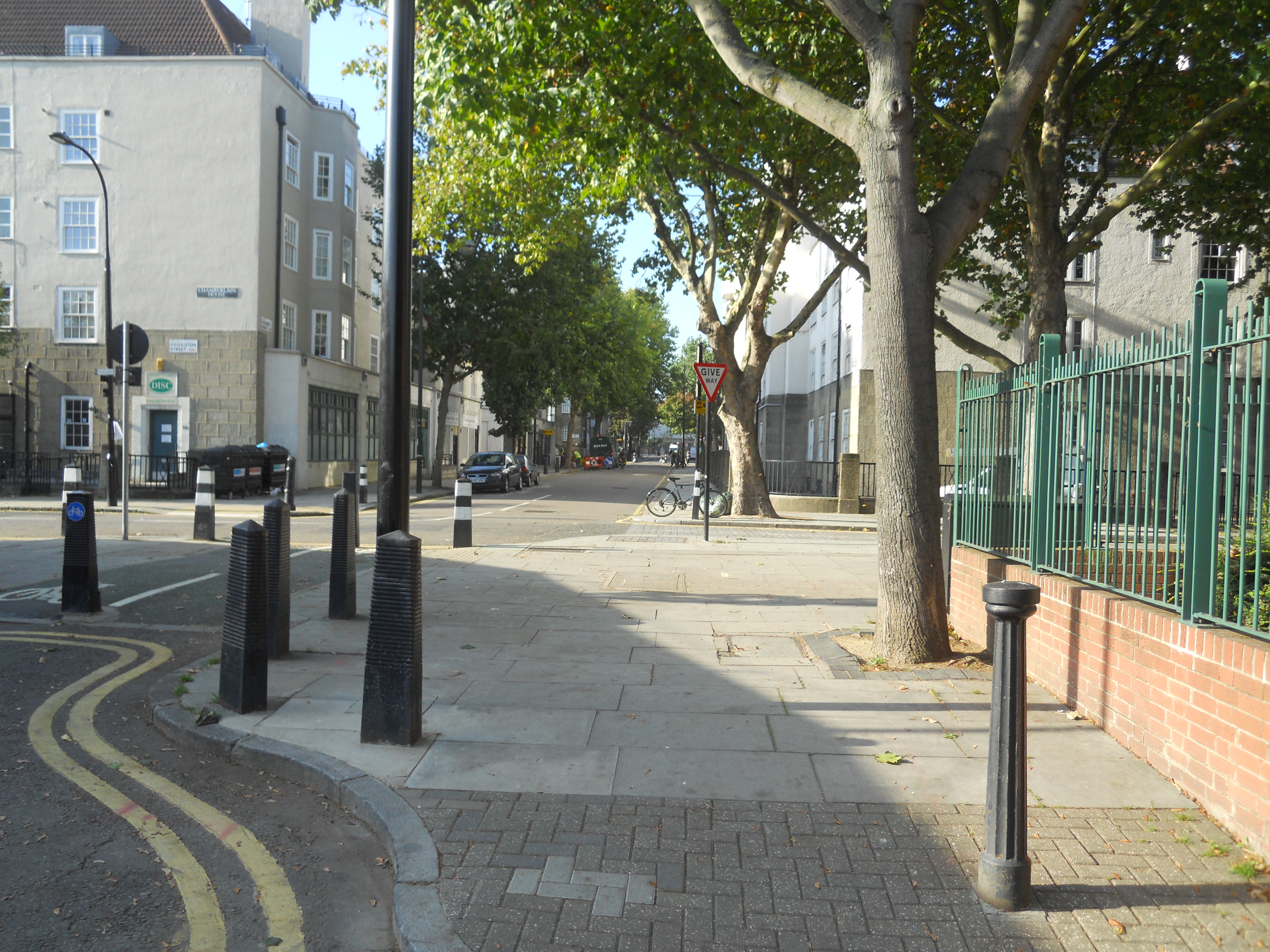
Towards Pheonix Road
At the end of Phoenix Road, you just cross Eversholt Street on one of the two pedestrian crossings and you walk down the road to Euston station.
The advantages of the route are as follows.
- The route is virtually flat.
- It would be easy trailing quite a large case.
- There are only two major roads to cross and both have light-controlled pedestrian crossings.
- There is the park, which would as I said before, be a better place to eat a packed meal than the station.
- You do pass a few shops and a reasonable-looking pub.
But there are disadvantages.
- The route is not signposted.
- The barriers at the St. Pancras end are wrongly placed.
- The side entrance to Euston station could be better.
So how would I make it better, so that in effect we had one super station for the north.
- I’d start with sign-posting. The posts are there at the St. Pancras end already.
- Perhaps, it should be marked on the ground, as a Kings Cross/St. Pancras to Euston walking route.
- You might even provide some eco-friendly transport along the route, like an electric shuttle bus or bicycle rickshaws.
- A couple of suitably placed Boris bike stations would help too.
- Shops and cafes should be developed along the road. There are some already.
To me though, this is one of those things that will happen. But probably first in a very unofficial way, as how many of those that work in the Francis Crick Institute will commute into Euston and walk there? It won’t be a small number.
It took me about fifteen minutes to do the walk and I just got a 205 bus back to Kings Cross for my train from the front of Euston station.
A Sign At Euston
I saw this sign at Euston tonight.
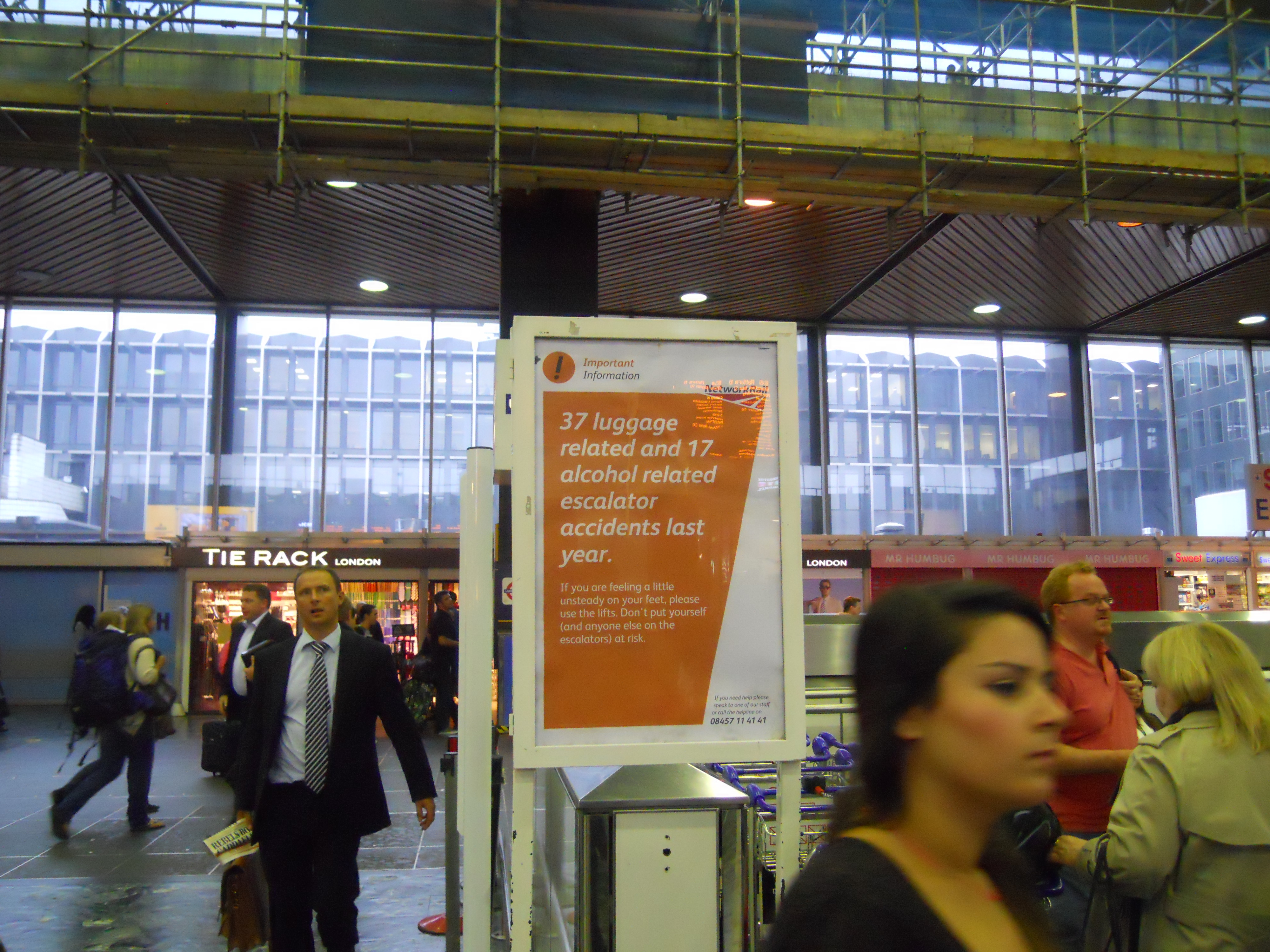
A Sign at Euston
How many of the 37 luggage related accidents, were caused by drunks carrying trays of lager?
Tired Euston
Euston has hardly changed since it was rebuilt in the 1960s. The black marble inside the station has always made it a bit of a black hole and I’ll admit it used to be worse as you walked down the ramps to the trains. They seemed to have brightened up this area with perhaps just a few more lights and some new paint.
But it is in the Underground and the connections to it, that it is really lacking; from the inadequate escalators from the station and the rather dull tunnels connecting you to the Northern and Victoria lines. Compared to later stations like Liverpool Street, it is all very poor. It will look even more so, once King’s Cross and St. Pancras are finished.
Euston also needs to be properly connected to the Metropolitan and Circle lines, which run just in front of the station, by some form of proper people mover.
Perhaps in the future, all the Marylebone/Euston Road stations could be properly linked, so that passengers arriving at Marylebone and Euston could be quickly whisked to St.Pancras and King’s Cross for Paris, Brussels and the North East.
I think, I would ban cars and lorries from the route, put a travelator down each side, with trams and gardens in the middle and cafes and restaurants along the side.
Reflections on My Journey to Scotland
In my Modern Railways for October, which I bought in Doncaster, there was an heretic article by Chris Stokes, asking if we really needed HS2 or the High Speed Line to the North, which would go to just Birmingham at first. He described it as a vanity project.
Twelve months ago, I was a sceptic on whether we needed a High Speed Line to the North, mainly because I didn’t think it would do anything for anybody in East Anglia where I lived. If I needed to get to the North, I wanted a fast line from somewhere I could drive to easily like Peterborough.
But when it was announced that the route would be to Birmingham in the last days of the disastrous NuLabor experiment, I warmed to it a bit, although I did think it needed to go via Heathrow. I also thought very much that it was a Nimby’s charter.
But Chris’s article has now turned me back to very much a sceptic. Competition being what it is, his argument, that unless you virtually close down the West Coast and Chiltern Birmingham services, no-one will pay a premium to go from London to the Midland’s premier city. My son incidentally always goes by Virgin and has never thought about using Chiltern, as Euston is on the same Underground Line as where he lives.
Chris also argues, that the amount of First Class traffic will decrease due to austerity, good housekeeping and modern technology removing the need to travel. Some years ago, I installed a Management Information System in a company, which was web-friendly and even allowed the computer-phobic CEO to find out how the company was doing from any computer in the world. But also, the modern traveller will become First Class smart and book it when and where they need it. So if you think there is a premium market that saves a few minutes, forget it!
Put simply, a lawyer say going to Birmingham from London for the day, will choose his route and class dependent on what is best for his needs. Hopefully, when I move to London, it will be in walking distance of Canonbury. Who’s to say that in 2015, someone isn’t running an express to say Milton Keynes, Coventry and Birmingham from Stratford and East London on the North London Line and possibly the Primrose Hill Tunnel?
So what will happen to lines to the North, if we don’t build HS2 on schedule? We’ll get the usual whining, we always get when the investment is cut, but let’s look at the reality of what will happen!
We now have two good and pretty reliable and fast train lines from London to the North of England and Scotland. I was told on my trip to to Inverness that it should be possible to be some minutes under four hours from Edinburgh to London. This compares with a fastest journey now of about four hours twenty minutes, although Operation Peppercorn is aiming for the magic four hours flat for the fastest trains with a stop at Newcastle. Glasgow to London by comparison is now about four hours and twenty minutes. Many of my Scottish friends say this is fast enough to mean they won’t bother to fly to London, as airport checks and delays are getting worse and they can use phones and laptops on the trains.
If there is a problem with the two stiles of a possible ladder reaching up the United Kingdom, is that some of the interfaces to other lines are poor. But the basics and some of the rungs of the ladder are already in place.
There are a succession of large stations on both lines, such as Peterborough, Crewe, Doncaster, York and Newcastle, which can be developed into easy change stations to other places. As I said earlier, Doncaster isn’t bad and I think Peterborough is going to be developed and hopefully linked to the nearby shopping centre, but a lot of work needs to be done.
As I rode out of Edinburgh towards Inverness, I was impressed to see that electrification has started to link Edinburgh and Glasgow. As it is trains now run every fifteen minutes and most take just fifty to link Scotland’s two capitals. I suspect that this will become a very important link between the two fast lines, not only because of level cross-platform interchange from the South to local trains, but also because full electrification would allow fast direct trains from Glasgow to York and Edinburgh to Liverpool. Taking the first journey, my road atlas estimates that at four hours ten minutes, which compares with about four hours by train now with two changes and two different companies. I estimate that something like a Pendelino could do this journey direct with perhaps just a stop at Newcastle in about three hours fofty-five minutes. Who would back against, Peppercorn 2, squeezing more minutes out of the East Coast Line.
A similar situation could exist between Newcastle, York and Doncaster in the East and Manchester, Liverpool and Preston in the West, by expanding and electrifying the TransPennine network. Edinburgh to Sheffield is a journey that uses either a direct diesel service or a change to TranPennine at Newcastle. If TransPennine was a level change at Newcastle from one fast electric to another, there would be a much better service.
London too has a strong link across, although as I said Euston is not a welcoming station, but when you’ve got three world-class stations in Kings Cross, St. Pancras and Euston, as you will have, an innovative transport solution along Euston Road could surely be achieved. For a start let’s have a proper walking route a hundred metres or so north of Euston Road, with cafes and shops. But I’m certain that people should be encouraged to take the Metropolitan Line rather than the Victoria or Northern. Perhaps we need a moving walkway! Euston is supposed to be being developed and also be a terminal for HS2. If the latter does happen, there will be a lot of grief and opposition in that area of London. That development, whether it incorporates HS2 or not, will divert rail passengers to other routes, such as Chiltern for Birmingham and East Coast for Scotland.
There is also another link that might be brought into use, especially if Euston has to be partially closed to traffic, whilst it is rebuilt. That is the link to Manchester out of St. Pancras, which was used reasonably successfully as Operation Rio during the West Coast Main Line upgrade. I’ve always argued that this should have stayed in place, as it interfaces well with the A14 at Wellingborough for those going from East Anglia to the North Midlands,Sheffield and ultimately Manchester.
So what’s missing?
As I found going to Scunthorpe, it’s not what’s missing in this case, but what’s still here; Pacers. All of these links to the two stiles of the ladder must be upgraded to the standard of the diesel trains, I used in Scotland. And where possible, they should link easily to the fast services. I think that this will happen, but in some ways it depends on a strong electrification program to release suitable diesel units.
The real problem though is the lack of a full East-West route between say Peterborough and Birmingham or perhaps Milton Keynes and Stevenage or Cambridge. The Peterborough to Nuneaton route is being upgraded for frieght and passenger trains between the two towns take seventy-five minutes. So it would look like that route could be another rung in the ladder. The other route is the possible Oxford-Cambridge Line, which could be built, if funds were made avaialable.
I believe strongly that the two route ladder offers advantages over just building a speculative line from South to North, which would cost several times the amount needed to build the two route ladder.
For example, as electrification progresses, subsidiary lines like Birmingham to Bristol could be further improved, so that more and more people had less than two hour access to the main network. More rungs could be opened up, by any company that feel there was a niche to be filled.
So should HS2 be built? I think that one day it might be built, so we must safeguard the route, so that at some future date it could be added as another part of the network.
If Beeching made one big mistake it was not in making sure that abandoned rail lines were able to be rebuilt. How many lines hastily abandoned in the 1960s are needed now? But perhaps it would mean knocking down a hundred or so houses and a Tesco’s!
Welcome to Euston
I arrived at Euston on time at about a quarter to eight!
It was clean, neat and tidy, but really it is not the most welcoming of stations. Perhaps, it is if you are going a few miles in a taxi, but I was going to Kings Cross for a train to Cambridge. On a good day, I’d have walked and possibly had breakfast, in one of the few stations in the world, that can call itself a destination in its own right; St. Pancras. So I struggled into the Underground, luckily against the flow of people and took the one stop to King’s Cross. I thought about breakfast, but as I wasn’t really hungry I took the 8:45 to get home. It was virtually empty, so that was at least good!
The Sleeper to Euston
AFter a curry in Fort William, I boarded the sleeper for London around 19:30 and it left on time at 19:50. Or should I say it left for Edinburgh, where the various coaches from all parts of Scotland were joined up into one long train for London.

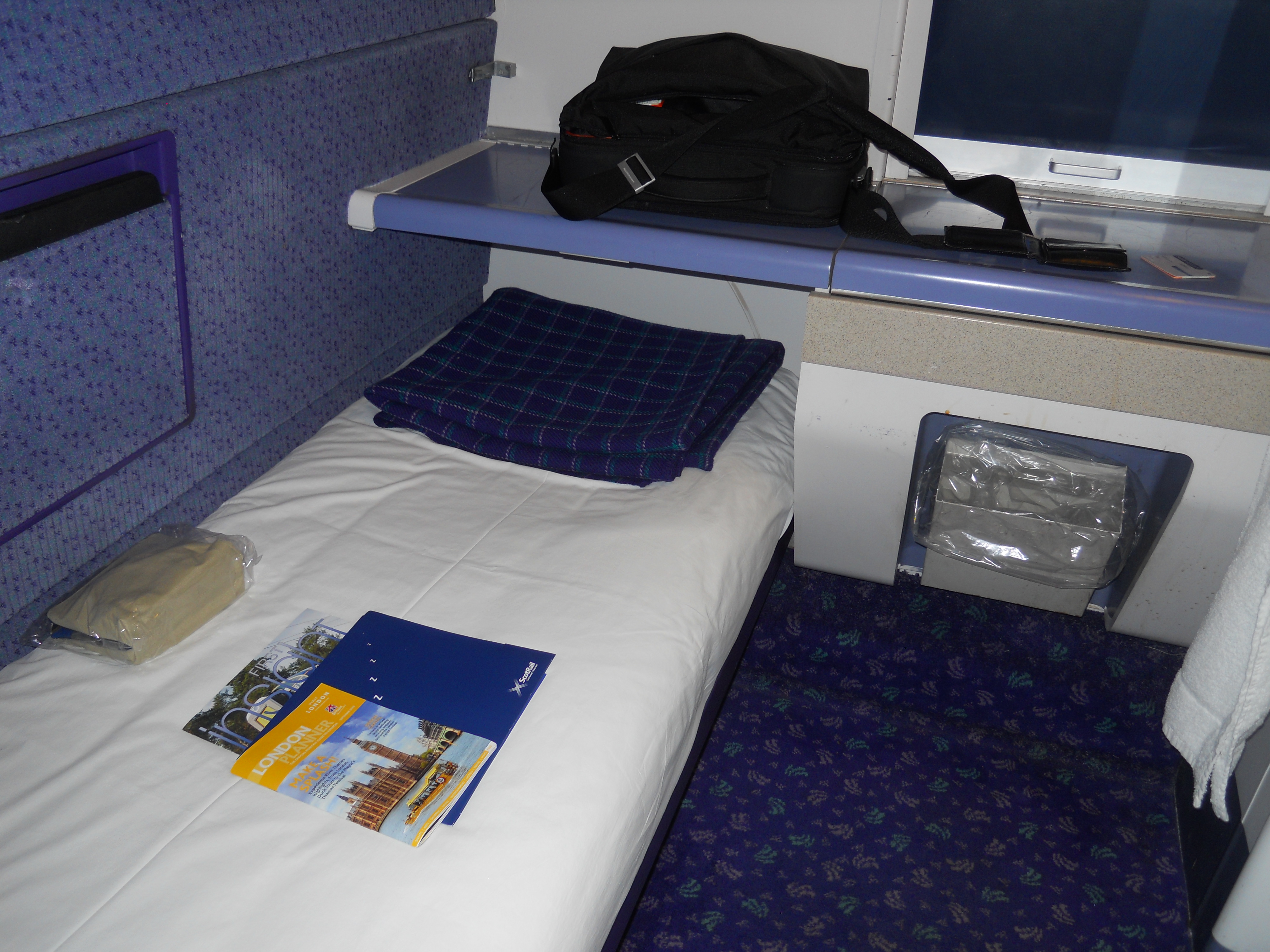
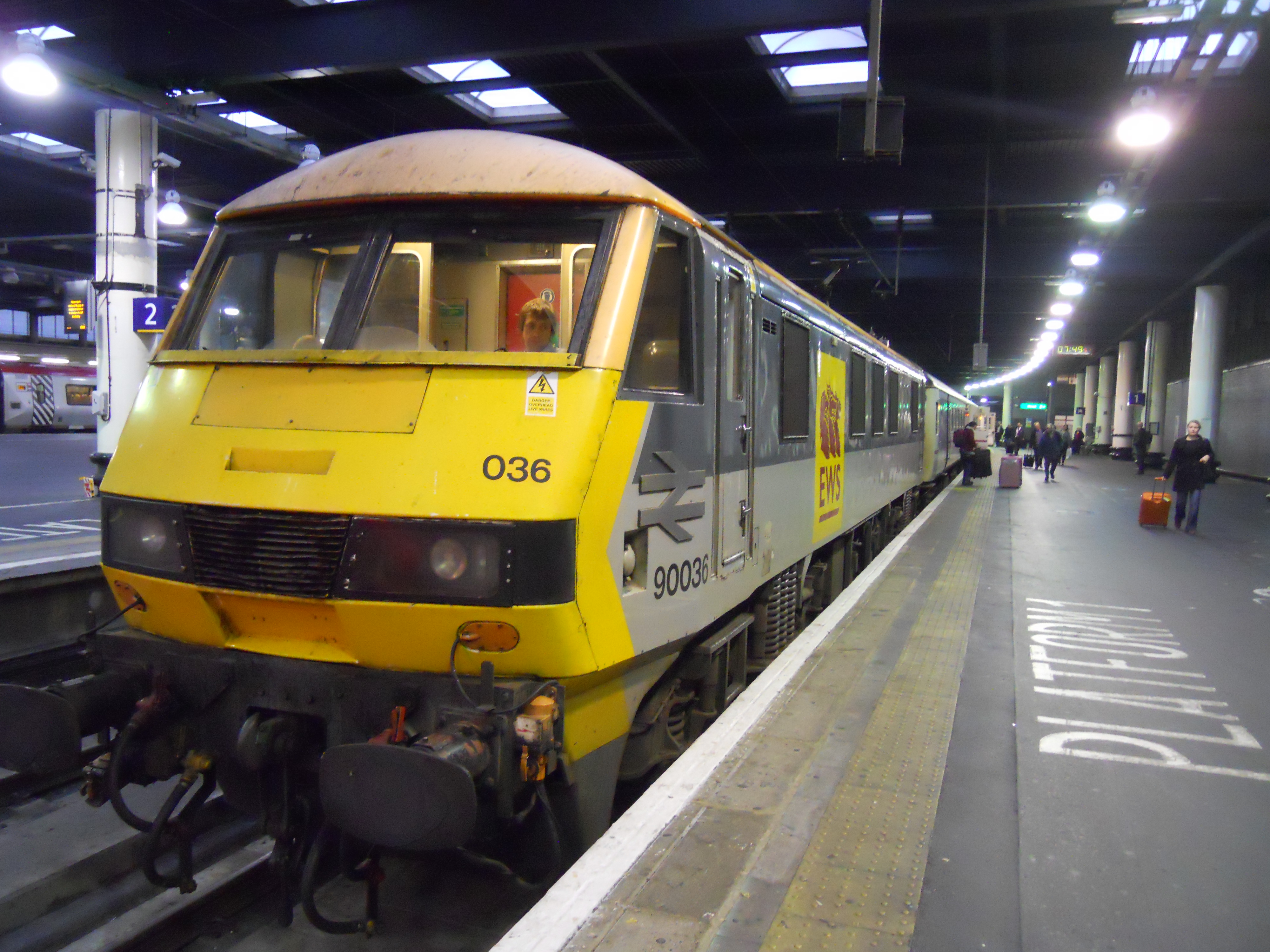
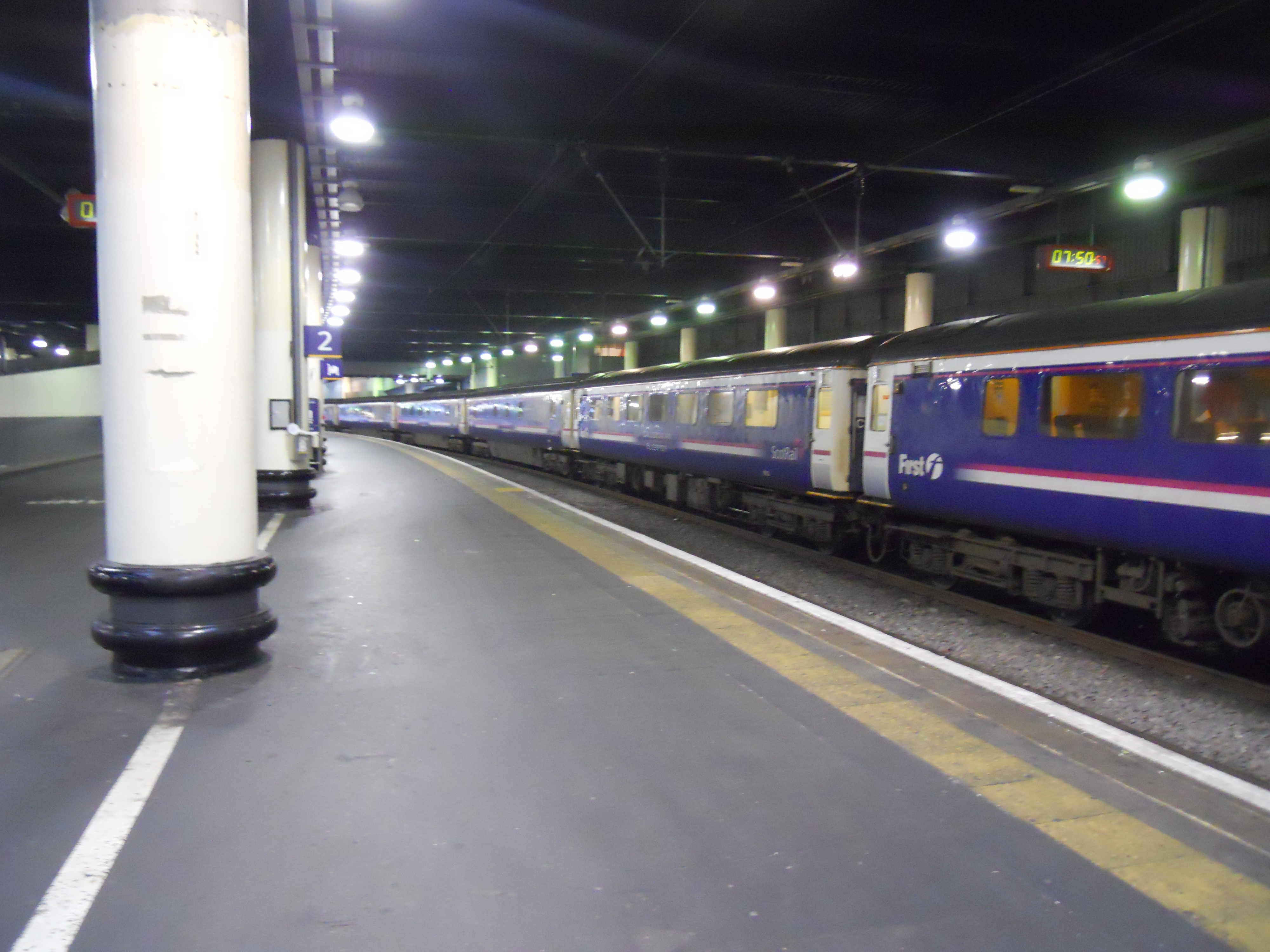


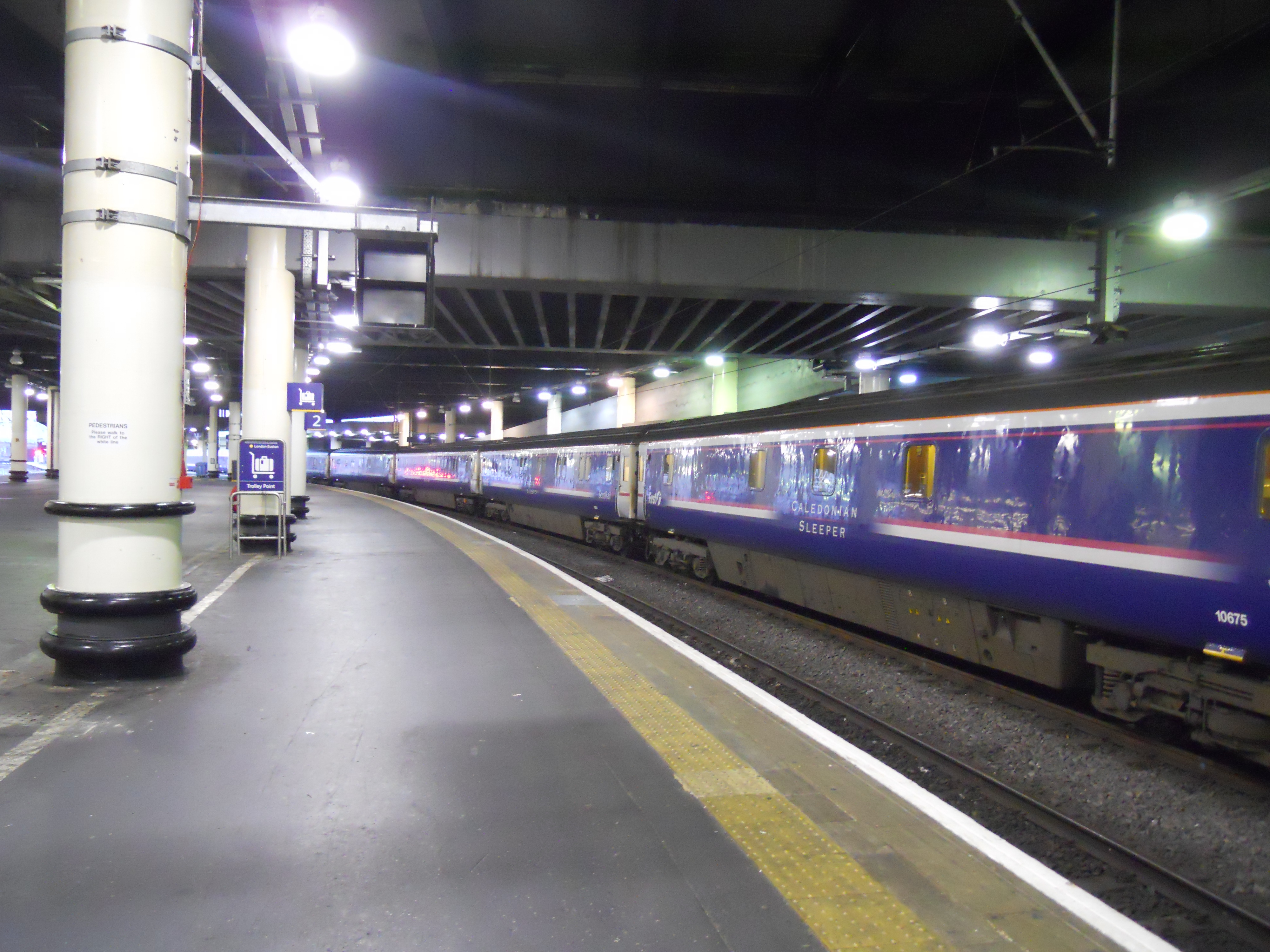
I had a whisky before I retired and slept soundly until Crewe. This was despite the fact that the steward had told me, I’d got the worst berth in the carriage over the bogie and I would have difficulty sleeping. The next thing I remember was being woken with my breakfast. As a coeliac, I just had the coffee and the juice, but actually, I wasn’t that hungry, as I’d eaten well in Scotland.
So would I tske the sleeper again?
Perhaps this one, but I doubt I’ll take the one we did as a family with a car to the South of France. I didn’t sleep well on that and spent most of the trip trying to find out where I was. But at least C and myself christened the berth.
The third sleeper was again with C on the Eastern and Oriental Express from Bangkok to Butterworth for Penang. That was a memorable trip, but it’s probably one I wouldn’t risk for some years.
Virgin’s First Class Toilets
Some coeliacs can be paranoid about toilets as many like me, have had so much diarrhoea, that it becomes a way of life. Now that I’m strictly gluten-free I rarely suffer that way, but I still sort out the best toilets. Certainly, one of the pleasures of travelling on Virgin is the quality of the First Class Lounge at Euston The free toilets were definitely up to the best standard expected.
On the subject of toliets,those at Portman Road are pretty good. It will be interesting to see how Gresty Road stacks up tonight.
 The Anonymous Widower