An Interloper At Euston
I took these pictures as I came through Euston on Saturday night, as I returned from Blackburn.
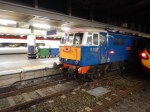


The engine is an immaculate Class 86 locomotive, which was built in the 1960s.
According to Wikipedia, Freightliner still have ten upwards of the locomotives in service and I recently saw two working together on a long intermodal freight service through Dalston Kingsland station.
They may have been bog-standard electric locomotives in their day, but surely if they can be restored and kept running, they are probably a lot more affotdable for main line use by charters, than anything else.
I would assume that E3137 had been hauling a charter into Euston. Long may it continue to do this.
I’m All For More Of This!
This article from Global Rail News is entitled Toronto park plan for downtown railway.
The article describes how Toronto wants to purchase the air rights over a 21-acre railway through the City Centre and put a park on the top.
There are certainly places in the UK, where this approach can be used to create parts, housing or commercial buildings over the railway.
Especially in Londom, where land is so expensive.
Look at this Google Map of the rail lines into Liverpool Street as they pass Shoreditch High Street station on the East London Line.
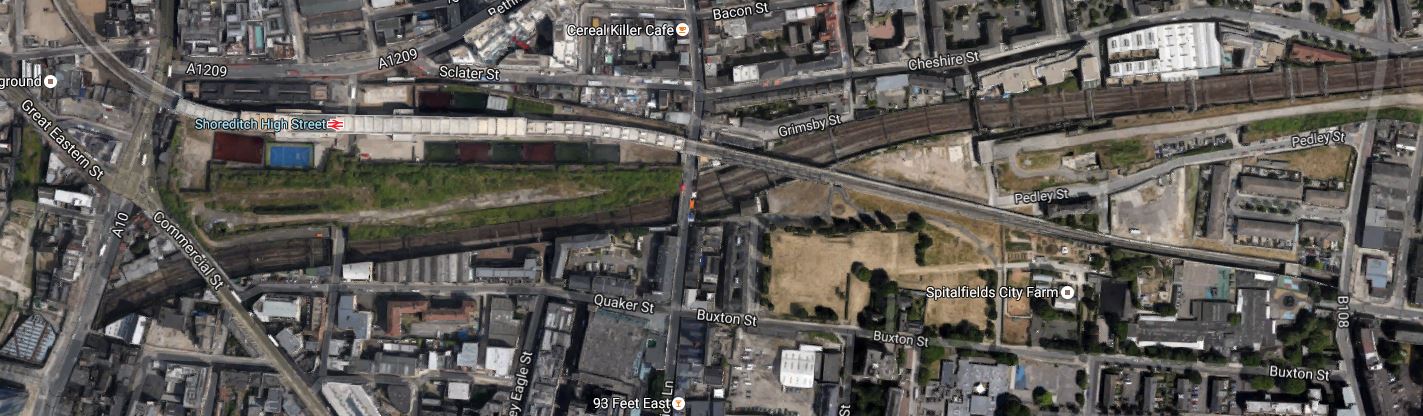
Lines Through Shoreditch
Surely, a better use could be found for the space above this railway. I estimate this space must be about ten hectares and if properly developed could contain lots of buildings and a green walkway connecting Shoreditch High Street station to Liverpool Street station.
And what about the waste of space that is Euston station?
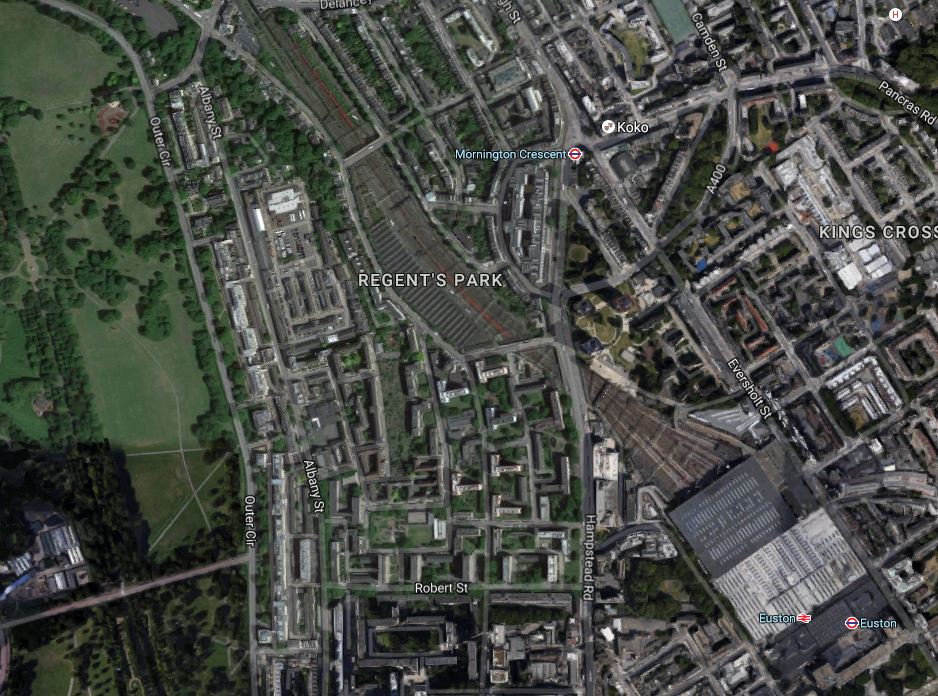
Euston Station And The Approach Lines
Hopefully adding HS2 to the station will improve things.
Crossrail 2 Will Be Threaded Through This
The map from carto.metro.free.fr, shows all the lines around Kings Cross station.

Lines Around Kings Cross
It certainly isn’t the easiest place to connect Crossrail 2, which will call at Angel, King’s Cross St. Pancras and Euston stations into the system. From a map in this document, it would appear that Crossrail 2 runs across to the north of the Victoria and Northern Lines.
Thank Heaven for 3-D computer design systems!
HS2 Does The Right Thing At Leeds
I don’t like the concept of most of the HS2 stations.
Euston, isn’t too bad, as the HS2 platforms are alongside those for the main station and I suspect that when and if I see it in reality, I will be able to arrive in the station on perhaps a London Midland train from Bletchley or Tring and just walk across to the HS2 platforms.
At some of our better interchange stations like Reading, to change trains, you go up escalators to a wide overbridge and then walk across to the escalator for the platform of your departing train. The design also allows seats and cafes in a totally non-claustrophobic environment. I have a feeling that the new London Bridge will raise the bar of this type of station even higher!
To my mind the designs for HS2 station at Birmingham is absolute rubbish and truly terrible. Birmingham is developing a local train, tram and bus network centred on New Street station, so instead of HS2 arriving into this hub, it arrives at a separate station some distance away and many passengers will have to get a tram to connect to their ongoing service.
As HS2 will run very large trains, imagine say a thousand Chelsea fans arriving on HS2 to go to a match at Villa Park and needing to get a train from New Street. You save masses of time by using HS2 and then waste it queuing for a tram.
But if HS2 arrived directly into New Street, a lot of the problems would be solved with a short walk.
In Birmingham there is no space in New Street itself, but why shouldn’t HS2 arrive in an underground station beneath New Street? Or in my preferred solution, in a giant double-ended station stretching right under the City Centre.
As they’ve got a redundant piece of Grade 1 Listed railway memorabilia, they’ll use that instead. The heritage lobby should crawl back into its hole!
But at Leeds, HS2 have put forward a new proposal, where HS2 meets the existing station in a giant version of the way trams met the train at Nottingham.
This is the only picture I can find of the proposal. It’s in an article in Global Rail News.

HS2 At Leeds Station
Passengers arriving in Leeds would just walk to the front of the train and then they’d be over the platforms of the existing Leeds station. If that is too difficult, then I’m sure we’ll see a few travalators.
It is a much better layout than that proposed for Birmingham.
Interchange between HS2 and local services must be a short walk, assisted by lifts, escalators or travalators as required.
The LaMiLo Project
Few have heard of the LaMiLo Project, which is an EU funded project to reduce truck traffic and the consequent air pollution in cities.
I hadn’t until half-an-hour ago, although I knew there were experiments going on at Euston.
This page on the London Councils web site, gives more details about the pilot project in London.
In this pilot a freight train was brought into Euston station in the middle of the night and pallets of goods were unloaded on to smaller trucks for onward delivery in Central London.
This is said on the London Councils web site about the pilot.
The pilot has provided outstanding results; it has seen 50,000 items delivered to over 250 councils building, leading to a 46% reduction in the number of vehicle trips and a 45% reduction in kilometres travelled.
It sounds like an idea worth pursuing. Although Nigel Farage would object to the EU involvement.
Walking Between St. Pancras And Euston Stations
In 2011, I wrote Getting Between Kings Cross/St. Pancras and Euston about how I walked between the stations.
This route has now been formalised with green signs.











I think when they finish the roadworks, it’ll be a good route. This is cut and modified from my original post.
So how would I make it better, so that in effect we had one super station for the north?
- Perhaps, it should be marked on the ground, as a Kings Cross/St. Pancras to Euston walking route.
- You might even provide some eco-friendly transport along the route, like an electric shuttle bus or bicycle rickshaws.
- A couple of suitably placed Boris bike stations would help too.
- Shops and cafes should be developed along the road. There are some already.
I was right that this would happen.
Euston Is Getting A Balcony
At Euston station today, it was obvious that Network Rail are creating a balcony in a similar way to how they did at Manchester Piccadilly and Waterloo stations. They describe the project on this page on their web site and these are some pictures I took today of the construction work.




Hamish Kiernan, Network Rail’s Commercial Retail Director is quoted as saying this.
Our award-winning developments at King’s Cross and Waterloo showcase what can be achieved at our major stations and now as we move our focus to Euston, we are confident we can create a bigger, brighter station for everyone.
Any improvement to Euston is to be welcomed.
I wonder how many other stations could be balconied to create more space.
What Do You Do With A Problem Like Euston?
Or more particularly, how do you connect Euston station to Euston Square Underground station.
I walked between the two stations today and took these pictures.


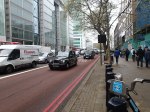





It’s a congested route and it involves at least one busy road crossing.
I had wondered if some sort of pedestrian over-bridge could be used with a moving pavement to link the two stations. But it would appear that layout of the buildings plonked in the front of Euston station would probably make this impossible.
Wikipedia does state that Network Rail devised plans in 2005 to link the two stations with a subway. This project seems to have sunk without trace.
The only thing that could possibly be done, is to put a lift to the street on the Northern side of the lines in Euston Square station, to improve access to the Eastbound platform.
I never walk between the two stations and to get to and from the station, I usually use a 30 or 73 bus, as the tube station underneath the mainline station is a dark warren of tunnels and escalators.
The trouble though with the buses, is they get stuck in the traffic on the Euston Road.
Why a proper connection between the two stations wasn’t incorporated, when they rebuilt Euston in the 1960s, only a genius of the level of Einstein could tell. But sadly he’s dead, so we’ll have to use the ouija board.
What puzzles me, is that how come the architects in the 1960s, could create two stations as bad as Manchester Piccadilly and Euston and yet leave Liverpool Lime Street as a properly working station! This section in Wikipedia offers a few clues.
Osborne Says Redevelop Euston Before HS2
There is an article in the Standard, where George Osborne says priority should be given to the redevelopment of Euston station, before HS2 is constructed.
I use the station several times a year and compared to Kings Cross, Liverpool Street, Paddington, Waterloo, Marylebone and St. Pancras, it is totally inadequate. It is even worse at the moment, than London Bridge, which is currently a building site.
What makes it so bad, is the lack of connection to the Circle line and the endless dingy walks from the other Tube lines to the station. There is no disabled access to the Underground.
There is a lot of scope to do this rebuilding right. These factors should be considered.
- The effect of the Croxley Rail Link to Watford Junction, which should be completed in 2017.
- Any development at Watford Junction, that could ease pressure on Euston.
- Could Willesden Junction be used to take passengers off the West Coast Main Line?
- Should an Old Oak Common station be built?
Properly planned, rebuilding of Euston,. adds a whole new dimension to HS2. It even questions whether HS2 terminates at Euston!
Could George Osborne’s view on Euston station be coloured, by his own personal experience and those of his constituents?
It doesn’t matter to me, as redeveloping Euston station is good sense, for all sorts of reasons!
Do We Need A Rolling HS2?
The report today by the think tank, the Institute of Economic Affairs, which says that HS2 will cost a lot more than is currently budgetted for. It’s all reported here on the BBC.
They make a lot of good points in the report.
Extra infrastructure such as trams and trains, will be needed to link other areas to the route.
Extra tunnels and other infrastructure will be needed to buy off the opposition.
The BBC summarises it like this.
The report said HS2 “and the add-on transport schemes will be heavily loss-making in commercial terms – hence the requirement for massive taxpayer support”.
As someone, who is very familiar with project management, I’ve always felt that the logic of HS2 and the way it is being implemented could and will be improved.
If we look at the current rail network, it has problems that will eventually be solved or helped by HS2.
Euston station is not fit for purpose and should be redeveloped and/or relieved. I favour a second terminus of the West Coast Main Line at Old Oak Common, as I mused here.
There are very severe capacity problems on the northern part of the West Coast Min Line between Wigan and Glasgow. This is not part of the current HS2, so perhaps it should be done to make sure the Scots get their connections to the South improved.
The East Coast Main Line to Leeds and Newcastle, has a notorious bottleneck at the Digswell Viaduct and according to this report on the BBC web site, it could be removed for under half a billion.
One problem that HS2 doesn’t solve is the bad connections across the north of England from Liverpool to Leeds and Hull. This BBC report includes an estimate of a billion plus.
So should we just define the route for HS2 and then break it into a series of manageable projects, that are implemented over the years.
We might design large stretches for say 300 kph, but most of the upgraded network would have limits of around 200 to 250 kph. Effectively large sections of the East and West Coast Main Lines can now handle 225 kph and just need resignalling.
The new Class 800 and Class 801 trains will be built to a design speed of 225 kph.
In some ways these trains may be the key to the whole of the expansion of high-speed services. I suspect, we’ll see them on London to Sheffield and Norwich for a start.
 The Anonymous Widower