SolarDuck, Green Arrow Capital And New Developments S.R.L. Sign Collaboration Agreement For A Grid-Scale Offshore Hybrid Wind-Solar Project In Italy
The title of this post, is the same as that of this press release from SolarDuck.
These three bullet points, act as sub-headings.
- 540 MW hybrid offshore wind-solar farm offshore Corigliano, Calabria
- Milestone project to accelerate scaling of Offshore Floating Solar Photovoltaic (OFPV)
- Strategic collaboration proves the potential of the technology in Italy and the wider
Mediterranean region
These three paragraphs outline the project.
SolarDuck, leader in OFPV technology, Green Arrow Capital, leading Italian Independent Asset
Manager in the alternative investment world, and New Developments s.r.l., one of Italy’s
most experienced developers, have agreed to collaborate on the development of a landmark
120MWp OFPV farm integrated with 420MW Floating Offshore Wind (FOW).The project will install SolarDuck’s unique elevated platform technology that allows PV panels
to be deployed in significant wave heights whilst maintaining a safe working environment for
access and maintenance and minimizing environmental impact. In addition, the collaboration
will also allow the harnessing of the complementarity of wind and solar energy resources.“With the current momentum, we believe this is a unique opportunity for the offshore
renewable energy industry to help shape a favorable regulatory framework and facilitate the
scaling of OFPV. This is not just important for Italy, but also for other countries in the
Mediterranean. Our collaboration with New Developments and Green Arrow Capital can also
serve as a catalyst for OFPV in Italy”, says SolarDuck CEO, Koen Burgers.
This Google Map shows the location of Corigliano at the foot of Italy.
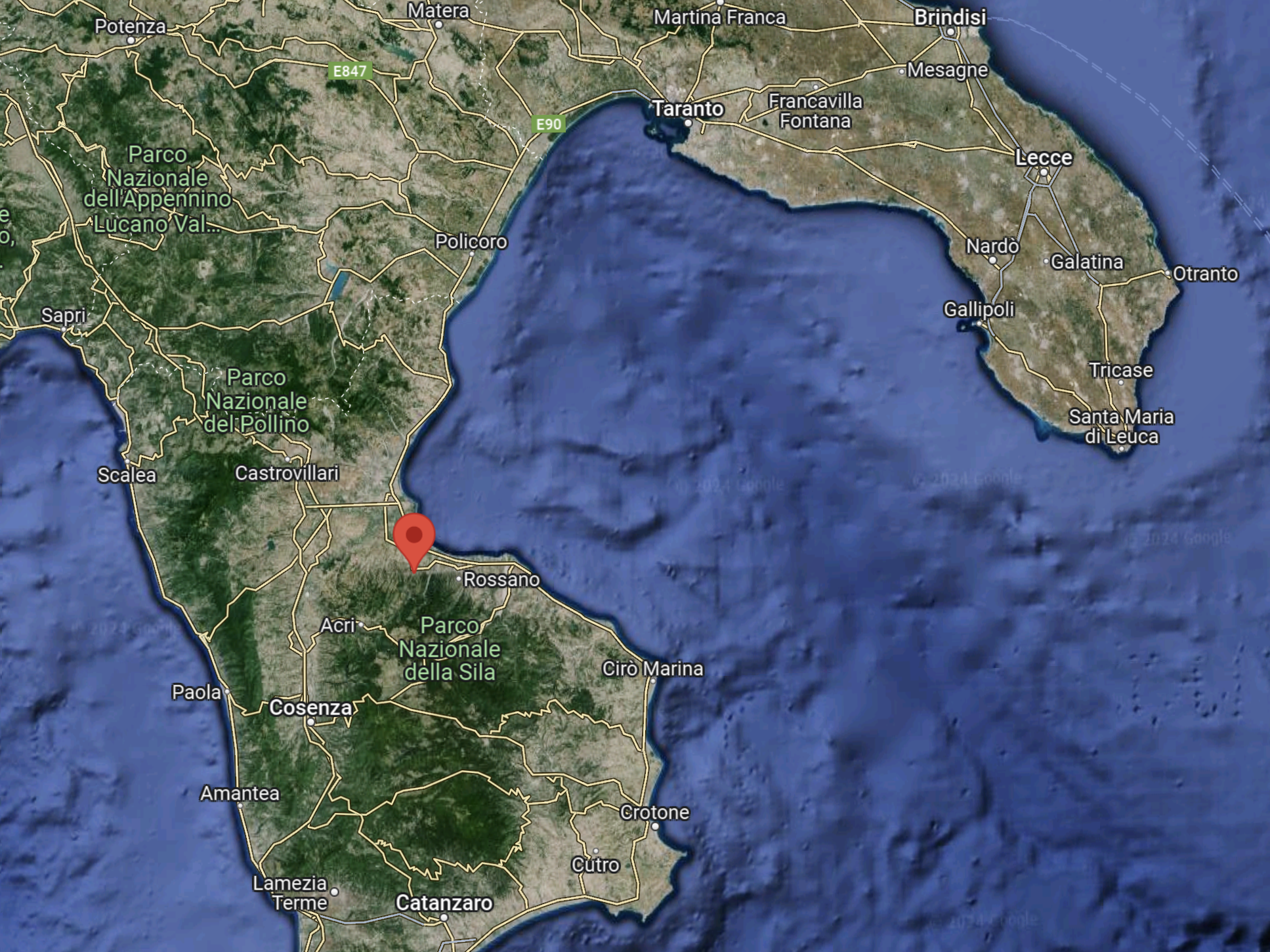
Note.
- Corigliano is indicated by the red arrow.
- There is an explanatory video of their technology on SolarDuck’s web site.
Opposite Corigliano on the other side of the can be seen the Italian Naval Base of Taranto, which was the scene of the Battle of Taranto, which was one of the most significant naval battles of Second World War, if not the most significant.
- This web page has the Fleet Air Arm’s account of the battle.
- I have a book, that shows the Japanese visiting Taranto after the battle.
- Did the Japanese use what they learned to plan their successful raid on Pearl Harbor?
- Without Pearl Harbor, would the Americans have stayed out of the Second World War?
I visited Taranto in the 1980s and stood on the Dockside. Perhaps, it is time to go again?
Conclusion
I have a feeling that a hybrid offshore wind-solar farm can generate more electricity in a given area, by making better use of the space available.
It will be interesting to see how this hybrid wind farm performs.
In an area with plenty of sun and wind, it could be a better solution.
Only the mathematics will tell.
UK Can Secure Record Number Of Offshore Wind Farms In This Year’s Auction For New Projects
The title of this post, is the same as that of this press release from RenewableUK.
The first five paragraphs, should be read as a whole and are a good summary of, where the UK is with offshore wind.
A new report published today by RenewableUK shows that the Government has an opportunity to secure a record number of new offshore wind farms, and record amount of new capacity, in this year’s summer’s auction for contracts to generate clean power (Contracts for Difference). In a huge boost to the UK’s energy security, the Government has the potential to double the country’s offshore wind capacity in this year’s auction alone.
RenewableUK’s latest EnergyPulse Insights Offshore Wind report reveals that 14 wind farms are already eligible to bid into this year’s CfD auction (Allocation Round 6), providing nearly 10.3 gigawatts (GW) of new capacity. The previous records were set in 2022 when 8.5GW was eligible across 7 projects.
In addition to this, a further 4.7GW of new offshore wind capacity (out of 8.7GW in the planning system) could become eligible before applications open for AR6 at the end of March. If these projects were to receive consent from the Government, 14.9GW of offshore wind capacity would be eligible for this year’s auction. The report notes that being eligible does not mean that projects will choose to bid in – but they have the potential to do so.
To put this 14.9GW of potential new capacity into context, we currently have 14.7GW of fully operational offshore wind which generates 14% of the UK’s entire electricity needs. Just one gigawatt of offshore wind generates enough electricity to power over a million British homes for a year.
The report also shows that a further 5.2GW are already under construction in UK waters, and it forecasts that nearly 45GW could be fully operational by the end of 2030.
It is certainly worth reading through to the last paragraph.
The press release also lists the projects eligible to bid into AR6.
- Norfolk Vanguard West and Norfolk Vanguard East (2,760MW) – RWE
- Hornsea Four (2,600MW) – Ørsted
- Awel y Môr (1,100MW) – RWE
- East Anglia Two (900MW) – Iberdrola
- East Anglia One North (800MW) – Iberdrola
- Hornsea Three (753.1MW) – Ørsted
- Seagreen 1A (500MW) – SSE Renewables, TotalEnergies
- East Anglia Three (318MW) – Iberdrola
- Inch Cape (270MW) – Inch Cape Offshore
- Pentland (floating project) (100MW) – Highland Wind Limited
- Erebus (floating project) (100MW)
- Blyth 2 (floating project) (58MW)
- Forthwind (test and demonstration site) (8MW) – Forthwind Limited
These make a total of 10,267MW
Currently, as I write this the UK is generating 29 GW, so 45 GW with a lot of energy storage, should be enough to power the country.
World’s First Semi-Submersible Floating Offshore Wind Farm Smashes Predictions
The title of this post, is the same as that of this article on offshoreWIND.biz.
This is the sub-heading.
WindFloat Atlantic, the world’s first semi-submersible floating offshore wind farm, has completed its third year in operation, closing in 2023 with an electricity production of 80 GWh.
These four paragraphs outline the performance of the wind farm.
Connected to the grid by the end of 2019 and fully commissioned in 2020, the floating offshore wind farm was developed by the Windplus consortium formed by Ocean Winds, a 50:50 joint venture between EDPR and ENGIE, Repsol, and Principle Power.
The pioneer wind farm consists of three platforms, each supporting one 8.4-MW Vestas turbine, which are anchored with chains to the seabed and connected to the onshore substation in the Portuguese municipality of Viana do Castelo through a 20-kilometre cable.
According to the project’s owners and operators, the 25 MW WindFloat Atlantic also closed in 2023 breaking more records with Storm Ciaran posing challenges with waves reaching a maximum height of 20 metres and wind gusts up to 139 kilometres per hour.
These conditions far surpassed the project’s previous records, demonstrating the readiness and robustness of the floating technology, even in extreme offshore conditions.
It would appear that this and the previous post; France’s First And Only Operational Floating Wind Turbine Gets Lifetime Extension, are not only indicating that floating wind power works, but that it works well in all types of conditions.
France’s First And Only Operational Floating Wind Turbine Gets Lifetime Extension
The title of this post, is the same as that of this article on offshoreWIND.biz.
This is the sub-heading.
Floatgen, the demonstration floating wind turbine installed at the SEM-REV offshore test site in France, has completed its planned five-year run but will operate for another five years as the demo project was decided to get a lifetime extension.
These are the first three paragraphs.
The floater, which consists of a 2 MW Vestas V80 wind turbine mounted on BW Ideol’s Damping Pool foundation, reached electricity production milestones several times since going into full operation in September 2018.
According to BW Ideol, Floatgen’s cumulated production has now surpassed 30 GWh, which the company ascribes to “the hydrodynamic properties and excellent sea-keeping capabilities” of its floating foundation.
Floatgen’s availability averaged 92.18 per cent between January 2021 and January 2024, with December 2023 standing out with a monthly production record of 922.026 MWh and a 61.96 per cent capacity factor, BW Ideol says.
Note.
- A three-year availability average of 92.18 % is surely very good.
- A 61.96 % capacity factor is better than most other floating wind farms, which are generally in the fifties.
With those figures, I suspect BW Ideol will be expecting, some orders soon.
This video shows a Floatgen being constructed.
BlueFloat, Renantis And Ørsted Move Forward With 1 GW Scottish Floater
The title of this post, is the same as that of this article on offshoreWIND.biz.
This is the sub-heading.
Stromar Offshore Wind Farm Limited, a joint venture between Ørsted, BlueFloat Energy, and Renantis, has submitted the environmental impact assessment (EIA) scoping and habitats regulations appraisal (HRA) screening reports for the 1 GW floating offshore wind farm in Scotland.
These are the first three paragraphs, which outline the progress that has been made so far.
The reports for the project, which is located approximately 50 kilometres from the Port of Wick, were delivered to the Marine Directorate and Aberdeenshire Council.
The EIA scoping reports outline the plans for the development, addressing both onshore and offshore considerations while the HRA screening reports outline the key protected sites and species of relevance to the Stromar development area. The HRA screening reports also present how impacts will be assessed in more detail at the next stage, the developer said.
The project team will now schedule several community consultation events in Spring 2024 to ensure stakeholders are fully informed and that their views are considered in the site selection, design, and development of the project, according to the developer.
This map shows the various ScotWind leases.

Note.
- The numbers are Scotwind’s lease number in their documents.
- 10 is now Stromar
- This is the Stromar web site.
- One of the partners; Falck Renewables changed its name to Renantis in 2022.
- The next stage is to be awarded a Contract for Difference.
The Internet is suggesting a completion date of 2028.
Funding Announced For First-In-Class Low-Carbon Installation Vessel For Floating Offshore Wind
The title of this post, is the same as that of this news item from Morek Engineering.
These two paragraphs outline the project.
The UK Government has awarded funding to a consortium led by Morek Engineering to design a new class of low-carbon installation vessel for the floating offshore wind market.
The consortium has won the funding through the UK Government’s Clean Maritime Demonstration Competition based on their proven track record in innovative vessel design and delivery of complex offshore operations. The consortium includes Morek Engineering, Solis Marine Engineering, Tope Ocean, First Marine Solutions and Celtic Sea Power.
Note.
- The design of the ship certainly seems to tick all the boxes.
- This is Morek’s web site.
Because of my experience of writing project management systems, I often wonder, whether some of my discarded ideas of the 1980s could be used in the deployment of floating offshore wind.
World’s First Floating Wind Farm To Undergo First Major Maintenance Campaign, Turbines To Be Towed To Norwegian Port
The title of this post, is the same as that of this article on offshoreWIND.biz.
This is the sub-heading.
The world’s first commercial-scale floating wind farm, the 30 MW Hywind Scotland, officially entered the operations and maintenance (O&M) phase in October 2017. After a little over six years of operation, the wind farm’s Siemens Gamesa wind turbines are now due for some major maintenance work.
And this is the first paragraph.
While offshore wind farms undergo turbine maintenance work more than once during their lifespans and tasks such as major component exchange are nothing uncommon, this is the first time a campaign of this kind will be done on a floating farm.
Hywind Scotland has a web site, where this is said on the home page.
The world’s first floating wind farm, the 30 MW Hywind Scotland pilot park, has been in operation since 2017, demonstrating the feasibility of floating wind farms that could be ten times larger.
Equinor and partner Masdar invested NOK 2 billion to realise Hywind Scotland, achieving a 60-70% cost reduction compared with the Hywind Demo project in Norway. Hywind Scotland started producing electricity in October 2017.
Each year since Hywind Scotland started production the floating wind farm has achieved the highest average capacity factor of all UK offshore windfarms, proving the potential of floating offshore wind farms.
This news item from Equinor is entitled Equinor Marks 5 Years Of Operations At World’s First Floating Wind Farm, says this about the capacity factor of Hywind Scotland.
Hywind Scotland, located off the coast of Peterhead, Scotland, is the world’s first floating offshore wind farm and the world’s best-performing offshore wind farm, achieving a capacity factor of 54% over its five years of operations. Importantly, Hywind Scotland has run to high safety standards, marking five years of no loss time injuries during its operation.
Any capacity factor over 50 % is excellent and is to be welcomed.
Maintaining A Floating Wind Farm
One of the supposed advantages of floating wind farms, is that the turbines can be towed into port for maintenance.
This first major maintenance of a floating wind farm, will test that theory and hopefully provide some spectacular pictures.
UK Offshore Wind In 2030
With the election coming up in the next year, I thought I’d add how much offshore wind will be available in the next few years.
In October 2023, according to this Wikipedia entry, there were offshore wind farms consisting of 2,695 turbines with a combined capacity of 14,703 megawatts.
These wind farms are due to be commissioned between now and the end of 2030.
- Dogger Bank A – 1235 MW – 2023
- Neart Na Gaoithe – 450 MW – 2024
- Dogger Bank B – 1235 MW – 2024
- Forthwind – 12 MW – 2024
- Moray West – 882 MW – 2025
- Dogger Bank C – 1218 MW – 2025
- Sofia Offshore Wind Farm – 1400 MW – 2026
- East Anglia 3 – 1372 MW – 2026
- East Anglia One North – 800 MW – 2026
- East Anglia Two – 900 MW – 2026
- Pentland – 100 MW – 2026 – Floating
- Hornsea Three – 2852 MW – 2027
- Norfolk Boreas, Phase 1 – 1380 MW – 2027
- Llŷr 1 – 100 MW – 2027 – Floating
- Llŷr 2 – 100 MW – 2027 – Floating
- Whitecross – 100 MW – 2027 – Floating
- Morecambe – 480 MW – 2028
- Bellrock – 1200 MW – 2028 – Floating
- Mona – 1500 MW – 2029
- Morgan – 1500 MW – 2029
- West of Orkney – 2000 MW – 2029
- Rampion 2 Extension – 1200 MW – 2030
- Norfolk Vanguard East – 1380 MW – 2030
- Morven – 2907 MW – 2030
- Norfolk Vanguard West – 1380 MW – 2030
- Berwick Bank – 4100 MW – 2030
- Outer Dowsing – 1500 MW – 2030
- Broadshore – 900 MW – 2028 – Floating
- Caledonia – 2000 MW – 2030
- Stromar – 1000 MW – 2028 – Floating
- N3 Project – 495 MW – 2030
- Muir Mhòr – 798 MW – 2030 – Floating
- North Falls – 504 MW – 2030
- Spiorad na Mara – 840 MW – 2031
- Bowdun – 1008 MW – 2033
- Ayre – 1008 MW – 2033 – Floating
- Buchan – 960 MW – 2033 – Floating
These can give these totals for the next few years.
- 2023 – 14.70 GW
- 2024 – 17.64 GW
- 2025 19.74 GW
- 2026 – 24.31 GW
- 2027 – 28.81 GW
- 2028 – 32.39 GW
- 2029 – 37.39 GW
- 2030 – 53.65 GW
- 2031 – 54.50 GW
- 2032 – 54.50 GW
- 2033 – 57.47 GW
Note.
- The Government’s 50 GW target of offshore wind power by 2030 has been achieved.
- A total of 7.27 GW of floating wind power has been installed.
- The Government’s target of 5 GW of floating offshore wind power by 2030 has also been achieved.
Currently, the UK is generating 37.49 GW of electricity.
Aker Solutions To Pilot Floating-Wind Power Hub
The title of this post, is the same as that of this press release from Aker Solutions.
This is the sub-heading.
Aker Solutions to pilot world’s first subsea power distribution system for floating offshore wind at Norway´s METCentre
These four paragraphs describe the system and explain how it works.
Note.
Aker Solutions has signed a front-end engineering and design (FEED) contract with the Marine Energy Test Centre (METCentre) in Norway to pilot new subsea power system technology which has the potential to significantly reduce the costs and complexity of offshore wind farms.
The project will see Aker Solutions provide new power transmission technology, Subsea Collector, for the METCentre’s offshore wind test area which today consists of two floating offshore wind turbines located 10 kilometers off the southwestern coast of Karmøy, Norway. The test area will expand to seven floating offshore wind turbines from 2026.
Subsea Collector provides an alternative solution to connect multiple wind turbines electrically in a star configuration instead of the traditional daisy chain pattern, allowing for more flexibility in offshore wind farm architecture and construction. The design also allows for reduced cable length per turbine and park, as well as less vessel time and installation costs. Initial findings support total cost savings on a 1GW floating wind farm of up to 10 percent.
The main component parts of the Subsea Collector comprise a 66kV wet mate connection system provided by Benestad and subsea switchgear with supervisory control and data acquisition by subsea power and automation alliance partner, ABB. Installation will be carried out by Windstaller Alliance, an alliance between Aker Solutions, DeepOcean and Solstad Offshore. Aker Solutions will also provide the static export cable to shore.
Total cost savings of ten percent on any large project are not to be sneezed at.
I also feel that this sort of architecture will be ideal for a test centre, where configurations are probably changed more often.
The Invisible £20 Billion North Sea Project
I introduced Cerulean Winds in the two posts What Is INTOG? and Cerulean Winds Is A Different Type Of Wind Energy Company.
They have now expanded their page on the North Sea Renewables Grid.
It is well worth a look!
 The Anonymous Widower