World’s First Semi-Submersible Floating Offshore Wind Farm Tops Production Expectations
The title of this post, is the same as that of this article on offshoreWIND.biz.
This is the sub-heading.
In its four years of operation, the world’s first semi-submersible floating offshore wind farm, WindFloat Atlantic, has surpassed anticipated production figures, achieving a total cumulative output of 320 GWh.
These first three paragraphs give more detail.
Connected to the grid by the end of 2019 and fully commissioned in 2020, the floating offshore wind farm was developed by the Windplus consortium formed by Ocean Winds, a 50:50 joint venture between EDPR and ENGIE, Repsol, and Principle Power.
The pioneer wind farm consists of three platforms, each supporting one 8.4-MW Vestas turbine, which are anchored with chains to the seabed and connected to the onshore substation in the Portuguese municipality of Viana do Castelo through a 20-kilometre cable.
It has been reported that the project’s electricity production has steadily increased each year, reaching 78 GWh in 2022 and 80 GWh in 2023.
It certainly appears that floating wind power, is living up to and above its expectations.
There Are Only Three Large Offshore Wind Farms In Contracts for Difference Allocation Round 6
This document from the Department of Business, Industry and Industrial Strategy lists all the Contracts for Difference Allocation Round 6 results for the supply of zero-carbon electricity.
The wind farms are.
- Green Volt – 400 MW – Floating – Claims to be “The first commercial-scale floating offshore windfarm in Europe”.
- Hornsea Four – 2,400 MW – Fixed – Ørsted
- East Anglia Two – 963 MW – Fixed – Iberdrola
Is this what misgovernment expected, when they raised the budget in July 2024, as I wrote about in UK Boosts Sixth CfD Auction Budget, Earmarks GBP 1.1 Billion For Offshore Wind.
Perhaps, some developers held back until government policy is clearer?
Global Offshore Wind To Top 520 GW By 2040, Floating Wind To Play Major Role – Rystad Energy
The title of this post, is the same as that of this article on offshoreWIND.biz.
This is the sub-heading.
According to Rystad Energy, global offshore wind capacity will surpass 520 GW by 2040, with floating wind installations nearing 90 GW by that time
These are the first three paragraphs.
In 2023, the offshore wind sector saw a seven per cent increase in new capacity additions compared to the previous year, said Rystad Energy. This momentum is expected to accelerate this year, with new capacity additions expected to grow by nine per cent to over 11 GW by the end of the year.
By 2040, Europe is expected to account for more than 70 per cent of global floating wind installations. Although some project delays beyond 2030 are anticipated, there will likely be a strong push to accelerate deployment, according to Rystad Energy.
As a result, floating wind capacity is projected to approach 90 GW by 2040, led by the UK, France, and Portugal, with Asia (excluding mainland China) expected to account for 20 per cent of global installations.
Note, that Rystad Energy is an independent energy research and business intelligence company headquartered in Oslo, Norway.
Implications For Energy Storage
In Grid Powers Up With One Of Europe’s Biggest Battery Storage Sites, I talk about how the 2.9 GW Hornsea Three wind farm will have a connection to the grid, that incorporates a 300 MW/600 MWh battery.
With 520 GW of offshore wind to be installed by 2040, I suspect that energy storage companies and funds will do well.
If the 520 GW of offshore wind were fitted with batteries like the 2.9 GW Hornsea Three wind farm, there would be a need for around 60 GW of battery output, with a capacity of around 120 GWh.
I doubt, there would be enough lithium for all those batteries.
Some countries like Norway, the United States, Australia, France, Spain, Japan, India, China and others will be able to develop large pumped storage hydroelectricity systems, but others will have to rely on newer, developing technologies.
The UK will be well-placed with around 80 GWh of pumped storage hydroelectricity under development and several promising developing storage technologies.
UK Company Unveils Mooring Solution For Floating Offshore Wind
The title of this post, is the same as that of this article on offshoreWIND.biz.
This is the sub-heading.
UK-based Blackfish Engineering has unveiled a mooring system, called C-Dart, which eliminates the direct handling of heavy mooring lines by operational personnel. The system is designed to rapidly connect various floating structures and assets, including wave and tidal energy converters, offshore wind, floating solar platforms, aquaculture, and more, according to the company.
These three paragraphs give a few details.
By utilising the principles of gravity, buoyancy, and rope tension, the C-Dart system facilitates a contact-free, automated connection process that secures equipment securely and swiftly, Blackfish said.
The system’s rapid connect and disconnect capability is said to cut down the time typically required for offshore operations which is vital in reducing the overall operational costs and downtime, particularly in the high-stakes environment of renewable energy projects.
Constructed from high-tensile, corrosion-resistant materials, the C-Dart system could withstand harsh oceanic environments, extending its service life while minimising maintenance requirements.
There is also this excellent video.
These are my thoughts.
The Companies Involved
The companies, organisations involved are listed on the C-Dart product page.
Skua Marine Ltd, Morek Ltd, Flowave, Underwater Trials Centre, Offshore Simulation Centre, National Decommissioning Centre, Bureau Veritas, Queen Mary University, The Waves Group, KML, Alex Alliston, Arnbjorn Joensen
Note.
- Blackfish Engineering are in Bristol.
- Bureau Veritas is a French company specialized in testing, inspection and certification founded in 1828.
- Queen Mary University is in London.
- The Underwater Trials Centre is in Fort William.
- The National Decommissioning Centre is in Aberdeen.
- The Offshore Simulation Centre, is in Norway.
Funding came from the Scottish Government.
Good Design And Improved Safety
It does look in this product that good design and improved safety go together.
Conclusion
This peoduct could be a real winner.
UK’s First Offshore Hydrogen Production Trials Kick Off in South Wales
The title of this post, is the same as that of this article on offshoreWIND.biz.
This is the sub-heading.
After six years of development, sustainability consultancy ERM has launched offshore trials to test its Dolphyn Hydrogen process which combines electrolysis, desalination, and hydrogen production on a floating wind platform, marking the first time hydrogen has been produced from seawater in a marine environment in the UK.
These are the first three paragraphs.
The trials conducted in Pembroke Port, South Wales, through July 2024 are said to represent an important step forward in enabling the UK to produce low-carbon hydrogen safely, reliably, and at scale.
In ERM’s Dolphyn Hydrogen process, hydrogen is transported to shore via a pipeline and it can be used directly for power generation, transport, industrial purposes, and heating.
The development of the Dolphyn Hydrogen process has been supported by the UK Government’s Department for Energy Security and Net Zero, through the Low Carbon Hydrogen Supply 2 Competition in the GBP 1 billion (approximately USD 1.2 billion) Net Zero Innovation Portfolio (NZIP). It has been awarded funding of over GBP 8 million (about USD 10.13 million) to date and has also been championed by devolved Governments in Wales and Scotland.
There’s more about Dolphyn Hydrogen on their web site.
Conclusion
This self-contained floating hydrogen factory could be very useful operating either singly or as a small fleet.
It would help if Dolphyn Hydrogen disclosed some hydrogen production capacities.
This is said in a press release.
The pilot project at Vattenfall’s Offshore Wind Farm in Aberdeen Bay will have an output of 8.8MW and will be able to produce enough hydrogen every day to power a hydrogen bus to travel 24,000km.
That looks about right.
I shall be following Dolphyn Hydrogen.
UK Offshore Wind In 2030 – Calculated June 2024
The next general election is likely to be held in 2029, so how much wind energy will be added during the next Parliament?
The Current Position
The Wikipedia entry for the list of operational wind farms in the UK, says this.
In October 2023, there were offshore wind farms consisting of 2,695 turbines with a combined capacity of 14,703 megawatts.
Due To Be Commissioned In 2024
It would appear these wind farms will come on-line in 2024.
- Neart Na Gaoithe – 450 MW – Fixed
- Doggerbank A – 1235 MW – Fixed
- Doggerbank B – 1235 MW – Fixed
This would add 2920 MW to give a total of 17,623 MW.
Due To Be Commissioned In 2025
It would appear these wind farms will come on-line in 2025.
- Moray West – 882 MW – Fixed
- Doggerbank C – 1218 MW – Fixed
This would add 2100 MW to give a total of 19,723 MW.
Due To Be Commissioned In 2026
It would appear these wind farms will come on-line in 2026.
- Sofia – 1400 MW – Fixed
- East Anglia 3 – 1372 MW – Fixed
- East Anglia 1 North – 800 MW – Fixed
- East Anglia 2 – 900 MW – Fixed
- Pentland – 100 MW – Floating
This would add 4572 MW to give a total of 24,295 MW.
Due To Be Commissioned In 2027
It would appear these wind farms will come on-line in 2027.
- Hornsea 3 – 2852 MW – Fixed
- Norfolk Boreas – 1380 MW – Fixed
- Llŷr 1 – 100 MW – Floating
- Llŷr 2 – 100 MW – Floating
- Whitecross – 100 MW – Floating
This would add 4532 MW to give a total of 28,827 MW.
Due To Be Commissioned In 2028
It would appear these wind farms will come on-line in 2028.
- Morecambe – 480 MW – Fixed
This would add 480 MW to give a total of 29,307 MW.
Due To Be Commissioned In 2029
It would appear these wind farms will come on-line in 2029.
- West Of Orkney – 2000 MW – Fixed
This would add 2000 MW to give a total of 31,307 MW.
Due To Be Commissioned In 2030
It would appear these wind farms will come on-line in 2030.
- Ramplion 2 Extension – 1200 MW – Fixed
- Norfolk Vanguard East – 1380 MW – Fixed
- Norfolk Vanguard West – 1380 MW – Fixed
- Awel y Môr – 1100 MW – Fixed
- Berwick Bank – 4100 MW – Fixed
- Outer Dowsing – 1500 MW – Fixed
- Hornsea 4 – 2600 MW – Fixed
- Caledonia – 2000 MW – Fixed
- N3 Project – 495 MW – Fixed/Floating
This would add 15755 MW to give a total of 47.062 MW.
Capacity Summary
- 2023 – None – 14703 MW
- 2024 – 2920 MW – 17,623 MW
- 2025 – 2100 MW – 19,723 MW
- 2026 – 4572 MW – 24,295 MW
- 2027 – 4532 MW- 28,827 MW
- 2028 – 480 MW – 29,307 MW
- 2029 – 2000 MW – 31,307 MW
- 2030 – 15755 MW – 47,062 MW
Note that capacity has increased more than threefold.
If we assume the following.
- New wind farms are commissioned throughout the year.
- 14,703 MW of wind power, with all our gas-fired, nuclear and onshore wind farms is enough to power the UK.
- The average capacity factor is 45 %.
- The strike price is £35/MWh.
The levels I have set are deliberately on the low side.
The amount of energy and cash flow generated by new wind farms in a year can be calculated as follows.
{Average New Capacity In Year}= ({Capacity at Year Start}+{Capacity at Year End})/2-14703
{Extra Electricity Generated In Year}= {Average New Capacity In Year}*365*24*{Capacity Factor}
{Cash Flow}={Extra Electricity Generated In Year} * {Strike Price}
The following figures are obtained.
- 2024 – 1460 MW – 5,755,320 MWh – £ 201,436,200
- 2025 – 3970 MW – 15,649,740 MWh – £ 547,740,900
- 2026 – 7306 MW – 28,800,252 MWh – £ 1,008,008,820
- 2027 – 11858 MW – 46,744,236 MWh – £ 1,636,048,260
- 2028 – 14,364 MW – 56,622,888 MWh – £ 1,981,801,080
- 2029 – 15,604 MW – 61,510,968 MWh – £ 2,152,883,880
- 3030 – 23,931.5 MW – 94,337,973 MWh – £ 3,301,829,055
Nate.
- The first column is the cumulative amount of new capacity about the 14,703 MW in December 2023.
- The second column is the extra electricity generated in the year over December 2023.
- The third column is the extra cash flow in the year over December 2023.
As the installed base of wind farms increases, the cash flow increases.
It should also be noted that there are a large number of wind farms, already pencilled in for 2031-2035.
What Will We Do With All This Extra Electricity?
We need more industries that will consume a lot of electricity, like cement, chemicals and steel.
But I suspect that the easiest thing to do, is to convert the excess electricity to hydrogen and export it to the Continent and especially the Germans by pipeline or tanker.
Conclusion
Whoever wins this year’s General Election, should have a growing source of revenue for the life of the parliament and beyond.
TetraSpar Demonstrator Floating Wind Turbine Hits 63 Pct Capacity Factor In Norway
The title of this post, is the same as that of this article on offshoreWIND.biz.
This is the sub-heading.
Stiesdal has revealed that its TetraSpar Demonstrator, located in Norway, has reached a capacity factor of 63 per cent.
These three paragraphs give a few more details.
Since its commissioning in late 2021, the TetraSpar Demonstrator has been operational at METCentre in Norway, delivering green energy, gathering data, validating numerical models, supporting research and development projects, and serving as a living laboratory for the development of floating wind technology, said Stiesdal in a recent social media post.
To date, the demonstrator has generated more than 37 GWh of renewable energy, according to the company. The 3.6 MW Siemens Gamesa direct-drive wind turbine and very high wind speeds at the METCentre site combined to yield a capacity factor of 54 per cent, said Stiesdal.
In the first two years of operation, the availability was recorded at 97 per cent and 98.3 per cent, respectively. For 2024, the availability has increased to 99.5 per cent with a capacity factor of almost 63 per cent, according to the company.
I have some further thoughts.
Tetra Offshore Foundations For Any Water Depth
The title of this section, is the same as that of this page on the Siesdal web site.
The page gives a lot of information and says that the TetraSpar can handle water depth of over a thousand metres.
Wind Farm Capacity Factor
The Wikipedia entry for capacity factor says this about the range of wind farm capacity factors.
Wind farms are variable, due to the natural variability of the wind. For a wind farm, the capacity factor is determined by the availability of wind, the swept area of the turbine and the size of the generator. Transmission line capacity and electricity demand also affect the capacity factor. Typical capacity factors of current wind farms are between 25 and 45%. In the United Kingdom during the five year period from 2011 to 2019 the annual capacity factor for wind was over 30%.
From that paragraph, 63 % seems to be extraordinarily good.
Conclusion
The TetraSpar appears to be a powerful concept.
Redevelopment Of Scottish Port Begins As Owner Secures GBP 400 Million For Offshore Wind Upgrade
The title of this post, is the same as that of this article on offshoreWIND.biz.
This is the sub-heading.
Haventus, the owner of the Ardersier Port in the Moray Firth, Scotland, has taken a final investment decision and kicked off construction work on redeveloping the port to serve both fixed-bottom and floating offshore wind projects. The revamped port is expected to open in the second half of 2025.
These are the first two paragraphs.
This month, Haventus was granted a GBP 100 million (approximately 117 million) joint credit facility from the Scottish National Investment Bank and UK Infrastructure Bank with GBP 50 million (approx. EUR 58.5 million) investment from each.
This follows a GBP 300 million (approx. 351 million) investment commitment by the energy investment firm Quantum Capital Group in 2023 when Haventus began the redevelopment of Ardersier Port.
This page on the Haventus web site, gives more details of the Port of Ardersier.
Included are.
- Access channel width – 160 m.
- Access channel depth – 12.4 m.
- Landside area – 350 acres.
- 420m main quay.
- 80 m Ro/Ro capable berth.
- People-friendly midges
- Green Freeport tax site designation
- More space is available if required.
There is also an informative video.
Haventus say they are delivering a world-leading energy transition facility. I can go along with that!
These are my thoughts.
The Location Of The Port of Ardersier
This Google Map shows the location of the Port of Ardersier.
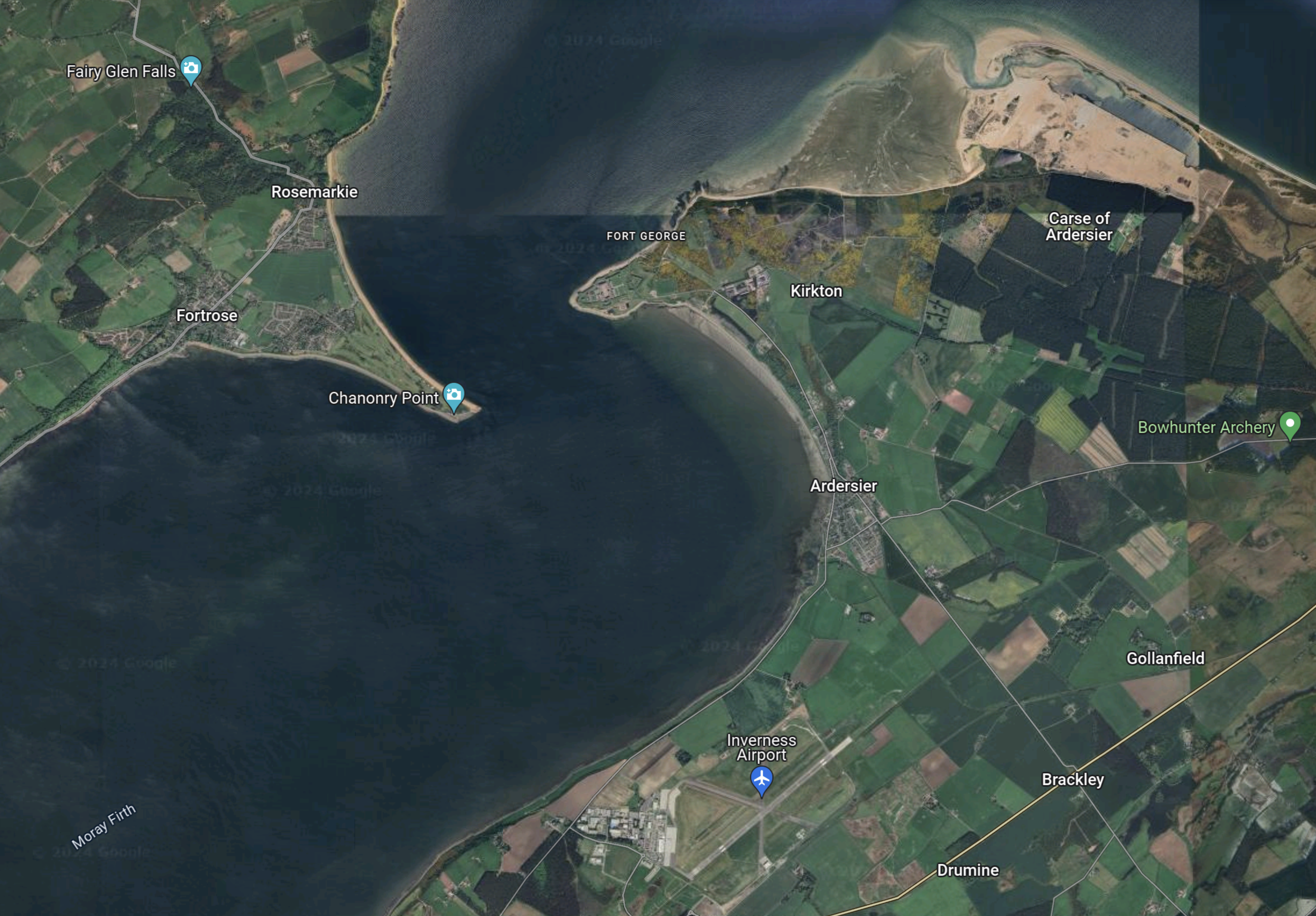
Note.
- The large expanse of water in the middle of the map is Moray Firth.
- The blue arrow at the bottom of the map indicates Inverness Airport.
- Inverness Airport, has a railway station on the Aberdeen and Inverness Line.
- The village of Ardersier is on the the Eastern bank of the Moray Firth
- The Port of Ardersier is in the North-East corner of the map.
The city of Inverness, with a population of around 48,000, is a few miles South-West of the South-West corner of the map.
Which Windfarms Will Be Built And Serviced From The Port Of Ardersier?
This map shows the various ScotWind leases, around the North of Scotland.

The numbers are Scotwind’s lease number in their documents.
These are the Scotwind wind farms to the North-East of Scotland, that could reasonably be assumed to be built and served from the Port of Ardersier.
- 7 – DEME Concessions Wind – 200 km² – 1.0 GW – Floating
- 8 – Falck Renewables Wind – 256 km² – 1.0 GW – Floating
- 9 – Ocean Winds – 429 km² – 1.0 GW – Fixed
- 10 – Falck Renewables Wind – 134 km² – 0.5 GW – Floating
- 11 – Scottish Power Renewables – 684 km² – 3.0 GW – Floating
- 12 – BayWa r.e. UK – 330 km² – 1.0 GW – Floating
These are the Scotwind wind farms to the North-West of Scotland, that could reasonably be assumed to be built and served from the Port of Ardersier.
- 13 – Offshore Wind Power – 657 km² – 2.0 GW – Fixed or Floating
- 14 – Northland Power – 390 km² – 1.5 GW – Floating
- 15 – Magnora – 103 km² – 0.5 GW – Floating
- 16 – Northland Power – 161 km² – 0.8 GW – Floating
These ten wind farms add up to 12.3 GW.
Transport
Consider.
- Obviously, heavy components will be brought in by sea, using the Ro/Ro capable berth or using a crane to unload a barge.
- Personnel will be able to fly in for the day.
- Will some visitors rom London use the Caledonian Sleeper to and from Inverness station to get a full day on site and a good night’s sleep, whilst travelling.
But I do see a problem with local traffic to and from the site.
Hydrogen Buses
This page on the Sizewell C web site, discusses how they will use hydrogen buses.
I could see the Port of Ardersier taking a leaf out of Sizewell C’s book and run hydrogen buses to Inverness, Inverness Airport and other nearby towns.
The North of Scotland certainly won’t be short of green hydrogen to power the buses.
Hydrogen
Conclusion
If you thought that the only useful wind-driven thing to come out of Scotland was bagpipes, you had better think again.
The Port of Ardersier will be the factory and operation and maintenance port for one of the largest offshore wind industries in the world.
Ørsted, Simply Blue, Subsea7 Submit Application For 100 MW Scottish Floating Wind Farm
The title of this post, is the same as that of this article on offshoreWIND.biz.
This is the sub-heading.
Ørsted, Simply Blue Group and Subsea7, through their joint venture partnership in Scotland, have submitted an offshore consent application for the proposed 100 MW Salamander floating offshore wind farm, one of the 13 projects selected in Scotland’s Innovation and Targeted Oil and Gas (INTOG) leasing round.
The article starts with a map that shows the location of the Salamander floating offshore wind farm and it shows how the sea is getting very crowded 35 kilometres off Peterhead.
This map shows the various ScotWind leases, around the North of Scotland.
The numbers are Scotwind’s lease number in their documents.
These are the Scotwind wind farms to the North-East of Scotland.
- 1 – BP Alternative Energy Investments – 859 km² – 2.9 GW – Fixed
- 2 – SSE Renewables – 859 km² – 2.6 GW – Floating
- 3 – Falck Renewables Wind – 280 km² – 1.2 GW – Floating
- 4 – Shell – 860 km² – 2.0 GW – Floating
- 5 – Vattenfall – 200 km² – 0.8 GW – Floating
- 6 – DEME – 187 km² – 1.0 GW – Fixed
- 9 – Ocean Winds – 429 km² – 1.0 GW – Fixed
- 10 – Falck Renewables Wind – 134 km² – 0.5 GW – Floating
- 11 – Scottish Power Renewables – 684 km² – 3.0 GW – Floating
- 12 – BayWa r.e. UK – 330 km² – 1.0 GW – Floating
Note.
- Salamander is located to the South of wind farms 10, 11 and 12 and to the North-West of wind farm 5.
- These windfarms total up to 16 GW.
- 4.9 GW are fixed foundation wind farms.
- 11.1 GW are floating wind farms.
These are my thoughts.
The Salamander Project
In the big scheme of things, the 100 MW Salamander wind farm, is rather a tiddler of a wind farm.
On the Salamander wind farm web site, a section gives the Project Goals.
- Our innovative pre-commercial stepping-stone concept will use novel floating foundations to (i) maximise Scottish content, (ii) enable the Scottish supply chain to gear up for the future floating offshore wind commercial opportunities in ScotWind and (iii) reduce the financial, environmental and technology risks of floating offshore wind.
- The Salamander project will contribute to the Scottish Government and UK Government net-zero targets. The project can contribute to the Scottish government’s target of 11 GW of installed offshore wind by 2030, as well as the UK government’s target of 5 GW of operational floating offshore wind by the same date.
- We are dedicated to developing a sustainable and transformative project, working with the oceans, and enabling communities to benefit from Project Salamander. Therefore, we commit to having a continuous and strong stakeholder and community engagement.
It appears to me, that the Salamander project will be a pathfinder for the 11.1 GW of floating wind farms to be built off Peterhead.
Bringing The Electricity South
National Grid are building four interconnectors between Eastern Scotland and Eastern England.
- Eastern Green Link 1 – Torness and Hawthorn Pit
- Eastern Green Link 2 – Peterhead and Drax
- Eastern Green Link 3 – Westfield and Lincolnshire
- Eastern Green Link 4 – Peterhead and Lincolnshire
Note.
- All interconnectors are 2 GW.
- All interconnectors are offshore for a long part of their route.
- It also appears that National Grid are burying much of the onshore sections.
But the 4 GW of interconnectors will only be able to bring a quarter of the offshore electricity generated in the Peterhead area to the South.
What Will Happen To The Excess Electricity?
Consider.
- There could be 16 GW of planned offshore wind power around Peterhead and North-East Scotland.
- There is only 4 GW of interconnector capacity between Peterhead and Eastern England.
- There is another 6.8 GW of electricity around North-West Scotland.
- There is 2.8 GW of electricity being developed to the East of Shetland.
- The Crown Estate is thinking of increasing the size of some offshore wind farms.
It is likely, that other wind farms will be built in the seas around the North of Scotland.
It appears that the North of Scotland could have at least 20 GW of excess electricity.
Possible solutions would include.
- Developing energy intensive industries like metal refining.
- More interconnectors to Denmark, England, Ireland and Norway.
- Storage of the electricity in giant pumped storage hydroelectric power stations.
- Creation of green hydrogen for export.
Note.
- Aluminium refining has been developed in the North of Scotland before.
- More interconnectors are a possibility, especially as Scotland is developing cable manufacturing capacity.
- Some maps show extra interconnectors between West Scotland and Merseyside.
- At least 70 GWh of pumped storage hydroelectric power stations are being developed along the Great Glen.
- I suspect that the pumped storage hydroelectric power stations could be connected to the wind farms, by cables under the waters of Loch Ness.
But surely, production of green hydrogen for export would be a very good way to go.
- Extra electrolysers could be added as required.
- Because of the interconnectors down both East and West Coasts, electrolysers could be built in England, where there is a large need for hydrogen.
- Hydrogen would be exported initially by tanker ships.
- At some point in the future, it might be viable to build a hydrogen pipeline to connect to the growing European hydrogen network.
The giant pumped storage hydroelectric power stations and the hydrogen electrolysers would be sized to make sure, that no wind power is never wasted.
Conclusion
The 100 MW Salamander floating wind farm may only be small, but it will prove the technology, the manufacturing and the supply chains, so that Scotland can have a second energy boom from the North Sea.
But this boom will certainly last longer than a hundred years.
Octopus Energy Invests In Floating Offshore Wind Tech Company
The title of this post, is the same as that of this article on offshoreWIND.biz.
This is the sub-heading.
Octopus Energy’s generation arm has invested in US-headquartered Ocergy to boost the development of floating offshore wind farms globally.
These are the first three paragraphs.
According to Octopus, Ocergy has an innovative approach to designing and manufacturing floating foundations, reducing the time and cost of building them.
Ocergy is pioneering a hyper-local supply chain approach, working with local manufacturers and creating green jobs in the areas where the wind turbines are installed, said the company.
Further efficiencies are unlocked through Ocergy’s lighter and modular designs which make the turbine foundations easy to transport and assemble at their final destination, according to the press release.
This page on the Ocergy web site contains the press release, mentioned in the article.
These are some sentences from the press release.
- Ocergy, which is headquartered in the US and has operations in France, is pioneering a hyper-local supply chain approach, working with local manufacturers and creating green jobs in the areas where the turbines are installed.
- Further efficiencies are unlocked through Ocergy’s lighter and modular designs which make the turbine foundations easy to transport and assemble at their final destination.
- Floating foundations are used in areas with coastlines that are too deep for foundations that are fixed to the seabed. Around 80% of global offshore wind resources are located in deep waters, underscoring this technology’s vast untapped potential.
- It comes as governments across the globe have set ambitious targets for floating offshore wind. The UK alone is targeting 5 GW of floating offshore wind capacity by 2030.
I certainly like their approach.
believe that innovative designs and streamlined manufacturing will play a large part in installing the large amount of floating wind, that is planned by governments worldwide.
I also believe that because of the repetitive nature of the building of these floating structures, innovative project management software and systems will be developed.
I certainly have my own ideas for that!

