The Noisy Class 66 Locomotive
The Class 66 locomotive used on UK railways is not a friendly beast as it makes a lot of noise and smell. There is a Wikipedia section on Cab Design Problems, which says this.
The British trade union ASLEF has complained that the locomotives are unfit and unsafe to work in, citing a lack of air conditioning, and poor seating and noise levels.
I’ve spoken to various Class 66 drivers and many don’t like the working environment, but like things like the reliability.
If you type “Class 66 noise” into Google, you find some interesting articles.
One interesting point about Class 66 locomotives is that they don’t meet the new emission regulations and so no more can be ordered. The details are all here on Wikipedia.
Because of this and the noise and smells the locomotives, I think that they should where possible, not work trains through built-up areas.
Ipswich To Felixstowe Has Improved
Over the last few months, I’ve travelled half a dozen times between Ipswich and Felixstowe by train.
I can’t remember a train being late at all, since the Bacon Factory Curve has been opened.
And here’s why!
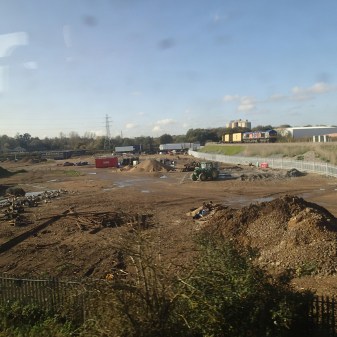
A Freight Train Waiting On The Bacon Factory Curve
Note the freight train waiting for our one-coach Class 153 to pass. Before the curve opened the freight train would have had to go into Ipswich yard and the locomotive would have had to run-round to the other end, causing all sorts of disruption to the Great Eastern Main Line and especially the Felixstowe Branch.
Also now I noticed that trains coming out of Felixstowe and going South towards London, now sometimes seem to get their diesel locomotive changed for a Class 90 electric one.
The next improvement will come when more of the Felixstowe branch line is double-tracked and the whole branch is electrified.
It’s all a far cry from when I lived in Felixstowe in the 1960s, where the most reliable way to get between the two towns was to cycle along the A45 or A14 as it is now! There were only a handful of trains every day.
How many other places on the UK network need smaller improvements like the Bacon Factory Curve to be implemented?
The Rail Line Into London Gateway
I took this picture as my train to Stanford-le-hope passed the rail line into London Gateway.
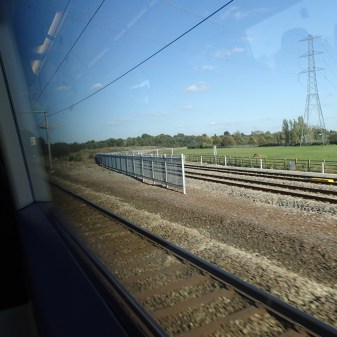
The Rail Line Into London Gateway
It shows the double-tracked rail line into the port.
I would assume it will be electrified, when the main routes through London, like the Gospel Oak to Barking Line, are also fitted with overhead wires, so that freight trains can use efficient electric haulage.
Bacon Factory Curve At Work
I took this picture from an Ipswich to Cambridge train.
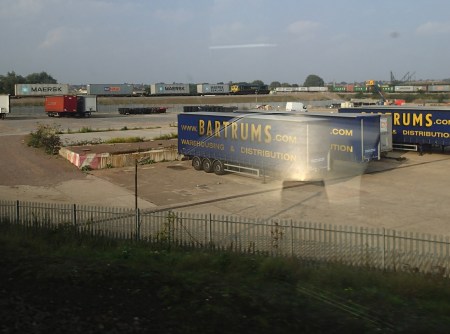
Freight Trains On The Bacon Factory Curve
It shows how the Bacon Factory Curve is working.
The train on the left is held on the curve itself, whilst the train on the right is proceeding towards Felixstowe.
In contrast to months ago, my train was not delayed and went straight past the junction.
An Unpleasant Experience
I took this picture at Highbury and Islington station from the second footbridge, that links the platforms to the Emergency Exit.
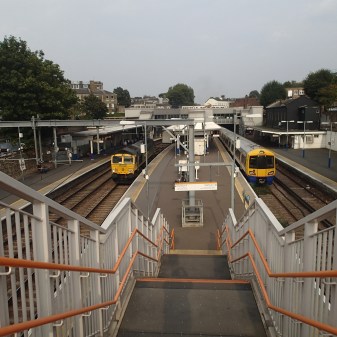
An Approaching Class 66
I have talked about the noise of Class 66 locomotives before in this post, where I said this.
It is important that rail locomotives are improved, as the current mainstay, the Class 66 is not liked by those who live on busy freight routes, due to its noise. I’ve also talked to drivers, who feel they have other problems too.
I could have been more critical. The Class 66 to the left of the picture was pulling a heavy freight train and passed under me, whilst working hard.
The noise was bad, but not as bad as the stink of the exhaust of the massive diesel engine.
I remarked on this to a member of the station staff, who was tidying up underneath the bridge and he said he hated them.
As there are now alternatives, surely pure diesel engines like the Class 66, that don’t meet the latest environmental regulations, should at lest be banned from operating in heavily-populated built-up areas.
In fact, as this line is electrified, what is a Class 66 doing on this line anyway?
Do We Want Platoons of Trucks?
I first read about this idea in the Sunday Times, but I have found a detailed article on the bbc.com website. Here’s the lead paragraph.
Convoys of wireless-linked semi-autonomous vehicles could soon be hitting our roads, giving drivers a chance to put their feet up on the morning commute.
I don’t drive and I miss driving, like you miss the teenager next door, who thinks he’s the best drummer since Ringo, who has just left home.
The technology may well work, but it’s in the same category as driverless cars and unmanned level crossings. They’re all perfectly good and safe until something goes wrong. How many air accidents were never envisaged, when the aircraft was designed?
The thing though about this technology, is there is already a proven alternative in the UK. It’s called freight trains. The money would be better spent removing trucks from the roads, as far as possible. Obviously for long distances across countries like the US, Canada, Australia and Russia, it may well have a place.
Musings On Freight And The New Thames Tunnel On The Goblin Extension
It may seem strange that freight has such a large affect on the Gospel Oak and Barking Line, which is essentially a passenger railway across North London.
But at the Barking end of the line there could be very good connections to London Gateway and the other end has good connections to the main routes to the north. So a container unloaded at the port, which is destined for say the large distribution centre at Daventry, could go on a train up the Goblin to the West Coast Main Line. Other large distribution centres are planned or being constructed, like the one at Radlett, so we will see more trains from the London Gateway taking this route as the port gets larger.
In a few years time, the line will be carrying a lot of freight trains, many of which will be hauled through at night. At least the line is being electrified, so the noisy thuds of the dreadful Class 66 locomotives will hopefully be replaced by smooth electric power.
If a new Thames Tunnel is built between Barking and Thamesmead, this will be a game changer, if it is a tunnel that is capable of taking the biggest freight trains. It should probably be built to the loading gauge of the Channel Tunnel, so allowing any train capable of using the Channel Tunnel to be able to use the new link.
London Gateway is one of the few ports capable of handling the new breed of ultra large container ships. Obviously, this will generate more freight train traffic for the UK out of London Gateway, but will some of these containers be destined for Europe? At present there is a route to get them onto HS1 for the Channel Tunnel, but a new Thames Tunnel might give opportunities for these trains to go along the North Bank of the Thames and then through the tunnel to pick up the North Kent Line for HS1. The advantage is that it avoids sending trains through the crowded North London rail system. Obviously freight going from Europe to London Gateway for onward shipping, could be routed in the reverse direction.
Increasingly, over the last few years there has been a significant stirring of the practice of sending freight trains through the Channel Tunnel. Car components and perishable fruit, are just two of the cargoes seeing an increase.
We will see a large increase in future with exports such as complete cars going both ways on special trains. Although, it’s a common site in Europe, large trains of new vehicles are rarely seen here.
All of these flows will probably be best routed through the new Thames Tunnel and over the upgraded Goblin.
We shouldn’t forget that the main reason for a rail tunnel between Barking Riverside to Thamesmead is to vitalise the housing developments in the east of London, as I outlined in A Divided City.
But could the Goblin Extension be used for extra passenger trains given that it would link HS2 at Old Oak Common to HS1 at Ebbsfleet via the North Kent Line.
During the day there probably aren’t enough paths for an intensive service from the North via HS2 to link with HS1. And anyway, is the demand there for direct trains between say Paris and Manchester or Cologne and Leeds?
But it would allow overnight sleeper services, which might be a better proposition.
On the other hand to run a regular service from Old Oak Common to Ebbsfleet might be worthwhile, especially if it stopped regularly in between, at say Abbey Wood, Barking, Walthamstow and West Hampstead.
A Beginner’s Guide On Opposing HS2
I found this here on Rail News.
Read it and enjoy.
As I’m a simple man, who prefers words of one syllable, my views on HS2 are as follows.
1. The best way to increase the capacity of our motorways is to move as much freight as possible off the roads onto the railways. As there are a limited number of freight paths on the East and West Coast Main Lines, one way to increase capacity would be to create a new high speed railway that is used by the high speed passenger trains from London to the Midlands, North and Scotland. Passenger trains would take HS2, thus releasing capacity on older lines for freight.
2. It is well known that speed attracts more passengers. At the moment there’s a lot of speculation about Norwich in Ninety. Every route from London has a time, that would attract passengers. Perhaps, it should be Birmingham in an hour, Cardiff and Manchester in two and Edinburgh in four. Speed will attract people to use the trains, hopefully freeing up the roads.
3. A lot of our older stations like Euston and Manchester Piccadilly need rebuilding, or are on cramped sites like Birmingham, Leeds and Newcastle, so building HS2 with a few well-connected and spacious stations may well make a better railway for every passenger. The network’s Victorian designers didn’t envisage the number and size of trains we are using today, let alone those that we will, in a few years time.
4. HS2 is making us think. In the past couple of months, George Osborne has laid out a plan for HS3 across the north of England from Liverpool and Manchester to Hull. The government has now announced that the existing line will be electrified as a priority. Would a politician have ever thought of this without HS2?
5. I also believe that HS2 should be freight enabled, so that at night, when the line won’t be busy, freight trains can be sneaked up and down the country. Network Rail are experimenting with using Euston in the middle of the night, as a distribution point for retail goods, so could we see that in cities like Birmingham, Leeds, Liverpool and Manchester?
6. I also think that HS2 could be the solution to how we get freight from London Gateway up to the North, if we built a tunnelled link from HS2 to HS1, This would also allow direct passenger and freight services between most of the UK and the Continent. Surely, it would be a better way to distribute Jaguars, Land-Rovers, Toyotas and Nissans all over the Continent and perhaps even further. That is just one example of probably many on how rail freight could be used.
7. I have my doubts about direct passenger services between say Manchester and Berlin, as for a journey of that length, the easyRyans of this would will always be a lot quicker and probably cheaper.
8. A properly linked up high speed rail system, connected to most parts of the country, will open up all sorts of possibilities.
9. Suppose the North Wales Coast line between Holyhead and Crewe was electrified and made into a full-size faster line, would this ease the problem of transporting freight and passengers to and from Ireland? At the present time it take nearly four hours to get to Holyhead from London, so with something like a Class 800 train, under three hours should be possible, even without the sections of HS2 north of Birmingham.
10. South Wales isn’t a problem from London and the South East, as by the end of this decade, Brunel’s Great Western will be making his ghost jump for joy, as trains speed along an electrified railway to Cardiff and South Wales as trains speed along at 225 kph. The line which, I’ve called HSW will probably change the way we think about high speed rail.
11. The main problem of South Wales is getting to Birmingham and the North. But this will probably be solved in the short term by the use of Class 800 running via Gloucester.
12. The Class 800 will have big part to play with HS2, as it will be used as a route extender, as I said in point 9, where it could be used to Holyhead.
Do These Strawberries Have Truck Or Rail Miles?
I was surprised that these strawberries were on sale in Sainsbury’s near me in London.

Do These Strawberries Have Truck Or Rail Miles?
I just wonder whether they came down from Scotland by truck or by train. Supermarket groups and other retailers are increasingly using trains. There’s an article here, which describes some developments in recent years, including how Tesco bring in fruit from Spain by train.
 The Anonymous Widower