Mitcham Eastfields Station
With the summer now giving us lighter evenings, after Wednesday’s visit to Greenhithe station, I decided to have a look at another of Network Rail’s modular stations.; Mitcham Eastfields. The station has an unusual layout as this Google Map image shows.
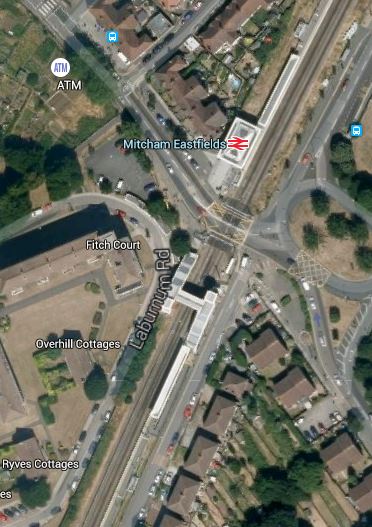
Mitcham Eastfields Station
Note that the two platforms are one each side of a level crossing and that the down platform where trains from London arrive has no facilities except a bridge to connect it to the other platform. It is an interesting attempt to find a solution to the level crossing problem. Wikipedia says this about the design.
The platforms are 170 m long, with a building on the up (northbound) platform. The platforms are arranged so that each is situated beyond the level crossing in the direction of travel, allowing the crossing to be reopened while trains are stopped at the station, minimising the disruption to road traffic.
I took these pictures as I walked from the down to the up platform over the footbridge.
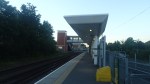


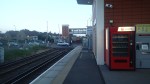
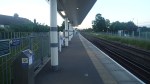
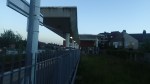
The design might need some fine tuning in the addition of a light-controlled crossing for foot passengers crossing from the down to the up platform, but it is an innovative approach to putting a station by a busy level crossing on a line with frequent trains.
A Trixi Mirror On The Essex Road
I saw this mirror on the traffic lights by Essex Road station a few weeks ago from the top of a bus, but it was only when I walked that way this morning, that I was able to photograph it.
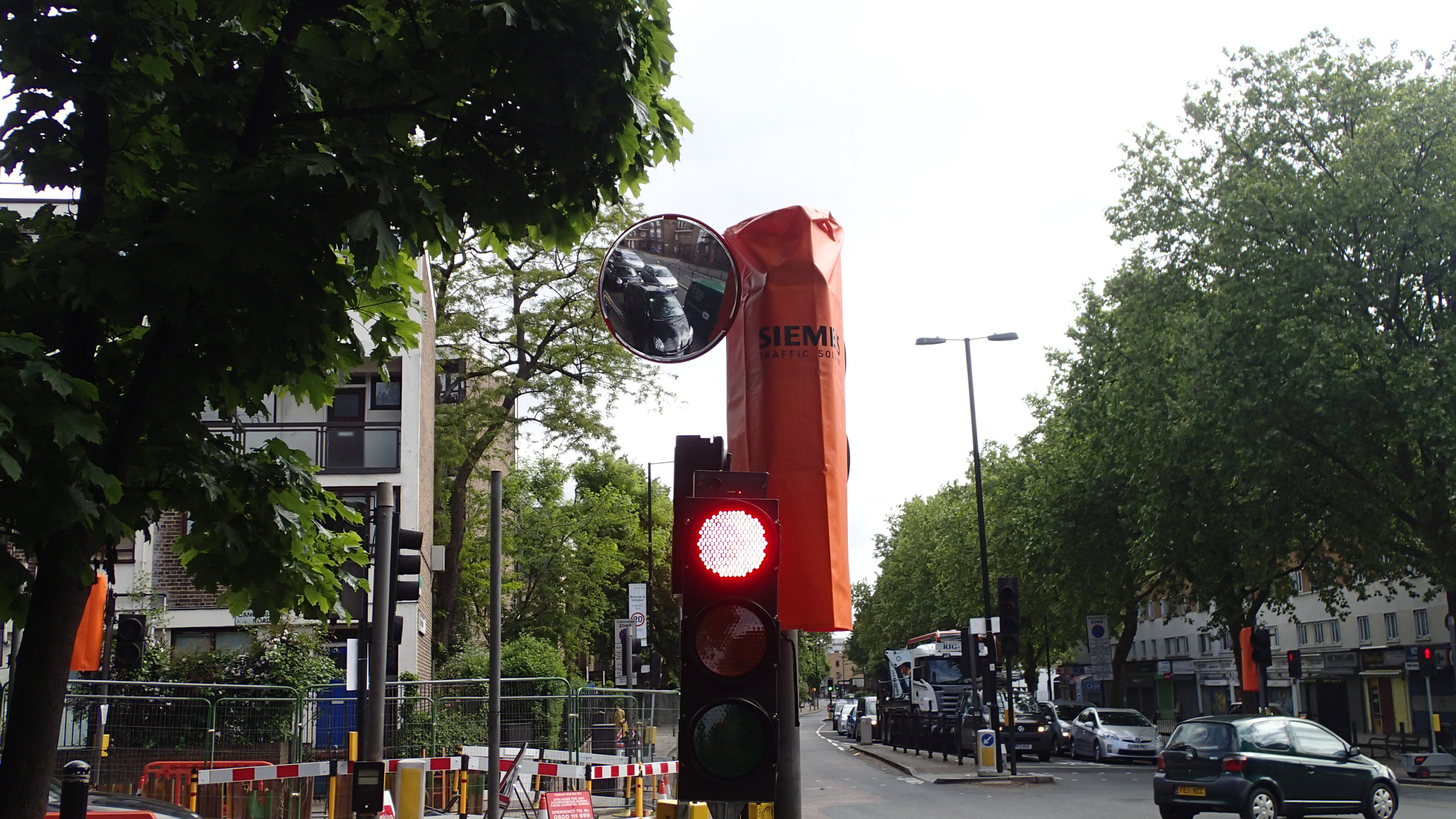
A Trixi Mirror On The Essex Road
It’s a Trixi mirror, from a company called Convex Mirrors amd is designed to protect cyclists from trucks and buses turning left, by making the driver more likely to see the rider.
Crossrail’s Secret Ventilation Shaft
When I researched the ventilation shafts for Crossrail, I was surprised how few of them there are.
But there was one I missed that is not mentioned in the usual web sites and it was built in 2004.
This article on the website building.co.uk describes a secret ventilation shaft for Crossrail underneath Moor House.

Crossrail’s Secret Ventilation Shaft
How much disruption was avoided by incorporating the shaft in the building?
One advantage in the early firming up the route of Crossrail 2, is that if a building has to be rebuilt on the route, it can incorporate features so that it is ready for the line.
How To Redesign An Everyday Object
Electricity pylons in the UK are generally made to a design that dates from the 1920s. So National Grid, who are responsible decided to have a design competition in partnership with RIBA.
According to this story on the BBC, National Grid are putting up a test line of the winner to teach engineers how to put them up.
They certainly look to be an improvement, but after nearly a hundred years, you’d expect that!
National Grid has also put up a blog.
I like the new pylons and hope to photograph them soon!
Could London Benefit From Fosteritos?
How many times a day, does a passenger on the London Underground, go down or up a short set of uncovered stairs to access a ticket hall with machines, ticket barriers and escalators and lifts to the trains? Stations, I use regularly with this layout include Kings Cross, Oxford Circus, Bank and Euston Square. Many of these staircases can be slippery in the wet, but some are covered.



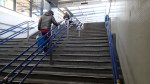
These pictures show the covered staircase at the front of Kings Cross station. This is better than uncovered, but it is probably an expensive solution, although it does incorporate a lift.
Norman Foster faced a similar problem in Spain of how to protect staircases and escalators emerging from the Bilbao Metro. These pictures show his elegant solution.




The Spaniards obviously liked them, as they called them fosteritos.
Perhaps, Transport for London needs to have a design contest to create a distinctive shelter for those slippery-when-wet staircases.
A Use For A Small Sheba Knife
My Sheba cutlery gets used in all sorts of ways.
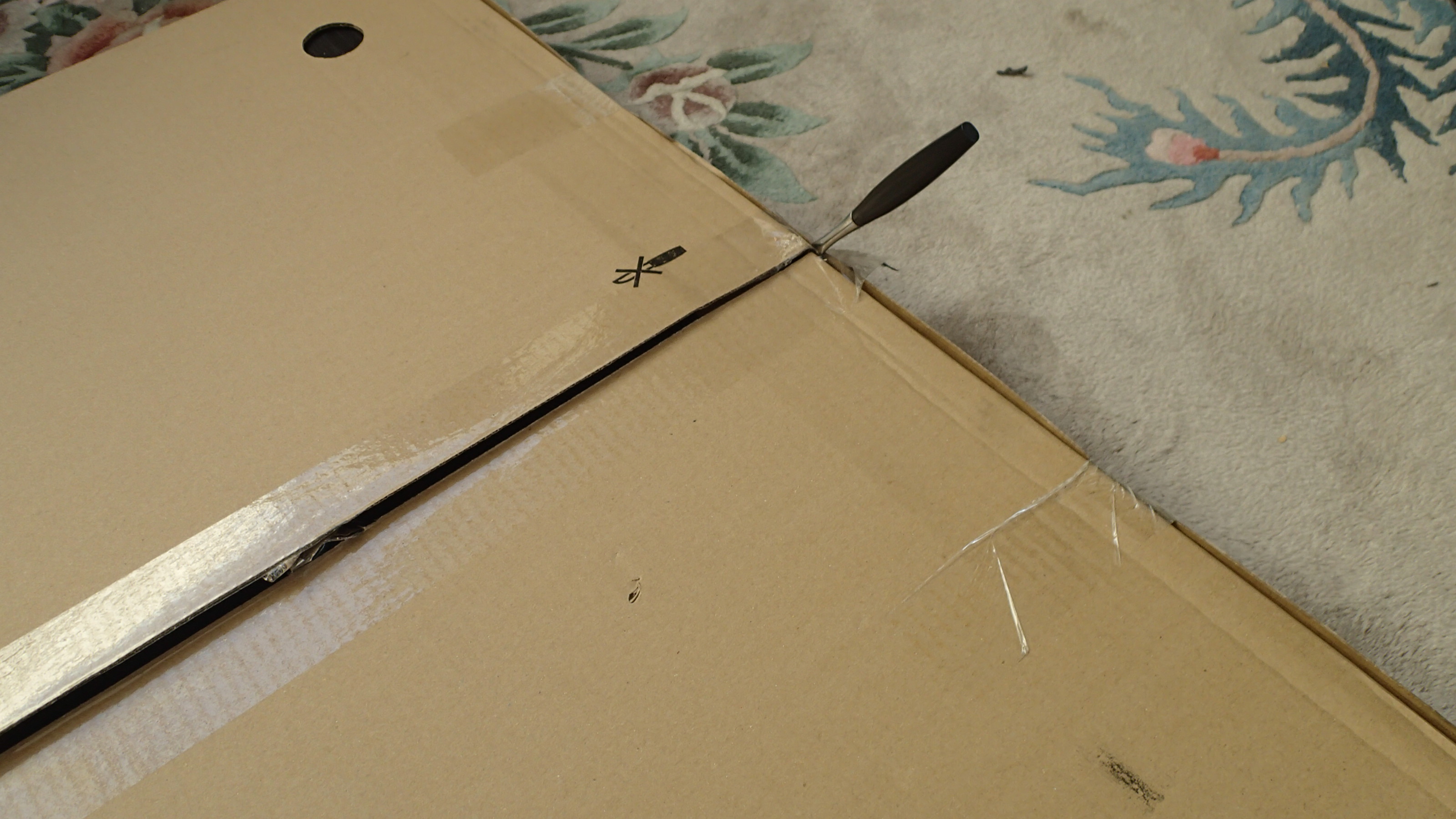
A Use For A Small Sheba Knife
As the small knives are more designed for spreading butter and jam, rather than cutting, they are ideal for opening packages without damaging the contents.
Sheba is the greatest cutlery design ever. And they were made in Sheffield and my upward of twelve settings have been used for nearly fifty years!
The Design Of Tram Or Tram-Train Stations
When I wrote the article about using tram-trains in Blackpool, I wanted to include a picture from an existing UK tramway to show what a stop might look like on the Colne Line after conversion to tram-train operation, if that should be decided. The only tramway near me is the Croydon Tramlink, for which my Freedom Pass is valid, so I went to take some pictures.
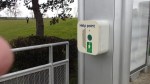
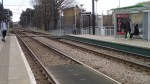




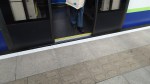

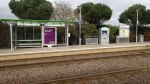
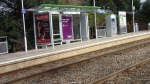



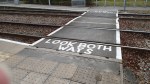

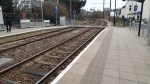




Some more are shown in this article about Birkbeck Tramlink stop.
I believe that the pictures show the sort of stations you would get on a line like the Colne Line, if you used Class 399 tram-trains instead of Class 142 trains. As Birkbeck shows you can have single-track bi-directional stations in addition to the more normal ones with two platforms, either on the outside of the tracks or as an island between them.
If I’d gone to any other UK tramway and a good few on the continent like Strasbourg, I’d have found similar good design. Although some don’t quite get the step-free access quite as good as Croydon and Strasbourg do.
But next time you get into a Class 142 or some of their dreadful cousins to go to work or for a bit of pleasure in Liverpool, Manchester, Leeds or Sheffield, think what train travel could be like in a brand new tram-train that sped you to your destination in complete comfort, in a faster time, than your current scrapyard special.
The experience will be even better, if the stations you use have all of the superb step-free access that you get in Croydon, Strasbourg and Edinburgh.
To sum up my ideal tramway must have.
1. Low floor trams or tram-trains with level access from the platform, with no gap between.
2. Gentle slopes up from street level to the platforms if possible.
3. As few lifts and escalators as possible to break down.
4. Crossing the tracks should be a simple walk across.
5. A shelter on every platform.
6. Good information on use and ticketing, with maps of the network and the local area at every stop and on every vehicle.
7. Multiple next stop displays with a clock on the vehicle. Trains and trams, are well behind London’s buses in this area.
8. Contactless bank card and cashless ticketing. Anything else is so last millennium! If one of the biggest cities in the world; London can do it across all their modes of transport and well upwards of a dozen transport operators, surely all smaller ones can!
9. Free wi-fi!
10. An on-board Train Captain like the Docklands Light Railway!
I’ve never used a tram network that scores ten! Croydon Tramlink scores about eight.
A Quick Exploration In Mulhouse
On the way from Basel to Strasbourg, I stopped off at Mulhouse to have a look at the city and ride its tram-trains.

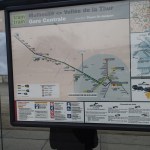
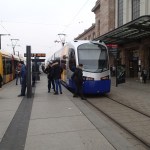
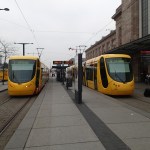
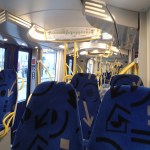

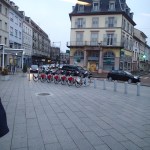
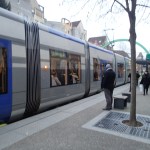

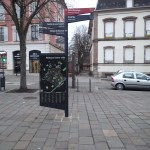



The line is a good bit short of its planned length and rather infrequent at the moment, but compared to the two German systems in Karlsruhe and Kassel, it is a step up in design quality.
I should also say, I was impressed with both Mulhouse and its trams and tram-trains.
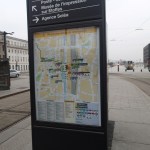
There was a lot of information maps everywhere and this was an order of magnitude better than anything I’d seen in Germany.
The Germans could do a lot worse than hop over the border with a camera and pinch the designs used in Mulhouse.
I particularly liked the red finger on the finger post, which always pointed to the historic city centre. So simple, I wonder why I’ve not seen it before!
If you look at the proposal for the extension of the Sheffield Supertram to Rotherham using a tram-train, it has similarities to the system in Mulhouse.
The Siemens S70/Avanto tram-trains used in Mulhouse are dual voltage capable of running on 750 V DC or 25kV AC. The Class 399 Sheffield tram-trains which are being made by Vossloh are said to have a similar capability. You could argue that being able to run on both these voltages is akin to the dual-voltage Class 378 which run on both voltages. The Class 378 halts for the changeover at places like Acton, but surely modern electric systems can be designed that handle the changeover between voltages automatically.
A Train With The Engine In The Middle
As I left Kassel, I saw this train, which appears to have an engine module in the middle.
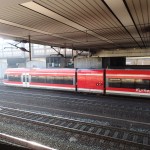
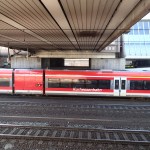
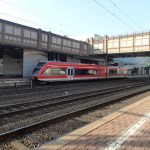
It is actually a Stadler GTW and it must be a good concept as over five hundred of them are working all around the world, in both diesel and electric versions..
One great advantage for passengers is surely that the noise and vibration problem of underfloor diesel engines is minimised. The train is also a low floor design.
The design is also very flexible.
- The power packs are probably interchangeable, so you could switch trains from diesel to electric according to need.
- A battery could be incorporated into the power pack, which is charged when running under wires.
- The articulated design goes well on curvy track.
- Extra passenger modules can be added.
- For the UK, they could be a way round not buying any more diesel multiple units. We would buy some diesel versions and if we had too many due to the march of electrification, we just swap the central module.
I wouldn’t be surprised if we saw more trains with a central power pack. I think if the UK used the same loading gauge as Europe, we’d have seen one in the UK on test by now.
It Looks Like This Class 319 Scrubbed Up Well
After a quick glance at the picture of Northern Rail’s first Class 319 train in a piece in Global Rail News, it looks like it’s scrubbed up well.
But then anything based 0n a Mark 3 coach, as are the 319s, are like well-respected actresses, who with a bit of make-up, TLC and some well-made clothes can outperform their younger fellows.
I’m looking forward to riding one from Liverpool Lime Street to a fully-rebuilt Manchester Victoria in a few weeks time.
 The Anonymous Widower