UK And Germany Will Face Threats Together, Says Burnham In Berlin
The title of this post, is the same as that of this article on the BBC.
This is the sub-heading.
The UK and Germany will face threats together, Prime Minister Andy Burnham has said as he reaffirmed a series of defence and security partnerships
These two paragraphs add some more detail.
On his first official European trip, apart from visits to Ukraine, Burnham met German Chancellor Friedrich Merz, and was greeted with military honours in Berlin.
Speaking to reporters at the German capital’s Federal Chancellery, the prime minister said both countries were facing hybrid attacks “on a regular basis” and “it makes sense” to take them on together.
I am surprised that the article doesn’t mention energy, as it is a problem for both Germany and the UK.
Germany’s problems include.
- They are short of both green electricity and gas.
- They produce about a fifth of their electricity from coal.
- They have weaned themselves off Russian gas and nuclear power.
- They have poor electricity storage.
Their strengths include.
- Siemens is the second-largest European wind turbine manufacturer.
- 29 wind farms in the UK, have been built around Siemens wind turbines.
- RWE is a major German developer of wind farms.
- RWE is the largest generator of electricity in the UK.
- RWE own or part-own thirteen wind farms in the UK.
Germany also has good plans to solve their problems.
- AquaVentus is a series of pipes and wires to bring green electricity and hydrogen from Norway, Denmark, the Netherlands, and Aberdeen and Humberside in the UK. to Wilhelmshaven in North-West Germany.
- H2ercules is a plan to deliver hydrogen around Germany to power industry.
In New Study Shows How North Sea Offshore Wind Can Yield More While Costing Less, I found this “It appears from the text in this must read report, that the Germans might develop as much as 20 GW in neighbouring countries.”
The UK’s problems include.
- High electricity and gas prices.
- Not enough electricity storage.
- Poor connections to the grid.
Our strengths include.
- A large amount of solar and wind power is being developed.
- We will generate more electricity than we need.
- Geographically, we generate more electricity on the East side of the UK, so our electrons are ideally placed in invade Germany.
- We shall be able to send electricity and hydrogen to Germany using the AquaVentus system.
- We are developing at least three 2 GW/30 GWh pumped storage systems in Scotland to store electricity and back up AquaVentus.
- Rough and Aldbrough are gas storage reservoirs on Humberside, that could be converted to store hydrogen, so we could keep Germany supplied.
- HiiROC is affordable hydrogen production technology being developed in Hull, which is five times more efficient, than traditional methods.
Centrica is backing HiiROC and is developing a stable of British ideas.
The UK’s Biggest Advantage
This map shows the The Exclusive Economic Zones (EEZ) around the UK.

Note.
- Undoubtedly, the rules by which EEZs were drawn, favoured the UK, and countries like Belgium and Germany didn’t do as well.
- The area of the UK’s EEZ is twenty-three times that of Germany’s EEZ.
- Belgium doesn’t do well compared to The Netherlands.
- There is a substantial area between the UK and Ireland, which can deliver energy to where it is worth more.
- Great Britain and Ireland are surrounded by a large area, that must be worth developing.
- There is a convenient corridor, that runs North-West from the German EEZ to the UK EEZ, which could be used to deliver energy to Germany.
Didn’t the UK (and the Irish) do well!
I believe that there are joint actions that the UK and Germany can take to both their own advantages.
Find A Way To Keep Rough Operational
If we keep Rough operational, then.
- It can usefully act as hydrogen storage for the Germans, with a connection to AquaVentus.
- We can also use it as a store for hydrogen created from excess energy, when we have too much.
- It can also supply hydrogen to companies like INEOS on Humberside.
- Hydrogen could also be exported from the Port of Hull in small coastal liquid hydrogen tankers.
- Companies that need a lot of zero-carbon energy could move to Humberside.
I suspect John Healey will make an announcement in the 2026 Budget.
AquaVentus And Energy Storage
AquaVentus, the pumped storage hydro in Scotland and the hydrogen storage on Humberside could make a big difference to the cost of UK energy, as instead of paying wind farm operators to turn off their wind farms, the excess electricity be handled in one of these ways.
- It can be sent to Germany using AquaVentus as electricity.
- Electricity can be stored in the pumped storage hydro in the Highlands.
- It can be used to create hydrogen which can be stored in Rough and Aldbrough.
- Hydrogen can be sent to Germany using Aquaventus.
- Electricity waste is minimised, which saves the UK money.
- Germany gets a more reliable supply of green hydrogen.
The UK should get a cash flow from Germany for the energy, that is delivered.
AquaVentus Could Be Combined With National Grid’s Eastern Green Links Project
Consider.
- AquaVentus will bring energy from Aberdeen and Humberside to Wilhelmshaven.
- National Grid are building five Eastern Green Links along the East Coast of the UK to move electricity to where it is needed.
- EGL1 will link Murton, Co Durham and Torness.
- EGL2 will link Drax, Yorkshire and Peterhead.
- EGL3 will link Anderby Creek and Peterhead.
- EGL4 will link Anderby Creek and Westfield, Fife.
- EGL5 will link Anderby Creek and Peterhead.
- All willhave a capacity of 2 GW.
The Eastern Green Links have a Wikipedia entry.
This Google Map shows the location of Wilhelmshaven with respect to the UK.
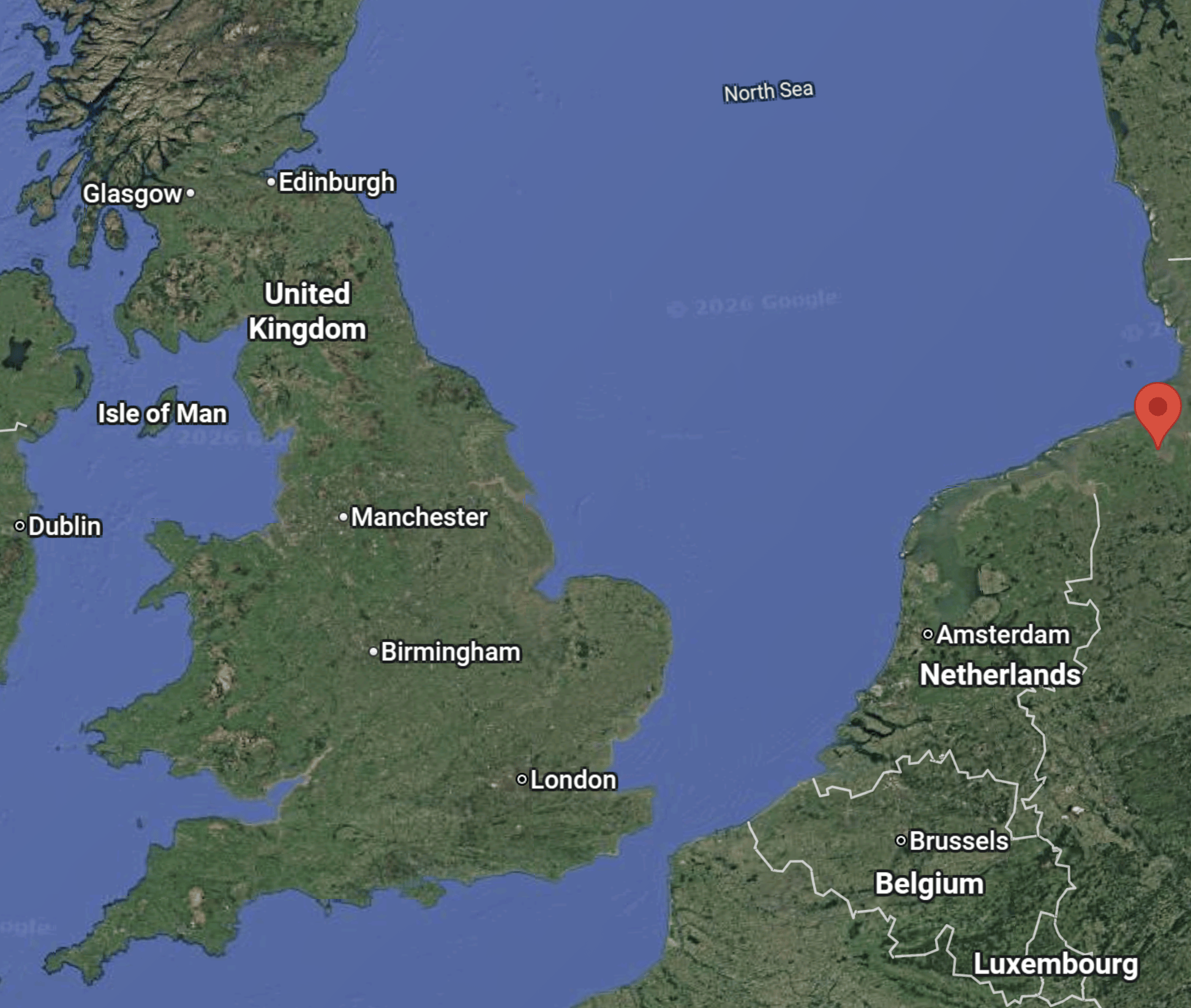
Wilhelmshaven is marked by the red arrow.
- It looks to me, that between Lincolnshire and Scotland AquaVentus and EGL1-5 will be following a similar route up the East Coast of the UK, which would surely make construction easier, faster and less costly.
- Provision could easily be made to provide a link to the Sizewell nuclear site, which has a total capacity of 4.4 GW.
- NeuConnect is a 1.4 GW interconnector between the Isle of Grain and Wilhelmshaven, that is under construction and will be 725 kilometres long.
- On the Isle of Grain is the 1.32 GW gas-fired power station, that is owned by RWE.
- BritNed is a 1 GW interconnector between the Isle of Grain and Rotterdam.
- Nemo Link is a 1 GW interconnector between Kent and Zeebrugge.
- LionLink is a proposed 1.8GW HVDC electrical interconnector to link offshore wind farms in the North Sea to the electrical grids in both Great Britain and the Netherlands.
- In National Grid, TenneT Germany Launch GriffinLink, A First Of A Find Project To Maximise Offshore Wind, I talk about GriffinLink, which will run between the UK and Germany.
I wouldn’t be surprised to see a tidying-up of the electrical connections between England, Belgium, The Netherlands and Germany.
Are the Danish And German Grids Connected Under The North Sea?
I asked Google AI this question and received this answer.
The Danish and German electricity grids are connected through undersea and land infrastructure, though direct grid-to-grid interconnections under the North Sea itself are currently expanding rather than existing as a direct bilateral link between the two countries’ mainland grids.
Current and Planned Connections
Land Boundary: The primary connection between Denmark and Germany is a shared 146-kilometer land border across the Jutland peninsula, which carries high-voltage alternating current (HVAC) power lines linking the two national transmission systems.
North Sea Undersea Cables (Indirect/Transit): The COBRAcable, a high-voltage direct current (HVDC) submarine link operated by TenneT and Energinet, connects the electricity grids of the Netherlands and Denmark, running through the German sector of the North Sea.
North Sea Hybrid Projects: German and Danish transmission system operators (such as Amprion and Energinet) have signed agreements and memoranda—including joint declarations from the North Sea Summit—to examine and develop future hybrid offshore wind interconnectors and energy hub links in the North Sea.
Baltic Sea Connections: In contrast, direct cross-border grid and hybrid wind connections between Denmark and Germany are more established or actively deploying in the Baltic Sea, such as through the Kriegers Flak and Bornholm Energy Island projects.
It looks like what is happening between England and Germany has already been developed between Germany and Denmark.
Does Germany Want To Put Wind Farms In Other Countries EEZs And Bring The Energy To Germany?
Google AI gave this answer to my question.
Yes, Germany is moving toward integrating and allowing cross-border and radial offshore wind projects located in the Exclusive Economic Zones (EEZs) of neighboring countries—such as Denmark—to connect directly to the German grid.
Rather than “renting” areas unilaterally, Germany is accomplishing this through joint cross-border European partnerships and bilateral agreements.
Key Details
Regulatory Changes: Germany has proposed amendments (such as via drafts integrating “international offshore connection lines” into its WindSeeG legislation) to explicitly cover radial lines from an offshore farm outside the German EEZ connected exclusively to the German grid.
Counting Toward Targets: These proposed rules allow cross-border radial offshore wind projects to count directly toward Germany’s national offshore wind targets (such as its 70 GW offshore wind goal).
Cross-Border Cooperation: Strategic frameworks—such as between Denmark and Germany—are being established to link projects in foreign waters (like Danish waters) to German converter platforms (e.g., the OST-2-4 platform in the German EEZ).
Research and Industry Push: Studies (including analysis by Fraunhofer IWES) and industry voices (such as Örsted) have argued that shifting or sharing some offshore build-out into neighboring waters like Denmark and Sweden can optimize output, lower costs, and reduce the risk of regionally weak wind conditions. This is also part of broader European agreements like the North Sea Summit declarations scaling up cross-border infrastructure.
Note.
- The UK and German EEZs join via a corridor, that would surely be bideal for a large capacity cable, which is clearly visible on then EEZ map.
- The UK has more than enough space for wind farms.
- The primary source of the UK’s offshore energy could shift to wind farms to the West and North-West of Great Britain.
- Eastern British would probably play a large part in the construction and service of German wind farms to the East of Great Britain.
There would appear to be winners all round.
- Germany gets the energy it needs.
- The UK gets the affordable energy it needs.
- The UK gets paid for the energy created in and exported from its waters.
- British jobs will be created in the construction and support of the German wind farms.
This could be the start of something very big for Germany and the UK.
Power Lines Disappear From Cornish Beauty Spot
The title of this post, is the same as this news item from National Grid.
This is the sub-heading.
Visitors to a North Cornwall beauty spot will be able to enjoy improved views after overhead power lines were removed by our engineers.
These three paragraphs add more detail.
They took down more than a mile of poles and lines at Hawkers Cove, near Padstow, which have been replaced by underground cables.
The cove is a popular destination known for its coastal scenery and views across the Camel Estuary, and we worked with Cornwall National Landscape, Cornwall Council, local landowners and a tenant farmer to identify which overhead equipment could be removed.
This resulted in more than a dozen poles and 15 spans of high and low voltage conductors covering 1,600 metres being taken down.
It appears that National Grid work in partnership with National Parks and National Landscapes, to identify and prioritise schemes.
I posted this story, as in Burnham’s speech, he said he would be setting up Great British Grid.
Will this mean, if you vote Labour, you’ll get ugly cables removed from around your house, so that it goes up in value?
Data Centre In The Shed Reduces Energy Bills To £40
The title of this post, is the same as that of this article on the BBC.
This is the sub-heading.
An Essex couple have become the first people in the country to trial a scheme that sees them heat their home using a data centre in their garden shed.
These three introductory paragraphs add some detail.
Terrence and Lesley Bridges have seen their energy bills drop dramatically, from £375 a month down to as low as £40, since they swapped their gas boiler for a HeatHub – a small data centre containing more than 500 computers.
Data centres are banks of computers which carry out digital tasks. As the computers process data, they generate lots of heat, which is captured by oil and then transferred into the Bridges’ hot water system.
Mr Bridges, 76, says keeping his two-bed bungalow near Braintree warm was a necessity as his wife has spinal stenosis and is in “a lot of pain” when it gets colder.
I think this simple idea is absolutely brilliant and very technically sound.
Here are some further thoughts.
It Would Be Ideal For A House Like Mine
My house is a modern three-bedroomed house with a garage and when I asked Google AI how many UK houses had garages, I received this answer.
Approximately 38% of dwellings in England have a garage, according to a 2020 report. While a specific UK-wide figure is not available, extrapolating this percentage to the total number of UK dwellings suggests there are over 10 million houses with garages, though the actual figure may vary across different regions.
Looking at the picture in the BBC article, I feel that this HeatHub could fit in my house.
I would expect that any house with a garage, a small garden or a big enough boiler space could accommodate a HeatHub.
Obviously, the house would need.
- A boiler, that provides heating and hot water.
- A good broadband connection.
My house has both.
Would My House’s Heating System Need To Be Modified?
It looks like it’s just a boiler replacement, so I don’t think so, but it may need to be moderbnised with digital controllers to get the best out of the system.
Will There Be Other Systems Like Thermify’s Heat Hub?
Some of our electricity suppliers seem very innovative and the market is very competitive.
Would they just sit back and let coompetitors take their customers? I doubt it!
So I suspect there will be other systems, each with their own features.
I have already, written about heata, which uses similar principles to give affordable hot water in British Gas Partners With heata On Trial To Reuse Waste Heat From Data Processing.
The BBC article gives some examples of data centres used to provide heating, so it is worth reading the full article.
Heathrow Shutdown Caused By Problem Found Seven Years Ago
The title of this post, is the same as that of this article on the BBC.
This is the sub-heading.
Issues at an electrical substation which caused a fire that resulted in Heathrow Airport closing were first detected seven years ago but not fixed, a report has found.
These two paragraphs, explain the problem.
The National Energy System Operator (NESO) said moisture entering electrical components at the North Hyde substation caused the blaze at the site that supplies the UK’s biggest airport with power.
It revealed an elevated moisture reading had been first detected in July 2018, but that “mitigating actions appropriate to its severity were not implemented”, with basic maintenance cancelled.
This was a failure of National Grid’s management and I suspect the company will received a severe punishment.
But what worries me, is that power networks are built from a series of standard components.
So how many other North Hydes are waiting to happen?
National Grid’s London Power Tunnels Breakthrough Completes £1 Billion Project’s Tunnelling Activity
The title of this post, is the same as that of this press release from National Grid.
These bullet points sum up the press release.
- Landmark moment for London Power Tunnels project as 140-tonne boring machine emerges at Eltham site following final subterranean journey
- Breakthrough marks the completion of 32.5km of tunnelling at depths of up to 60m under seven South London boroughs
- Due for completion in 2026, the project is rewiring the capital’s electricity network to boost resilience and future-proof supplies as demand grows
This is the seventh major tunnel in London in recent years to be completed.
- Elstree and St. John’s Wood Cable Tunnel – Electricity – 12 miles – 2005
- Lower Lea Valley Cable Tunnels – Electricity – 3.7 miles – 2008
- Lee Tunnel – Sewage – 4.3 miles – 2016
- New Cross and Finsbury Market Cable Tunnel – Electricity – 3.5 miles – 2017
- Northern Line Extension To Battersea – Rail – 2 miles – 2021
- Elizabeth Line – Rail – 26 miles – 2022
- Silvertown Tunnel – Road – 1 mile – Under Construction
- Thames Tideway Tunnel – Sewage – 16 miles – Under Construction
- Euston Tunnel – Rail – 4.5 miles – Under Construction
Note.
- It is likely that there will be CrossRail 2 and an extension to the Bakerloo Line.
- It certainly seems to have been a prudent decision to create Tunneling and Underground Construction Academy or TUCA to train more tunnellers, before the Elizabeth Line was built.
But I don’t believe that will be all the large tunnels that will be built in the capital.
Ofgem Enables National Grid To Make Early Payment Of Interconnector Revenues, Helping To Reduce Household Bills
The title of this post, is the same as that of this press release from National Grid.
These are the first three paragraphs.
National Grid has offered to pay £200m of interconnector revenues ahead of schedule rather than at the end of the standard five-year review period to play its part in reducing household energy bills.
Interconnectors, which are subsea electricity cables connecting the UK and Europe, enable the import of cheaper, cleaner energy from European neighbours, supporting security of supply and reducing carbon emissions.
It’s estimated that National Grid’s interconnector portfolio will help the UK avoid around 100 million tonnes of carbon emissions by 2030.
Ofgem has approved National Grid’s request to make early payments.
These are my thoughts.
What’s In It For Consumers?
National Grid is making a payment early, so they are not getting anything, they won’t eventually get.
But they are getting it early!
What’s In It For National Grid?
As National Grid is making a payment early, they are forgoing interest on the £200 million.
In New Electricity ‘Superhighways’ Needed To Cope With Surge In Wind Power, I talked about National Grid’s plan to build new North-South interconnectors, that would handle all the extra wind-power.
National Grid currently owns all or part of these operating or planned interconnectors.
- BritNed
- HVDC Cross-Channel
- IceLink
- IFA-2
- Isle of Man to England Interconnector
- NemoLink
- North Sea Link
- Viking Link
- Western HVDC Link
National Grid would appear to have a substantial interest in the UK’s interconnectors and is the £200 million payment to ensure they get the contract to build and operate any new UK interconnectors? I’m not saying it’s a bribe, but it’s just operating the interconnectors in a manner that is an advantage to the UK and its electricity customers.
Surely, if the ultimate customers are happy, there will be less calls for the break-up of National Grid.
What Is A Cap And Floor Regime?
The press release explains a cap and floor regime like this.
Ofgem’s cap and floor regime sets a yearly maximum (cap) and minimum (floor) level for the revenues that the interconnector licensees can earn over a 25-year period. Usually, revenues generated by the interconnector are compared against the cap and floor levels over five-year periods. Top-up payments are made to the interconnector licensee if revenues are lower than the floor; and similarly, the licensee pays revenues in excess of the cap to consumers.
Ofgem’s approval enables National Grid to make payments of above cap revenues significantly earlier than originally planned, which will contribute to reducing consumer energy costs over the next two years. National Grid is now working with Ofgem to explore how to ensure the early payments can have the most impact for consumers.
I wonder if Ofgem and National Grid feel that a cap and floor regime is not only good for them, but for electricity consumers as well.
Cap And Floor Regimes And Energy Storage
There has been talk that cap and floor regimes should be used for energy storage.
This article on Current News is entitled Cap And Floor Mechanism The ‘Standout Solution’ For Long Duration Storage, KPMG Finds.
These are the first two paragraphs.
A cap and floor regime would be the most beneficial solution for supporting long duration energy storage, a KPMG report has found.
Commissioned by Drax, the report detailed how there is currently no appropriate investment mechanism for long duration storage. Examining four investment mechanisms – the Contracts for Difference (CfD) scheme, Regulated Asset Value (RAV) model, cap and floor regime and a reformed Capacity Market – it identified cap and floor as the best solution.
I also suspect that if the operator does a National Grid with the revenues, a cap and floor regime, must be even better.
I would not be surprised to see schemes like Coire Glas pumped hydro operating under a cap and floor regime.
Effect On Other Energy Companies
Wind farms seem to be operated under the Contracts for Difference scheme in many cases, but will we see cap and floor regimes being used in this market?
I can certainly see a new regime emerging, that is better for investors, wind farm builders, consumers and the Treasury.
In some ways keeping a happy relationship between the investors, Government and consumers is most important. So as National Grid, the Government and consumers don’t seem to be jumping up and down about their cap-and-floor regime, it must be working reasonably well!
Conclusion
Get the right regime and quality investors could be flocking to the UK’s energy generation and supply industry.
National Grid by their actions in paying up early, have thoroughly endorsed the system.
Are There Any Medical Application For Large Amounts Of Electricity?
I ask this question, as an eminent medical researcher has just thanked me by text for my energy posts.
It could be that he sees some benefit in having lots of energy available from wind.
I have a few thoughts.
Are Electricity Bills Getting To Be A Larger Proportion Of The Running Costs Of Hospitals Or Medical Research Establishments?
We are all suffering to some extent from higher electricity prices, but some of the latest medical equipment with large electromagnets and powerful X-rays must be expensive on electricity.
Proton Therapy
Does proton therapy use very large amounts of electricity and is this one of the reasons, that these seemingly-powerful machines are thin on the ground?
So if electricity is much more plentiful and hopefully more affordable, is this going to mean that proton therapy is used more often?
Synchrotrons
The Diamond Light Source is described like this in Wikipedia.
Diamond Light Source (or Diamond) is the UK’s national synchrotron light source science facility located at the Harwell Science and Innovation Campus in Oxfordshire. Its purpose is to produce intense beams of light whose special characteristics are useful in many areas of scientific research. In particular it can be used to investigate the structure and properties of a wide range of materials from proteins (to provide information for designing new and better drugs), and engineering components (such as a fan blade from an aero-engine) to conservation of archeological artifacts (for example Henry VIII’s flagship the Mary Rose).
There are more than 50 light sources across the world. With an energy of 3 GeV, Diamond is a medium energy synchrotron currently operating with 32 beamlines.
When the history of the pandemic is written, Diamond may well turn out to be one of the heroes.
This page on the Diamond web site, lists some of the applications of a particular analysis, that Diamond can perform.
Under Life Sciences and Bio-Medicine, this is said.
One of the remarkable exploits of SRIR microspectroscopy is probing single isolated cells and tissues at sub-cellular resolution, collecting broadband molecular information with excellent spectral quality via the diffraction limited microbeam. Studying individual cells is important because it reveals the cell-cell differences (e.g. due to cell cycle or biological variability) which are averaged together in conventional IR imaging or spectroscopy. This is important for identifying the subtle underlying spectral differences of interest in the research.
Applications include developing spectral biomarkers for disease diagnosis – particularly cancer research, location of stem cells within tissues, following effects of natural and synthetic chemicals on stem-cell differentiation and quantifying drug sensitivity.
A key development recently achieved is moving from fixed and dried samples to ex vivo, living conditions in the natural aqueous environment and time-dependent studies of biological processes. The combined requirements of high spatial resolution, rapid data acquisition and high photon flux (due to strong IR absorption by water) make synchrotron radiation an invaluable microanalysis tool.
In the THz part of the spectrum, very bright (coherent) synchrotron radiation (CSR) is useful in the study of low energy modes, especially in highly absorbing samples. The THz properties of biological materials is a rapidly growing field, from the organism level (imaging) down to fundamental spectroscopy at the biochemical level, where, for example, the solvation shell around proteins can be studied via changes in low energy hydrogen bonds.
That all sounds impressive.
As with NMR, which I used in the 1960s and as since been developed into MRi, I wonder if important hospitals and universities will have their own mini-Diamonds to do the analyses described above.
Again what will be the electricity bill?
Conclusion
I suspect that electricity may be a significant cost of the running some of these new machines and an abundance of wind power, which reduces the cost of electricity, may improve medical research and treatment.
UK To Norway Sub-Sea Green Power Cable Operational
The title of this post is the same as that of this article on the BBC.
This is the first two paragraphs.
The world’s longest under-sea electricity cable, transferring green power between Norway and the UK, has begun operation.
The 450-mile (725km) cable connects Blyth in Northumberland with the Norwegian village of Kvilldal.
The BBC article is based on this press release from National Grid.
The link has been called the North Sea Link (NSL).
These are some thoughts.
What Is The Capacity Of The North Sea Link?
The National Grid press release says this.
[The link] will start with a maximum capacity of 700 megawatts (MW) and gradually increase to the link’s full capacity of 1400MW over a three-month period.
It also says this.
Once at full capacity, NSL will provide enough clean electricity to power 1.4 million homes.
It is more or less equivalent to two or three gas-fired power stations.
What Is The Operating Philosophy Of The North Sea Link?
The National Grid press release says this.
The Norwegian power generation is sourced from hydropower plants connected to large reservoirs, which can respond faster to fluctuations in demand compared to other major generation technologies. However, as the water level in reservoirs is subject to weather conditions, production varies throughout seasons and years.
When wind generation is high and electricity demand low in Britain, NSL will enable renewable power to be exported from the UK, conserving water in Norway’s reservoirs. When demand is high in Britain and there is low wind generation, hydro power can be imported from Norway, helping to ensure secure, affordable and sustainable electricity supplies for UK consumers.
It almost seems to me, that the North Sea Link is part of a massive pumped-storage system, where we can bank some of our wind-generated electricity in Norway and draw it out when we need it.
I would suspect that the rate and direction of electricity transfer is driven by a very sophisticated algorithm, that uses detailed demand and weather forecasting.
As an example, if we are generating a lot of wind power at night, any excess that the Norwegians can accept will be used to fill their reservoirs.
The Blyth Connection
This page on the North Sea Link web site, describes the location of the UK end of the North Sea Link.
These three paragraphs describe the connection.
The convertor station will be located just off Brock Lane in East Sleekburn. The site forms part of the wider Blyth Estuary Renewable Energy Zone and falls within the Cambois Zone of Economic Opportunity.
The converter station will involve construction of a series of buildings within a securely fenced compound. The buildings will be constructed with a steel frame and clad with grey insulated metal panels. Some additional outdoor electrical equipment may also be required, but most of the equipment will be indoors.
Onshore underground cables will be required to connect the subsea cables to the converter station. Underground electricity cables will then connect the converter station to a new 400kV substation at Blyth (located next to the existing substation) which will be owned and operated by National Grid Electricity Transmission PLC.
This Google Map shows the area.
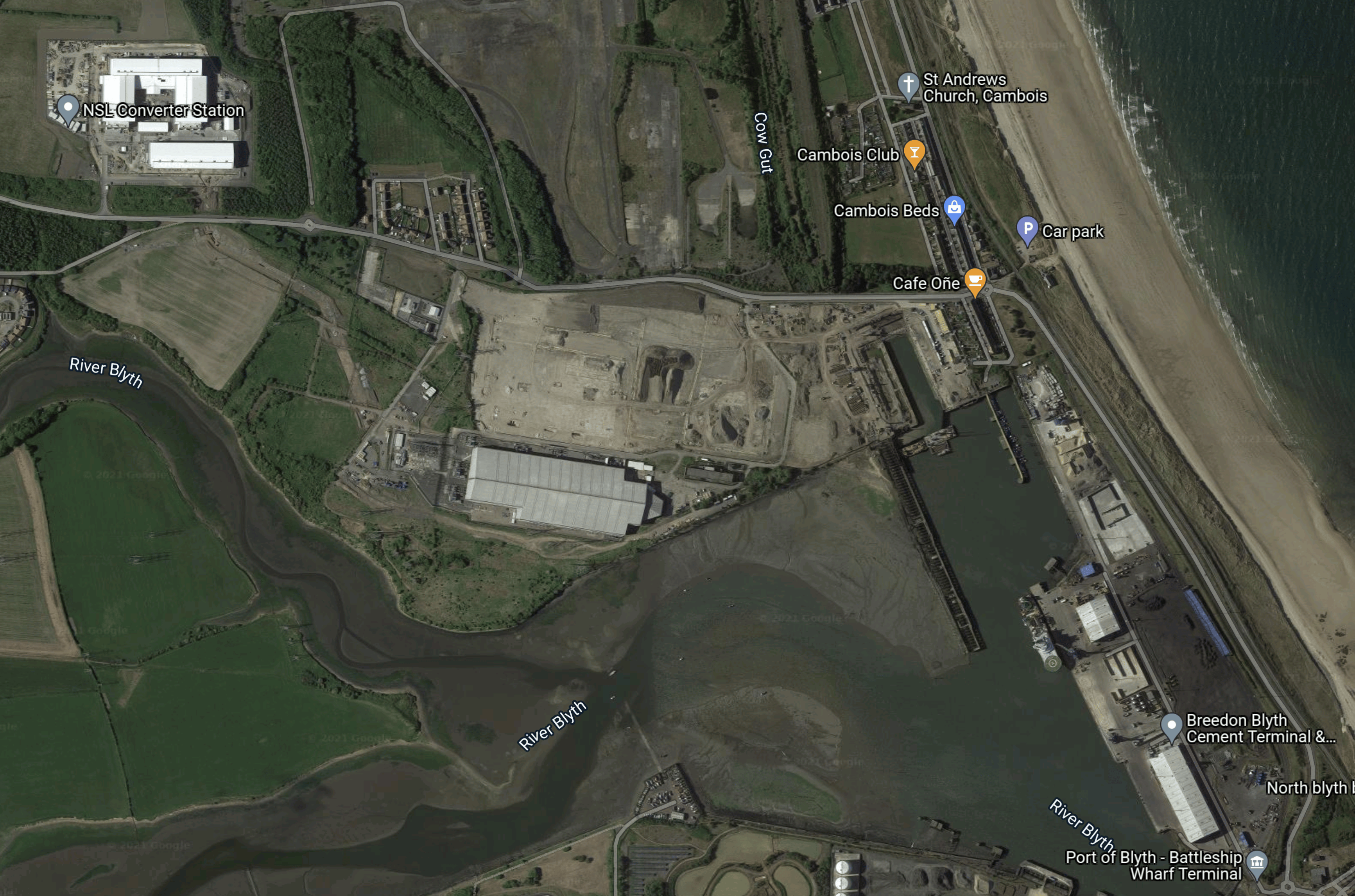
Note.
- The light grey buildings in the North-West corner of the map are labelled as the NSL Converter Station.
- Underground cables appear to have been dug between the converter station and the River Blyth.
- Is the long silver building to the West of the triangular jetty, the 400 KV substation, where connection is made to the grid?
The cables appear to enter the river from the Southern point of the triangular jetty. Is the next stop Norway?
Britishvolt And The North Sea Link
Britishvolt are are building a factory at Blyth and this Google Map shows are to the North and East of the NSL Converter Station.
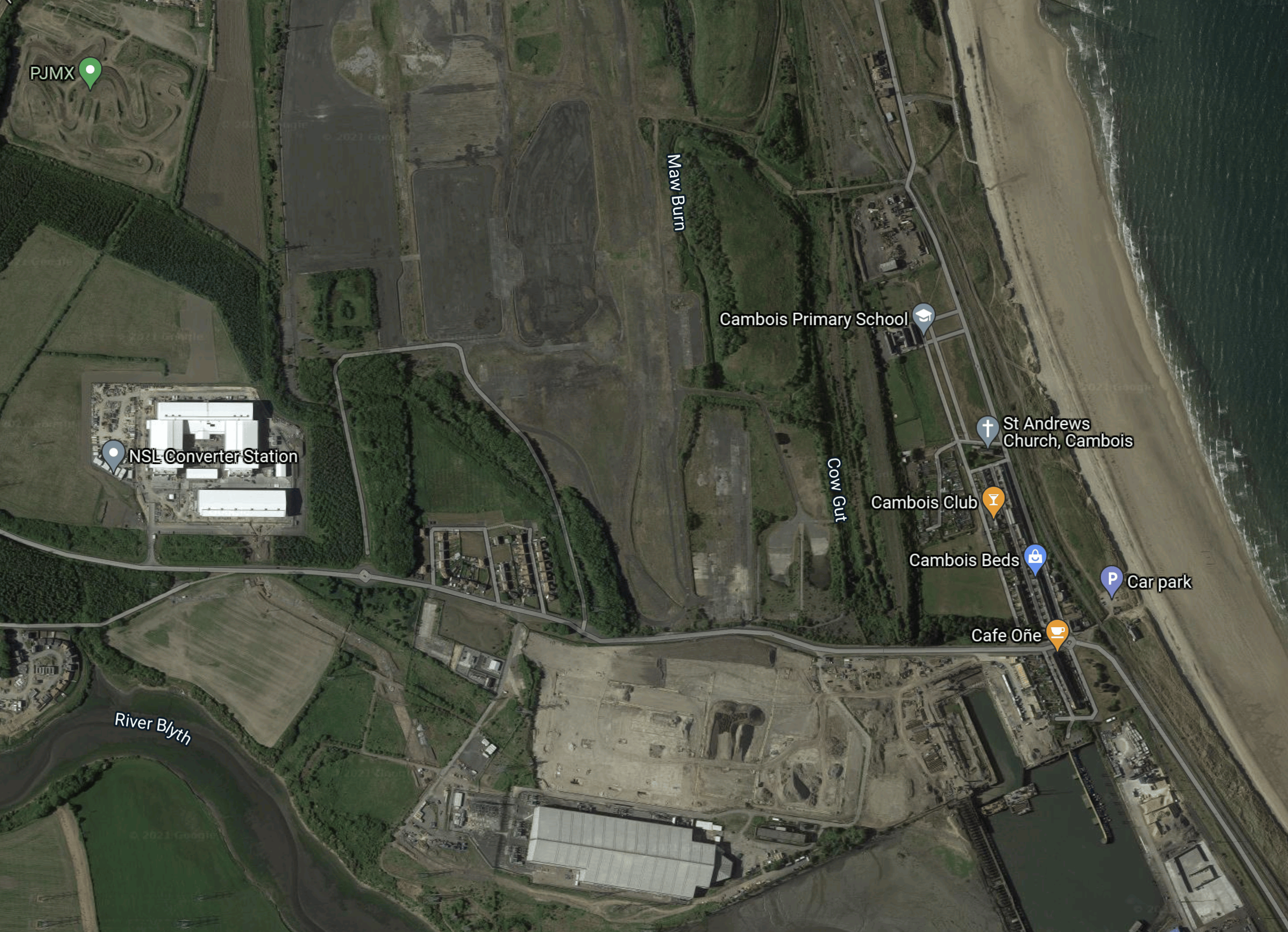
Note the light-coloured buildings of the NSL Converter Station.
I suspect there’s plenty of space to put Britishvolt’s gigafactory between the converter station and the coast.
As the gigafactory will need a lot of electricity and preferably green, I would assume this location gives Britishvolt all they need.
Where Is Kvilldal?
This Google Map shows the area of Norway between Bergen and Oslo.
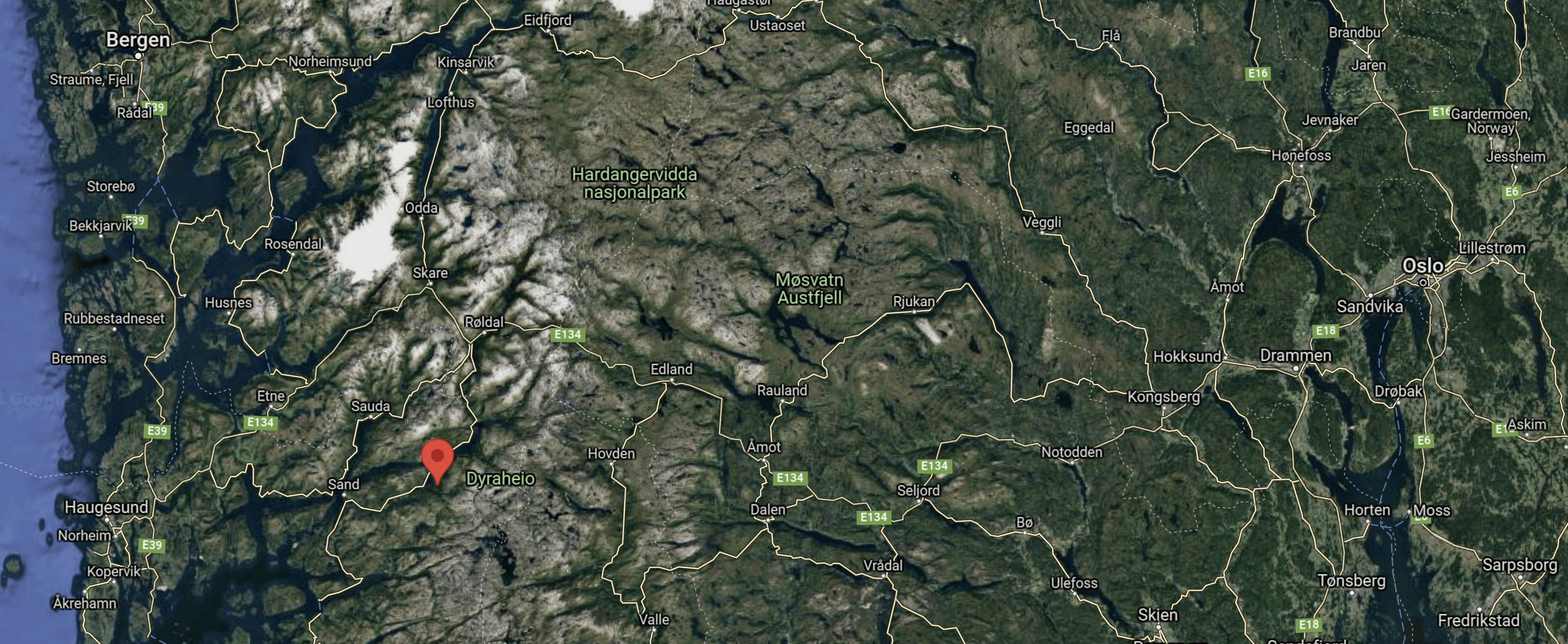
Note.
- Bergen is in the North-West corner of the map.
- Oslo is at the Eastern edge of the map about a third of the way down.
- Kvilldal is marked by the red arrow.
This second Google Map shows the lake to the North of Kvilldal.
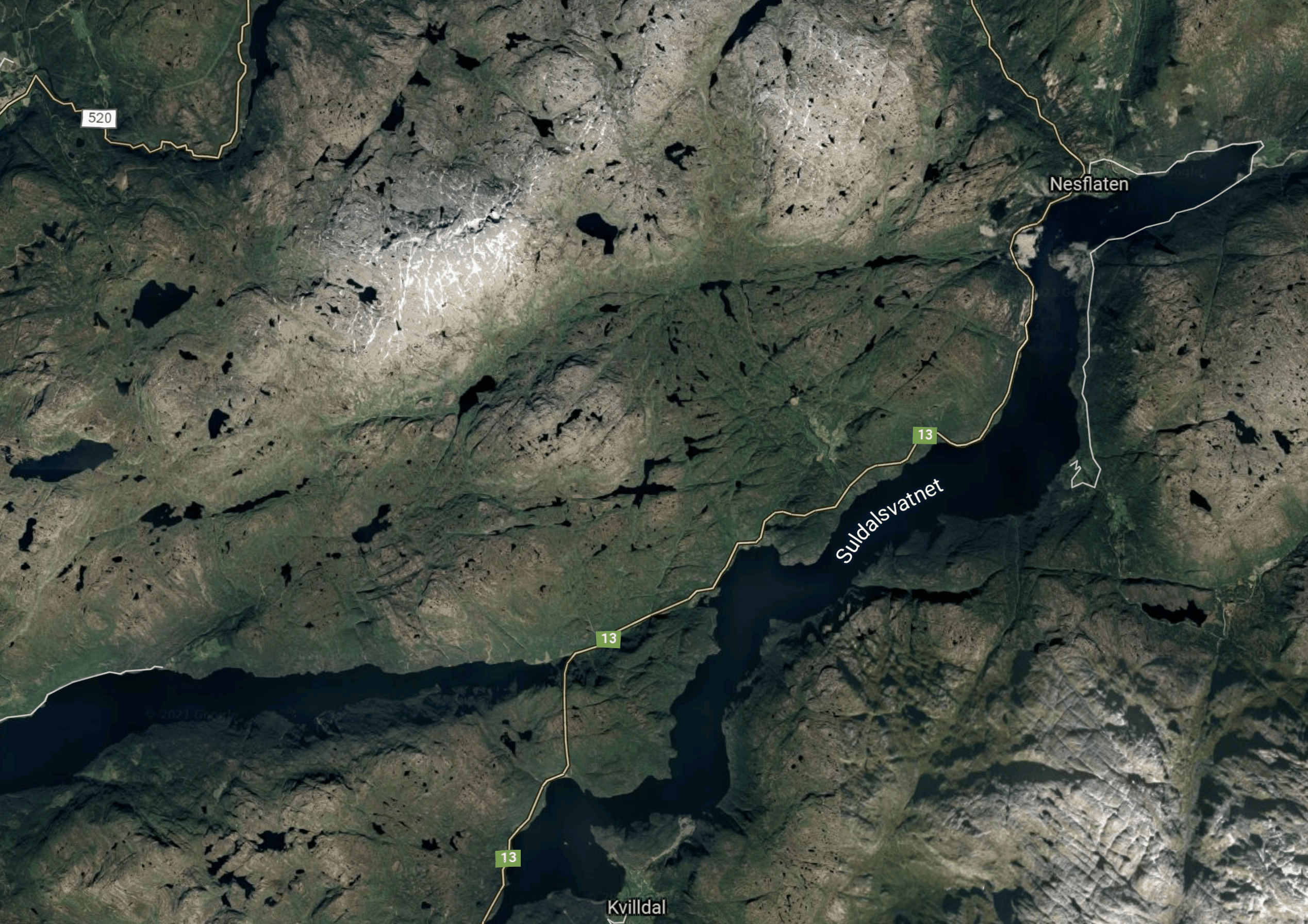
Note.
- Suldalsvatnet is the sixth deepest lake in Norway and has a volume of 4.49 cubic kilometres.
- Kvilldal is at the South of the map in the middle.
This third Google Map shows Kvilldal.
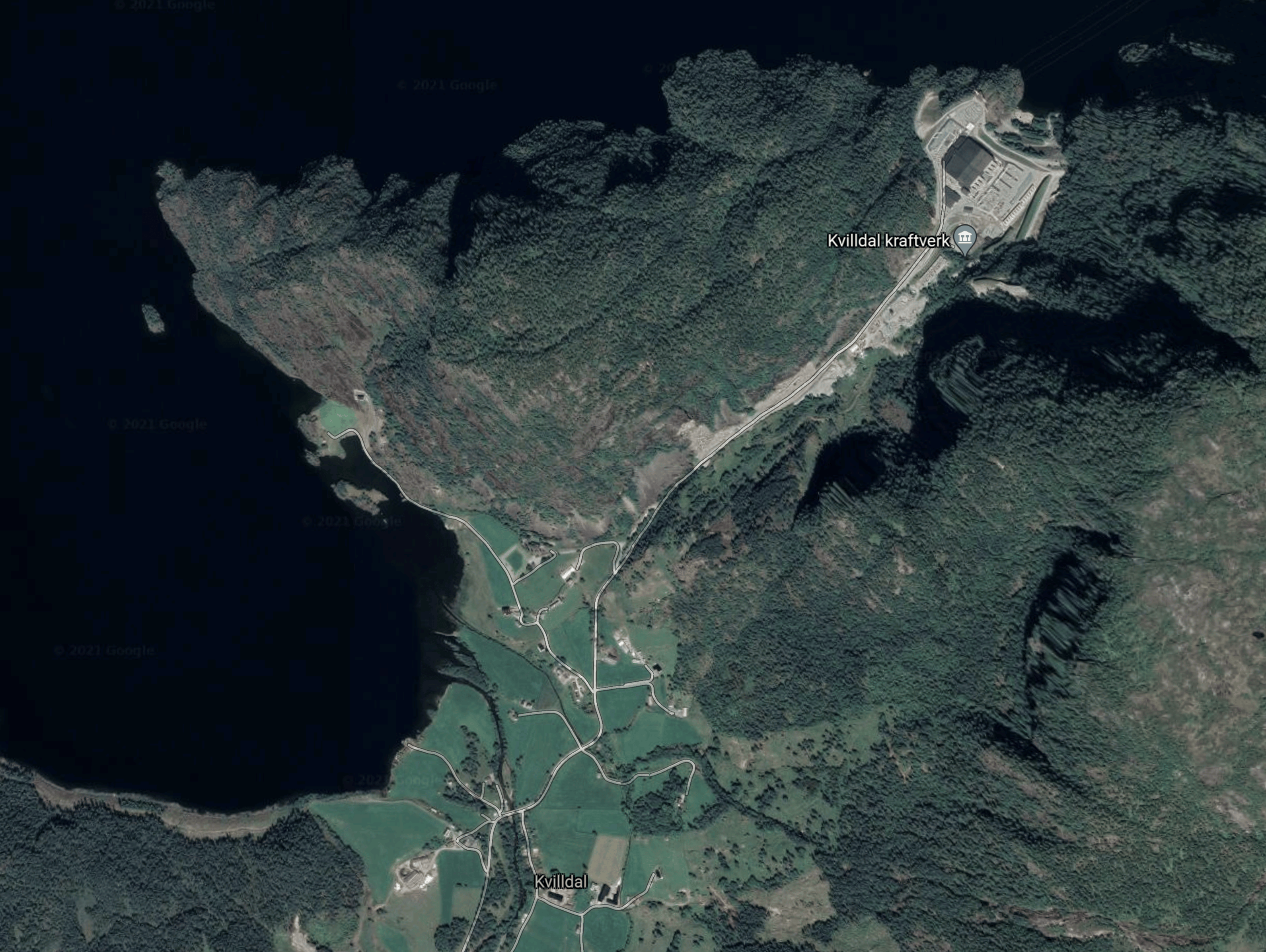
Note.
- Suldalsvatnet is the dark area across the top of the map.
- The Kvilldal hydro-electric power station on the shore of the lake.
- Kvilldal is to the South-West of the power station.
Kvilldal doesn’t seem to be the biggest and most populous of villages. But they shouldn’t have electricity supply problems.
Kvilldal Power Station And The North Sea Link
The Wikipedia entry for Kvilldal power station gives this information.
The Kvilldal Power Station is a located in the municipality of Suldal. The facility operates at an installed capacity of 1,240 megawatts (1,660,000 hp), making it the largest power station in Norway in terms of capacity. Statnett plans to upgrade the western grid from 300 kV to 420 kV at a cost of 8 billion kr, partly to accommodate the NSN Link cable] from Kvilldal to England.
This power station is almost large enough to power the North Sea Link on its own.
The Kvilldal power station is part of the Ulla-Førre complex of power stations and lakes, which include the artificial Lake Blåsjø.
Lake Blåsjø
Lake Blåsjø would appear to be a lake designed to be the upper reservoir for a pumped-storage scheme.
- The lake can contain 3,105,000,000 cubic metres of water at its fullest.
- The surface is between 930 and 1055 metres above sea level.
- It has a shoreline of about 200 kilometres.
This Google Map shows the Lake.
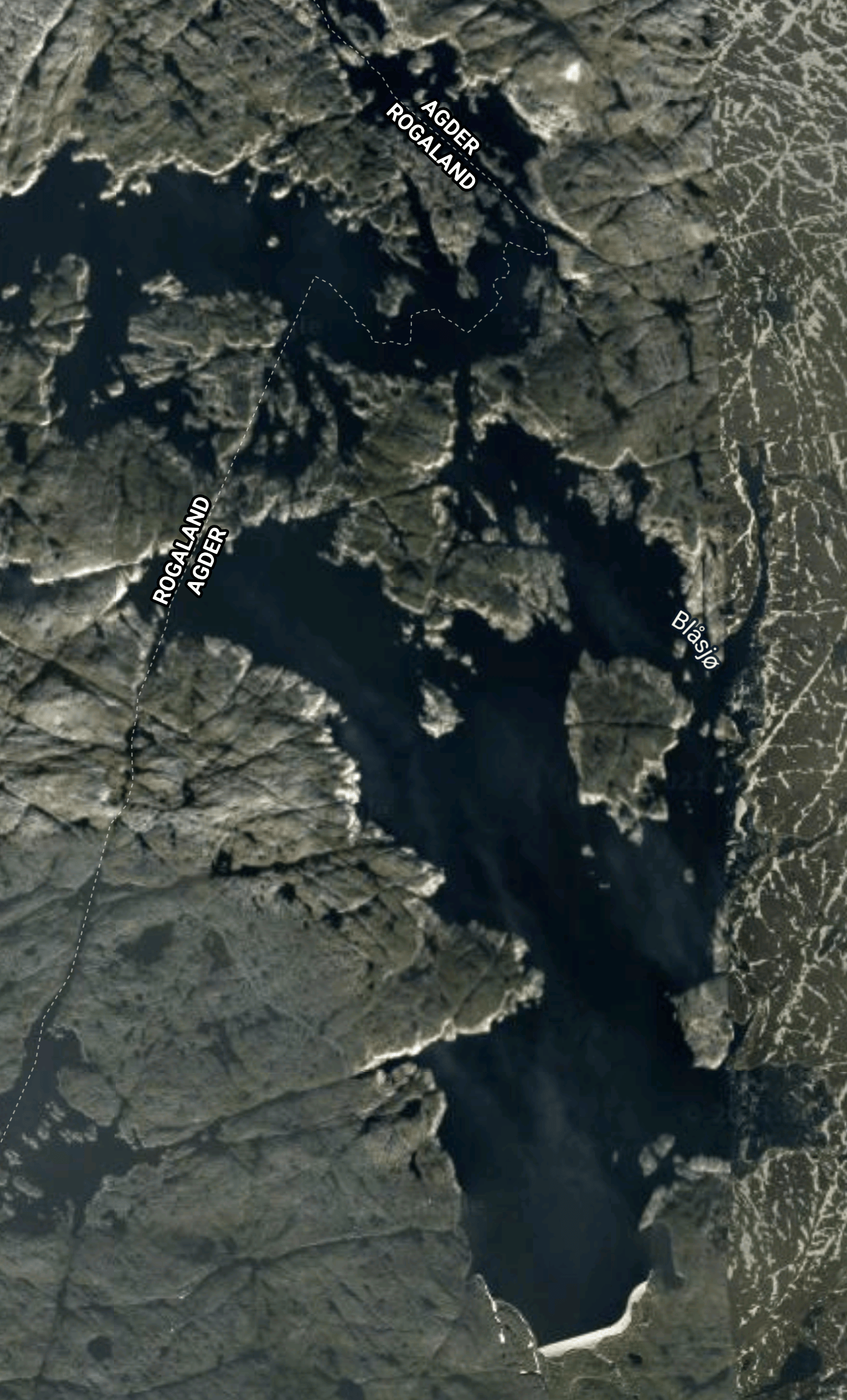
Note the dam at the South end of the lake.
Using Omni’s Potential Energy Calculator, it appears that the lake can hold around 8 TWh of electricity.
A rough calculation indicates that this could supply the UK with 1400 MW for over eight months.
The Wikipedia entry for Saurdal power station gives this information.
The Saurdal Power Station is a hydroelectric and pumped-storage power station located in the municipality of Suldal. The facility operates at an installed capacity of 674 megawatts (904,000 hp) (in 2015). The average energy absorbed by pumps per year is 1,189 GWh (4,280 TJ) (in 2009 to 2012). The average annual production is 1,335 GWh (4,810 TJ) (up to 2012)
This Google Map shows the area between Kvilldal and Lake Blåsjø.
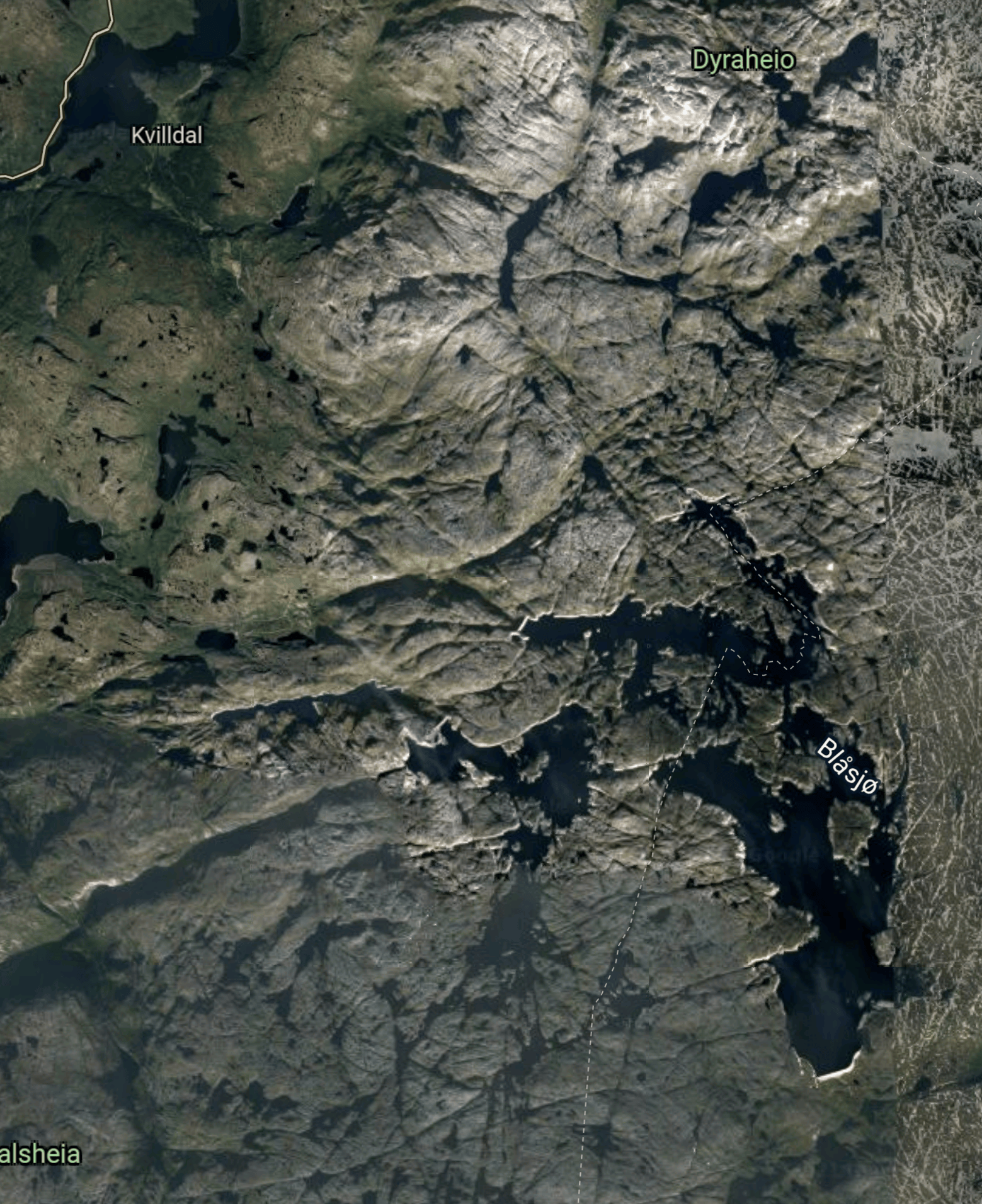
Note
- Kvilldal is in the North West of the map.
- Lake Blåsjø is in South East of the map.
This second Google Map shows the area to the South-East of Kvilldal.
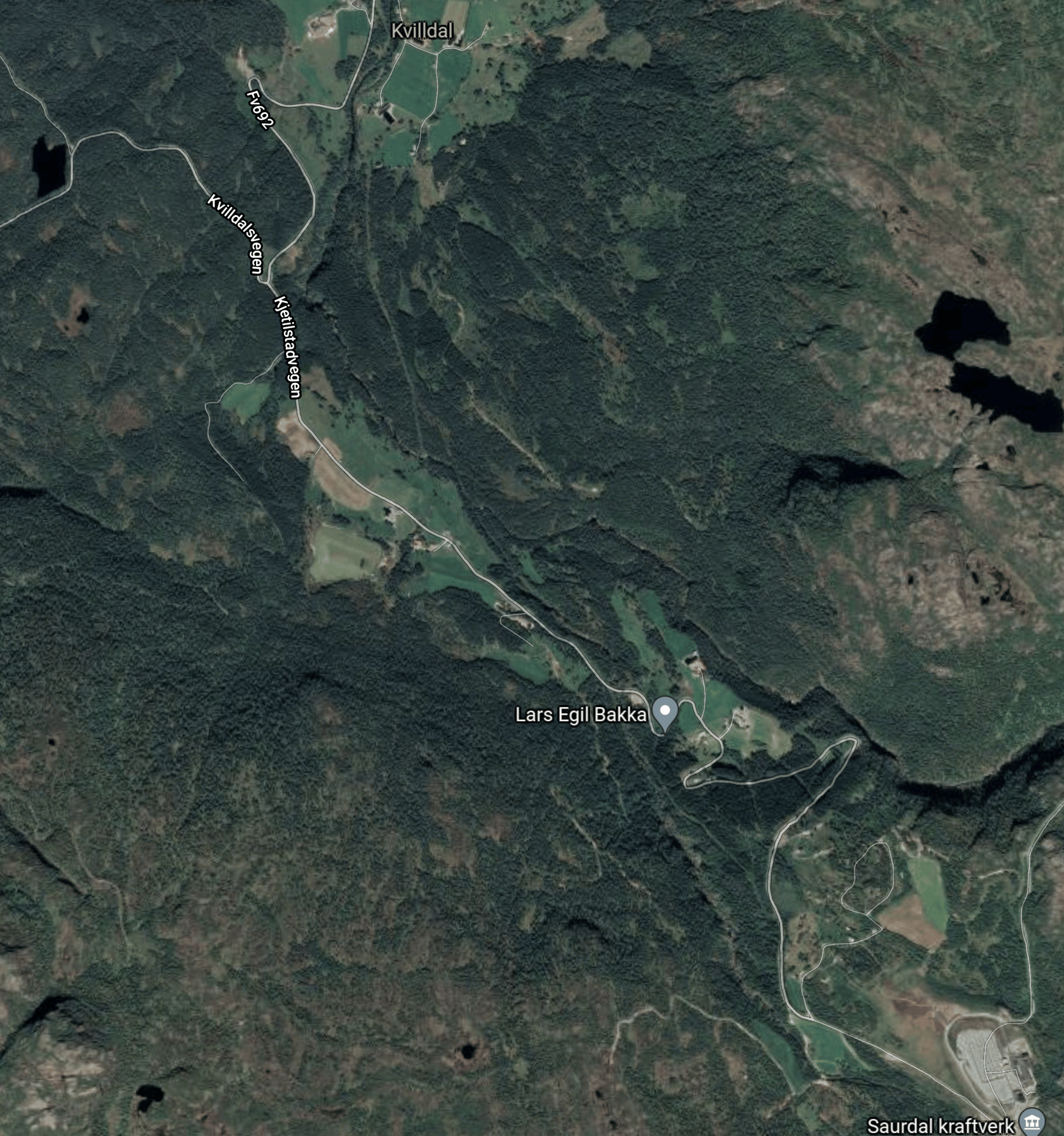
Note.
- Kvilldal is in the North-West of the map.
- The Saurdal power station is tight in the South-East corner of the map.
This third Google Map shows a close-up of Saurdal power station.
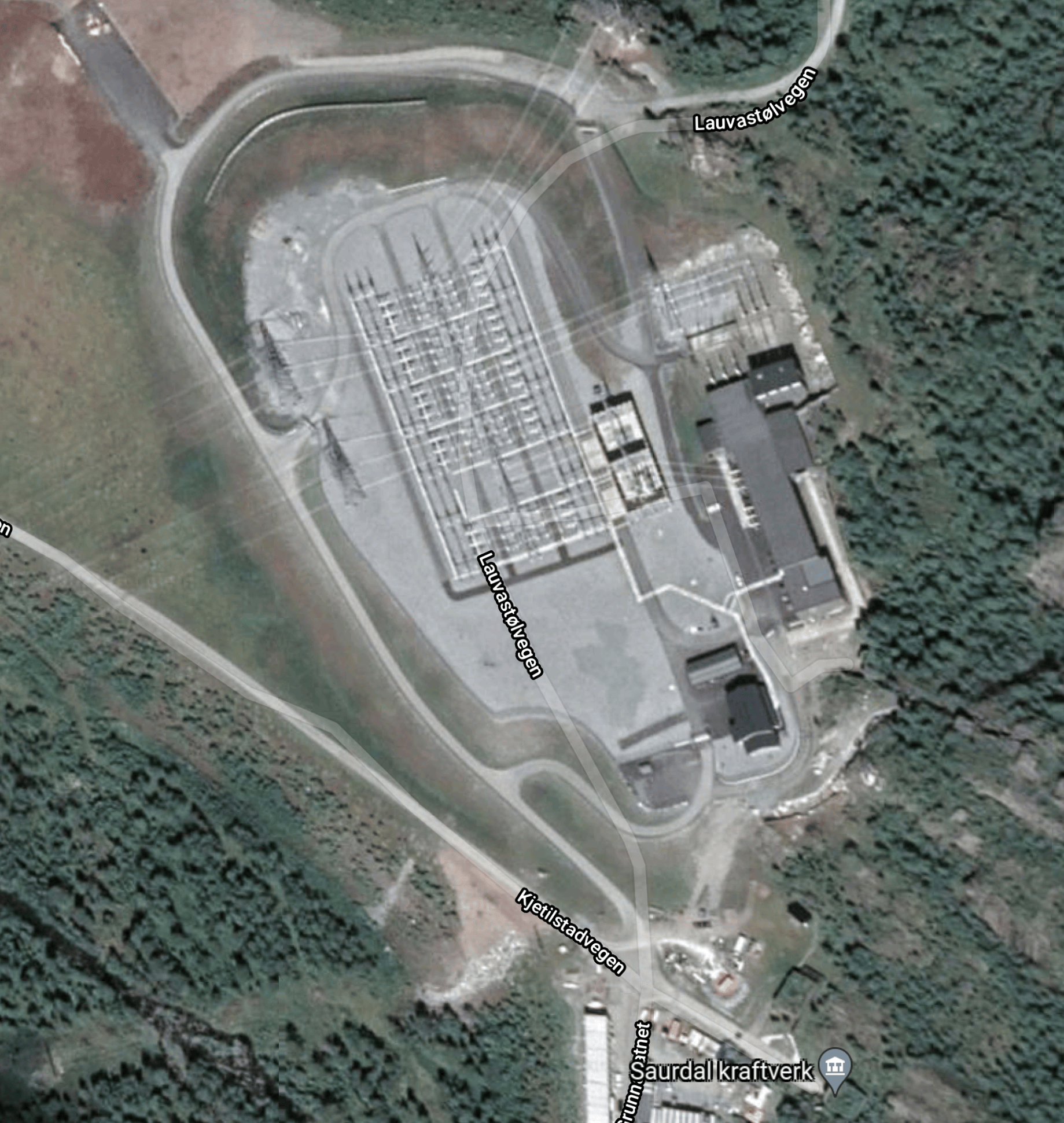
Saurdal power station is no ordinary power station.
This page on the Statkraft web site, gives a brief description of the station.
The power plant was commissioned during 1985-1986 and uses water resources and the height of fall from Lake Blåsjø, Norway’s largest reservoir.
The power plant has four generating units, two of which can be reversed to pump water back up into the reservoir instead of producing electricity.
The reversible generating units can thus be used to store surplus energy in Lake Blåsjø.
Is Lake Blåsjø and all the power stations just a giant battery?
Economic Effect
The economic effect of the North Sea Link to both the UK and Norway is laid out in a section called Economic Effect in the Wikipedia entry for the North Sea Link.
Some points from the section.
- According to analysis by the United Kingdom market regulator Ofgem, in the base case scenario the cable would contribute around £490 million to the welfare of the United Kingdom and around £330 million to the welfare of Norway.
- This could reduce the average domestic consumer bill in the United Kingdom by around £2 per year.
- A 2016 study expects the two cables to increase price in South Norway by 2 øre/kWh, less than other factors.
This Economic Effect section also talks of a similar cable between Norway and Germany called NorGer.
It should be noted, that whereas the UK has opportunities for wind farms in areas to the North, South, East and West of the islands, Germany doesn’t have the space in the South to build enough wind power for the area.
There is also talk elsewhere of an interconnector between Scotland and Norway called NorthConnect.
It certainly looks like Norway is positioning itself as Northern Europe’s battery, that will be charged from the country’s extensive hydropower and surplus wind energy from the UK and Germany.
Could The Engineering Be Repeated?
I mentioned NorthConnect earlier.
- The cable will run between Peterhead in Scotland and Samnanger in Norway.
- The HVDC cable will be approximately 665 km long.
- The cable will be the same capacity as the North Sea Link at 1400 MW.
- According to Wikipedia construction started in 2019.
- The cable is planned to be operational in 2022.
- The budget is €1.7 billion.
Note.
- Samnager is close to Bergen.
- NorthConnect is a Scandinavian company.
- The project is supported by the European Union, despite Scotland and Norway not being members.
- National Grid is not involved in the project, although, they will be providing the connection in Scotland.
The project appears to be paused at the moment, awaiting how North Sea Link and NordLink between Norway and Germany are received.
There is an English web site, where this is the mission statement on the home page.
NorthConnect will provide an electrical link between Scotland and Norway, allowing the two nations to exchange power and increase the use of renewable energy.
This sounds very much like North Sea Link 2.
And then there is Icelink.
- This would be a 1000-1200 km link between Iceland and the UK.
- It would have a capacity of 1200 MW.
- National Grid are a shareholder in the venture.
- It would be the longest interconnector in the world.
The project appears to have stalled.
Conclusion
I can see these three interconnectors coming together to help the UK’s electricity generation become carbon-free by 2035.
Ovo To Launch ‘Half-Price’ Electric Vehicle Charging Tariff
The title of this post, is the same as that of this article on the Guardian.https://www.theguardian.com/money/2021/jan/26/ovo-to-launch-half-price-electric-vehicle-charging-tariff
This is the sub-title.
New Drive Anytime rate bids to mirror rivals’ off-peak tariff with savings of 60% a year, supplier claims.
If I had a car, it might be a good deal.
Could Hydrogen Replace The Need For An Electric Grid?
This article on Brink with this title is a definite must read!
It all boils down to the fact, that it’s cheaper to transport gas over long distances, than electricity.
I also suspect, that a steel pipe, which is full of inflammable gas is more difficult and less profitable to steal, than a nice meaty copper cable.