SSE And Gilkes Energy Submit Plans For Pumped Hydro Storage Project
The title of this post, is the same of this article in Solar Power Portal.
This is the sub-heading.
SSE Renewables and Gilkes energy have submitted a planning consent application to Scottish Ministers for a proposed Pumped Storage Hydro (PSH) project.
These two paragraphs add more detail.
The Fearna PSH project is proposed as a 50:50 joint venture project between SSE and Gilkes Energy, with Gilkes Energy leading the development under a developer services agreement with SSE Renewables. The scheme will have an installed capacity of 1.8GW and a stored capacity of up to 36GWh, providing 20 hours of storage. If approved, the project would be the largest pumped hydro scheme in the UK.
The proposed site is located around 25km from Invergarry in the Scottish Highlands and adjoins SSE Renewables’ existing Loch Quoich reservoir, which forms part of the Great Glen hydro scheme. The development will include the construction of tunnels and a new power station that will connect the existing Loch Quoich reservoir to an upper reservoir at Loch Fearna.
This Google Map shows the location of Invergarry and Loch Quoich.

Note.
Loch Quoich is the dolphin-shaped loch at the West of the image.
Invergarry is indicated by the red dot at the East of the image.
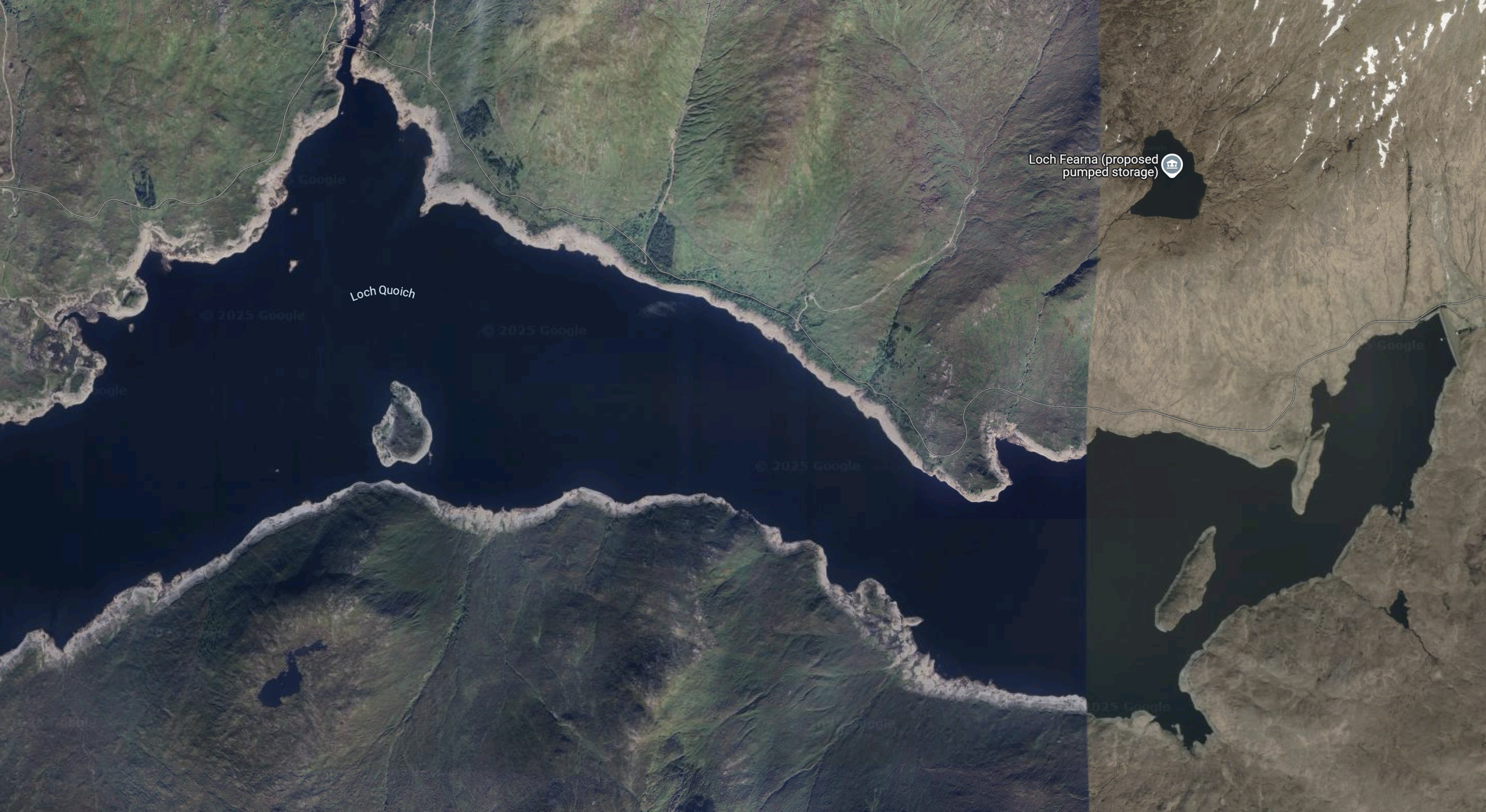
This second Google Map shows the location of Loch Fearna to the North-East of Loch Quoich.
These are my thoughts.
It Will Be A Large Scheme
With an installed capacity of 1.8GW and a stored capacity of up to 36GWh, providing 20 hours of storage, this is not a small scheme.
Wikipedia’s Description Of Loch Quoich
This is the first two paragraphs of the Wikipedia entry for Loch Quoich.
Loch Quoich (Scottish Gaelic: Loch Chuaich) is a loch and reservoir situated west of Loch Garry approximately 40 km northwest of Fort William, Lochaber, Scotland. The name means “loch of the quaich”. In 1896, it was listed as six miles long and three-quarters of a mile in width, belonging to Mrs. Ellice of Glenquoich, within the parish of Kilmonivaig.
Both lochs form part of the Glen Garry hydroelectricity project commissioned by the North of Scotland Hydro-Electric Board in the 1950s.
So is the Loch Fearna scheme, a massive repurposing of the existing Glen Garry hydroelectricity project?
I wrote about this before in Repurposing The Great Glen Hydro-Electric Scheme?
This map from the SSE Renewables web site shows the layout of the dams and power stations between Loch Quoich and Invergarry..
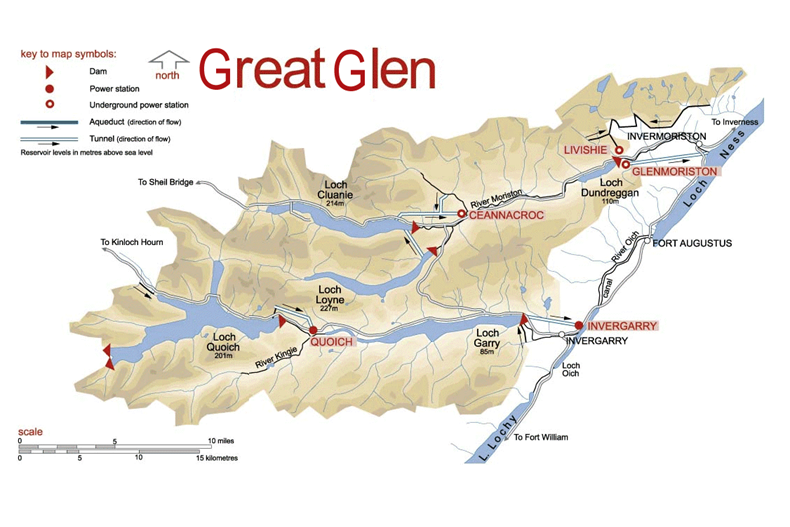
The sizes of the power stations in the scheme are as follows.
- Ceannacroc – 20 MW
- Livishie – 15 MW
- Glenmoriston- 37 MW
- Quoich – 18 MW
- Invergarry – 20 MW
- Mucomir – 1.7 MW
This gives a total power of 112.7 MW.
112.7 MW to 1.8 GW (1800 MW) is a colossal increase in power.
It should be noted that 1.8 GW is half the power of Hinckley Point C nuclear power station.
SSE And Gilkes Energy Announce Joint Plans To Progress Loch Fearna Pumped Storage Hydro Project
The title of this post, is the same as that of this press release from SSE Renewables.
These five paragraphs from the press release outline the scheme.
SSE has announced plans to progress a new pumped storage hydropower scheme at Loch Fearna in Scotland’s Great Glen, in a 50:50 development joint venture with a consortium led by Gilkes Energy.
The proposed co-development is located at the western end of Glengarry around 25km west of Invergarry and adjoins SSE Renewables’ existing Loch Quoich reservoir in the Great Glen hydro scheme.
SSE Renewables already operates the largest fleet of hydro-electric power and pumped storage hydro assets in Scotland. It is now progressing development plans for new pumped storage hydropower projects in the Highlands to complement its existing fleet and deliver the large-scale, long-duration electricity storage (LDES) needed as part of Britain’s future energy mix.
The Fearna Pumped Storage Hydro (PSH) project envisages the development of tunnels and a new power station connecting SSE Renewables’ existing reservoir at Loch Quoich with an upper reservoir at Loch Fearna.
Under the terms of the joint venture being announced today, Gilkes Energy will lead the project’s development under a development services agreement with SSE Renewables.
I wrote about the Great Glen hydro scheme in Repurposing The Great Glen Hydro-Electric Scheme, where I included this map, from the SSE Renewables web site shows the layout of the dams and power stations.
The sizes of the power stations in the scheme are as follows.
- Ceannacroc – 20 MW
- Livishie – 15 MW
- Glenmoriston- 37 MW
- Quoich – 18 MW
- Invergarry – 20 MW
- Mucomir – 1.7 MW
This gives a total power of 112.7 MW.
This five paragraph from the press release details the size of the scheme.
It is envisaged the proposed development would be up to 1.8GW in generating capacity and capable of producing around 37GWh of stored energy capacity. The project has already secured a grid connection offer totalling 1,795MW.
The 1.8 GW/37 GWh Fearna pumped hydro scheme will dwarf the Great Glen hydro scheme.
it is now seventy years since some of these hydro-electric systems were built in Scotland.
As an engineer, I wouldn’t be surprised to a see a fair amount of updating in the Highlands to upgrade Scotland’s hydro-electricity.
Repurposing The Great Glen Hydro-Electric Scheme
The Great Glen hydro-electric scheme was built in the 1950s and early 1960s, by the North of Scotland Hydroelectric Board.
- The scheme is now owned by SSE Renewables and has a page on their web site.
- There are six individual power stations; Ceannacroc, Livishie, Glenmoriston, Quoich, Invergarry and Mucomir.
- There are five dams; Cluanie, Loyne, Dundreggan, Quoich and Invergarry.
This map from the SSE Renewables web site shows the layout of the dams and power stations.
The sizes of the power stations in the scheme are as follows.
- Ceannacroc – 20 MW
- Livishie – 15 MW
- Glenmoriston- 37 MW
- Quoich – 18 MW
- Invergarry – 20 MW
- Mucomir – 1.7 MW
This gives a total power of 112.7 MW.
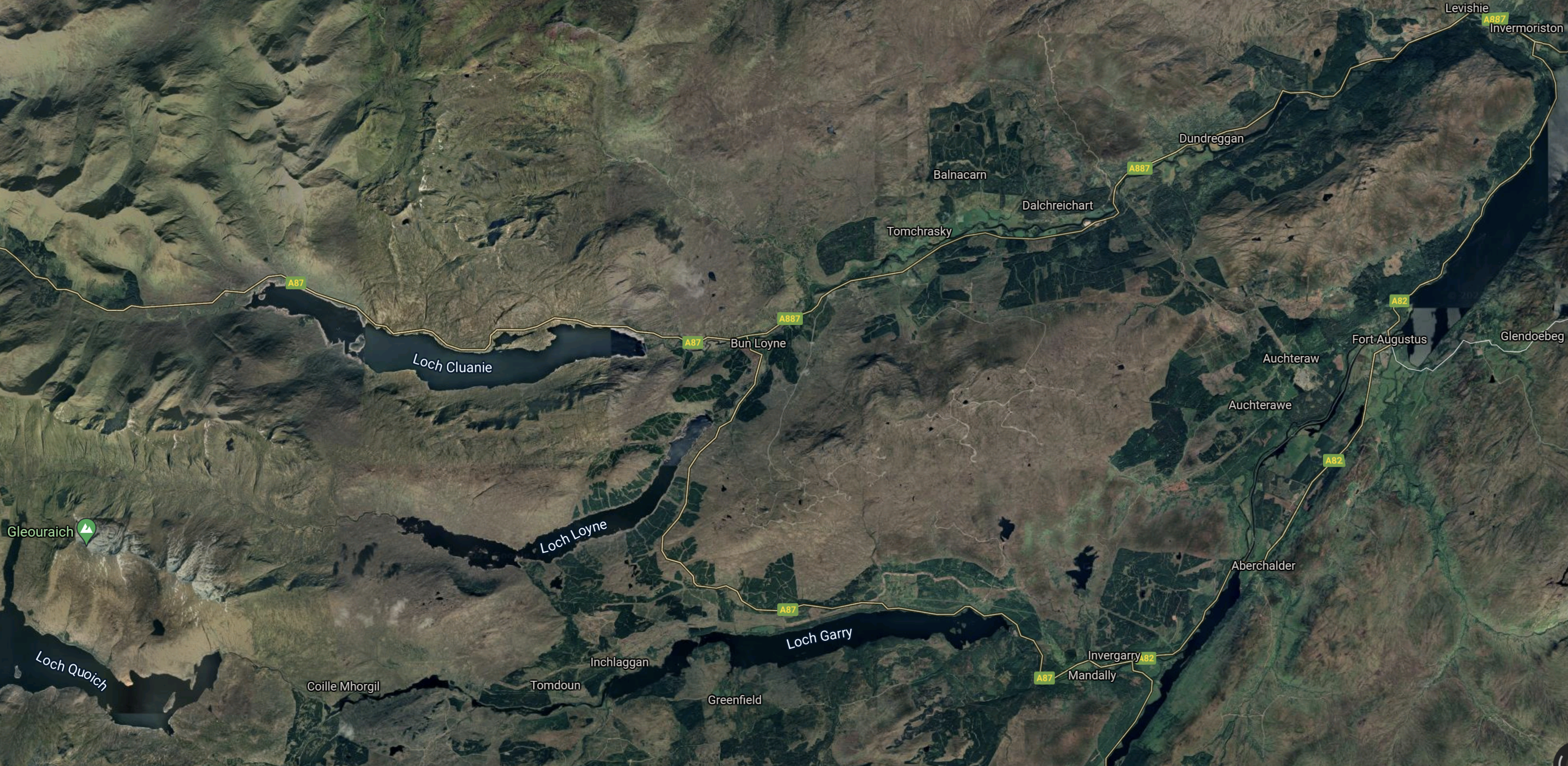
This Google Map shows the same area as the SSE Renewables Map.
Note.
- Loch Quoich is in the South-West corner.
- To the East of Loch Quoich is Loch Garry and to the North-East is Loch Loyne.
- Loch Cluanie is to the North.
- Invermoriston is in the North-East corner.
The scheme also includes three underground power stations and several miles of tunnels.
Strathclyde University And Pumped Storage Power For Scotland
This page on the Strathclyde University gives a list of the pumped storage potential for Scottish hydrogen-electric dams and power stations.
These figures are given for the dams and lochs in the Great Glen scheme.
- Invergarry – 22 GWh
- Glenmoriston- 41 GWh
- Quoich – 27 GWh
It would appear that based on research from Strathclyde University, that the Great Glen scheme could support up to 90 GWh of pumped storage.
Water Flows In The Great Glen Scheme
Looking at the SSE Renewables map of the Great Glen scheme, water flows appear to be as follows.
- Loch Quoich to Loch Garry via Quoich power station.
- Loch Garry to Loch Oich via Invergarry power station.
- Loch Loyne to Loch Dundreggan via River Moriston.
- Loch Cluanie to Loch Dundreggan via Ceannacroc power station and River Moriston.
- Loch Dundreggan to Loch Ness via Glenmoriston power station.
All the water eventually flows into the sea at Inverness.
Refurbishing And Repurposing The Great Glen Scheme
Perhaps as the power stations are now over fifty years old, one simple way to increase the generating capacity of the Great Glen scheme, might be to selectively replace the turbines, with modern turbines, that can generate electricity more efficiently.
I suspect that SSE Renewables have an ongoing program of improvements and replacements for all of their hydro-electric stations in Scotland. Some turbines at Sloy power station have already been replaced with larger ones.
Adding Pumped Storage To The Great Glen Scheme
I would assume that the water to pump uphill at night or when there is a surplus of electricity will come from Loch Oich or Loch Ness.
Some power stations like Glenmoriston and Invergarry might be updated to both generate electricity or pump water up hill, as is required.
Conclusion
There would appear to be up to three schemes, that could each add around 30 GWh of pumped storage.
One advantage is that the waters of Loch Ness can be used for the lower reservoir.
 The Anonymous Widower