Offshore Wind Turbines In 2025: China Continues Leading In Single-Unit Capacity, Vestas’s 15 MW Turbine Installed At Offshore Wind Farms
The title of this post, is the same as that of this article on offshoreWIND.biz.
This is the sub-heading.
In offshoreWIND.biz‘s 2024 annual wind turbine overview, you could have read about the first 16 MW floating wind platform installed offshore and a 26 MW prototype under construction, both in China, and a 21 MW prototype being assembled in Europe. Wind turbine generator (WTG) technology did not stop progressing in 2025, with Chinese OEMs still leading capacity-wise, while in Europe, first offshore wind farms are now featuring 15 MW turbines and a 21+ MW model was installed onshore for testing.
The article is very much a must-read and there is a lot of innovation going on.
As a comparison, between 2020 and 2026 we commissioned or are building these offshore wind farms in the UK.
- East Anglia One – 2000 – 714 MW – 102 x 7 MW
- Hornsea One – 2020 – 1218 MW – 174 x 7 MW
- Kincardine – 2021 – 49.5 MW – 6 x floating
- Hornsea Two – 2022 – 1386 MW – 165 x 8 MW
- Moray East – 2022 – 950 MW – 100 x 9.5 MW
- Triton Knoll – 2022 – 857 MW – 90 x 9.5 MW
- Seagreen Phase 1 – 2023 – 1400 MW – 114 x 10 MW
- Dogger Bank A – 2025 – 1235 MW – 95 x 13 MW
- Moray West – 2025 – 882 MW – 60 x 14 MW
- Neart Na Gaoithe – 2025 – 450 MW – 54 x 8 MW
- Dogger Bank B – 2026 – 1235 MW – 95 x 13 MW
- East Anglia 3 – 2026 – 1372 – 95 x 14 MW
- Sofia – 2026 – 1400 MW – 100 x 14 MW
Average sizes for the various years are as follows.
- 2020 – 7 MW
- 2021 – floating
- 2022 – 8-9.5 MW
- 2023 – 10 MW
- 2025 – 8-14 MW
- 2026 – 13-14 MW
It can clearly be seen that in the last few years, turbines have been getting bigger.
I have some thoughts on the article.
2025 Saw Some Plans For And Installations Of Some Very Large Turbines
These four monsters were mentioned at the start of the article.
- 26 MW – Prototype installed for testing (China)
- 21.5 MW – Prototype installed for testing (Europe)
- 15 MW Installed at offshore wind farms (Europe)
- 50 MW Twin-turbine platform; Announced (China)
- MingYang Turbines to Spin on Hexicon’s Floating Offshore Wind Project
- World’s First Offshore Wind Farm Using 16 MW Turbines Enters Construction In China
- The Secret Of The TwinHub
- Hexicon Wins UK’s First Ever CfD Auction For Floating Offshore Wind
- The Chinese seem to be providing turbines for both manufacturers.
- The TwinHub is the Swedish design, being built for trial in Cornwall.
- This new design is a 50 MW design, whereas these two are 32 MW.
MingYang Turbines to Spin on Hexicon’s Floating Offshore Wind Project
The title of this post, is the same as that of this article on offshoreWIND.biz.
This is the sub-heading.
Hexicon has selected China-headquartered Mingyang Smart Energy (Mingyang) as the preferred turbine supplier for its flagship 32 MW TwinHub floating offshore wind project in the UK.
These two paragraphs add a bit more detail.
Hexicon has also awarded Mingyang the wind turbine generator Front-End Engineering Design (FEED) contract for the project, which is located 16 kilometres off the coast of Cornwall, England.
TwinHub will use Hexicon’s TwinWind floating foundation technology which will allow two of Mingyang’s MySE 8.0-180 wind turbines to be placed on a single foundation, which could enable more energy to be generated in a given area while reducing the environmental impact compared with a single foundation.
Hexicon’s flagship project secured a Contract for Difference (CfD) in the UK Government’s most recent allocation round.
Hexicon Wins UK’s First Ever CfD Auction For Floating Offshore Wind
The title of this post, is the same as that of this press release from Hexicon.
This is the first paragraph.
Today (7th of July) the UK Government confirmed that Hexicon AB’s TwinHub project in the Celtic Sea was successful in the latest Contracts for Difference (CfD) Allocation Round (AR4). It has been awarded a CfD for its 32MW floating wind project at a strike price of £87.30/MWh (2012 real prices) taking the project a significant step closer to completion.
This image shows one of their TwinHub turbine installations being towed into place.
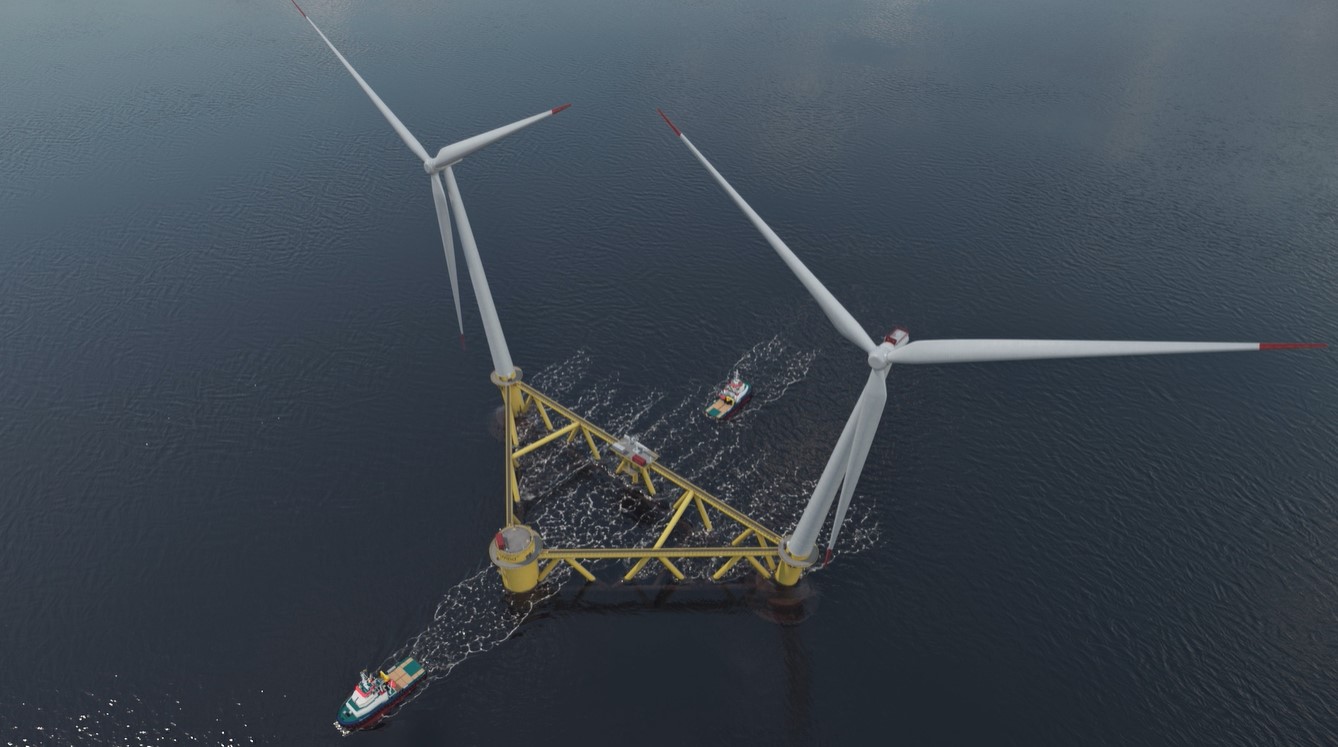
The TwinHub home page has a title of The First Floating Offshore Wind Project in The Celtic Sea.
This is the description on the page.
The TwinHub offshore wind demonstration project intends to prove how Hexicon’s innovative design with two turbines on one floating foundation can further reduce the Levelized Cost of Energy (also referred to as LCoE) before large scale commercialisation. The TwinHub project is a stepping stone to help kick-start floating wind in the Celtic Sea, an area identified as a hotspot for floating wind by the UK Government. It will pave the path for larger and larger projects to help support The Crown Estates’ ambitious target of 4GW of floating wind in the Celtic Sea.
Scroll the page down and there is a short video of a pair of wind turbines in operation.
- It appears that when there is no wind, it automatically goes into a safe parked mode.
- As the wind rises, one turbine starts up.
- The second turbine starts up and the float turns so they face the wind.
It appears to be a classic example of disruptive innovation.
I did the calculations for floating and reusable oil and gas platforms in the 1970s, that were designed by two Cambridge University professors, which would have been launched horizontally and upturned when in position. This experience leads me to believe that the Swedish designers of this type of platform have been able to verify that this is a workable design.
This document from the Department of Business, Industry and Industrial Strategy indicates that the demonstration is for 32 MW.
Does that indicate, that this installation is twin 16 MW wind turbines?
16 MW seems to be the size of the largest wind turbines in the world.
There is a lot to like about this Swedish design.
- As the video shows, it appears to balance itself with the wind.
- I suspect from the calculations I did in Cambridge, that the twin design with its higher weight is more stable than a floating single turbine design.
- The float and its two turbines can be assembled alongside a dock with a large stable onshore dockside crane.
- Servicing would also be done in a dock.
- Working onshore is much safer and easier, than working offshore.
- The twin design allows more power to be generated in a given area of sea.
This is a brilliant concept and it will give Putin, the Sheikhs and the other oil dictators, the most terrible of nightmares.
The initial site chosen for this design in the UK, will be in the sea at Hayle in Cornwall.
This map shows the location.
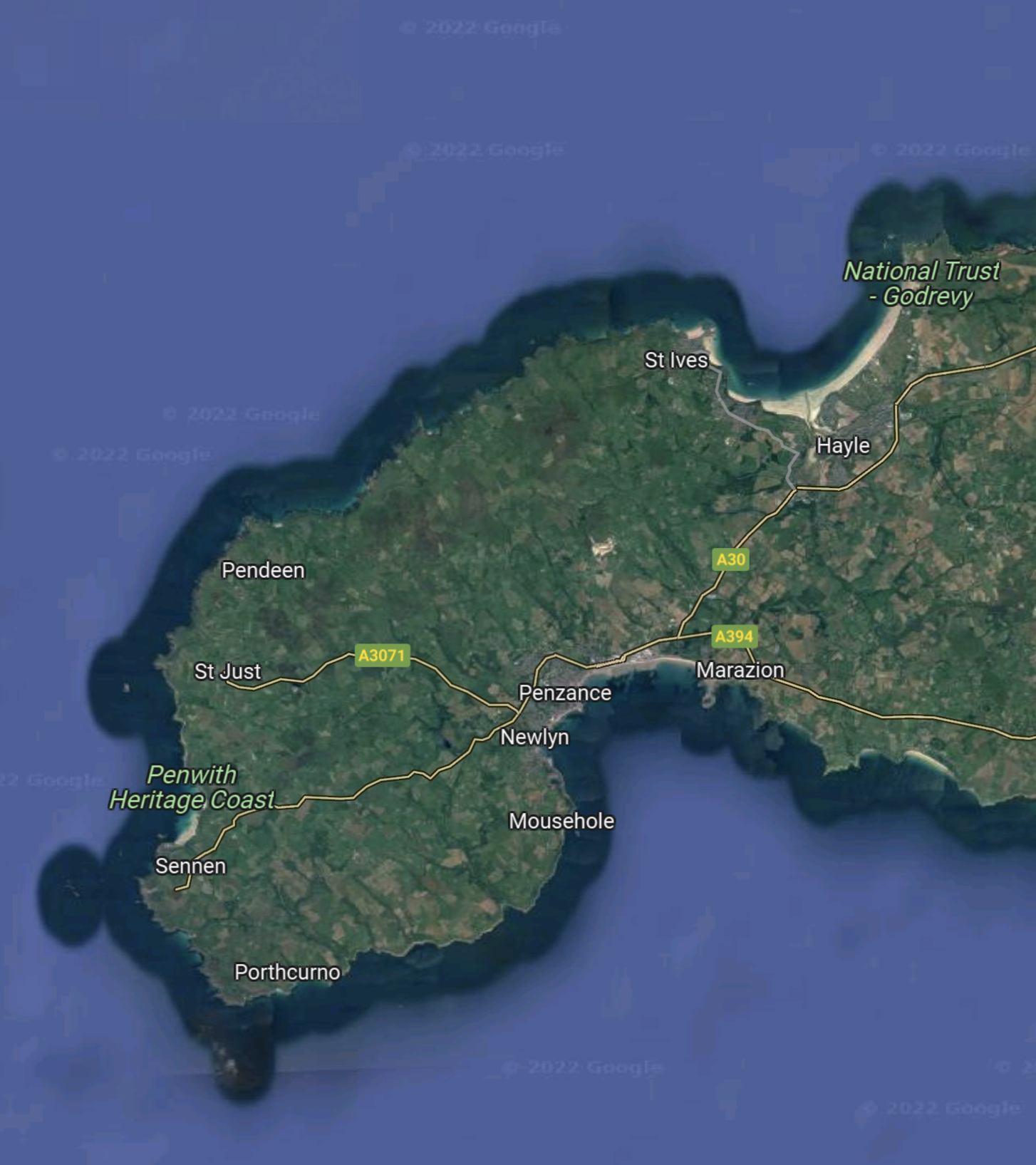
Hayle is in the North-East corner of the map, by the sandy beach.
A 32 MW turbine could probably provide enough electricity for 15,000 houses.
 The Anonymous Widower